
 By

As tech companies keep slashing jobs, Canva’s co-founder is drawing attention not for the cuts themselves, but for how she handled them. Underneath the praise sits a harder question: what is really driving the restructuring?
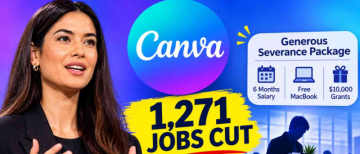
Layoff announcements usually follow a familiar script: a cold email, a vague apology and a lot of anxious silence. So when Canva’s CEO announced that 1,271 people, about 22 per cent of the company, would be affected by a restructuring, the reaction was surprising. A large share of the conversation online wasn’t anger. It was admiration.
But a good package doesn’t answer every question. Let’s break down what happened, what she did differently, what the company has said about its reasons, and what it hasn’t yet told us.
Key takeaways
- 1,271 employees are affected, about 22 per cent of the workforce, across job losses, role changes and relocations.
- Not all of them are being laid off. The company hasn’t said how many will ultimately lose their jobs.
- The severance is unusually clear: at least six months’ pay for everyone, regardless of where they live.
- The CEO apologised and explained. She called it the hardest moment in the company’s 13-year history.
- The stated reason is slowing growth, the first slowdown in a decade, and a structure that made it hard for teams to share responsibility.
- AI sits in the background. The letter itself reportedly doesn’t blame AI, but the wider business context is hard to ignore.
- The cost isn’t public yet. Canva hasn’t disclosed what the restructuring will cost.
What Canva announced
Canva co-founder and CEO Melanie Perkins shared the news in a letter to all staff, then posted it publicly. The restructuring covers 1,271 employees, roughly 22 per cent of the workforce, and it comes in three forms:
| Outcome | What it means |
|---|---|
| Role changes | Some employees will move into different roles |
| Relocation requests | Some will be asked to move, with support promised |
| Departures | Others will leave the company |
The figure of 1,271 covers all three, so it is not a headline count of redundancies. A key part of the plan is to make Sydney the main base for more of the company’s product teams.
Why is Canva doing this?
Perkins gave several reasons in her letter.
Growth has slowed. She said it was the first slowdown in a decade, and that after considering other options, she concluded smaller changes wouldn’t be enough.
The structure got in the way. She said the way the company was organised made it harder for teams to take responsibility for work that crossed departmental lines. The goal is to simplify layers, consolidate overlapping responsibilities and make sure teams have the right mix of skills.
Location matters. Bringing more product teams to Sydney is meant to speed up decision-making and collaboration.
The AI question
The letter, according to reports, doesn’t explicitly say that jobs are being replaced by AI. Perkins pointed to changing technology and customer expectations, but the reasons she gave centred on slowing growth, how teams were organised and where they worked.
Still, the wider picture is hard to ignore, and business coverage has described the move as part of a structural reckoning driven by AI.
- Competition. Canva faces growing pressure from AI image-generation tools, including those from big names such as OpenAI and Google.
- A lower growth target. In August, the company reduced its expected annual revenue growth from about 30 per cent to 20 per cent.
- Slower rollouts. It reportedly slowed the launch of some AI products while working to bring down their underlying costs.
- Cheaper AI tasks. Perkins said the cost of completing an AI task has fallen by nearly 90 per cent since the company launched Canva AI 2.0 in April.
- New AI products. Canva has expanded its AI-powered creative tools, including a new product called Canva Craft.
So there are two honest readings. One is that this is mainly an organisational fix for a company that grew fast and became tangled. The other is that it is part of a wider reshaping of the software industry by AI, with the letter simply not saying so. Both can be partly true, and the company’s own words support the first more directly than the second.
What Perkins did differently
1. She was direct about how bad it was.
She called it the hardest moment in the company’s history and apologised. She didn’t hide behind corporate phrases like “rightsizing.”
2. She explained the reasoning.
Instead of a vague announcement, the letter laid out why the company believed the changes were needed. Employees and the public could understand the logic, even if they disagreed.
3. She offered generous money.
Departing employees get at least six months’ salary, including statutory entitlements, and the company says this applies regardless of location. In an industry where severance often depends on country and tenure, that is a clear, simple promise.
4. She kept the support going after the exit.
The package includes 12 months of healthcare coverage in countries where Canva currently offers it, 12 months of access to the company’s employee assistance programme for staff and their families, career coaching, résumé help, interview preparation and a year of LinkedIn Premium.
5. She added the small things people remember.
Departing staff can keep their company MacBooks, on the reasoning that not everyone has a personal laptop. There is also an alumni talent directory, shared with investors, partners and the wider industry, and a new fund offering grants of up to $10,000 for those who want to start a business or launch a community project.
6. She told everyone at once and in public.
Sharing the letter publicly, instead of letting details leak, gave the company control of the story and gave employees a message they could read for themselves.
The package at a glance
| Element | What’s offered |
|---|---|
| Severance | At least 6 months’ pay, including statutory entitlements, regardless of location |
| Healthcare | 12 months, where Canva currently provides it |
| Wellbeing | 12 months of the employee assistance programme, for staff and families |
| Career support | Coaching, résumé help, interview preparation, 1 year of LinkedIn Premium |
| Equipment | Employees keep company MacBooks |
| Network | Opt-in alumni talent directory shared with partners and investors |
| Start-up grants | Up to $10,000 for new ventures or community projects |
Why it struck a nerve
Part of the reaction comes from contrast. Recent tech layoffs have often been remembered for how they were carried out: early-morning emails, locked laptops and little notice. Against that backdrop, six months’ pay and a laptop look unusually humane, and the severance stands out among the packages announced during this year’s tech layoffs.
It also matters that Canva is a founder-led company with a reputation for a warm culture. For a business like that, a restructuring of this scale marks a turning point, so the way it was handled is being watched closely.

The caveats
The praise is real, but it’s worth keeping a sense of proportion.
- A generous package is still a layoff. More than a thousand people are losing their jobs, changing roles or being asked to move. Money softens the blow, but it doesn’t remove the uncertainty.
- The cost and the final number aren’t public. Canva hasn’t said what the restructuring will cost or how many people will ultimately lose their jobs.
- Relocation is a hard ask. Moving to Sydney isn’t an option for everyone, and “support” will be judged on what it looks like in practice.
- Public praise is not employee experience. Applause online tells us how the announcement landed outside the company. How people inside feel is harder to measure.
- The business question remains. Slower growth is the stated reason, and whether the restructuring fixes it is something only the coming quarters will show.
- A good message isn’t a good outcome. Communication matters, but the real test is whether the support promised is delivered as described.
What other leaders can learn
Whatever you think of layoffs themselves, the playbook has lessons that apply well beyond one company.
- Say it plainly. Own the decision instead of hiding behind jargon.
- Explain why. People accept bad news more easily when they understand the logic.
- Be consistent. One clear rule, such as six months’ pay for everyone, feels fairer than a patchwork of terms.
- Support people after they leave. Healthcare, coaching and networks matter as much as the cheque.
- Remember the small gestures. A laptop, a directory and a grant cost relatively little but are remembered for years.
- Be honest about the real drivers. When AI, competition or growth are in the picture, readers notice if they are missing from the explanation.
For India’s IT and startup sectors, where layoffs have become a recurring worry, the example sets a benchmark that employees may now start to expect.
What happens next
The next few weeks will show how the changes are carried out inside the company, how many staff accept relocation and whether the support promised arrives as described. Employees leaving through the restructuring reportedly have until December 14 to register their interest in some of the programmes on offer. Analysts will also watch whether Canva’s growth recovers after the restructuring, whether the company shares the cost and final numbers, and whether other firms change how they communicate cuts in response to the attention.
What to watch next
- Whether Canva discloses the restructuring’s cost and how many people leave.
- How many employees accept relocation to Sydney.
- Canva’s growth numbers in the coming quarters, against the lower 20 per cent target.
- How the company’s AI products, including Canva Craft, perform.
- Whether other tech companies copy parts of the package.
Quick FAQ
How many people are affected by Canva’s restructuring?
1,271 employees, about 22 per cent of the workforce, though not all will lose their jobs.
What severance is Canva offering?
At least six months’ salary, 12 months of healthcare where provided, 12 months of employee assistance, career support, a year of LinkedIn Premium and the chance to keep their MacBooks, plus access to an alumni talent directory and start-up grants of up to $10,000.
Why is Canva restructuring?
The CEO said growth slowed for the first time in a decade and that its structure made it hard for teams to share responsibility. Business coverage also links the move to pressure from AI.
Is this because of AI?
The company’s letter reportedly doesn’t say so directly, though the wider business context includes AI competition and a lowered growth target.
Are all affected employees being laid off?
No. Some roles will change, some staff will be asked to relocate and others will leave.
Why is the response so positive?
Many people see the clear communication, apology and generous support as a better model than the typical layoff announcement.
© Copyright 2026. All Rights Reserved. Powered by Vygr Media.