 By

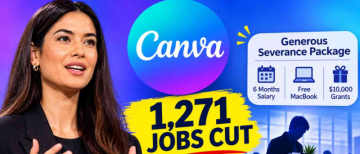
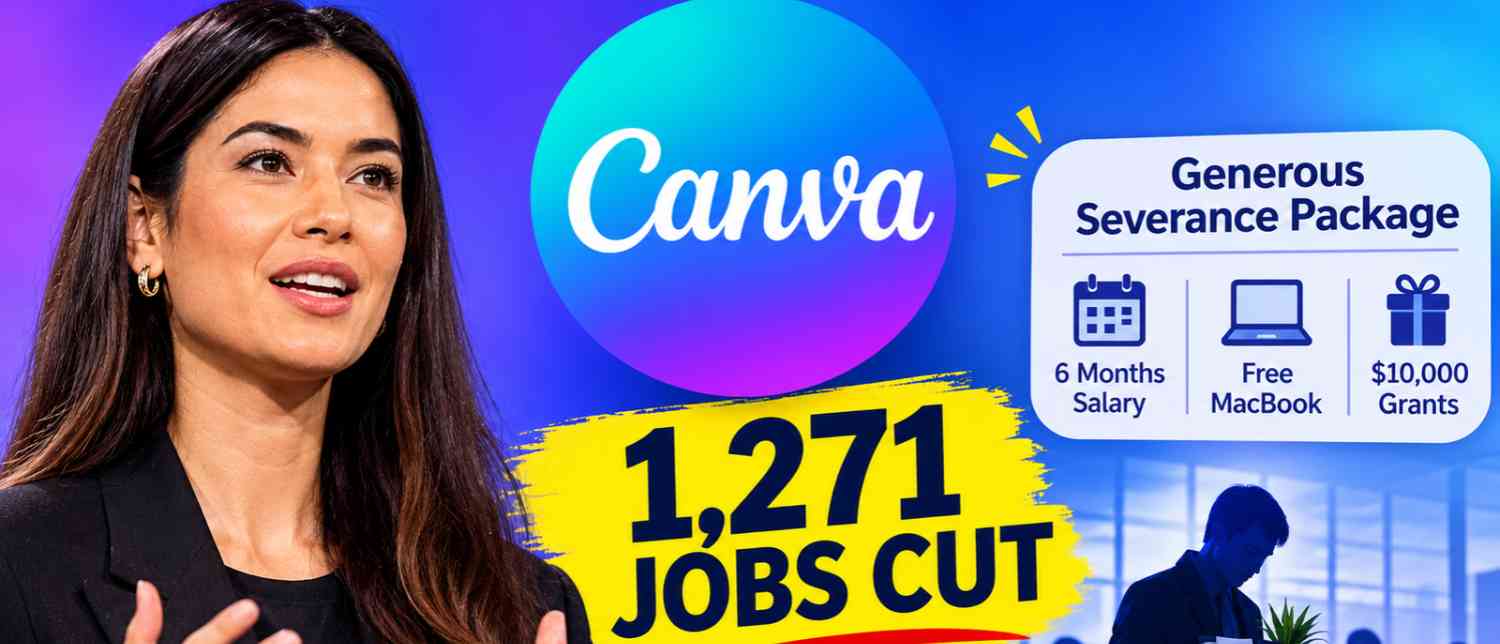
The global technology industry has witnessed another significant workforce reduction, but this time, the conversation surrounding layoffs has taken an unexpected turn. Australian design software giant Canva has announced plans to cut 1,271 jobs, affecting approximately 22% of its workforce. While the decision has raised concerns about employment security, slowing business growth and the growing influence of artificial intelligence (AI), the company's approach towards departing employees has attracted considerable attention online.
Unlike many corporate layoffs, where employees are often left struggling with limited financial assistance and uncertain career prospects, Canva is offering an unusually comprehensive severance package. The benefits reportedly include at least six months of salary, continued healthcare coverage in eligible countries, career transition assistance, a free one-year LinkedIn Premium subscription and even the option to keep company-issued MacBooks.
The company is also introducing financial support for employees interested in pursuing entrepreneurial ventures or community projects.
The announcement has triggered widespread discussions about corporate responsibility, workplace empathy and how technology companies should treat employees during difficult business decisions. However, behind the generous exit benefits lies a more complicated story involving slowing revenue growth, rising AI development costs, increasing competition and a major organisational restructuring.
Canva Announces 1,271 Job Cuts, Affecting 22% of Its Workforce
Canva's workforce reduction represents one of the company's most significant organisational changes since its establishment.
The company is cutting 1,271 positions, equivalent to approximately 22% of its workforce, as part of a broader restructuring exercise. The decision was communicated by co-founder and CEO Melanie Perkins, who acknowledged the company's changing business environment and the need to prepare for its next phase of growth.
In her message to employees, Perkins reflected on Canva's journey from an ambitious startup idea to a widely used visual communication platform serving hundreds of millions of users.
However, she also acknowledged that the company's growth had slowed for the first time in a decade, making organisational changes necessary.
The restructuring is not simply about reducing employee numbers. Canva is reportedly looking to simplify its internal structure by bringing product, growth and platform teams closer together. The objective is to reduce communication barriers, eliminate unnecessary layers and create a more integrated working environment.
The company is also moving away from excessive specialisation, encouraging employees to take on broader responsibilities rather than remaining restricted to narrowly defined roles.
These changes indicate that Canva is reassessing how its workforce operates as competition intensifies and the technology landscape continues to evolve.
Canva Severance Package: Six Months' Salary, Free MacBooks and Career Assistance
The most talked-about aspect of the Canva layoffs 2026 is undoubtedly the company's severance package. Rather than limiting its support to standard termination payments, Canva has introduced several measures intended to help affected employees manage the financial and professional consequences of losing their jobs.
Here is what departing employees can reportedly expect:
1. At least six months of salary
Every affected employee will receive at least six months' salary, including applicable statutory entitlements, irrespective of their geographical location.
This is particularly significant for employees who may need additional time to secure another position in an increasingly competitive job market.
2. Employees can keep their company-issued MacBooks
Canva is allowing departing employees to retain their company-issued MacBook laptops.
Although this might appear to be a relatively small gesture compared with financial compensation, it has practical value. Employees can continue using the devices for job applications, online interviews, professional development, freelance assignments and other career-related activities.
For someone who does not own a personal laptop, this benefit could make an immediate difference during the transition.
3. One year of free LinkedIn Premium
Canva is also providing affected employees with a 12-month LinkedIn Premium subscription.
The benefit is intended to make the job search easier by supporting professional networking and access to career-related tools. At a time when hundreds of talented professionals may be competing for similar opportunities, maintaining visibility among recruiters and potential employers can be valuable.
4. One-on-one career coaching and interview preparation
The company's support extends beyond financial assistance.
Departing employees will receive individual career coaching, résumé assistance and interview preparation. Canva's talent acquisition team will also help employees prepare for their next professional opportunities.
This is an important distinction because receiving severance pay does not automatically make it easier to find another job. Professional guidance can help employees identify suitable opportunities, communicate their strengths and navigate the recruitment process more confidently.
5. Up to 12 months of healthcare and employee assistance
Employees in countries where Canva provides healthcare benefits will receive up to 12 months of continued healthcare coverage.
The company's employee assistance programme, Canva Care, will also remain available to departing employees and their families for 12 months.
This provision recognises that losing employment can affect more than an individual's monthly income. It can also create uncertainty around healthcare, family responsibilities and emotional well-being.
6. $10,000 grants for entrepreneurial ideas
Perhaps one of the most distinctive elements of the Canva severance package is its $10,000 grant programme.
Departing employees interested in establishing their own businesses or pursuing meaningful community projects can apply for financial assistance through this initiative.
Importantly, the programme is designed to provide support without taking equity in the ventures. This means employees can pursue their ideas without having to surrender ownership in exchange for the grant.
The initiative creates an alternative pathway for people who may not necessarily want to return immediately to traditional employment.
7. Additional support for recently hired employees
Another noteworthy provision concerns employees who joined Canva relatively recently.
The company is reportedly removing the one-year vesting cliff for affected employees who joined within the preceding 12 months. This allows eligible departing employees to receive shares they might otherwise have had to wait longer to vest.
Canva has also introduced an opt-in alumni talent directory to help former employees discover professional opportunities. Perkins has reportedly invited business leaders with relevant openings to connect directly with her regarding potential opportunities for departing staff.
Taken together, these measures make the Canva layoffs particularly notable. The company is not simply providing a financial exit package; it is attempting to offer departing employees resources that can help them move forward professionally and personally.

Why Is Canva Laying Off 1,271 Employees?
While the severance package has attracted considerable appreciation, the underlying business reasons for the workforce reduction deserve equal attention.
Canva's decision comes at a time when the company is facing several challenges, including slowing revenue growth, rising artificial intelligence expenses and intensifying competition in the digital design industry.
Slowing growth after a decade of expansion
For years, Canva experienced remarkable growth, establishing itself as one of the world's most accessible graphic design and visual communication platforms.
Its easy-to-use interface, extensive templates and collaboration features attracted individuals, businesses, educational institutions and marketing professionals.
However, the company's growth momentum has reportedly slowed.
In August 2026, Canva reduced its revenue growth forecast for the year from 30% to 20%. The adjustment followed higher-than-expected costs associated with developing and operating its artificial intelligence features.
For a company that has enjoyed years of strong expansion, slower growth represents an important strategic challenge.
The restructuring appears to be an attempt to make the organisation more efficient and position it for its next stage of development.
Rising artificial intelligence costs
AI is transforming the technology industry, but adopting it at scale is not necessarily inexpensive.
Canva has been investing heavily in AI-powered capabilities and developing its own AI models to reduce dependence on external technology providers.
However, building, maintaining and delivering generative AI tools to millions of users requires significant resources.
The company must balance innovation with the costs of operating these features at scale. As AI becomes increasingly central to its product strategy, controlling infrastructure and development expenses has become an important business priority.
Increasing competition from AI-powered platforms
Canva is also facing a changing competitive environment.
AI-powered design startups and general-purpose platforms such as ChatGPT and Gemini are making it easier for users to create images, presentations, marketing material and other visual content.
Tasks that once required users to spend considerable time working with conventional design tools can now be completed through increasingly sophisticated AI-powered interfaces.
This does not mean traditional design platforms have become irrelevant. However, it does mean that companies such as Canva must continuously demonstrate why users should choose their products over emerging alternatives.
The challenge is no longer simply offering attractive templates or convenient editing features. It is about delivering greater creative value, better productivity and more sophisticated AI capabilities without allowing operating costs to spiral.
Canva Layoffs in India: What Happens to Its Content and Creative Operations?
The restructuring has also drawn attention in India, where Canva has an established workforce and operates across several business functions.
The changes are particularly relevant to its content operations, as the company reassesses the skills, roles and organisational structure required for its future.
Reports surrounding the restructuring have highlighted the impact on India's content-related operations. This has raised questions among professionals working in content development, technical writing, localisation and other creative functions about how the changing technology landscape could affect their careers.
However, an important distinction needs to be made between organisational restructuring and direct AI-driven job replacement.
Canva has pushed back against the suggestion that artificial intelligence is simply replacing departing employees. The company has maintained that the changes are part of a broader organisational exercise involving the consolidation of teams, evolving responsibilities and a reassessment of the skills needed for the future.
This distinction matters because AI adoption and workforce reduction are increasingly being discussed together across the technology industry. While automation can change how certain tasks are performed, it does not automatically establish that every eliminated position has been replaced by an AI tool.
For employees in India, the immediate concern is understanding which functions are being reorganised, what opportunities might exist within the new structure and whether traditional content-related roles will evolve alongside AI-powered workflows.
Canva has not publicly provided a detailed country-wise breakdown of the 1,271 affected employees. Consequently, the precise number of Indian employees losing their positions remains unclear. It would be premature to assume that the entire reported impact on content operations represents permanent job losses.
AI or Restructuring? Understanding the Real Reason Behind Canva's Job Cuts
One of the biggest questions emerging from the Canva layoffs is whether artificial intelligence is directly responsible for employees losing their jobs.
The timing certainly makes the question relevant. Canva has invested significantly in AI-powered design capabilities, while generative AI platforms are increasingly capable of producing images, presentations, marketing content and other creative material.
However, the company's stated explanation focuses on a combination of business and organisational factors rather than announcing that AI tools are replacing the affected workforce.
Canva is bringing its Product, Growth and Platform teams together under a unified product organisation. It is also reducing specialised divisions, simplifying management structures and encouraging employees to take broader ownership of projects.
In addition, the company is concentrating more product teams in Sydney and expects most hybrid employees to spend approximately two to three days per week working from an office from January.
These changes suggest a wider attempt to reshape how the organisation functions.
Nevertheless, the distinction between AI adoption and job restructuring should not obscure the broader employment challenge.
As generative AI becomes more capable, companies across industries are reconsidering how much human involvement different processes require. Content creation, graphic design, customer support, marketing and documentation are among the areas experiencing significant technological changes.
Even when a company does not explicitly attribute job cuts to automation, employees may still face changing expectations, new skill requirements and increased competition.
For creative and content professionals, the lesson is becoming increasingly clear: adapting to AI-assisted workflows and developing skills that go beyond repetitive production tasks may become essential for long-term career security.

Social Media Reacts: Why Is Canva Being Praised Despite Mass Layoffs?
Perhaps the most unusual aspect of the Canva layoffs is the public reaction.
Typically, announcements involving thousands of job cuts trigger criticism, employee concerns and discussions about corporate accountability. This time, however, a significant part of the online conversation has focused on the company's treatment of departing employees.
Social media users, particularly on LinkedIn and Instagram, have praised the severance package, describing it as unusually thoughtful and humane.
Some professionals have called it one of the most compassionate layoff announcements they have encountered, while others have suggested that more companies should adopt similar employee-support measures.
The decision to let employees keep their MacBooks has generated particular interest.
For many people, a personal computer is an essential tool for finding employment, updating résumés, attending virtual interviews and pursuing freelance opportunities. Losing access to a company-issued laptop immediately after termination can create an additional financial burden.
By allowing employees to retain their devices, Canva is addressing a practical problem that traditional severance packages may overlook.
The discussion has also extended to the company's leadership.
Some social media users have credited CEO Melanie Perkins' communication style and leadership approach for the emphasis on empathy and employee dignity. Comments highlighting the role of women in leadership have attracted attention, with users discussing whether leadership perspectives can influence how difficult organisational decisions are communicated.
However, not everyone agrees with the overwhelmingly positive reaction.
Critics argue that offering generous compensation should not automatically make mass layoffs an example of exemplary corporate behaviour. They point out that more than a thousand employees are still facing professional uncertainty, and financial assistance cannot entirely replace job security.
Others have questioned whether the discussion around the benefits package is distracting attention from the larger questions about slowing growth, AI-driven changes and the future of employment.
Both perspectives deserve consideration. A generous severance package can be commendable without making the underlying job cuts any less painful.
Does Canva's Severance Package Set a New Standard for Tech Industry Layoffs?
The technology sector has witnessed repeated rounds of workforce reductions in recent years. Employees at established companies and emerging startups alike have experienced sudden organisational changes, hiring freezes and redundancy announcements.
In many cases, discussions surrounding layoffs focus on financial performance, restructuring targets and shareholder expectations. The experience of departing employees can receive considerably less attention.
Canva's approach raises an important question: if companies must reduce their workforce, what responsibility do they have towards the people who helped build their businesses?
Six months of salary provides employees with a financial cushion. Healthcare continuation offers additional protection. Career coaching and interview preparation can make the transition less overwhelming, while grants for entrepreneurial ventures provide an alternative to conventional employment.
The alumni talent directory is another interesting initiative because it extends the company's responsibility beyond the final working day by attempting to connect former employees with opportunities.
Not every business has the financial resources to offer benefits on this scale. Nevertheless, the broader principles behind the package are relevant to organisations of different sizes.
Transparent communication, reasonable notice, fair financial compensation, practical career assistance and respectful treatment should not be considered optional gestures.
Canva's announcement could encourage other employers to reconsider how they manage workforce reductions, particularly as AI-driven restructuring becomes more common.
The real benchmark should not simply be the monetary value of a severance package. It should also be whether employees are treated fairly, informed honestly and given meaningful support during an uncertain period.
What Canva's Layoffs Mean for the Future of the Technology Industry
The Canva restructuring is part of a larger transformation taking place across the global technology industry.
Businesses are increasingly expected to operate efficiently, innovate faster and deliver more value with fewer resources. Artificial intelligence is accelerating this transformation by changing how products are developed, how teams collaborate and how everyday tasks are completed.
For employees, this creates an increasingly uncertain professional environment. Even organisations experiencing considerable success may reconsider their workforce requirements when their business models, growth expectations or technological priorities change.
However, the Canva layoffs also demonstrate that companies have choices when it comes to managing difficult employment decisions.
The company could not avoid the disruption caused by its restructuring, but it has attempted to make the transition less financially and professionally challenging for those affected.
There is also an important detail worth remembering: the figure of 1,271 represents employees impacted by the restructuring, including people facing role changes and relocation requirements. It should not automatically be interpreted as 1,271 confirmed job losses.
Ultimately, Canva's decision presents two contrasting realities. On one hand, more than a thousand employees are experiencing uncertainty because of a major corporate restructuring. On the other, the company's severance package demonstrates how employers can approach workforce reductions with greater consideration for the people involved.
Whether Canva's approach becomes a model for other technology companies remains to be seen. But one thing is clear: as AI continues to reshape the workplace, the way companies treat employees during periods of transition will become just as important as the technological innovations they introduce.
© Copyright 2026. All Rights Reserved. Powered by Vygr Media.