 By
By 
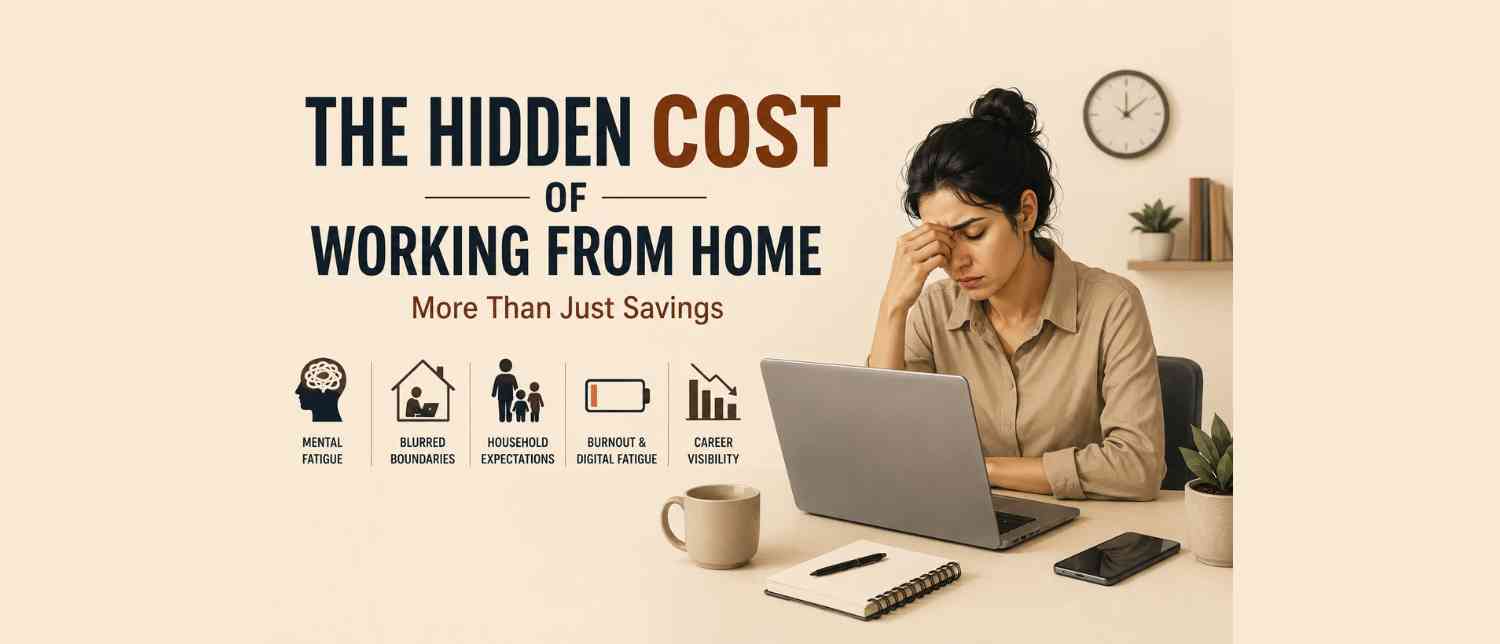
For years, the work-from-home (WFH) debate has revolved around a familiar checklist: no commute, flexible hours, lower expenses, better work-life balance. On the other side are the arguments for office life- better collaboration, networking, visibility, and career growth.
But somewhere between these two narratives lies an uncomfortable truth that many professionals are only beginning to articulate: the true cost of working from home is often invisible.
It isn't just the monthly electricity bill or the internet recharge. It's the emotional labour of proving you're working. It's the mental exhaustion of being "always available." It's the gradual erosion of boundaries between professional and personal life. And in many households, particularly in India, it's the constant expectation that if you're physically present, you're automatically available.
The future of work isn't about choosing between home and office. It's about understanding the hidden trade-offs of both.
The Commute Tax Is Real, But So Is the Home Tax
Anyone who has spent hours navigating traffic in Bengaluru, Delhi, Mumbai, or Gurugram knows that commuting comes with a steep cost. Employees spend thousands every month on fuel, public transport, parking, eating out, and office attire—not to mention the precious hours lost in transit.
From a purely financial perspective, remote work often appears to be the obvious winner. Eliminating daily travel can significantly reduce monthly expenses while returning valuable personal time to employees. Many professionals also report improved flexibility and better control over their schedules.
Yet these savings tell only half the story.
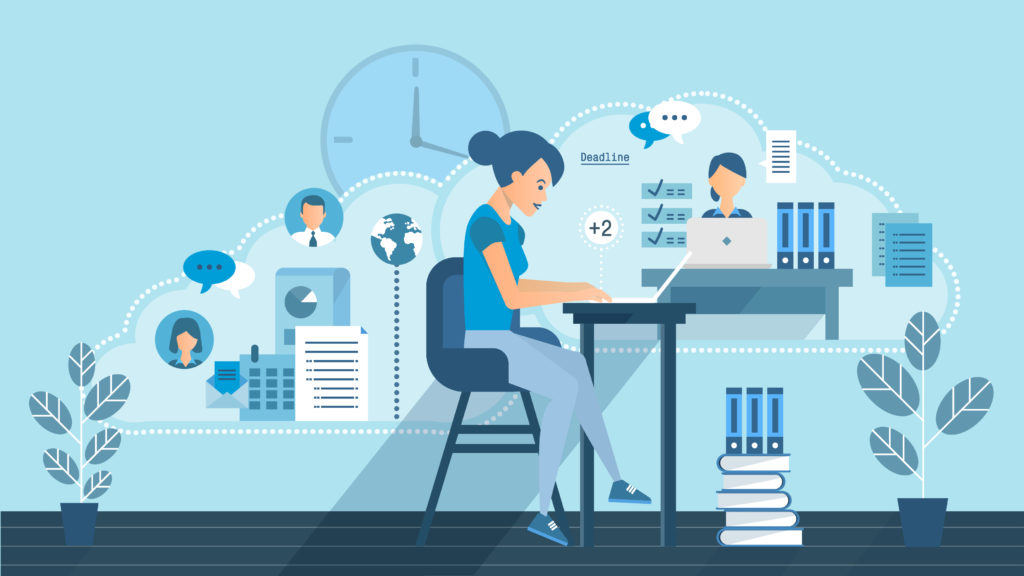
Working from home shifts many costs from employers to employees. Electricity bills rise. High-speed internet becomes a necessity. Home office furniture, ergonomic chairs, larger homes with dedicated workspaces, and uninterrupted power backup often become personal investments.
More importantly, the psychological cost rarely appears on any spreadsheet.
Home Is No Longer a Place to Switch Off
One of the greatest ironies of remote work is that the place once associated with rest has quietly become another office.
Emails don't stop after dinner.
Slack notifications continue during family time.
Meetings spill into evenings because "you're already home."
Without a physical commute acting as a psychological transition, many professionals struggle to mentally disconnect from work. Over time, the result isn't greater flexibility but continuous low-grade stress, digital fatigue, and eventual burnout. Mental health experts increasingly warn that remote employees often work longer hours precisely because the boundary between work and life becomes difficult to enforce.
The laptop may close, but the mind rarely does.
The Invisible Workers Inside Indian Homes
Perhaps nowhere are the hidden costs of WFH more evident than inside Indian households.
A recent viral video by Delhi-based content creator Heena Dogra struck a chord because it articulated what millions of remote workers experience but rarely discuss.
Despite earning more than her office-going brother and working longer hours, she explained that she still receives less respect simply because she works from home. Family members assume she is "free," ask her to entertain guests, serve tea, complete household chores, or postpone meetings because "you're at home anyway."
The story resonated because it wasn't unique. For many Indians, particularly women working from home often means doing two jobs simultaneously.
Professional responsibilities continue uninterrupted while domestic expectations remain unchanged. The workplace has entered the home, but household responsibilities haven't left.
Remote work, therefore, doesn't eliminate labour; it frequently multiplies it.

Respect Still Comes With an Office ID Card
The pandemic transformed where people work. It did not completely transform how society perceives work.
Many families continue to equate productivity with physical presence. Dressing formally, commuting, carrying an office laptop, and returning home late remain visible symbols of employment.
Remote work lacks those visible cues. Consequently, professionals often find themselves repeatedly explaining that sitting in front of a laptop for ten hours is, in fact, work. This perception gap creates emotional fatigue.
Employees aren't simply completing projects they're also constantly validating the legitimacy of their jobs. Ironically, the flexibility that remote work promises sometimes comes at the cost of professional recognition within one's own household.
Productivity Is Only One Piece of the Puzzle
Companies often debate WFH using productivity metrics. Employees discuss it using quality-of-life metrics. Both are important.
Research conducted after the pandemic suggests many organisations found productivity largely sustained under flexible work arrangements, challenging the early fears that remote employees would become less effective.
However, productivity alone cannot measure employee well-being. A worker may deliver excellent results while quietly battling loneliness, digital exhaustion, or the feeling of being permanently "on." Performance metrics rarely capture isolation.
Career Growth Has Its Own Geography
There is another uncomfortable reality many remote employees acknowledge.
Visibility matters.
Career advancement often depends not only on performance but also on relationships, spontaneous conversations, mentoring opportunities, and informal interactions that occur outside scheduled meetings. These "water cooler conversations" cannot always be replicated on Zoom.
While remote employees may save time and money, some worry about becoming professionally invisible, missing opportunities for promotions, leadership roles, or influential projects simply because they are less physically present. This doesn't mean offices are inherently superior.
It simply means organisations must consciously design equitable systems that reward outcomes rather than attendance.
Digital Fatigue Is the New Workplace Hazard
Working from home was once marketed as freedom. Today, many professionals describe it as continuous screen time.
Video meetings replace hallway conversations.
Instant messaging replaces walking to someone's desk.
Lunch breaks become optional.
Even social interactions increasingly happen through another screen.
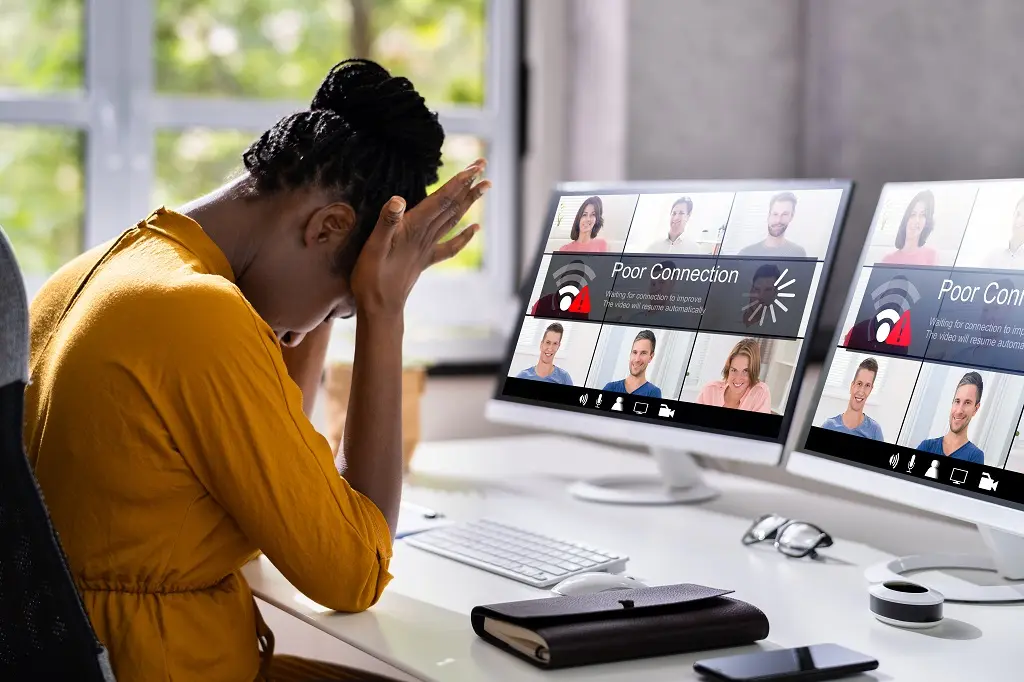
The cumulative effect is digital fatigue a growing sense of mental depletion caused by constant virtual engagement. Unlike physical tiredness, digital fatigue often manifests subtly: reduced concentration, irritability, emotional exhaustion, sleep disturbances, and declining motivation.
Because employees are technically "at home," these symptoms frequently go unnoticed until burnout becomes unavoidable.
There Is No Universal Winner
The work-from-home debate often seeks a single answer. There isn't one.
A young professional living alone in a metropolitan city may crave office interaction.
A parent caring for children may value flexibility above everything else.
Someone with a long daily commute may happily exchange office visibility for three additional hours with family.
Another employee may willingly travel every day because collaboration accelerates learning.
The value of WFH depends on life stage, personality, job role, household environment, and organisational culture. That is why blanket return-to-office mandates and blanket remote policies both risk missing the point.
The Future Belongs to Intentional Flexibility
Instead of asking whether offices should disappear or whether everyone should return, organisations need better questions.
Which tasks genuinely require collaboration?
Which roles benefit from focused individual work?
How can companies measure contribution instead of physical attendance?
How can managers prevent burnout in remote teams?
How can families better understand that being home does not mean being available?
These questions are far more important than counting office attendance. Hybrid work, when thoughtfully implemented, may offer the most practical compromise—not because it pleases everyone equally, but because it recognises that employees are different.
Flexibility should not mean permanent availability. Nor should office attendance become a substitute for effective leadership.
Beyond Productivity Lies Humanity
Perhaps the biggest lesson of the remote work era is that work has never been solely about location. It has always been about people.
People need flexibility.
People need recognition.
People need meaningful relationships.
People also need clear boundaries.
A workplace that saves employees two hours of commuting but expects them to answer emails at midnight is not progressive. Likewise, an office that demands attendance simply to justify expensive real estate is equally disconnected from modern realities.
The future of work will not be defined by where employees sit. It will be defined by whether organisations create environments—physical or virtual—that allow people to thrive without sacrificing their health, relationships, or dignity.
The greatest hidden cost of working from home isn't electricity, Wi-Fi, or even missed promotions. It is the quiet expectation that because work happens at home, it somehow isn't real.
Until that perception changes in our companies, our policies, and our homes, the work-from-home revolution will remain incomplete.
With input from agencies
Image Source: Multiple agencies
© Copyright 2026. All Rights Reserved. Powered by Vygr Media.