 By
By 
For nearly eight decades, Pakistan has projected Pakistan-Occupied Kashmir (PoK), officially termed “Azad Jammu and Kashmir” (AJK), as a symbol of self-rule and freedom. The word “Azad,” meaning free, has remained central to Islamabad’s diplomatic messaging on Kashmir since 1947. However, a wave of protests, political mobilization, and growing public discontent across the region is increasingly challenging that narrative.
Recent developments in Pakistan-Occupied Jammu and Kashmir (PoJK), particularly the rise of the Jammu Kashmir Joint Awami Action Committee (JAAC) movement and the testimony of its leaders, have reignited debate over the region’s political status, governance structure, economic exploitation, and relationship with Pakistan.
The latest unrest has not emerged in isolation. Rather, analysts, political observers, and local activists argue it is the culmination of decades of grievances involving political disenfranchisement, economic deprivation, administrative control from Islamabad, and suppression of dissent.
The ‘Azad’ Kashmir Narrative Under Scrutiny
The central argument emerging from recent protests is that the region commonly described by Pakistan as “Azad Kashmir” has never exercised genuine autonomy.
Despite having its own legislative assembly, president, prime minister, and judiciary, critics argue that key powers remain concentrated in Islamabad. The region’s constitutional and administrative framework has long been viewed as being subordinate to Pakistan’s federal establishment.
According to multiple analyses, major political decisions, resource allocation, security matters, and strategic governance continue to be influenced by Pakistani authorities rather than elected local representatives.
This perceived disconnect between constitutional symbolism and political reality has increasingly become a rallying point for protesters.
Observers note that Islamabad’s international advocacy for Kashmiri self-determination has come under renewed scrutiny as residents in PoJK themselves raise questions about their own political rights and freedoms.
From Economic Protests to a Wider Political Movement
The current phase of unrest initially emerged around bread-and-butter issues.
Residents protested soaring inflation, high electricity tariffs, increasing flour prices, unemployment, and deteriorating public services. What began as economic demonstrations gradually evolved into a broader political movement questioning decades of governance practices.
The JAAC emerged as one of the most prominent platforms articulating these concerns.
Its demands extended beyond price reductions and subsidies, encompassing governance reforms, accountability, resource rights, and local empowerment.
Political commentators note that the movement transformed from a socioeconomic protest into a larger challenge to the legitimacy of Pakistan’s governance model in the region.
Mangla Dam and the Question of Resource Exploitation
One of the most frequently cited grievances concerns the Mangla Dam, among Pakistan’s largest hydroelectric projects.
Located in Mirpur district of PoJK, the dam has historically been presented as a major contributor to Pakistan’s energy infrastructure. However, critics argue that local communities have borne disproportionate costs while receiving limited benefits.
The construction and later expansion of the project displaced tens of thousands of residents. Entire settlements, agricultural lands, ancestral properties, and large portions of old Mirpur were submerged.
Protest leaders and regional activists contend that despite generating significant electricity for Pakistan, local populations continue to face expensive power tariffs and insufficient compensation.
The issue has become symbolic of what many protesters describe as a broader pattern of economic extraction without equitable revenue sharing.
_1781377667.jpg)
Growing Public Anger Across PoJK
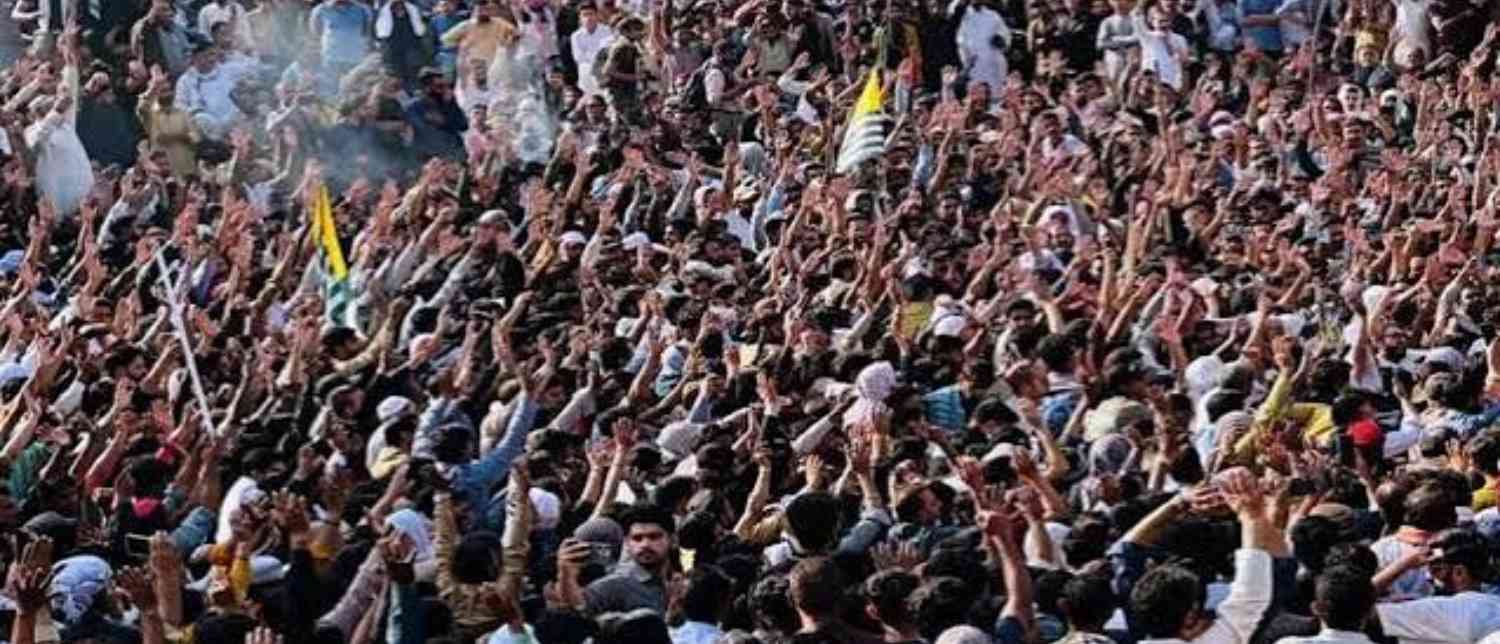
Recent protests have witnessed participation from a broad cross-section of society, including traders, students, workers, civil society groups, and political activists.
Large demonstrations have been reported in Muzaffarabad, Rawalakot, Mirpur, Bagh, and other areas.
The movement has increasingly focused on themes such as dignity, rights, representation, and accountability.
Analysts point out that unlike previous episodes of unrest, current protests have managed to sustain momentum by connecting economic hardships with deeper constitutional and political concerns.
The protests have also drawn attention because they challenge an official narrative that has remained largely uncontested within Pakistan’s domestic discourse for decades.
The Rise of Shaukat Nawaz Mir
Among the most recognizable faces of the movement is JAAC leader Shaukat Nawaz Mir.
Mir has emerged as one of the strongest voices questioning Pakistan’s governance of PoJK.
In various statements cited across reports, he has argued that the region remains politically constrained despite being labeled “Azad.” His remarks have resonated widely among sections of the population frustrated by economic hardship and perceived political marginalization.
As public demonstrations expanded, Mir became one of the most prominent organizers associated with the movement.
His growing influence also attracted the attention of authorities.
Allegations of Crackdowns and Political Suppression
The unrest has been accompanied by allegations of aggressive state responses.
Reports indicate that protesters and activists faced arrests, raids, surveillance, communication restrictions, and security operations.
According to accounts cited in multiple reports, authorities launched extensive efforts to detain JAAC leaders and weaken organizational networks.
The movement’s leadership has accused the state of attempting to suppress legitimate democratic demands through coercive measures rather than dialogue.
Critics argue that such actions contradict Pakistan’s longstanding advocacy for political rights and democratic freedoms in Kashmir.
The handling of protests has consequently become a major point of contention both inside and outside the region.
Shaukat Nawaz Mir’s Allegations of Historical Violence
One of the most striking elements of recent reporting has been Mir’s account of alleged historical state violence in Pakistan-Occupied Kashmir.
According to his claims, the region has witnessed repeated episodes of repression over the decades, many of which remain poorly documented internationally.
Mir alleged that thousands of people have suffered as a result of political suppression and heavy-handed security policies.
His assertions have intensified debate regarding the historical relationship between Islamabad and PoJK.
While these claims remain politically contested, they have contributed significantly to the current discourse surrounding rights, accountability, and governance in the territory.
The Ghost of Kashmir Returns to Haunt Pakistan
A recurring theme emerging from recent analyses is what some commentators describe as Pakistan facing the consequences of narratives it historically employed against India.
For decades, Islamabad highlighted alleged democratic deficits, human rights concerns, and demands for self-determination in Indian-administered Jammu and Kashmir.
Today, critics argue, many of those same questions are being raised by residents within Pakistan-administered territories.
This reversal has prompted observers to characterize the situation as a political irony: issues once used by Pakistan to criticize India are now being directed toward Islamabad itself.
The growing visibility of internal dissent has therefore acquired significance beyond local politics, influencing wider regional debates over Kashmir.
The Illusion of Autonomy
Political experts examining PoJK governance frequently point to institutional limitations embedded within the region’s constitutional framework.
While elected bodies exist, critics argue that substantive authority remains constrained.
Many key decisions relating to administration, security, and policy are perceived to originate outside the region.
The result, according to analysts, is an “illusion of autonomy” in which democratic structures exist formally but exercise limited independent authority.
This perception has become increasingly widespread among younger generations who have grown frustrated with persistent economic difficulties and governance challenges.
Why the Current Unrest Matters
Observers believe the present wave of protests differs from earlier movements because it combines economic grievances, political demands, and identity-related concerns.
Instead of focusing exclusively on subsidies or utility bills, protesters increasingly question the broader framework governing the territory.
The movement therefore represents not merely dissatisfaction with current policies but a challenge to long-standing political assumptions.
Analysts suggest that the significance of the protests lies in their ability to unite diverse social groups around common concerns.
Such mobilization has made it more difficult for authorities to portray unrest solely as isolated incidents or temporary economic agitation.
Implications for Pakistan’s Kashmir Policy
The developments in PoJK carry implications beyond regional governance.
Pakistan has traditionally positioned itself internationally as a defender of Kashmiri aspirations and self-determination.
However, growing unrest in territories under its own administration has complicated that narrative.
Critics argue that Islamabad now faces difficult questions regarding democratic representation, resource distribution, constitutional rights, and political freedoms within PoJK itself.
The protests have consequently generated increased international interest in governance conditions inside the territory.
Whether Pakistan responds through reforms, negotiations, or continued security measures may shape the trajectory of future unrest.
A Turning Point for Pakistan-Occupied Kashmir?
Many commentators view the current moment as a potential watershed in the history of Pakistan-administered Kashmir.
The combination of economic distress, political mobilization, public anger, and heightened scrutiny has exposed tensions that have accumulated over decades.
For supporters of the movement, the protests represent a demand for dignity, rights, and meaningful self-governance.
For critics of Islamabad’s policies, they reveal contradictions embedded within the “Azad Kashmir” narrative itself.
Regardless of political interpretation, one conclusion appears increasingly difficult to ignore: the debate surrounding Pakistan-Occupied Kashmir is no longer confined to international diplomacy or India-Pakistan rivalry. It is now being shaped by voices emerging from within the territory itself.
As demonstrations continue, the future of PoJK may depend less on historical slogans and more on how effectively long-standing demands for accountability, representation, and economic justice are addressed.
With inputs from agencies
Image Source: Multiple agencies
© Copyright 2026. All Rights Reserved. Powered by Vygr Media.