 By
By 
For many women in India’s cities, booking a bike taxi is not a lifestyle choice. It is a practical calculation. It is cheaper than a cab, faster than sitting in traffic and often the easiest way to cover the last few kilometres between a metro station, workplace and home.
But what happens when the person entrusted with getting you there safely becomes the reason you start fearing for your safety?
Three recent cases involving women passengers on Rapido rides — two in Delhi and one in Bengaluru — raise an uncomfortable question: how safe are women really when they use app-based bike taxis, and how much responsibility can realistically be placed on the passenger to protect herself?
The incidents are different. One Delhi woman says she was taken along an unfamiliar, deserted route and allegedly could not get the rider to stop. Another Delhi woman says a person arrived in a car even though she had booked a bike, with the vehicle and rider details not matching what was shown on the app. In Bengaluru, a 32-year-old woman suffered devastating injuries in a bike-taxi accident and subsequently entered a legal battle over compensation and accountability.
None of these cases should be treated as proof that every Rapido rider is unsafe or that every bike-taxi journey is dangerous. But together, they expose something more important: when a ride goes wrong, the passenger may have very little control over what happens next.
And for women, that loss of control can be frightening in ways that go far beyond an ordinary traffic accident.

When the safest option may suddenly feel like the most dangerous one
The Delhi case is perhaps the most disturbing illustration of this vulnerability.
Ayesha Srivastav said she booked a Rapido bike to travel to work but became alarmed when the rider took an unfamiliar and apparently deserted route towards Vishwavidyalaya. According to her account, she asked him to change the route or stop the scooter. She alleged that he refused. She eventually jumped from the moving bike because she feared for her safety, sustaining injuries to her hands, legs and head.
The most important detail here is not simply that the route was unfamiliar.
It is that the passenger says she felt she could no longer control the situation.
That distinction matters.
A driver taking a different route is not automatically evidence of malicious intent. Navigation systems make mistakes, roads close and drivers may know shortcuts. But the moment a passenger says, “Please stop,” the situation changes. A ride-hailing service is fundamentally a service in which the passenger must be able to trust that she can exit the vehicle when she reasonably wants to.
If she believes she cannot, the psychological dynamic becomes entirely different.
In this case, the woman's decision to jump from a moving scooter was obviously dangerous. But asking only, “Why would she jump?” misses the more difficult question: what circumstances made jumping seem safer to her than remaining on the bike?
Rapido later said it had permanently suspended the reported captain, shared his details with the passenger for legal proceedings and offered legal and medical assistance.
That response is welcome. But it also raises another question: why should a passenger have to take the incident to social media before she feels heard?

The second warning sign: when the vehicle itself cannot be trusted
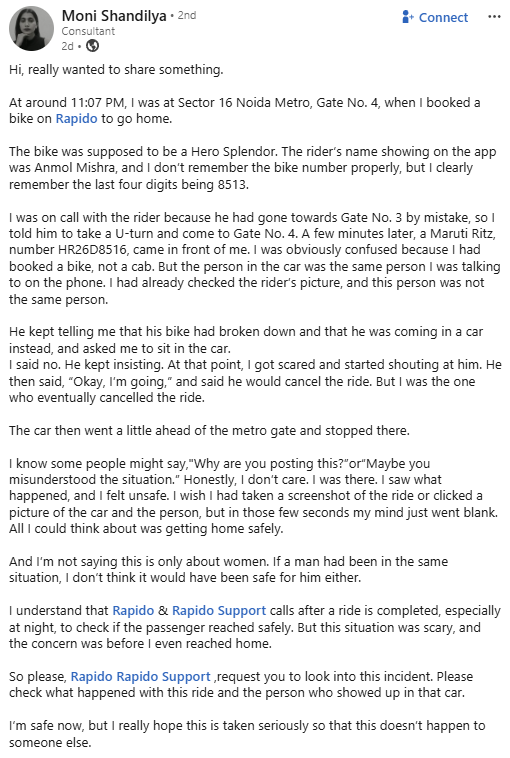
Another Delhi woman, Moni Shandilya, described a completely different experience that nevertheless reveals another vulnerability in app-based mobility.
She had booked a Rapido bike near Noida Sector 16 Metro station late at night. The booking displayed a Hero Splendor and the rider's details. But, according to her account, a car arrived instead. The man inside allegedly said his bike had broken down and asked her to get into the car. The vehicle registration did not match her booking, and she also felt that the man did not match the rider photograph displayed in the app. She refused and eventually cancelled the ride.
This should be an obvious red line.
A passenger should never have to decide whether a stranger's explanation is believable when the basic identity of the vehicle does not match the booking.
The woman's fear is particularly understandable because the entire safety promise of an app-based ride depends on verification. The app tells the passenger: this is your driver, this is your vehicle and this is the journey you are about to take.
If the person standing in front of you does not match that information, the digital safety net has already failed.
Rapido said the vehicle mismatch violated its policies and safety standards and that the captain's account had been suspended pending investigation. The company also said it was strengthening monitoring through customer feedback, ride reviews and vehicle checks.
Those measures matter. But verification cannot merely exist as a policy on paper. It has to work at the precise moment when a passenger needs it.
Bengaluru shows the other side of the safety equation
The Bengaluru case is different again — and arguably just as important.
Sani Krishna, a 32-year-old interior designer, was travelling by bike taxi to work on June 17 when an accident allegedly involving reckless riding resulted in a collision and a tractor running over her. She suffered seven fractured ribs, required emergency surgery to remove her spleen and underwent facial plastic surgery. Her family said treatment costs had crossed Rs 20 lakh.
Her subsequent fight was not simply about the accident. It was about what happens after the accident.
Krishna issued a legal notice demanding full reimbursement, accountability and an apology. Rapido initially pointed to an insurance cover with a maximum claim of Rs 1 lakh, while Krishna's legal team argued that such a limit was inadequate given the scale of her injuries and expenses. Rapido, for its part, said the insurance process required supporting documentation and that it was willing to facilitate the claim.
By August 13, Rapido had changed its position in this particular case, saying it would facilitate processing of the entire eligible medical expense claim without applying the standard policy cap, subject to documentation and insurer verification. The company said bike-taxi rides booked through its platform are covered by insurance for customers and captains.
That is an important development. Yet Krishna herself said the fight was not over because she wanted accountability and an apology as well as financial assistance. She remained unable to travel or work while recovering from the injuries.
And this is where the three stories converge.
Safety is not merely about preventing an assault or accident. It is also about what happens when prevention fails.

Can women really “avoid” unsafe Rapido rides?
This is where conversations about women's safety often become unfair.
We tell women to check the driver's photograph. Check the number plate. Share the ride. Wear a helmet. Avoid isolated roads. Keep emergency contacts ready. Don't travel late. Don't get into an unfamiliar vehicle. Keep your phone charged.
All of that is sensible.
But there is a dangerous implication buried underneath such advice: that if a woman follows enough precautions, she can guarantee her own safety.
She cannot.
A woman can verify the registration number and still encounter reckless driving. She can share her live location and still be taken somewhere she does not want to go. She can book a verified vehicle and still face an accident. She can do everything “right” and still end up injured.
Personal safety precautions reduce risk. They do not eliminate it.
That distinction needs to become central to the debate.
The responsibility for passenger safety cannot be outsourced entirely to the passenger.
What ride-hailing platforms must do differently
The first requirement is obvious: verification must be non-negotiable.
If a rider is registered for a motorcycle, he should not be able to turn up in a completely different vehicle and expect the passenger to accept the explanation. Any vehicle substitution should require explicit verification through the platform before the passenger can begin the trip.
Second, there needs to be a genuinely rapid emergency response.
An SOS button is useful only if pressing it produces meaningful intervention. A passenger who reports that she is being taken somewhere against her wishes should not be routed through a maze of automated responses.
Platforms should consider real-time escalation when certain high-risk signals occur: repeated route deviations, prolonged stops in unusual locations, abrupt changes in destination, emergency button activation or a passenger repeatedly attempting to contact support.
Third, complaints involving women and vulnerable passengers should receive priority review.
The first response to a frightened passenger cannot simply be a generic customer-service message. The platform should preserve trip data, GPS history, call records and vehicle information so that an investigation can begin immediately.
And fourth, compensation mechanisms must be transparent.
Passengers should know before booking what insurance covers, what the limits are, what documentation is required and who actually pays the claim. A seriously injured passenger should not have to become an investigator, negotiator and legal expert while recovering in a hospital bed.
But what can passengers do?
Despite everything said above, passengers still need practical safeguards.
Before getting on a Rapido bike, match the rider's name, photograph, vehicle and registration number with the booking. If any of them do not match, do not get on. Rapido itself advises passengers to cancel when they notice a vehicle mismatch and contact support for a safe alternative.
Share the trip details or live location with someone you trust, particularly when travelling late or through unfamiliar areas.
Keep your phone accessible rather than buried inside a bag. Know where you are going. If the route suddenly changes and you feel uncomfortable, say so clearly and early.
And perhaps most importantly: trust discomfort before you have proof of danger.
You do not need to establish in advance that someone has bad intentions before deciding that you do not want to continue a ride.
At the same time, passengers should remember that attempting to physically fight a moving rider or jumping from a moving vehicle can create an immediate risk of severe injury. If there is a safety concern, the priority should generally be to get to a populated, visible location or a safe stopping point whenever possible, while contacting someone and emergency support.
The goal is not to turn every woman into a security expert.
The goal is to give her enough options to leave a situation before it becomes an emergency.
The bigger question: should women stop using bike taxis?
That would be the easiest conclusion — and perhaps the least useful one.
Bike taxis exist because urban transportation has real gaps. They are affordable, convenient and capable of cutting through traffic. For many commuters, they provide a mobility option that would otherwise be unavailable or significantly more expensive.
Telling women simply not to use them does not solve the underlying problem.
It merely transfers the cost of inadequate safety systems to women.
If a service is safe enough for millions of people to use, it must be safe enough for women to use without having to calculate every possible worst-case scenario before booking.
That means regulators, platforms, drivers and society all have a role.
Drivers need accountability. Platforms need robust verification and rapid intervention. Regulators need enforceable safety standards. Insurance must be meaningful rather than merely advertised. And passengers need clear, accessible mechanisms to report danger.
Most importantly, companies need to understand that trust is not built when everything goes right. It is built by how a company responds when something goes horribly wrong.
Women should not have to choose between mobility and safety
The three cases from Delhi and Bengaluru do not tell us that every Rapido ride is unsafe. They do tell us something more uncomfortable: a passenger can lose control of a journey very quickly, and the consequences can be physical, financial and psychological.
One woman says she jumped from a moving bike because she believed she was in danger. Another refused to enter a vehicle that did not match her booking. A third was left fighting for compensation after suffering life-altering injuries in a crash.
Different circumstances. Different forms of vulnerability. One common thread: the passenger depended on a system she expected to protect her.
That expectation is not unreasonable.
Women should certainly take sensible precautions. But the ultimate answer to women's safety cannot be another checklist handed to women.
Check the number plate. Share your location. Carry your phone. Avoid isolated roads. Don't travel alone.
At some point, we have to ask why the burden keeps returning to the person who is already vulnerable.
The real test for app-based mobility is not whether a woman can protect herself from every possible bad situation. It is whether the system can prevent an unsafe situation from escalating when she cannot.
Until that standard becomes non-negotiable, every convenient bike ride will carry a question that no passenger should have to ask:
What if the person driving me decides that my safety is no longer in my hands?
With input from agencies
Image Source: Multiple agencies
© Copyright 2026. All Rights Reserved. Powered by Vygr Media.