

 By
By 
An extraordinary stellar system discovered with the help of space-based X-ray observatories is giving astronomers a rare glimpse into the violent and rapidly changing final stages of stellar evolution. An international team led by Indian astronomers has identified two white dwarfs locked in an ultracompact orbit, circling each other once every 374 seconds — roughly six minutes — while steadily spiralling closer together.
The system, known as eRASSU J060839.5–704014, or eRASSU J0608, is remarkable not simply because of its exceptionally short orbital period, but because its orbit is shrinking at a rate faster than almost any other known binary system of this type. The finding could eventually make the system an important target for future space-based gravitational-wave observatories.
The study was led by Dr Rahul Sharma and Prof Chandreyee Maitra of the Inter-University Centre for Astronomy and Astrophysics (IUCAA), Pune, and was published in The Astrophysical Journal Letters on August 10.
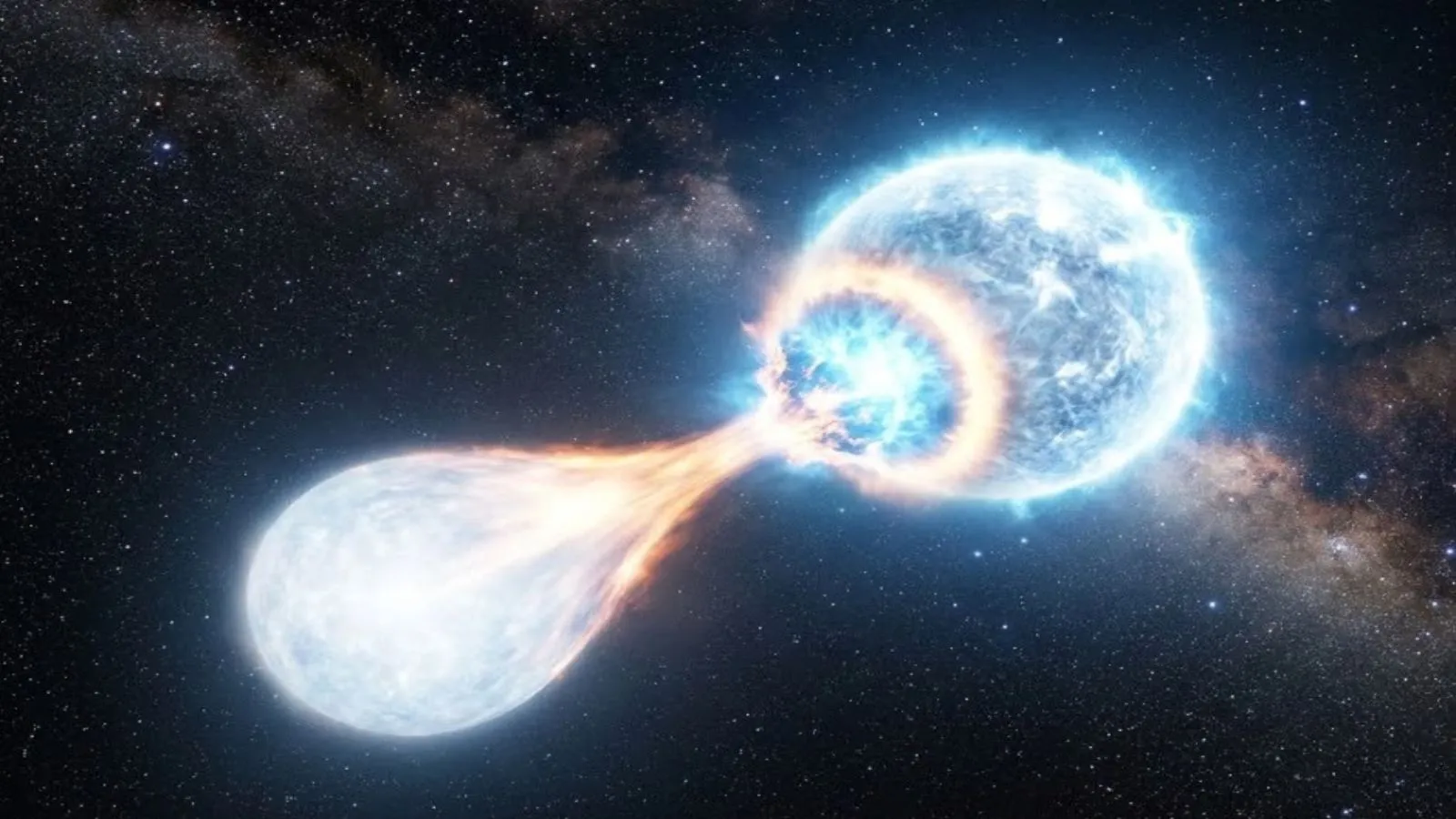
Two dead stars locked in an extraordinary orbit
White dwarfs are the dense remnants left behind after Sun-like stars exhaust their nuclear fuel and shed their outer layers. Although they are approximately Earth-sized, they can retain a substantial fraction of a star's mass, making them extraordinarily dense objects.
In the newly studied system, two such stellar remnants have ended up in an exceptionally tight binary. Rather than taking days, months or years to complete an orbit, the two white dwarfs circle their common centre of mass in just 374 seconds.
Such systems are known as ultracompact binaries and represent some of the most extreme stellar environments known. Their exceptionally short orbital periods also make them valuable laboratories for studying how compact stellar remnants evolve under intense gravitational forces.
What makes eRASSU J0608 particularly intriguing is that the stars are not simply orbiting each other at a remarkably fast pace. They are also moving progressively closer together.
A cosmic spiral driven by gravitational waves
The shrinking orbit is a crucial clue. As massive objects accelerate around one another, they can lose energy through gravitational radiation, sending ripples through spacetime known as gravitational waves.
In the case of eRASSU J0608, the loss of orbital energy and angular momentum is causing the two white dwarfs to spiral inward. As their separation decreases, their orbital motion becomes even faster, creating a self-reinforcing process that is expected to continue as the system evolves.
Astronomers tracked this orbital evolution over approximately three and a half years, combining new observations from the Einstein Probe mission and NASA's NICER telescope with earlier observations from the XMM-Newton observatory. This long observational baseline allowed researchers to measure how the binary's orbit was changing rather than simply capturing a snapshot of its behaviour.
The measured orbital decay is particularly striking because it is faster than that seen in two other well-known ultracompact white-dwarf systems, HM Cnc and V407 Vul. That places eRASSU J0608 among the most rapidly evolving systems of its kind currently known.
Why the six-minute orbit matters
The six-minute orbital period is more than an impressive astronomical statistic. It tells scientists that the two stellar remnants are extraordinarily close to one another.
At such a small separation, material from one white dwarf may be transferred directly onto the surface of its companion rather than first forming the conventional accretion disc often associated with interacting binary systems. This phenomenon is known as direct-impact accretion.
When the transferred material strikes the receiving white dwarf, it releases enormous amounts of energy and heats the stellar surface to temperatures exceeding one million degrees Celsius. The result is a powerful, pulsing X-ray signal that repeats in step with the binary's 374-second orbital period.
That X-ray behaviour effectively gives astronomers a cosmic clock. By monitoring the timing of the pulses over several years, researchers can detect tiny changes in the orbital period and determine whether the two stars are moving closer together.
The system could help test future gravitational-wave observatories
One of the most important implications of the discovery lies beyond conventional astronomy.
Gravitational waves were first directly detected a decade ago using ground-based observatories, opening an entirely new way of observing the universe. But different gravitational-wave frequencies reveal different classes of cosmic objects and events.
Future space-based observatories are expected to be particularly sensitive to the lower-frequency gravitational waves produced by compact systems such as double white dwarfs.
One of the most anticipated missions in this area is the European Space Agency's Laser Interferometer Space Antenna (LISA). Planned for launch in the next decade, LISA is designed to observe low-frequency gravitational waves from a variety of sources, including tightly orbiting stellar remnants.
eRASSU J0608 could be especially useful because its behaviour is both strong and predictable. Such systems can serve as verification sources, allowing scientists to check whether a space-based gravitational-wave detector is responding as expected to a known astrophysical signal.
The system's measured orbital decay has also enabled researchers to estimate a quantity called its chirp mass, which helps determine the strength of its gravitational-wave signal. The estimated chirp mass of eRASSU J0608 is about 0.43 times the mass of the Sun, placing it among the higher-mass systems known in this category.
From discovery to a future gravitational-wave target
The system was originally identified through the SRG eROSITA all-sky survey. Its unusual properties then prompted more detailed investigation using multiple X-ray observatories.
The combination of observations was critical. No single observation could provide the complete picture of how the binary was evolving. By comparing measurements collected at different times and with different instruments, researchers were able to establish that the orbital period was changing rapidly.
The Indian-led research therefore highlights the growing role of Indian astronomy in studying some of the universe's most extreme objects. The work also demonstrates how observations from multiple international missions can be combined to investigate phenomena that unfold over timescales far longer than a single observing session.
What happens next?
Despite the significance of the discovery, astronomers still have important questions to answer about eRASSU J0608.
The research team plans to continue monitoring the system with X-ray telescopes while also searching for a visible-light counterpart. Detecting such a counterpart could help scientists determine the system's distance and measure the masses of the two white dwarfs more accurately. Better measurements would, in turn, improve predictions of the gravitational-wave signal expected from the system.
The continued observations are particularly important because eRASSU J0608 appears to represent a fleeting stage in the evolution of compact stellar binaries. Systems like this do not remain in the same configuration indefinitely. Their loss of orbital energy gradually changes the system, making every additional observation an opportunity to understand how these extreme binaries evolve.
A rare window into stellar evolution
The discovery of eRASSU J0608 offers a striking reminder that stellar remnants are far from inactive after their parent stars die.
These two white dwarfs may no longer shine like ordinary stars, but their gravitational interaction is producing an extraordinary sequence of events: a six-minute orbit, million-degree temperatures, powerful X-ray pulses and a steadily shrinking separation.
For astronomers, the system is valuable precisely because all of these phenomena are connected. Its rapidly changing orbit provides evidence of gravitational-wave-driven evolution, while its predictable signal could eventually help space-based observatories validate their ability to detect low-frequency gravitational waves.
As observations continue, eRASSU J0608 could become more than an unusual binary discovered in distant space. It may serve as a natural laboratory for testing theories of compact-star evolution and, potentially, as one of the celestial signposts guiding the next era of gravitational-wave astronomy.
With input from agencies
Image Source: Multiple agencies
© Copyright 2026. All Rights Reserved. Powered by Vygr Media.