
 By
By 
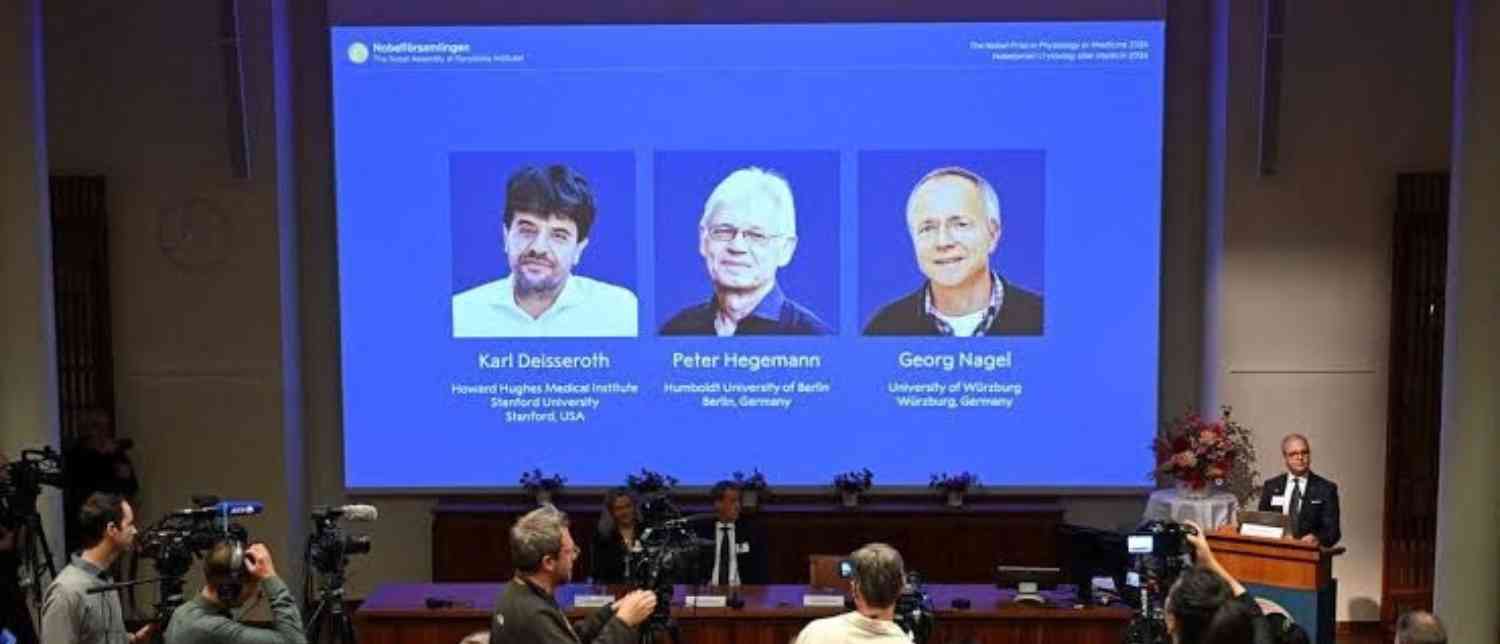
The 2026 Nobel Prize in Physiology or Medicine has been awarded to three scientists whose pioneering work has transformed the way researchers understand the brain. Karl Deisseroth, Peter Hegemann and Georg Nagel have jointly received the prestigious honour for their discoveries involving light-gated ion channels and optogenetics, a revolutionary technique that allows scientists to control the activity of nerve cells using light.
The breakthrough has opened a new chapter in neuroscience by giving researchers an unprecedented ability to switch specific neurons on or off and observe what happens inside a living brain. It has helped scientists investigate how neural circuits influence memories, emotions, behaviour and bodily functions, while also creating possibilities for treating neurological and psychiatric disorders.
The award was announced on October 5, 2026, marking the beginning of this year's Nobel Prize announcements. The recognition highlights decades of research that began with an apparently unusual question about how a tiny single-celled alga responds to light and eventually led to one of the most powerful tools in modern neuroscience.

What is optogenetics and why is it so important?
At its simplest, optogenetics is a method that combines genetics and light to control nerve cells.
For years, scientists could observe associations between different regions of the brain and particular behaviours. But seeing that a particular brain region was active during an action did not necessarily prove that the activity caused the action.
Optogenetics changed that.
The technique makes selected nerve cells sensitive to light. Researchers can then use carefully controlled pulses of light to activate or inhibit those cells and examine the resulting changes in brain activity or behaviour.
That ability to manipulate individual groups of neurons with remarkable precision has become a major advance in neuroscience. Instead of simply observing the brain, scientists can experimentally test how particular neural circuits work.
The Nobel recognition specifically honours discoveries that made it possible to demonstrate how nerve cells shape memories, feelings and behaviours in living brains.
The surprising beginning: an alga that responds to light
The story behind the 2026 Nobel Prize in Medicine began not in a neuroscience laboratory but with Chlamydomonas, a single-celled alga.
Peter Hegemann became interested in understanding how this microscopic organism senses light and uses it to guide its movement. During research in the early 2000s, Hegemann and Georg Nagel identified a light-sensitive protein known as channelrhodopsin.
The protein is embedded in the cell membrane. When exposed to blue light, it opens a channel that allows positively charged ions to pass through the membrane. This movement of ions generates an electrical signal.
The discovery was important because it demonstrated that light could directly control electrical activity in a cell.
Hegemann and Nagel subsequently showed that channelrhodopsins could function in other types of cells as well. By introducing the relevant algal genes into frog egg cells, they demonstrated that the proteins could convert light into electrical signals outside the organism in which they were originally found.
What initially appeared to be a discovery about how algae detect light would eventually become the foundation for a technology capable of manipulating neurons.
Karl Deisseroth turns the discovery into a brain-control tool
The next major step came from Karl Deisseroth, a neuroscientist associated with Stanford University and the Howard Hughes Medical Institute.
Deisseroth recognised the enormous potential of light-sensitive proteins for neuroscience. His work helped transform channelrhodopsin from a biological curiosity into a practical tool for controlling nerve cells.
In 2005, his research team introduced the gene for channelrhodopsin-2 into rat nerve cells grown in the laboratory. When exposed to blue light, those modified nerve cells generated electrical signals.
The breakthrough demonstrated that neurons could effectively be given a light-controlled switch.
Two years later, in 2007, Deisseroth and his team showed that the approach could work inside the brains of living mice. This was a crucial milestone in the development of optogenetics as a powerful neuroscience technique.
The implications were enormous. Scientists could now target specific populations of neurons and control their activity with pulses of light, allowing them to investigate how individual neural circuits contribute to behaviour.

How optogenetics is helping scientists understand the brain
The human brain contains an extraordinary network of interconnected nerve cells. Understanding how these networks produce thoughts, memories, emotions and behaviour has been one of the biggest challenges in modern science.
Optogenetics has provided researchers with a much more precise way to investigate those networks.
Scientists have used the technique to study neural circuits involved in pain, thirst, hunger, social behaviour, reward and attention. It has also become an important research tool for examining neurological and psychiatric conditions.
The technology is particularly valuable because it can help researchers move beyond simply identifying where activity occurs in the brain.
For example, if a particular group of neurons becomes active when an animal performs a specific behaviour, researchers can use optogenetics to stimulate those cells and determine whether that stimulation produces the behaviour.
That ability to investigate cause and effect has helped reshape modern brain research.
Potential medical applications of optogenetics
Although optogenetics remains primarily a research technology, its potential medical applications have generated significant interest.
One of the most promising areas is vision restoration.
Researchers are exploring optogenetic approaches that could potentially help people with severe visual impairment by making surviving retinal cells responsive to light. Such approaches aim to bypass damaged parts of the visual system and restore some ability to detect visual information.
The technology is also being investigated for improving the precision of cochlear implants, which are used to help people with severe hearing loss.
Beyond vision and hearing, the precision offered by optogenetics has raised possibilities for studying and eventually developing better treatments for neurological and psychiatric disorders. Researchers are investigating neural circuits associated with conditions including epilepsy, Parkinson's disease, Alzheimer's disease, schizophrenia and other disorders.
However, these potential applications should not be mistaken for established treatments. Much of the work remains at the research and experimental stage, and considerable scientific and clinical challenges must still be addressed before many optogenetic approaches can become routine medical therapies.
Who are the three Nobel laureates?
Karl Deisseroth
Karl Deisseroth, born in Boston in 1971, is a professor at Stanford University and is associated with the Howard Hughes Medical Institute.
His research has focused on developing technologies that allow scientists to understand how specific nerve cells and neural circuits operate in living brains.
His contribution to optogenetics was particularly important because he helped turn light-sensitive proteins into a practical method for controlling neuronal activity.
Peter Hegemann
Peter Hegemann, born in Münster, Germany, in 1954, is a neuroscientist at Humboldt University of Berlin.
His interest in how the single-celled alga Chlamydomonas detects light led to the discovery of the light-sensitive proteins that became central to optogenetics.
His work provided the biological foundation that eventually allowed scientists to manipulate nerve cells with light.
Georg Nagel
Georg Nagel, born in Weingarten, Germany, in 1953, is a professor at the University of Würzburg.
Working with Hegemann, Nagel played a key role in establishing that channelrhodopsins function as light-gated ion channels and can convert light into electrical signals in cells.
That discovery proved critical to the later development of light-controlled neural technologies.
From pond algae to a new era of neuroscience
Perhaps the most striking aspect of the 2026 Nobel Prize in Medicine is the unlikely path taken by the research.
A question about how a microscopic organism responds to light ultimately helped scientists develop a method for controlling nerve cells inside living brains.
That journey illustrates the importance of fundamental research. The original investigations were not necessarily aimed at creating a technology for treating neurological disease. Instead, researchers were trying to understand how a simple organism senses its environment.
Years later, those discoveries became the foundation for a technique that has changed neuroscience.
The Nobel Committee described the laureates' work as laying the foundation for a new era in neuroscience, reflecting how dramatically optogenetics has expanded scientists' ability to investigate the brain.
Why the 2026 Nobel Prize matters
The Nobel Prize in Medicine 2026 is not simply recognition for the discovery of a new laboratory technique. It represents a major shift in how scientists can study one of biology's most complicated systems.
The brain contains billions of neurons communicating through extraordinarily complex networks. Understanding how those networks produce memory, emotion and behaviour requires tools capable of operating with exceptional precision.
Optogenetics provides one such tool.
By giving scientists the ability to control selected nerve cells with light, the work of Deisseroth, Hegemann and Nagel has made it possible to ask more precise questions about the living brain.
The full medical potential of the technology is still being explored. But its influence on neuroscience is already substantial.
The 2026 Nobel Prize therefore recognises a scientific journey that began with a light-sensitive protein in a single-celled alga and evolved into a technology capable of illuminating some of the deepest mysteries of the human brain.
© Copyright 2026. All Rights Reserved. Powered by Vygr Media.