 By
By 
NASA has invited the Indian Space Research Organisation (ISRO) to join its ambitious Moon Base programme, opening a new chapter in India-US cooperation in space. The proposal comes as NASA moves from simply returning astronauts to the Moon towards building the infrastructure required for a sustained human presence near the lunar South Pole.
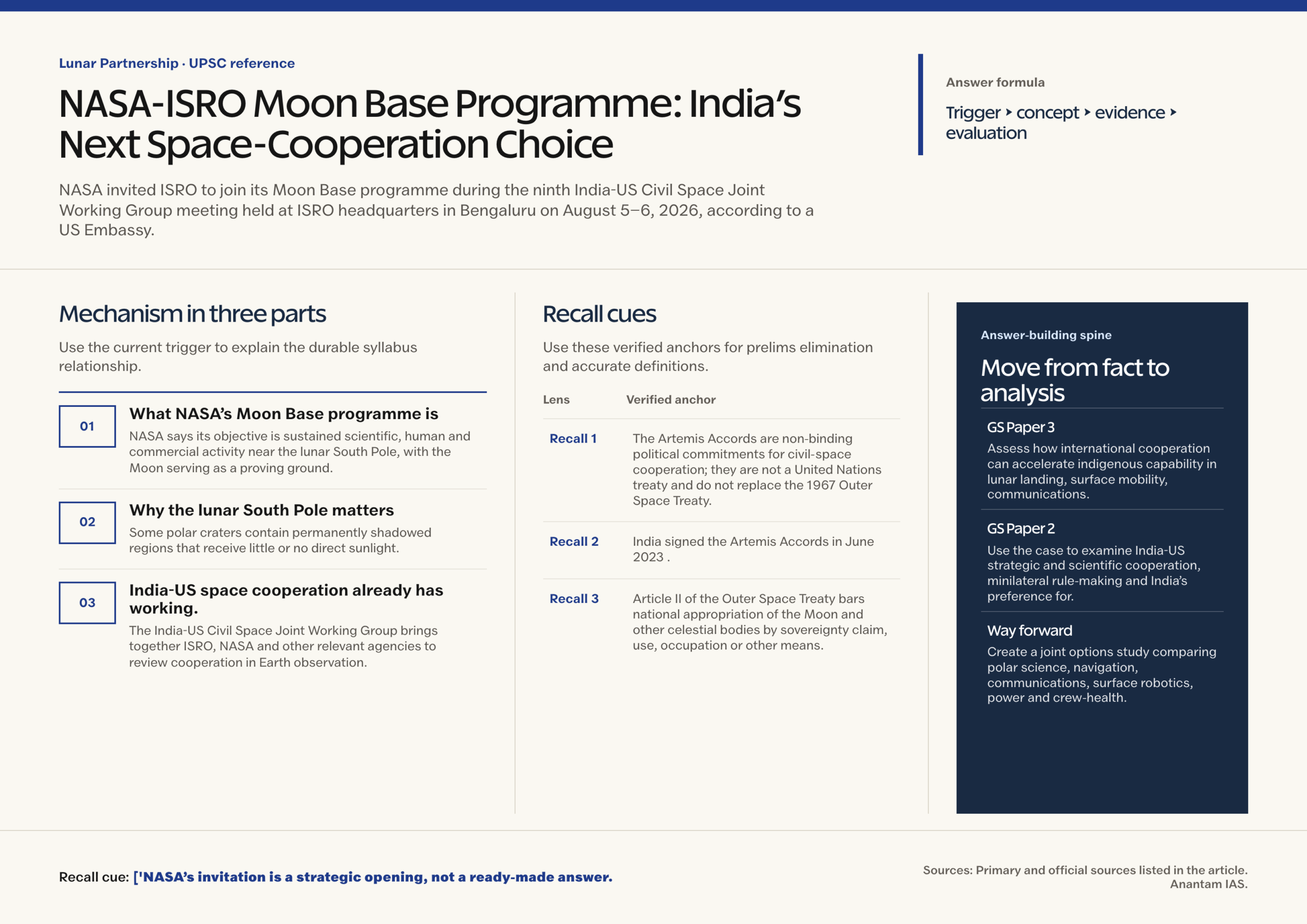
The invitation was extended during the ninth meeting of the India-US Civil Space Joint Working Group (CSJWG), held at ISRO headquarters in Bengaluru on August 5 and 6. According to a joint statement released by the two sides, NASA invited ISRO to participate in the Moon Base programme, building on the partnership established under the Artemis Accords.
For India, the development is significant not merely because it involves another Moon mission. It potentially places ISRO inside a much larger international effort aimed at developing technologies, infrastructure and scientific capabilities for long-duration lunar exploration.
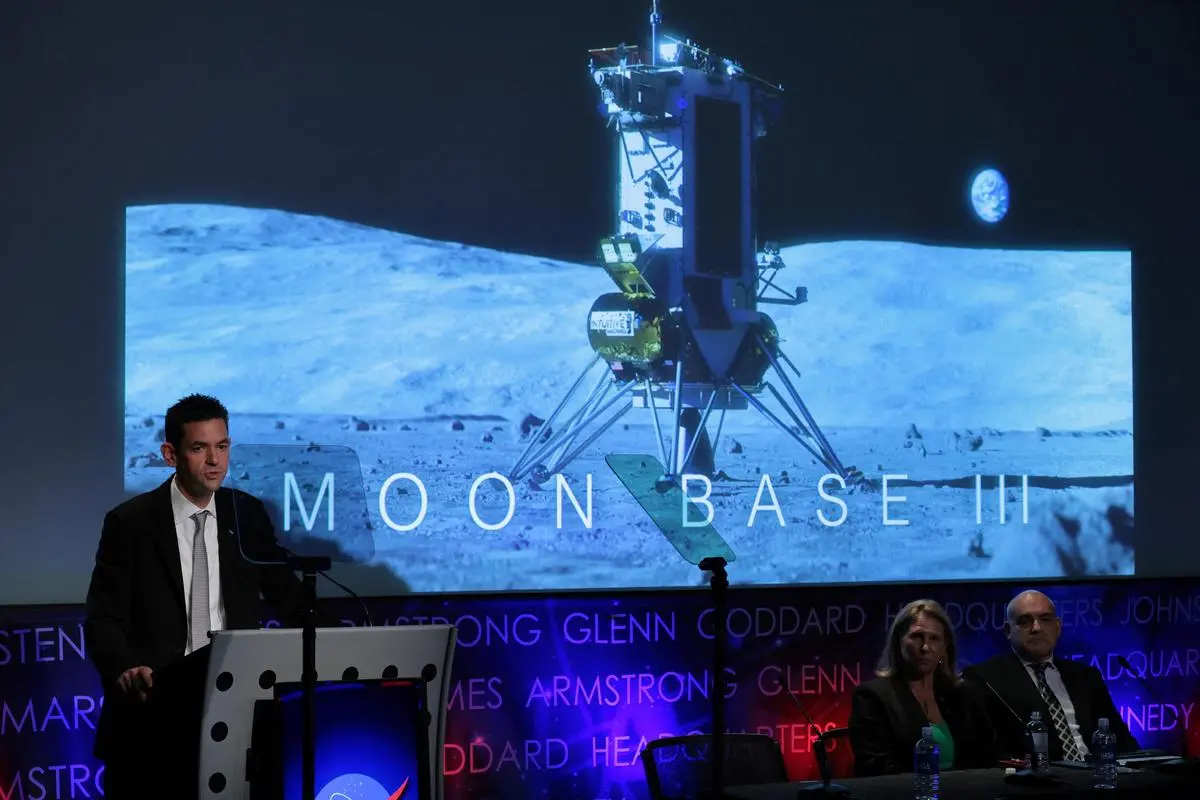
NASA Moon Base: What is the programme?
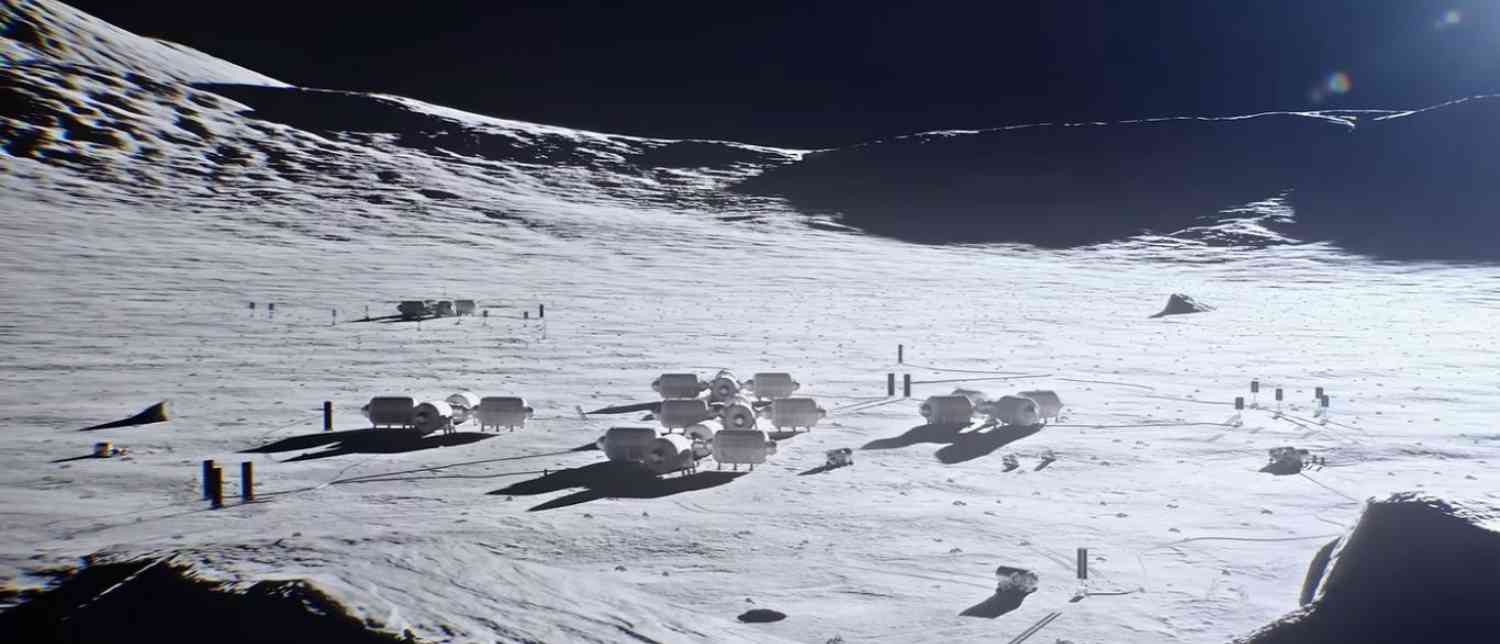
NASA's Moon Base programme is designed to establish an enduring human presence near the lunar South Pole. Rather than attempting to build a complete lunar settlement in one mission, NASA plans to develop the outpost progressively through a combination of robotic and crewed missions.
NASA describes the effort as a phased approach. Robotic missions will first test technologies and study the lunar environment, followed by the gradual deployment of infrastructure and systems needed to support astronauts living and working on the Moon.
The proposed Moon Base will not simply be a collection of habitats. NASA's plans involve an interconnected network of transportation, power, communications, habitation, logistics and cargo-delivery systems. Lunar vehicles, autonomous robots and technologies capable of operating in the harsh surface environment will also be critical to the project.
The location is equally important. NASA plans to establish the base near the lunar South Pole, an area considered particularly valuable for scientific exploration and future resource utilisation. However, the region also presents severe engineering challenges, including extreme temperatures, rugged terrain and permanently shadowed craters.
Why does NASA want a Moon Base?
The Moon Base is intended to serve several purposes beyond establishing a permanent foothold on the lunar surface.
For NASA, the Moon is a proving ground for technologies and operational techniques that could eventually be used for human missions to Mars. The agency describes the Moon as a gateway to deeper exploration because it is relatively close to Earth while still presenting many of the challenges associated with deep-space operations.
A sustained lunar presence could also expand scientific research. The Moon preserves clues about the history of Earth and the solar system, and its environment provides opportunities for experiments that cannot easily be replicated on Earth.
NASA's current Moon Base strategy also places substantial emphasis on commercial companies and international partners. The agency says Artemis Accords signatories can contribute technology demonstrations, scientific payloads and foundational infrastructure during different phases of the Moon Base build-up.
That makes India's invitation particularly relevant.
What does the NASA invitation mean for ISRO?
At present, the two countries have not publicly specified which particular Indian systems, technologies or missions could eventually contribute to the Moon Base. The invitation therefore should not be interpreted as an announcement of a specific ISRO lunar mission or an immediate Indian commitment to build part of the base.
Instead, it signals an opportunity for India to participate in a wider framework of international lunar cooperation.
Business Standard reported that the two sides also agreed to advance discussions on open scientific data sharing under the Artemis Accords. They discussed expanding civil and commercial space cooperation, as well as pursuing future partnerships in space science and human-spaceflight technologies.
This could prove important because India's space programme has developed considerable experience in lunar exploration, particularly through the Chandrayaan missions. The invitation could provide another avenue for ISRO to apply that expertise to a much broader international programme.
India and the Artemis Accords
India's involvement in the Moon Base discussion is rooted in its decision to join the Artemis Accords.
India signed the Artemis Accords on June 21, 2023, becoming the 27th signatory. The accords provide principles and guidelines intended to support cooperation in the civil exploration and use of outer space.
However, there is an important distinction between signing the Artemis Accords and participating directly in NASA's Artemis programme.
The Indian government stated in Parliament in 2025 that India had signed the accords but was not then a participant in the NASA-led Artemis programme. It also said ISRO would explore possibilities for future participation.
The latest invitation suggests that this relationship is now moving towards a potentially more concrete level of cooperation around lunar infrastructure.
A partnership built beyond a single mission
India and the US have already demonstrated that their space cooperation can extend across complex missions.
One of the most prominent examples is the NASA-ISRO Synthetic Aperture Radar (NISAR) mission. The two agencies worked together on the Earth-observation satellite, which combines NASA and ISRO technologies and capabilities. The mission's successful launch has now become another foundation for discussions about future cooperation.
The two countries are also pursuing cooperation in human spaceflight. India's broader human-spaceflight programme, Gaganyaan, and its planned collaboration with NASA and commercial partners have created another area for technological exchange.
Against this background, the Moon Base invitation appears less like an isolated development and more like the next step in a relationship that has gradually expanded from individual scientific projects towards broader space capabilities.
Why the lunar South Pole matters
The lunar South Pole has become one of the most important destinations in the new era of Moon exploration.
NASA's planned base is targeted at the region because it offers major scientific and exploration opportunities. Some permanently shadowed areas could contain water ice, while variations in illumination and terrain create both opportunities and challenges for future operations.
But building there will require technology capable of functioning in conditions that are dramatically different from those on Earth.
NASA is therefore developing systems for reliable power, autonomous robotics, lunar-dust mitigation, communications, transportation and surface operations. These technologies will form the practical foundation of a future lunar outpost.
For ISRO, participation could offer access to a large international ecosystem in which Indian technologies and scientific instruments could potentially be tested in an environment that is central to the future of human space exploration.
What could India gain?
The most immediate potential benefit is technological and scientific.
Participation in a major international lunar programme could expose Indian researchers and engineers to new areas of deep-space infrastructure, surface mobility, communications, habitation and resource utilisation. It could also create opportunities for Indian scientific instruments and experiments to operate alongside those developed by NASA and other international partners.
There could be a broader strategic benefit as well.
India has increasingly positioned itself as a major spacefaring nation, with achievements such as Chandrayaan-3's successful lunar landing demonstrating its ability to conduct sophisticated lunar missions. Greater participation in international lunar exploration could strengthen India's role in shaping the future of space exploration rather than simply observing it from the sidelines.
At the same time, the exact terms of India's participation remain to be worked out. Neither the joint statement nor the reports announcing the invitation specify a particular Indian contribution, funding arrangement or mission schedule. Those details will be crucial in determining the practical scale of ISRO's involvement.
Moon Base is about more than the Moon
NASA's vision ultimately extends well beyond establishing a permanent lunar outpost.
The agency views sustained lunar exploration as preparation for future deep-space missions, including human missions to Mars. Living and working for extended periods near the lunar South Pole would allow NASA and its partners to test technologies, procedures and operational models before attempting journeys much farther from Earth.
That makes the proposed collaboration potentially important for India too.
If ISRO becomes an active contributor to the Moon Base programme, India's involvement could help build capabilities that have applications far beyond lunar exploration. Advanced robotics, autonomous systems, life-support technologies, communications, navigation and resource-utilisation techniques could all become relevant to future deep-space missions.
For now, the NASA invitation is the beginning of a conversation rather than the conclusion of a deal. But it represents a notable shift in the trajectory of India-US space cooperation.
The Moon Base itself is still being assembled step by step, with NASA and its partners developing the robotic missions, landers, vehicles and infrastructure needed to make a sustained lunar presence possible.
India now has an opportunity to become part of that effort.
If the two countries translate the latest invitation into concrete projects, the partnership could take India-US space cooperation from Earth observation and individual missions to a far more ambitious frontier: building the infrastructure for humanity's long-term return to the Moon.
With input from agencies
Image Source: Multiple agencies
© Copyright 2026. All Rights Reserved. Powered by Vygr Media.