 By

In her new memoir ‘Belonging: A Journey of Love’, the former Congress chief describes a conversation in which the late President suggested it was “time for a change at the top”.
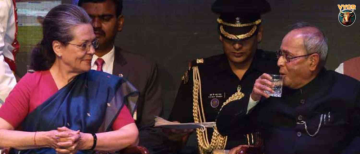
Pranab Mukherjee, the late former President and one of the Congress party’s most experienced leaders, once hinted at his wish to become Prime Minister, according to a new memoir by Sonia Gandhi. She writes that the remark came during a conversation in 2010, and that it took her by surprise.
Belonging: A Journey of Love, a 526-page book, reached bookstores on Tuesday, November 10. In it, Gandhi describes how the UPA government worked in practice, rejects the charge that she was a “back seat driver”, and recalls the moment Mukherjee raised the subject of leadership.
(A correction to the framing in some summaries: in 2010, Sonia Gandhi was the Congress president and UPA chairperson, not a spokesperson.)
The 2010 Conversation
Gandhi writes that she and Mukherjee, whom she always called “Pranab ji”, often spoke after party meetings. Members of the Strategy Group, which met to plan the party’s approach in Parliament, would sometimes stay back for a chat.
On one such occasion in 2010, she recalls, Mukherjee was frustrated over big differences with P Chidambaram, a senior colleague in the Union Cabinet. After expressing that frustration, he shocked her by saying that perhaps it was time for a change at the top. Gandhi writes that she took this as a hint of his long-held desire to become Prime Minister.
How Sonia Gandhi Reacted
She did not take up the subject. Gandhi says she gently changed the conversation. She adds that Mukherjee may have been disappointed but never made her feel that he held it against her.
She also points out that the Congress later nominated Mukherjee as the UPA’s candidate for President in 2012, and that he was elected. She writes that she often called on him afterwards, mostly to talk with a learned and knowledgeable politician.
Mukherjee’s Own Account
Mukherjee’s own writing shows that the Prime Minister’s post was on his mind at key moments. In his memoirs, he wrote that he was reluctant to join the government in 2004 after Gandhi declined the Prime Minister’s post and chose Manmohan Singh, who had once been his junior. He joined at Gandhi’s insistence, and he later wrote that Singh came to rely on him on important issues.
He also described the 2012 presidential nomination. After a meeting with Gandhi on June 2, 2012, he came away with a vague impression that she might prefer to make Singh the presidential candidate. That, he thought, could open the way for him to become Prime Minister. He recalled that she told him he was eminently suited for the highest office but should not forget the crucial role he played in the government.
The “Unspoken Division of Responsibility”
The Mukherjee anecdote appears in a part of the book that describes how Gandhi and Singh divided their work. She describes an “unspoken division of responsibility”: the government under Manmohan Singh and the party under her. A core group met weekly with the Prime Minister to coordinate the two sides. Its members were Mukherjee, Arjun Singh, A K Antony and Ahmed Patel.
Rejecting the “Back Seat Driver” Label
A large part of the passage deals with the claim that Gandhi, as party chief, was the real power behind the government. She writes that she was clear that Singh was the Prime Minister. As party president, she could give him her views or differ with him, but she saw it as her duty to defer to him. She says she was determined never to cause a misunderstanding that would please the party’s opponents and weaken the government.
Gandhi also refers to a book published about a decade later by one of Singh’s former aides, which repeated the allegation that she sent for files from the Prime Minister’s Office, interfered in administration and influenced key appointments. She calls the allegations malicious and totally false, and says the charge about files distressed her most. She writes that the PMO issued a statement categorically denying that official files were ever shown to her.
She also cites the reaction of Singh’s daughter, Upinder Singh, who called the aide’s book a betrayal of trust and said her father’s relationship with Gandhi was one of mutual trust and respect. Gandhi adds that the opposition and the media nevertheless looked for every chance to push the “back seat driver” story.
Why the Anecdote Matters
Mukherjee, who died on August 31, 2020, at the age of 84, was a central figure in Congress governments for decades. He worked closely with Indira Gandhi and was regarded as the clear number two in Singh’s cabinet. Gandhi’s account adds a personal detail to a question that has long been discussed in political circles: whether Mukherjee felt overlooked for the top job. Her version is that he made a brief, indirect remark, that she did not pursue it, and that their relationship remained cordial.
What to Watch Next
As the book circulates, readers and political observers will look for further details about the UPA years, the party’s internal discussions and Gandhi’s relations with colleagues. Mukherjee’s family and the Congress have not been reported as responding yet to this particular anecdote.
© Copyright 2026. All Rights Reserved. Powered by Vygr Media.