 By
By 
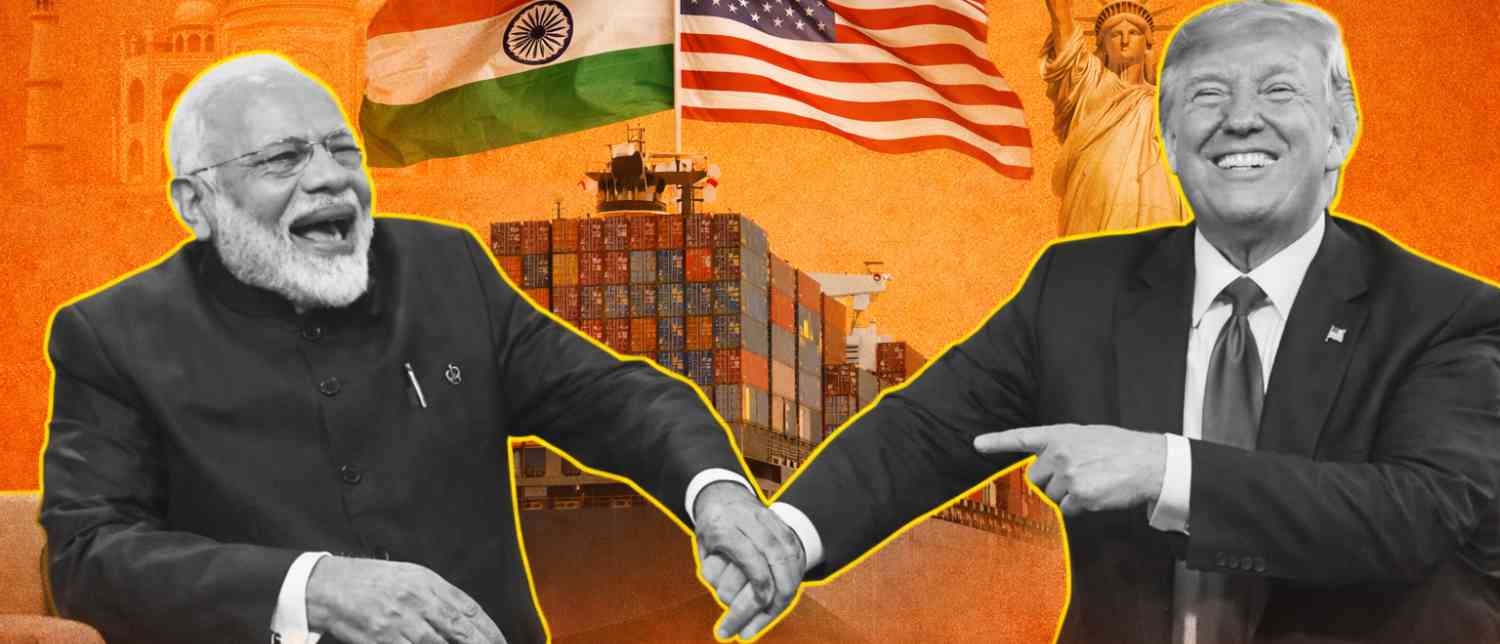
When US President Donald Trump announced that Washington had slashed tariffs on Indian goods to 18 per cent, it was framed as a decisive breakthrough—an abrupt end to months of public sparring, policy whiplash, and tariff brinkmanship. For India, the relief was immediate. For markets, the response was euphoric. For analysts and diplomats, however, the announcement raised more questions than it answered.
This was not merely a trade deal. It was a political signal, a geopolitical adjustment, and possibly a strategic recalibration driven as much by global competition as by bilateral economics. To understand what the India–US trade deal truly represents—and what it does not—it must be read alongside India’s expanding trade diplomacy, particularly its recently concluded free trade agreement (FTA) with the European Union, and through the prism of sectors, markets, and global power shifts.
The Announcement That Spoke in Headlines, Not Footnotes
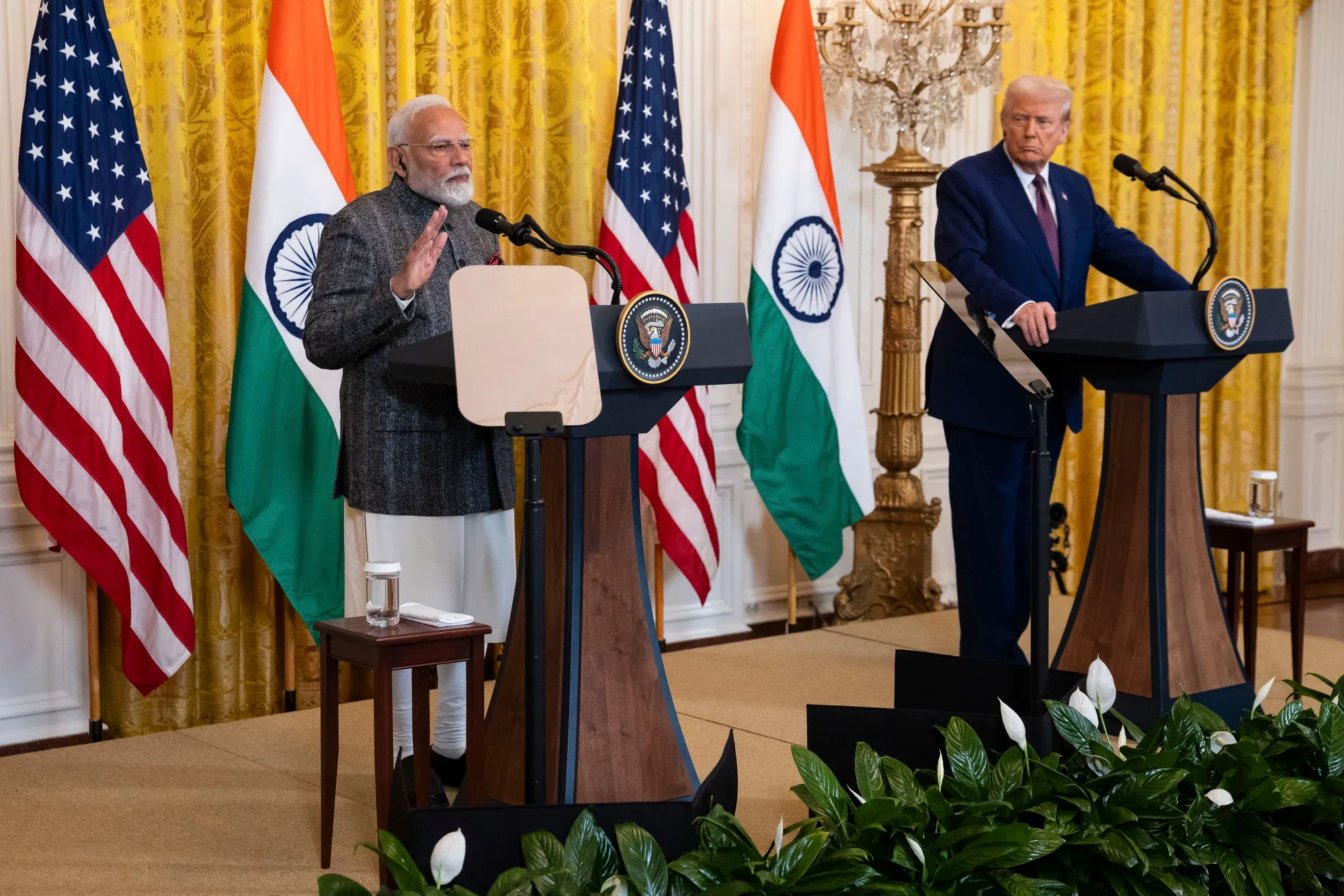
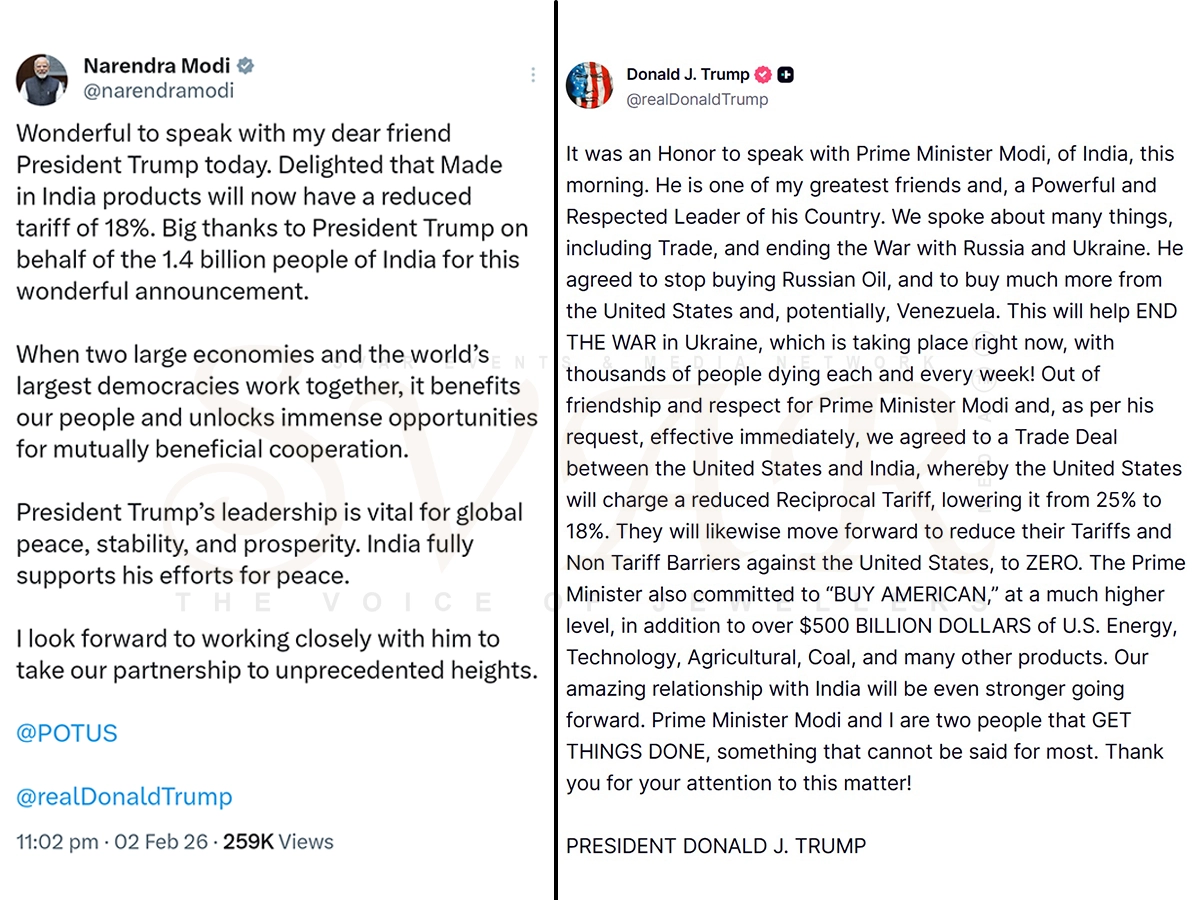
Trump’s declaration was sweeping. He claimed India had agreed to reduce both tariff and non-tariff barriers “to zero,” halt purchases of Russian oil, and buy over $500 billion worth of American goods—ranging from energy and technology to agricultural products and coal. The US, in return, would cut reciprocal tariffs on Indian exports from 25 per cent to 18 per cent.
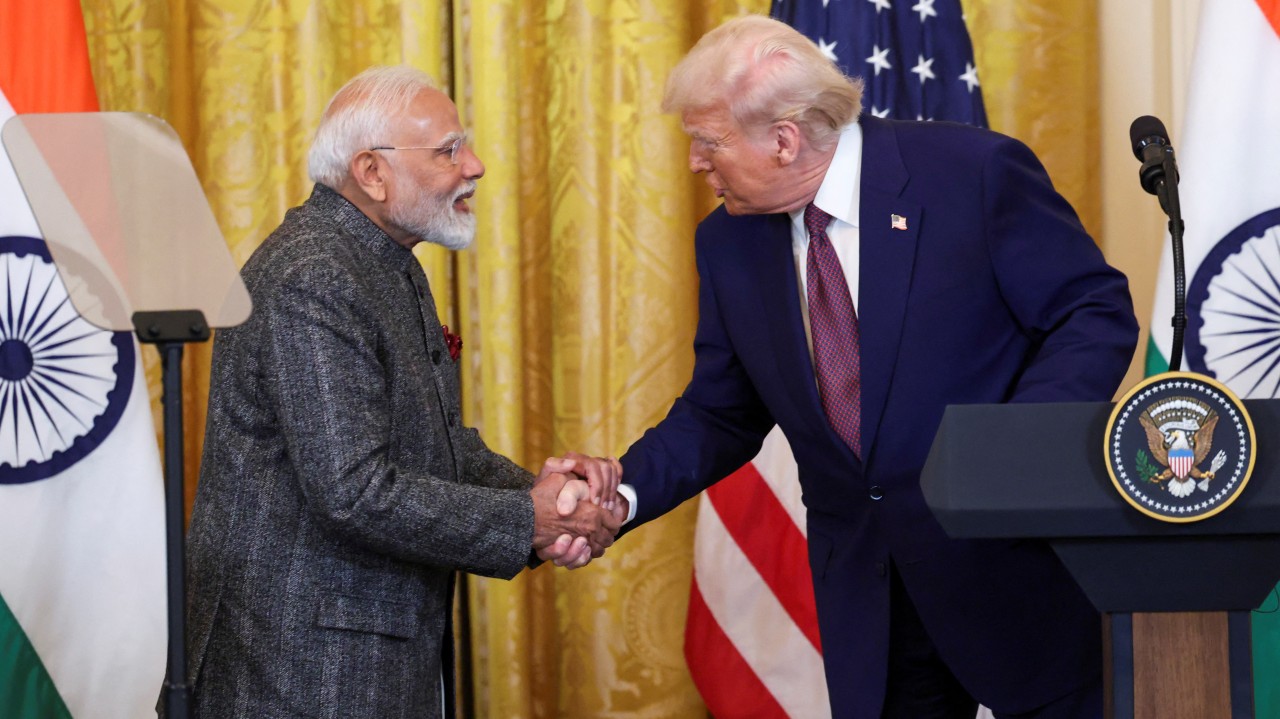
Prime Minister Narendra Modi welcomed the tariff reduction enthusiastically, thanking Trump on behalf of 1.4 billion Indians and highlighting the opportunities unlocked when the world’s two largest democracies cooperate. Notably, Modi’s public response avoided mention of any conditions outlined by Trump. There was no confirmation of zero tariffs, no reference to Russian oil, and no elaboration on the $500 billion figure.
That silence was not accidental. It reflected the core ambiguity of the deal.
What “Zero Tariff Barriers” Actually Means
Tariff barriers are explicit taxes on imports. Non-tariff barriers are more subtle: quotas, licensing rules, labelling requirements, standards, subsidies, and procedural delays that affect market access and pricing without direct taxation. Trump’s assertion that India would reduce both to zero was dramatic—but unverified.
New Delhi has not confirmed any across-the-board elimination of tariffs or non-tariff barriers. Analysts widely interpret Trump’s language as an in-principle commitment to lower or phase out duties on select US products, not a wholesale dismantling of India’s trade defences.
Crucially, neither side has clarified which product lines would see zero tariffs, over what timeline, or under what enforcement mechanism. Without a joint statement or negotiated text, the announcement remains more political than contractual.
Agriculture: The Red Line That Still Holds
Nowhere is the uncertainty more pronounced than in agriculture. As part of long-running India–US FTA discussions—revived after Modi’s visit to Washington in February 2025—the United States has repeatedly pushed for greater access to India’s agricultural and dairy markets. India has consistently refused, citing political sensitivity and farmer livelihoods.
Economist Biswajit Dhar voiced a concern shared by many observers: while the Indian government had committed not to opening agriculture, Trump’s claims suggested that the US might be gaining access. So far, however, India has not publicly indicated any willingness to liberalise these sectors.
That distinction matters. Trade liberalisation in agriculture is not merely an economic decision in India—it is a political fault line.
The $500 Billion Question
Trump’s claim that India would purchase $500 billion worth of US goods has also drawn scepticism. Ajay Srivastava of the Global Trade Research Initiative pointed out that India currently imports less than $50 billion annually from the US. Without timelines, sectoral breakdowns, or enforcement clauses, the figure looks aspirational rather than binding.
Until clarity emerges, Srivastava cautions, the deal should be seen as a political signal—not a final agreement. Celebration, he argues, should give way to caution.
Domestic Politics: Celebration, Cynicism, and Counterclaims
Inside India, the deal has ignited sharp political debate. Commerce and Industry Minister Piyush Goyal defended the agreement as the “best in the neighbourhood,” highlighting that India’s 18 per cent tariff rate is among the lowest imposed by the US—far below China’s 37 per cent and lower than Bangladesh’s 20 per cent and Pakistan’s 19 per cent.
Goyal dismissed opposition criticism, particularly from Congress leader Rahul Gandhi, who alleged that Prime Minister Modi had signed the deal under pressure. Goyal accused Gandhi of misleading the public and questioned whether he resented India’s progress.
The opposition, meanwhile, has characterised the agreement as disproportionately favouring the US and questioned why Trump announced it first. Goyal’s response was blunt: since the US imposed reciprocal tariffs, it was only logical that Washington announce their removal.
Russian Oil: Assertion, Adjustment, or Ambiguity?
Trump’s assertion that India would stop buying Russian oil adds another layer of complexity. Neither India nor the US has issued details on such a commitment. The Kremlin, for its part, said it had not heard from India about halting purchases.
India’s position remains consistent: energy decisions are driven by price, market forces, diversification, and energy security. This framework offers New Delhi political latitude—and avoids explicit commitments that could constrain strategic autonomy.
Mukesh Aghi, CEO of the US India Strategic Partnership Forum, described the issue as one of adjustment, not compromise. India, he suggested, may gradually reduce Russian imports while increasing purchases from the US and other suppliers like Venezuela—but not overnight.
Markets React, but Sectors Read Carefully
If politics was divided, markets were unequivocal. Indian stock markets opened on February 3 with historic gains. The Sensex surged as much as 3,656 points—around 4.5 per cent—while the Nifty jumped nearly 5 per cent. Export-linked and manufacturing stocks led the rally, reflecting investor relief and optimism.
Indian IT stocks also rallied, with major companies rising 5–7 per cent intraday before closing 1–2 per cent higher. ADRs of Infosys and Wipro gained 4.32 per cent and 6.75 per cent, respectively.
Yet beneath the rally, industry executives struck a measured tone.
IT’s Reality Check: Sentiment Up, Fundamentals Unchanged
The India–US deal does not directly affect the IT services sector. It does not address work visas, cross-border data flows, digital trade rules, or outsourcing norms—the issues that materially shape IT exports. Billing structures, delivery models, and pricing dynamics remain unchanged.
With the US accounting for 55–60 per cent of revenues for large Indian IT firms—and nearly half for companies like TCS—macro conditions and enterprise spending cycles matter far more than tariff headlines.
Still, the deal has lifted sentiment. Analysts note that uncertainty around US trade policy had frozen discretionary spending for four to six quarters. While order inflows continued, deal conversions and project execution were delayed.
The December quarter showed early signs of stabilisation. Greater clarity on bilateral trade policy, analysts say, could encourage clients to firm up budgets and move beyond routine projects.
Indirect Gains and the China-Plus-One Effect
Beyond IT, indirect opportunities loom. Deeper cooperation in manufacturing, supply chains, and strategic technologies typically drives demand for enterprise software, cloud migration, engineering services, and industrial digitalisation.
Mukesh Aghi underscored India’s tariff advantage over China and other Asian hubs. Components from China entering the US face tariffs as high as 34 per cent. India’s 18 per cent rate dramatically alters the math for companies pursuing a “China-plus-one” strategy.
That shift is already visible. India hosts over 2,000 Global Capability Centers, 60 per cent of them American, engaged in high-end R&D. Over the past two years, these centres have generated more than 300,000 intellectual property filings.
Apple’s trajectory illustrates the trend. Once a negligible market, India now generates over $9 billion in Apple’s domestic revenue, with exports surging as iPhone production increasingly shifts to India.
The EU Factor: Why Timing Matters
To understand Trump’s sudden reversal, one must look beyond Washington—to Brussels.
India’s recently concluded FTA with the European Union has reshaped the strategic landscape. The EU is already India’s largest trade partner in goods and second-largest overall. With an FTA, two-way trade is set to expand significantly, including in select services.
The agreement grants India zero or progressively reduced tariffs in labour-intensive sectors such as textiles, leather, footwear, gems, and jewellery—areas hit hard by the earlier 50 per cent US tariffs. While benefits will kick in only after ratification—likely within a year—the playing field is being decisively levelled.
Bangladesh, Vietnam, and Pakistan—previously enjoying preferential EU access—now face new competition from India.
Unlike the US, the EU respected India’s red lines. Agriculture and dairy were excluded. Instead of weaponising tariffs, Europe used tariff reductions as leverage for reciprocal concessions.
That contrast matters.
FOMO, Not Friendship?
Trump’s earlier strategy relied on coercion—raising tariffs to extract concessions. The India–EU pact blunted that approach. It demonstrated that India had alternatives, and that in a fractured global trading system, FTAs—not unilateral pressure—were the currency of influence.
US officials were openly unhappy. Treasury Secretary Scott Bessent criticised Europe for not imposing tariffs on India over Russian oil—and accused it of indirectly funding Russia by buying refined oil from India.
Yet the reality is that Trump’s own trade volatility has pushed both India and Europe to diversify partnerships. Europe, rattled by US unpredictability—from Ukraine negotiations over its head to territorial rhetoric over Greenland—has paused its own US trade talks.
Beyond Trade: Mobility, Defence, and a New Order
The India–EU partnership extends beyond commerce. A new Comprehensive Framework of Cooperation on Mobility aims to ease restrictions on Indian students and workers in Europe—sharply contrasting with tightening US H-1B visa norms.
The two sides have also signed their first Security and Defence Partnership, covering maritime security, cyber threats, space security, defence technology, and counter-terrorism. India is negotiating Rafale aircraft with France and submarines with Germany, and could potentially tap EU defence funds and R&D programmes.
As Europe seeks strategic autonomy amid doubts over NATO’s future, India finds new avenues for defence manufacturing and joint development—advancing its own atmanirbharta goals.
The Bigger Picture: Diplomacy in an Uncertain World
Seen in this light, the India–US trade deal is less a triumph of personal chemistry and more a reflection of shifting global realities. India has negotiated with confidence, concluding FTAs with the UK, EFTA, Australia, the UAE, New Zealand, Oman, and now the EU—while reviving talks with Canada and negotiating with Chile, Peru, and Israel.
January and February 2026 may well mark a turning point. Markets have responded with optimism. Exporters see opportunity. Cynics warn of hype.
Both can be right.
The deal does not magically erase structural challenges, nor does it guarantee $500 billion in trade. But it signals something important: India is no longer negotiating from a corner. In a world where trade is increasingly shaped by power and politics, having options is leverage.
When diplomacy trumps cynicism, it is not because optimism is blind—but because strategy is finally being rewarded.
*Views expressed in the above piece are personal and solely those of the author. They do not necessarily reflect Vygr’s views.
With inputs from agencies
Image Source: Multiple agencies
© Copyright 2025. All Rights Reserved. Powered by Vygr Media.