
 By
By 
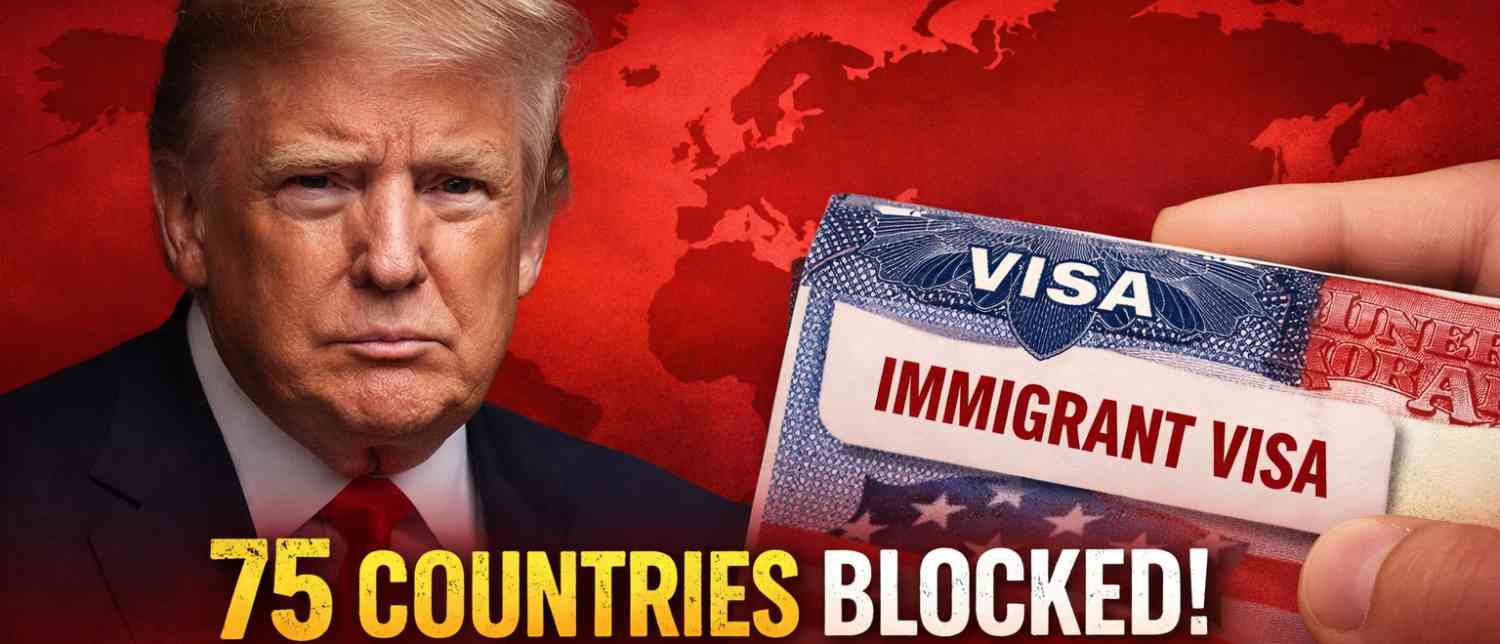
In one of the most sweeping immigration actions of Donald Trump’s renewed presidency, the United States has indefinitely suspended immigrant visa processing for citizens of 75 countries across Africa, Asia, Latin America, the Middle East, and Eastern Europe. The decision, which takes effect from January 21, marks a significant escalation in the administration’s broader effort to tighten legal immigration pathways and enforce stricter eligibility standards for permanent residency in the US.
The suspension applies exclusively to immigrant visas—those sought by individuals intending to live and work permanently in the United States. Tourist visas, business travel, student visas, and other temporary categories remain unaffected, at least for now. However, the move is already expected to have far-reaching consequences, particularly for family-based immigration and reunification cases.
Countries such as Pakistan, Bangladesh, Somalia, Russia, Iran, Afghanistan, Brazil, Nigeria, and Thailand are among those impacted by the decision, which US officials describe as an indefinite “pause” pending a comprehensive reassessment of visa screening procedures.
What the Visa Freeze Means—and Who It Affects
Under the new directive issued by the US State Department, consular officers worldwide have been instructed to halt the processing of immigrant visas for nationals of the listed countries. Even in cases where an immigrant visa has already been approved but not yet printed, officers are required to formally refuse the application.
The restriction does not apply to:
-
Tourist or business visas
-
Temporary work visas
-
Travel related to major international events, including this year’s FIFA World Cup
That said, the Trump administration has reiterated that all visa applicants, regardless of category, will continue to face enhanced scrutiny, including detailed reviews of their social media activity.
The freeze is expected to disproportionately affect family-sponsored immigration, preventing spouses, children, parents, and other immediate relatives—many of whom would otherwise qualify for lawful permanent residency—from completing the immigration process.
Why the US Suspended Immigrant Visas for 75 Countries
According to the State Department, the decision is rooted in a stricter interpretation and enforcement of the “public charge” provision of US immigration law. This long-standing rule allows immigration authorities to deny entry to applicants deemed likely to become dependent on government welfare or public benefits.
State Department spokesperson Tommy Pigott defended the move, stating that the administration aims to curb what it describes as systemic abuse of the immigration system.
“The Trump administration is bringing an end to the abuse of America’s immigration system by those who would extract wealth from the American people,” Pigott said.
He added that immigrant visa processing from the affected countries would remain paused while the department reassesses its vetting and screening procedures to prevent the admission of foreign nationals who may rely on public assistance.
A US official familiar with the internal memo confirmed that the suspension has no fixed end date and will remain in place until the reassessment process is completed.
The State Department will pause immigrant visa processing from 75 countries whose migrants take welfare from the American people at unacceptable rates. The freeze will remain active until the U.S. can ensure that new immigrants will not extract wealth from the American people.— Department of State (@StateDept) January 14, 2026
The Role of the ‘Public Charge’ Rule
The public charge provision has existed in US immigration law for decades, but its enforcement has varied widely across administrations. Traditionally, consular officers were granted broad discretion in evaluating whether an applicant might rely on public assistance in the future.
In 2019, during Trump’s first term, the definition of public charge was significantly expanded to include a wider range of public benefits. That policy faced legal challenges and was partially blocked by courts before being rescinded under the Biden administration in 2022.
Under Biden-era rules, only limited forms of assistance—primarily cash benefits and long-term institutional care—were considered, while programs such as:
-
Medicaid
-
Housing vouchers
-
Supplemental Nutrition Assistance Program (SNAP)
-
Women, Infants, and Children (WIC) nutrition benefits
were excluded from consideration.
However, the Trump administration has once again moved to aggressively apply public charge standards. In November 2025, the State Department issued a global cable instructing consular officers to apply stricter screening criteria, factoring in elements such as an applicant’s age, health, financial resources, English-language proficiency, and potential need for long-term medical care.
Under this guidance, even applicants who are older, overweight, or who have previously used government cash assistance or institutional care could be denied visas.
Somalia, Fraud Concerns, and Heightened Scrutiny
Somalia has drawn particular attention in the administration’s justification for the freeze. Federal officials cited a major fraud investigation in Minnesota, where prosecutors uncovered widespread misuse of taxpayer-funded benefit programs.
Authorities claimed that many individuals implicated in the case were Somali nationals or Somali-Americans, a factor that reportedly contributed to Somalia receiving heightened scrutiny under the revised screening framework.
Critics Push Back Against Administration Claims
The Trump administration’s assertion that immigrants from these countries are likely to drain public resources runs counter to findings from multiple independent studies.
Research conducted by organizations such as the Cato Institute and the American Immigration Council has consistently shown that immigrants, on average, use fewer public benefits than US-born citizens and contribute positively to the economy over time.
Despite these findings, the administration maintains that the freeze is necessary to protect American taxpayers and uphold the integrity of the immigration system.
Exceptions and Limited Pathways Forward
While the visa pause is broad, a small number of exceptions remain in place. Applicants may still be considered if:
-
They hold dual nationality and possess a valid passport from a country not included in the ban
-
They can demonstrate that their entry serves a clear “America First” national interest
Even in such cases, exemptions are expected to be rare and will only be granted after applicants clear public charge assessments.
Trump’s Broader Immigration Crackdown
The visa suspension aligns with Trump’s long-standing commitment to sharply reduce immigration, particularly from non-European countries. He has previously made controversial remarks about immigrants from certain regions and has openly expressed a preference for increased immigration from Scandinavian and other European nations.
The State Department disclosed that since Trump’s return to office, more than 100,000 visas have been revoked, marking a one-year record.
Meanwhile, the Department of Homeland Security reported last month that:
-
Over 605,000 people have been deported
-
Approximately 2.5 million others left the US voluntarily
Together, these figures underscore the scale and intensity of the administration’s current immigration enforcement strategy.
Full List of Countries Affected by the US Immigrant Visa Freeze
The following 75 countries are subject to the suspension of immigrant visa processing:
Afghanistan, Albania, Algeria, Antigua and Barbuda, Armenia, Azerbaijan, Bahamas, Bangladesh, Barbados, Belarus, Belize, Bhutan, Bosnia and Herzegovina, Brazil, Myanmar (Burma), Cambodia, Cameroon, Cape Verde, Colombia, Côte d’Ivoire, Cuba, Democratic Republic of the Congo, Dominica, Egypt, Eritrea, Ethiopia, Fiji, The Gambia, Georgia, Ghana, Grenada, Guatemala, Guinea, Haiti, Iran, Iraq, Jamaica, Jordan, Kazakhstan, Kosovo, Kuwait, Kyrgyzstan, Laos, Lebanon, Liberia, Libya, North Macedonia, Moldova, Mongolia, Montenegro, Morocco, Nepal, Nicaragua, Nigeria, Pakistan, Republic of the Congo, Russia, Rwanda, Saint Kitts and Nevis, Saint Lucia, Saint Vincent and the Grenadines, Senegal, Sierra Leone, Somalia, South Sudan, Sudan, Syria, Tanzania, Thailand, Togo, Tunisia, Uganda, Uruguay, Uzbekistan, and Yemen.
What Happens Next?
With no timeline for review completion, the suspension introduces deep uncertainty for tens of thousands of families, employers, and prospective immigrants worldwide. Legal challenges are expected, particularly given the policy’s broad nationality-based scope and its reliance on discretionary interpretations of public charge law.
For now, however, the freeze stands as one of the most consequential immigration decisions of Trump’s presidency—reshaping legal immigration flows to the United States and signaling a return to some of the most restrictive policies seen in recent decades.
With inputs from agencies
Image Source: Multiple agencies
© Copyright 2025. All Rights Reserved. Powered by Vygr Media.