
 By
By 
Walmart has etched its name into corporate history by becoming the first retailer ever to reach a $1 trillion market valuation, marking a defining moment not just for the company but for the global retail industry as a whole. The milestone was achieved on Tuesday, February 3, following a year-long rally that pushed Walmart’s shares nearly 26% higher, significantly outperforming broader market benchmarks.
With this achievement, the Bentonville, Arkansas–based retail giant now stands shoulder to shoulder with some of the world’s most powerful technology companies, including Nvidia, Alphabet, Apple, Microsoft, Amazon, and Meta—a positioning that reflects how profoundly Walmart has evolved beyond its brick-and-mortar roots.
Outperforming the Market Amid Economic Strain
Walmart’s surge to a $1 trillion valuation comes against a challenging economic backdrop. U.S. households—particularly low- and middle-income earners—have been under sustained financial pressure due to persistent inflation, a cooling job market, tariffs, and uncertainty linked to the recent U.S. government shutdown. Consumer spending across discretionary categories has faced headwinds as budgets tighten.
Yet, despite these pressures, Walmart’s stock has outpaced the S&P 500’s 16% rise, underscoring investor confidence in the company’s business model and long-term strategy.
A key driver behind this resilience has been Walmart’s ability to capture demand across income brackets. While many retailers have struggled to maintain relevance amid shifting consumer behaviour, Walmart has successfully positioned itself as both a value destination for budget-conscious shoppers and a convenience-first platform for higher-income consumers.
A Retailer That Cracked the Dual-Customer Code
Walmart’s ascent has been especially notable because it has achieved something few competitors have managed: appealing simultaneously to wealthier consumers seeking speed and convenience and to its core base of lower-income shoppers focused on affordability.
As inflation has squeezed household finances, higher-income shoppers have increasingly turned to Walmart for discretionary categories such as apparel and furniture, drawn by competitive pricing and faster delivery options. At the same time, Walmart has retained loyalty among price-sensitive customers who rely on the retailer for essentials.
This dual strategy has translated into exceptional long-term performance. Over the past decade, Walmart’s stock has surged 468%, dramatically outperforming the S&P 500’s 264% gain during the same period. Investors increasingly view this balanced customer approach as a structural advantage that rivals have struggled to replicate.

Digital Transformation Fuels the Rally
Walmart’s $1 trillion valuation is not the result of retail scale alone—it reflects a fundamental transformation into a technology-driven commerce platform.
Over the past five years, the company has aggressively expanded its digital ecosystem. Its online marketplace now offers more than half a billion items, significantly broadening product selection and enhancing customer choice. Walmart has also rolled out one-hour delivery, meeting rising expectations for speed in an era shaped by e-commerce leaders.
To further strengthen customer loyalty, Walmart launched Walmart+, its membership program designed to rival Amazon Prime. The subscription service bundles faster shipping, fuel discounts, and other benefits, reinforcing Walmart’s push to deepen customer engagement.
Perhaps most notably, Walmart has built a $4+ billion advertising business, a high-margin revenue stream that leverages its vast customer data and digital traffic. This advertising arm has played a key role in boosting profitability and improving margins—an increasingly important factor for investors evaluating retail stocks.
“They’ve gone from just being the local retailer for good prices to really embracing technology,” said Eric Clark, Chief Investment Officer at Accuvest Global Advisors. “It’s been a massive digital business transformation that this company has gone through over the last five years.”
Betting Big on Artificial Intelligence
At the heart of Walmart’s transformation lies its early and aggressive investment in artificial intelligence. While many traditional retailers were slow to adopt advanced technology, Walmart poured billions of dollars into AI-driven supply chain automation, laying the groundwork for its current competitive edge.
These investments have reshaped everything from inventory forecasting and search functionality to produce freshness and delivery speed. By using AI to anticipate demand more accurately, Walmart has reduced waste, kept shelves better stocked, and ensured faster fulfilment—critical advantages in both physical stores and online operations.
The results have been measurable. Walmart has beaten U.S. same-store sales estimates for 15 consecutive quarters, according to data compiled by LSEG—a performance streak that has reinforced investor confidence and helped sustain the stock’s rally.
As more consumers shift grocery shopping online, optimism around Walmart’s AI capabilities has only grown, positioning the retailer as a serious technology contender rather than a legacy player playing catch-up.
The AI Arms Race With Amazon
Walmart’s ambitions extend beyond internal efficiency. The company has entered the AI arms race by forging strategic partnerships with OpenAI and Google, embedding its shopping tools directly into AI-powered search chatbots. This move allows consumers to discover products, compare options, and complete purchases through conversational interfaces—streamlining the path from search to checkout.
These efforts are aimed at narrowing the gap with Amazon, which gained an early advantage through Rufus, its GenAI-powered shopping assistant designed to answer customer queries and guide purchasing decisions.
Industry observers increasingly see Walmart as a formidable rival in this space. According to Brian Mulberry, Senior Client Portfolio Manager at Zacks Investment Management, Walmart is emerging as “the new AI giant.”
The technology, Mulberry noted, is enabling Walmart to cut the cost of goods, improve operational efficiency, and capture a larger share of consumer spending—benefits that extend well beyond the digital storefront.
Leadership Transition at a Pivotal Moment
Walmart’s historic valuation milestone coincides with a major leadership change. John Furner stepped into the role of global CEO this week, taking the helm at a time when technology investment and competitive positioning are more critical than ever.
Under Furner’s leadership, Walmart is expected to double down on its tech and AI strategy, even as competition intensifies from multiple fronts. Amazon continues to dominate e-commerce innovation, while Aldi applies pressure through aggressive pricing. Meanwhile, Target is working to reverse a prolonged sales slump, adding to the competitive dynamics in U.S. retail.
The leadership transition underscores Walmart’s recognition that sustaining its $1 trillion valuation will require continued reinvention—not complacency.
Entry Into the Nasdaq-100 Signals a New Identity
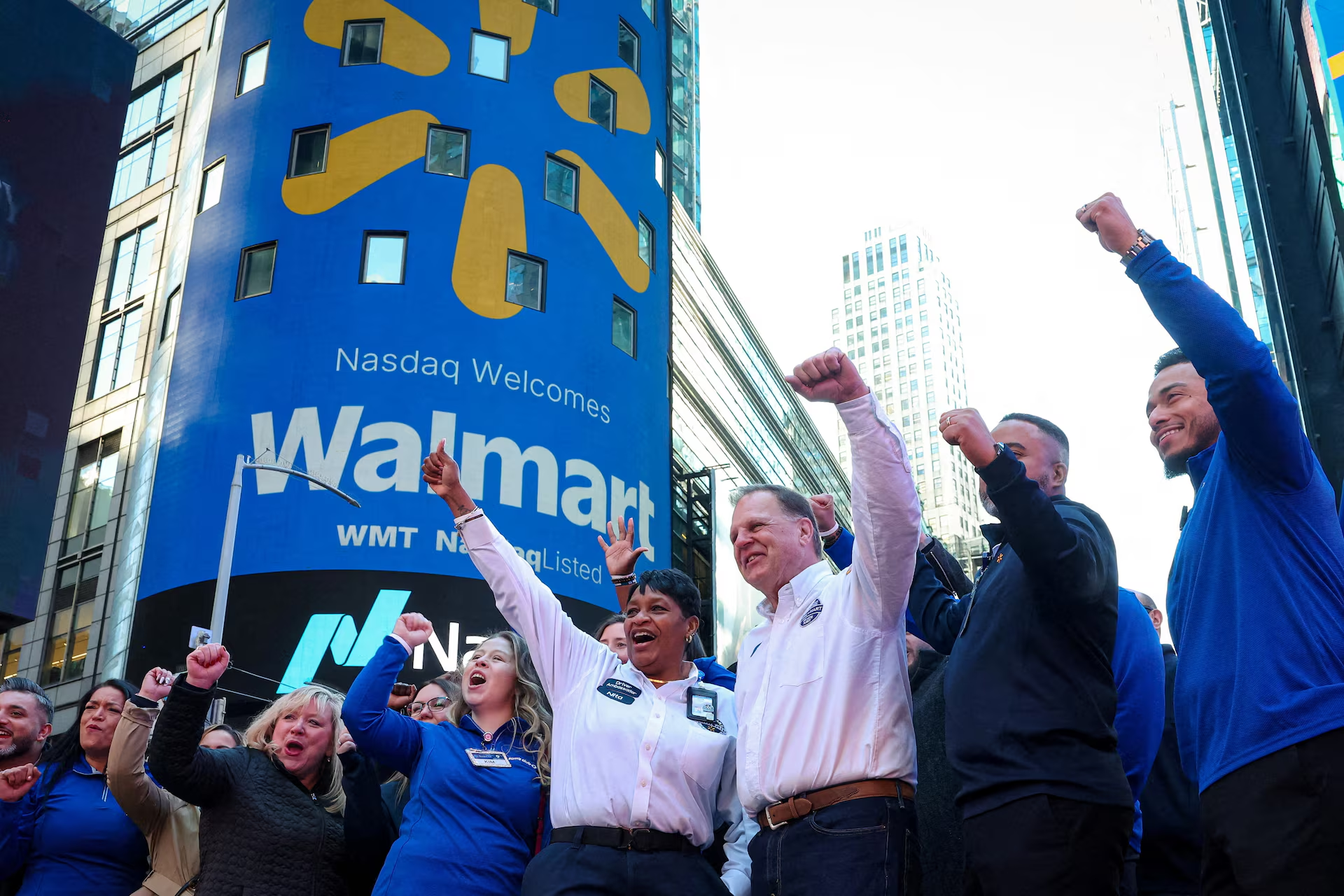
Two weeks before crossing the $1 trillion threshold, Walmart achieved another symbolic milestone: it was added to the tech-focused Nasdaq-100 Index, replacing British drugmaker AstraZeneca.
The Nasdaq-100 is home to the most valuable non-financial companies in the U.S., and Walmart’s inclusion reflects how investors increasingly view the company—not merely as a retailer, but as a technology-enabled commerce platform.
This shift in perception has been instrumental in attracting new investor interest and aligning Walmart with a cohort traditionally dominated by Silicon Valley heavyweights.
Joining the Elite $1 Trillion Club
With its valuation milestone, Walmart now joins an exclusive group of U.S. companies worth $1 trillion or more. The roster includes Nvidia ($4.5 trillion), Alphabet ($4.1 trillion), Apple ($3.9 trillion), Microsoft ($3.1 trillion), Amazon ($2.6 trillion), Meta ($1.8 trillion), Broadcom ($1.6 trillion), Tesla ($1.6 trillion), and Berkshire Hathaway ($1 trillion).
That Walmart—long associated with supercentres and everyday low prices—now stands among these names highlights just how far the company has come.
More Than a Valuation Milestone
For Walmart, reaching a $1 trillion market value is not merely a financial achievement—it is validation of a strategic pivot years in the making. By embracing technology, investing early in AI, expanding its digital ecosystem, and balancing the needs of diverse consumer groups, the company has rewritten the rules of modern retail.
As economic uncertainty continues to shape consumer behaviour and competition intensifies across physical and digital channels, Walmart’s transformation positions it not just to survive—but to lead.
The $1 trillion mark, then, is less a finish line than a signal: Walmart is no longer just the world’s largest retailer. It is now one of the world’s most powerful technology-driven commerce companies.
With inputs from agencies
Image Source: Multiple agencies
© Copyright 2025. All Rights Reserved. Powered by Vygr Media.