 By
By 
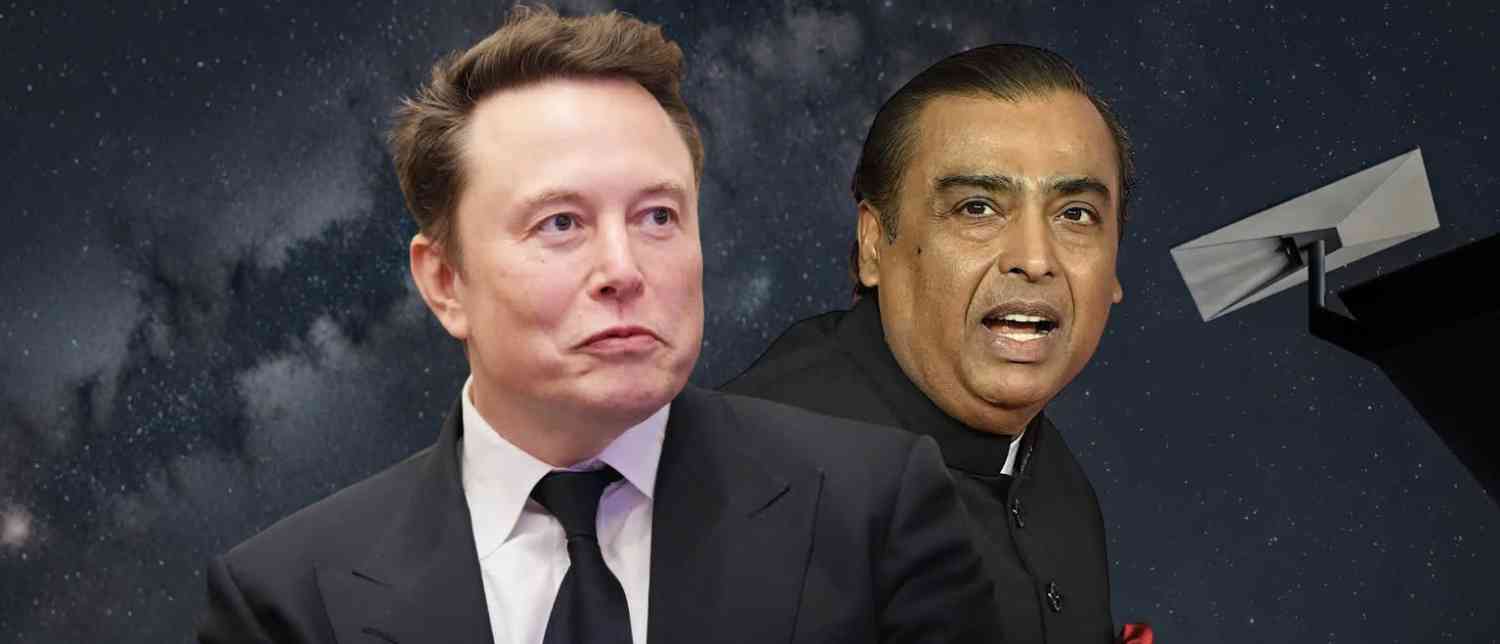
The world’s richest man wants India to roll out the red carpet for Starlink. When New Delhi refuses to operate on his preferred timeline, he takes to X, the social media platform he owns, to publicly question India’s regulatory system, accuse powerful Indian business interests of blocking competition and taunt Mukesh Ambani with a provocative question: “Is Ambani the real boss of India?”
What Elon Musk appears to forget is that Bharat is neither Ukraine nor Bangladesh, and New Delhi is not a corporate subsidiary waiting for instructions from Silicon Valley. India is a sovereign nation of more than a billion people, not an emerging-market playground where a billionaire’s impatience automatically becomes public policy. Its regulatory institutions are not customer-service desks expected to clear a foreign tycoon’s paperwork simply because he has billions of dollars, hundreds of millions of followers and a talent for turning controversy into a global spectacle.
Musk may own X. He may lead Tesla. He may control a satellite communications empire that promises to connect the world. But he does not own India, its skies, its telecommunications infrastructure or its national security decisions.
And that is precisely where this controversy needs to be put into perspective.
Starlink’s potential to bring internet connectivity to remote villages, underserved communities and geographically isolated regions is real. India should not obstruct useful technology merely to protect established telecom operators. But neither should the promise of innovation become a convenient weapon for pressuring a sovereign government into relaxing its rules.
India’s national security is non-negotiable. It is not a bargaining chip, a public-relations inconvenience or a regulatory obstacle that can be bullied out of the way.
The spectacle is particularly revealing because Musk is not merely asking for a licence. By dragging Ambani into the argument and implying that India’s regulatory decisions are controlled by a domestic billionaire, he is inviting the public to accept an allegation that has not been substantiated by publicly available evidence.
A licensing dispute is being transformed into a morality play in which Musk casts himself as the champion of Indian consumers and his critics as defenders of a protected monopoly. It is an attractive narrative. It is also an incomplete one.
India has every right to question whether its regulatory system is transparent, efficient and fair. If Starlink has met every applicable requirement and is being treated differently from competitors, the government should explain why. If a domestic business has improperly influenced the process, that allegation deserves investigation.
But Musk cannot simply declare the system corrupt because the outcome does not match his expectations.
And before the world’s richest man lectures India about free markets, there is an awkward question he should be prepared to answer: Why is market access an unquestionable right when it concerns his business in India, but national security and domestic industrial protection become legitimate policy instruments when America restricts foreign competitors?
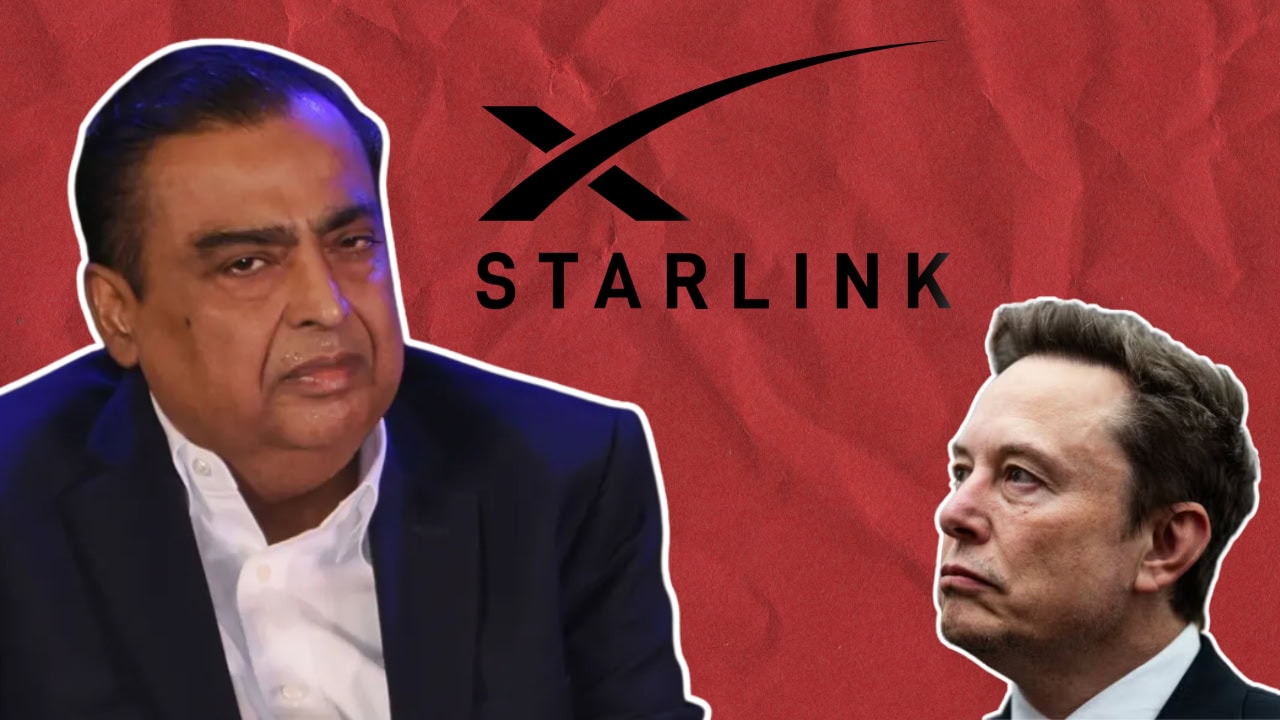
The Elon Musk-Ambani Controversy: What Happened on X?
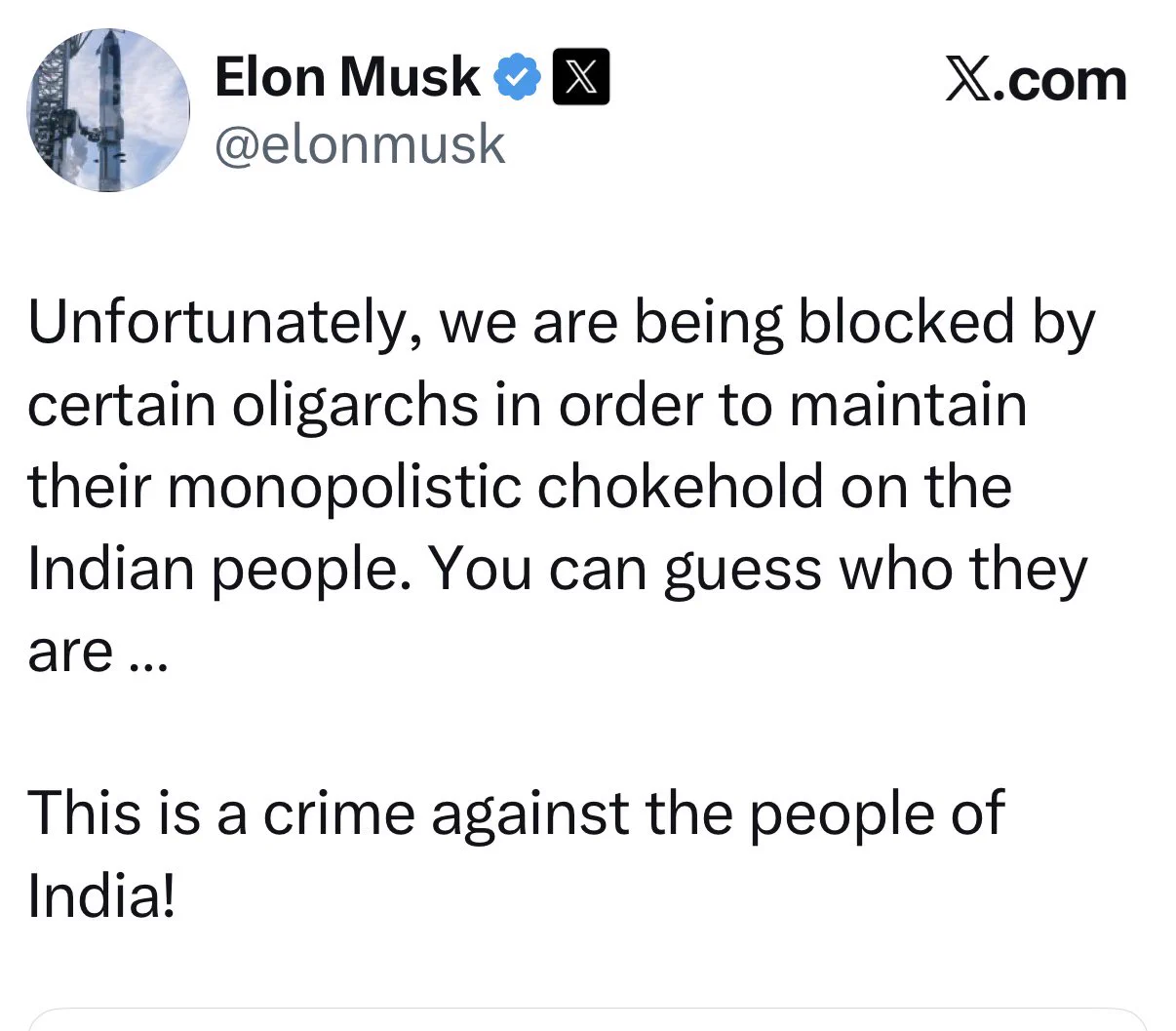
The latest confrontation escalated in October 2026, when Musk used his verified X account to criticise India’s handling of Starlink’s entry into the country. His posts turned an already complicated licensing process into a public confrontation involving the government, Reliance Industries chairman Mukesh Ambani and the future of satellite internet in India.
Musk accuses Indian business interests of blocking Starlink
Musk alleged that powerful business interests were preventing Starlink from entering India to preserve their existing market positions.
He wrote:
“Unfortunately, we are being blocked by certain oligarchs in order to maintain their monopolistic chokehold on the Indian people.”
He followed this with:
“This is a crime against the people of India!”
The implication was unmistakable: Musk wanted the public to view Starlink’s delayed entry as an attack on Indian consumers rather than as a regulatory dispute.
There is a legitimate argument behind his position. More competition can improve services, encourage innovation and expand consumer choice. But accusing unnamed business interests of manipulating national policy is a serious charge. It requires evidence, not merely an assertion from a powerful entrepreneur.
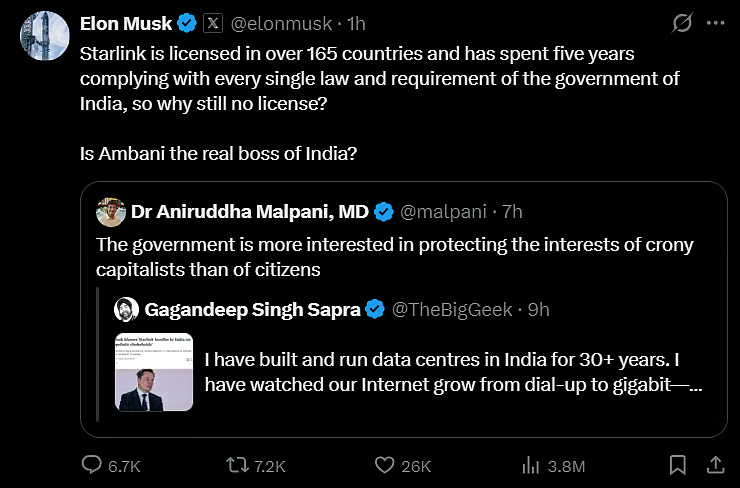
“Is Ambani the Real Boss of India?”
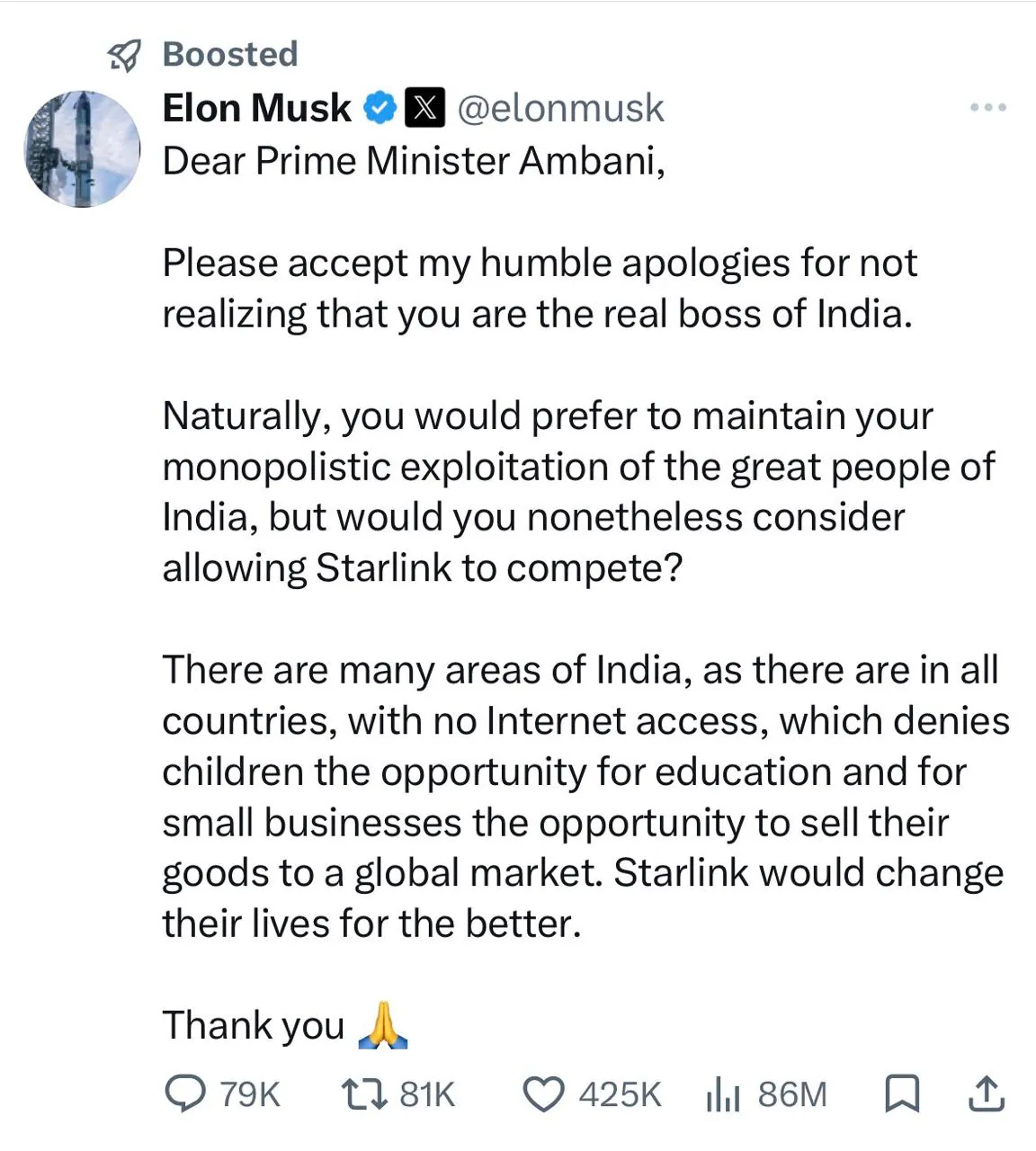
Musk subsequently named Ambani, writing:
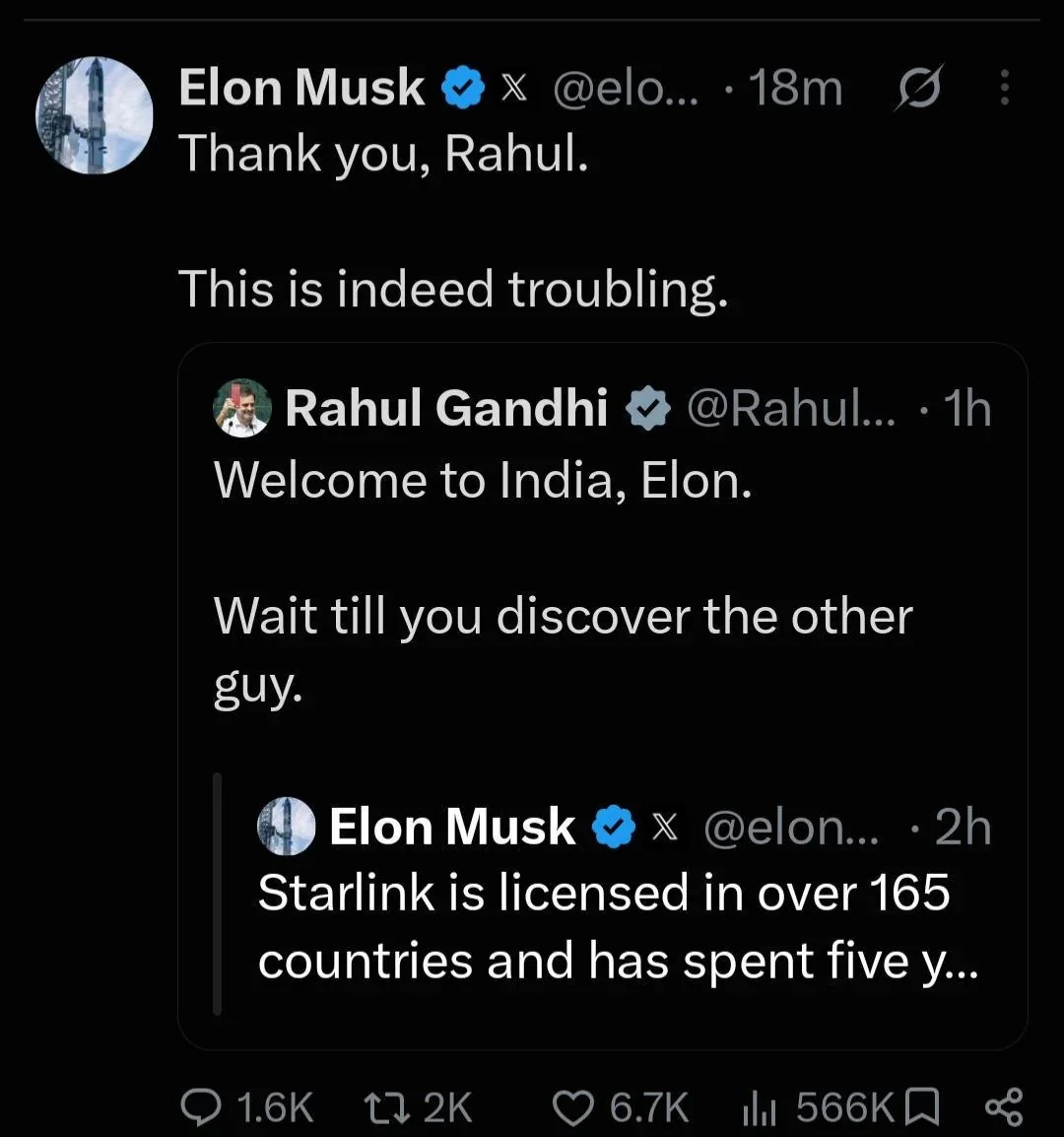
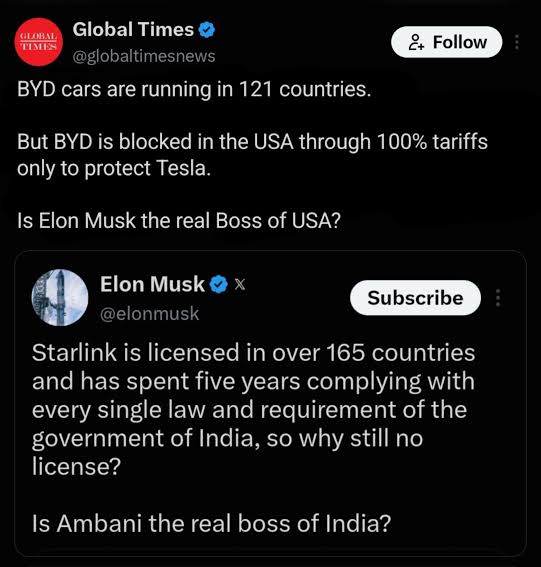
“Starlink is licenced in over 165 countries and has spent five years complying with every single law and requirement of the government of India, so why still no licence? Is Ambani the real boss of India?”
He later sharpened the sarcasm:
“Dear Prime Minister Ambani, Please accept my humble apologies for not realizing that you are the real boss of India.”
The posts made for compelling social media drama, but they also blurred an important distinction. A company’s assertion that it has complied with all requirements is not equivalent to a regulator confirming that every condition for commercial operations has been fulfilled.
Licensing, security clearance, spectrum-related approvals and permission to commence services are distinct matters. Completing one stage does not automatically eliminate the others.
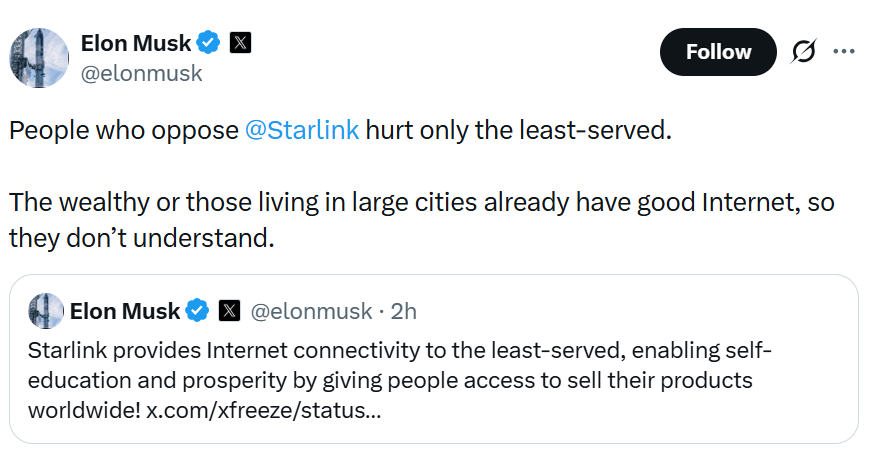
Musk invokes the interests of underserved Indians
Musk also presented Starlink as a service that could help people neglected by conventional telecommunications infrastructure.
Among the statements attributed to his verified account were:
“Starlink will help the least-served in India”.
And:
“People who oppose Starlink hurt only the least-served. The wealthy or those living in large cities already have good Internet, so they don’t understand.”
This argument deserves serious consideration. Satellite broadband can provide connectivity in remote locations where installing fibre-optic cables or building conventional mobile infrastructure is expensive or impractical.
However, the potential benefits of a technology do not prove that every regulatory delay is politically motivated. Nor do they exempt a company from legitimate national security requirements.
Musk’s public campaign may increase pressure for faster decisions, but it does not establish that Ambani personally caused the delay.
Starlink India Launch: Is Mukesh Ambani Really Responsible?
This is the central factual question in the controversy: has Reliance or Ambani actually blocked Starlink’s entry into India?
India’s satellite communications market includes three prominent licensed operators: Starlink, Reliance’s Jio Satellite Communications and Bharti-backed Eutelsat OneWeb. Their entry involves regulatory authorisations and security requirements that extend beyond the initial licensing stage.
OneWeb received an early letter of intent in August 2021 and obtained its satellite communications licence in April 2022. Jio received its licence in October 2022, while Starlink applied in November 2022.
In May 2025, the government introduced additional security requirements addressing issues including network security, data localisation, lawful interception and monitoring of user terminals. Starlink received its Indian satellite communications licence in June 2025 and space-sector authorisation in July 2025.
These milestones demonstrate that Starlink’s entry is part of a longer regulatory process, not simply a disagreement between two billionaires.
The government has maintained that the operators must satisfy outstanding requirements before commercial operations can begin. The fact that Jio and OneWeb are also subject to the approval process complicates the suggestion that Starlink alone is being deliberately obstructed to protect Ambani.
That does not prove the process is flawless. Nor does it mean domestic companies should escape scrutiny. A fair investigation should establish whether the requirements are reasonable, whether they are applied consistently and whether any operator has received preferential treatment.
If evidence emerges that Reliance has improperly influenced the licensing process, the government should investigate it. If Starlink has been treated unfairly, the company deserves a transparent explanation.
But an allegation is not a verdict. Musk’s suspicion of Ambani is not proof of Ambani’s guilt.
National Security Is Not an Excuse to Be Dismissed
Satellite internet is not simply another consumer subscription service. It relies on infrastructure that extends beyond national borders and can affect communications security, emergency response, spectrum management and lawful interception.
For India, these concerns are especially important because communications infrastructure intersects with border security, sensitive installations and the ability of law enforcement agencies to respond to threats.
Governments need to understand how user terminals are authorised, how networks are secured, how relevant data is handled and how lawful security requirements can be enforced.
India is not alone in scrutinising satellite communications. Starlink’s role in conflict zones and politically sensitive environments has demonstrated that satellite connectivity can influence military communications, emergency response and the ability of populations to communicate when conventional networks are disrupted.
The experience of other countries reinforces a basic point: satellite broadband offers substantial public benefits, but it can also raise complex questions about control, access and security.
Starlink has indicated that it is preparing its operations to meet Indian requirements, including requirements concerning the handling and storage of Indian user data. Such commitments are relevant, but a company’s claims about compliance are not a substitute for final regulatory approval.
India should not use national security as a blanket excuse for indefinite delays. Equally, Musk should not treat security requirements as illegitimate merely because they complicate his business plans.
The right approach is straightforward: clear rules, reasonable timelines, consistent enforcement and proportionate safeguards.
Free Markets for India, Protectionism for America: The Musk Paradox
There is something deeply convenient about the way free-market principles are invoked in this controversy. When Starlink wants access to India, competition is presented as a moral imperative, consumer choice as an unquestionable right and regulatory delays as evidence of a system captured by powerful domestic interests. Yet when foreign competitors threaten American commercial interests, Washington has shown little hesitation about putting up barriers.
The United States has erected formidable trade barriers against Chinese electric vehicles, including a 100% tariff on Chinese EVs under measures announced in 2024. BYD, one of the world’s leading electric-vehicle manufacturers, faces a hostile commercial environment in the American passenger-car market. Washington invokes strategic competition, industrial protection and security concerns; critics, meanwhile, can reasonably ask whether shielding American manufacturers including Tesla from an increasingly formidable competitor is also part of the calculation.
No official needs to admit that industrial protection benefits a domestic company for the commercial consequences to be obvious. Yet it would be equally simplistic to pretend that every American trade restriction exists solely to rescue Tesla. The point is not to manufacture a conspiracy. It is to expose the selective enthusiasm for free markets that appears whenever powerful economic interests collide.
The irony is difficult to ignore. When a foreign competitor threatens American manufacturers, the United States can impose steep tariffs and defend them as necessary to protect its strategic and economic interests. But when an American billionaire encounters regulatory requirements in India, the conversation suddenly shifts towards accusations of monopolistic behaviour, unfair obstruction and political influence.
The underlying questions are not identical. Trade tariffs on electric vehicles and security clearances for satellite communications involve different legal frameworks and risks. But both illustrate a basic reality: governments do not operate in a world of unrestricted free markets. They balance competition against national security, domestic industry and strategic interests.
If Washington can restrict foreign products in pursuit of its national interests, New Delhi can demand rigorous security compliance from a foreign satellite operator. If America can defend its domestic industrial base, India can defend its communications infrastructure. And if Musk expects the United States’ strategic decisions to be respected, he should extend the same courtesy to India.
India should not use national security as a pretext to protect domestic businesses from legitimate competition. Equally, Musk should not dismiss India's security concerns simply because they complicate Starlink's commercial ambitions. Reliance Jio should not receive special favours because it is Indian, and Starlink should not receive special exemptions because its owner is one of the world's richest men.
Bharat is open for business, not open to bullying. Starlink is welcome to compete but it must compete under Indian law, not under Elon Musk’s timetable.
India Must Reject Both Corporate Bullying and Crony Capitalism
Defending India’s right to regulate Starlink does not mean giving Indian conglomerates a free pass.
Ambani leads a powerful business group, and Reliance Jio occupies a major position in the Indian telecommunications market. Any credible allegation that a company has used political influence to obstruct a competitor deserves serious scrutiny.
The same standard must apply whether the company involved is Indian or American.
If the government is delaying Starlink for legitimate security reasons, it should explain the outstanding requirements and provide a clear path towards compliance. If the rules are being applied inconsistently, that must be corrected. If a company has improperly influenced the process, the evidence should be investigated.
A fair market requires more than official assurances. It requires visible consistency.
At the same time, Musk should not assume that his global profile, technological achievements or enormous following on X entitles him to special treatment.
India’s market is an opportunity for foreign companies, not an obligation to accommodate them on their preferred terms. There is a difference between demanding fair competition and attempting to pressure a government through public accusations.
The government should not bend its rules for Ambani. It should not bend them for Musk either.
What Is at Stake for Indian Consumers?
Amid the public feud, consumers risk becoming props in a contest between powerful business interests.
Starlink could provide valuable internet access in remote villages, disaster-affected regions and locations where conventional infrastructure remains inadequate. Better connectivity could support education, healthcare, small businesses and emergency communications.
But satellite broadband is not automatically the cheapest or most practical option for every household. Equipment costs, subscription charges, network capacity and the availability of existing services all matter.
For many urban and semi-urban consumers, mobile and fibre broadband may remain more affordable. Satellite connectivity could prove especially valuable where those options are unavailable, unreliable or prohibitively expensive to extend.
Starlink should therefore be judged on measurable outcomes: coverage, affordability, reliability, investment, security compliance and its ability to serve underserved communities.
Competition could encourage existing providers to innovate and improve their services. But that benefit will materialise only if Starlink offers a commercially viable, secure and accessible alternative.
A licence alone does not guarantee digital inclusion. Nor does a regulatory delay automatically prove that consumers are being deliberately denied their rights.
The public interest must remain at the centre of the debate not the reputations, rivalries or profit margins of billionaires.
Conclusion: Bharat Is Open for Business, Not Open to Bullying
The Elon Musk-Starlink controversy has exposed a familiar tension in the global technology economy: powerful companies champion open markets when they seek entry, while governments invoke security, industrial policy and domestic interests when they consider access too risky.
India should welcome technology that expands connectivity, creates value and improves consumer choice. It should also make its regulatory processes transparent, predictable and fair. National security cannot become a blanket excuse for indefinite delays, just as commercial ambition cannot become a reason to disregard national security.
Musk is right about one thing: competition matters. Indian consumers deserve more choices, and the country should not allow any business to monopolise opportunity through improper influence.
But the allegation that Ambani is the “real boss of India” remains an allegation, not an established explanation for Starlink’s delayed launch. The fact that other satellite operators are also subject to outstanding regulatory requirements makes a simplistic conspiracy narrative difficult to sustain.
The United States’ restrictions on Chinese electric vehicles offer another reminder that free-market rhetoric frequently coexists with strategic protectionism. The comparison does not prove that every restriction is justified. It demonstrates why demands for openness must be examined alongside the policies of those making them.
India must hold itself to a high standard: no arbitrary barriers, no corporate favouritism and no selective enforcement. But that standard must apply equally to Indian conglomerates and foreign technology giants.
Starlink should be allowed to compete if it meets India’s legitimate requirements. Ambani should receive no special protection, and Musk should receive no special exemption.
Bharat is not Musk’s backyard. Its national security is not for sale, and its regulatory sovereignty is not subject to a billionaire’s approval.
That is not hostility towards innovation. It is what fair competition, responsible regulation and national sovereignty should look like.
© Copyright 2026. All Rights Reserved. Powered by Vygr Media.