 By
By 
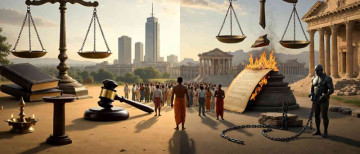
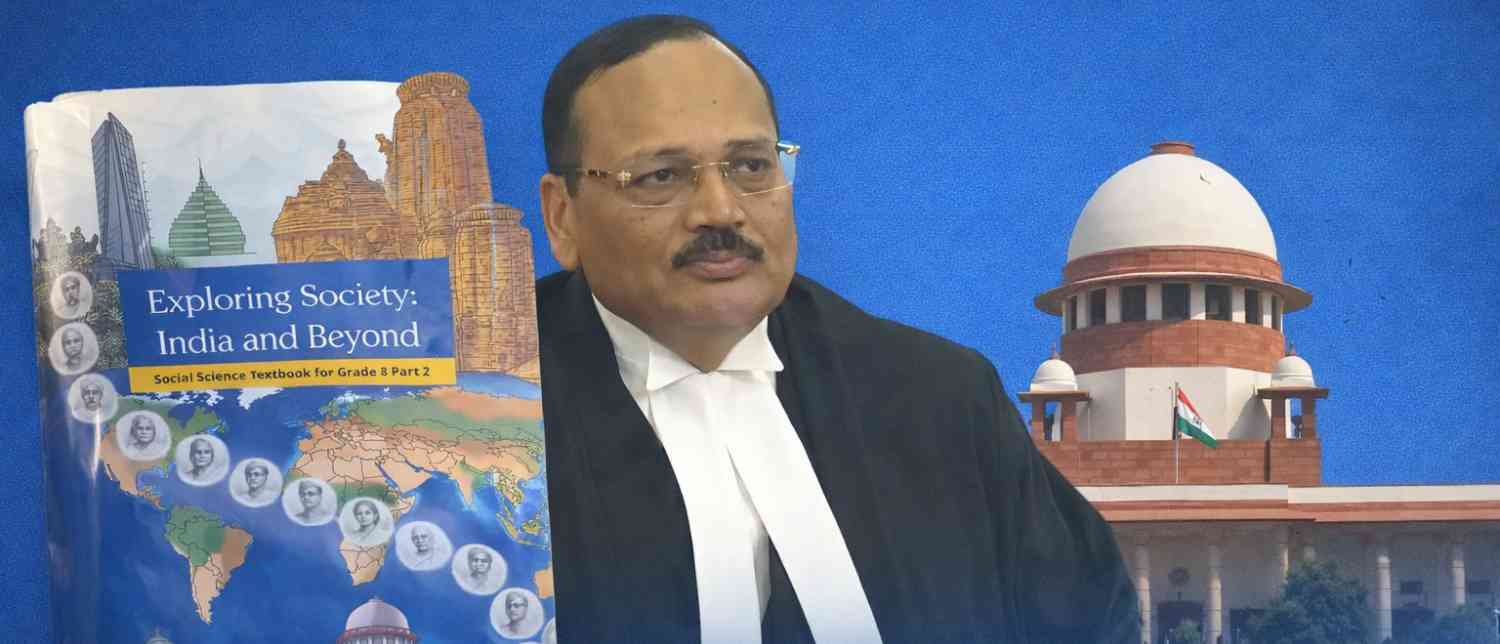
The storm over a Class 8 Social Science textbook has evolved into one of the most consequential debates on constitutional balance in recent years. What began as a line in a civics chapter soon escalated into a full-blown institutional confrontation—drawing in the Supreme Court of India, the National Council of Educational Research and Training (NCERT), the Union government, and even the Prime Minister.
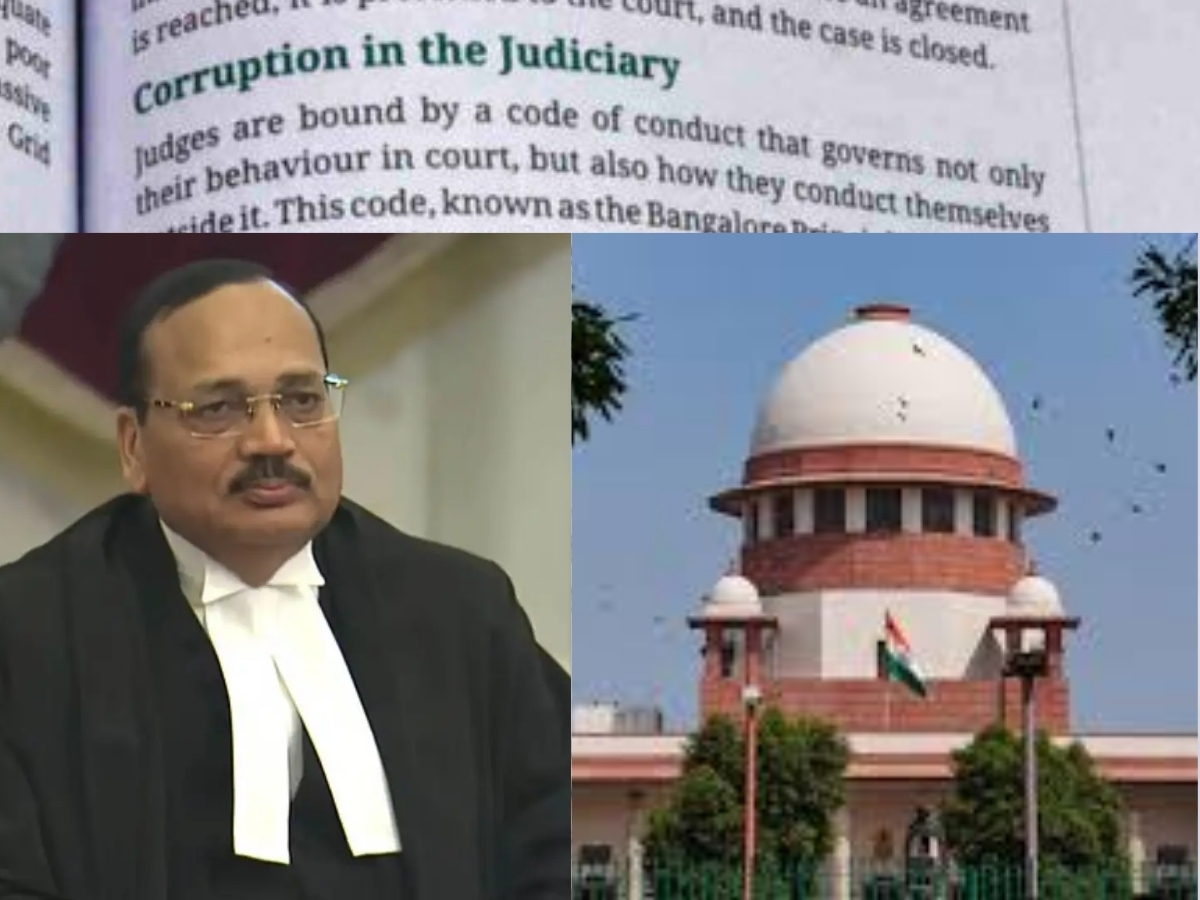
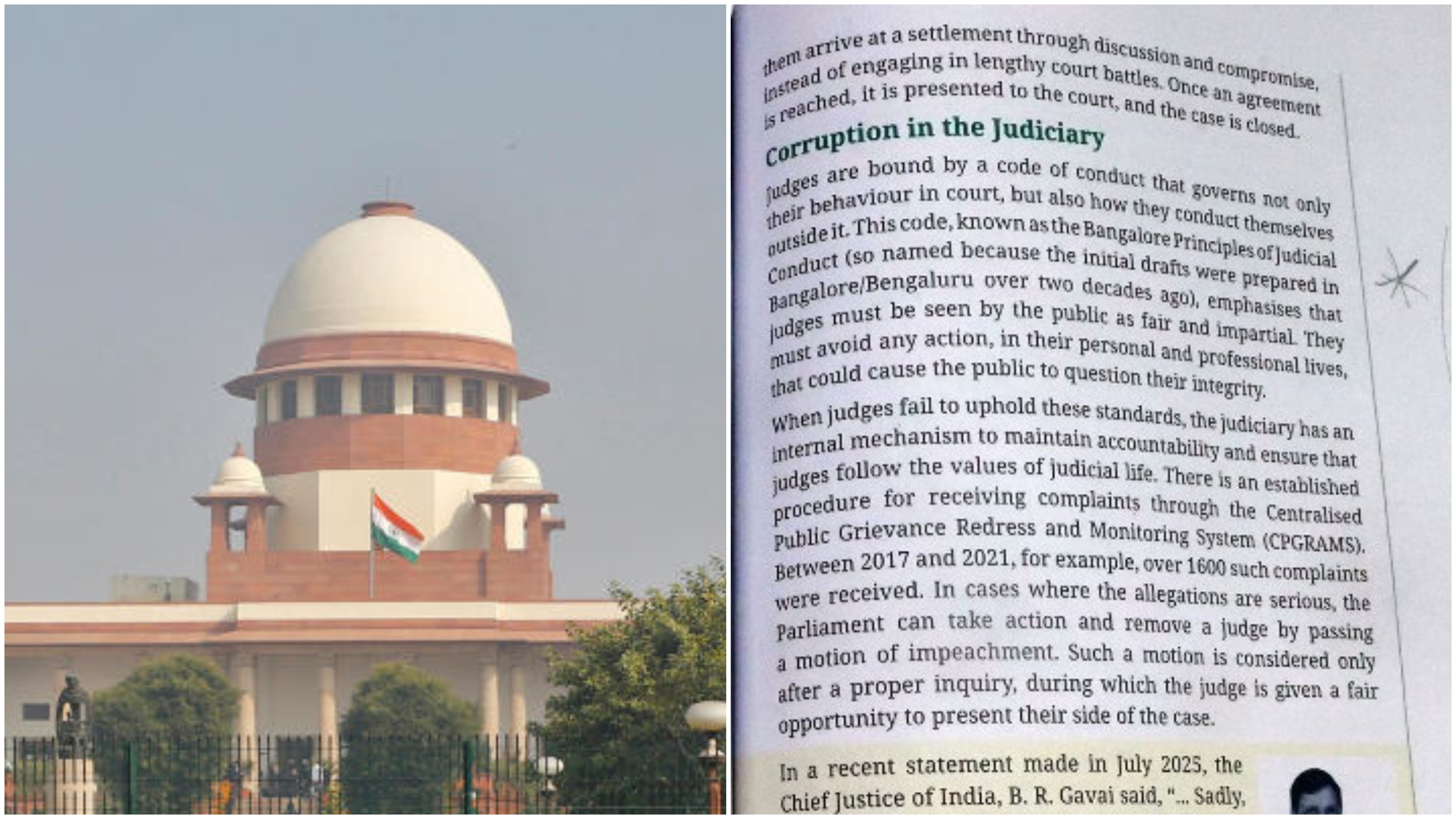
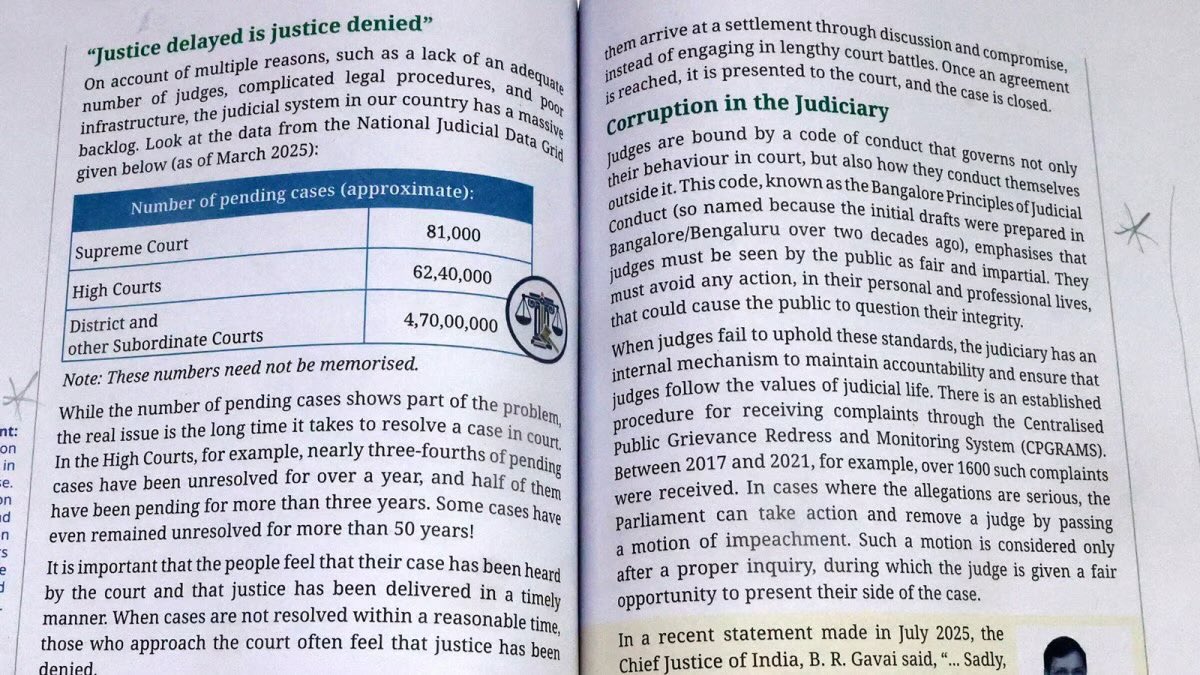
At the centre of the controversy lies a chapter titled “The Role of the Judiciary in Our Society” in the book “Exploring Society: India and Beyond, Vol II”. The chapter included references to “corruption in the judiciary,” mentioned hundreds of complaints against judges, discussed alleged lack of transparency, and quoted former Chief Justice of India BR Gavai. What followed was unprecedented: a suo motu hearing, a blanket ban on the book in India and abroad, seizure orders, notices under contempt provisions, and strong words from Chief Justice Surya Kant.
But beyond outrage and regret lies a deeper constitutional question: How should India teach its children about its institutions—honestly, critically, yet responsibly?
The Immediate Trigger: A Chapter That Sparked a Constitutional Firestorm
The revised NCERT chapter marked a significant departure from earlier editions. Traditionally, textbooks at the middle school level focused on explaining the hierarchy of courts, the structure of the judicial system, and access to justice. This time, however, the chapter went further.
It discussed challenges faced by the judiciary, including corruption and case backlogs. It cited the approximate number of pending cases across courts:
-
81,000 cases in the Supreme Court
-
6,240,000 in High Courts
-
47,000,000 in district and subordinate courts
The chapter also explained that judges are bound by a code of conduct governing both their courtroom behaviour and conduct outside court. It highlighted internal accountability mechanisms and referred to the Centralised Public Grievance Redress and Monitoring System (CPGRAMS) as an established procedure for receiving complaints.
It added that efforts at both Union and state levels are being made to strengthen transparency and public trust, including through technology and swift action against corruption. To reinforce the point, it quoted Justice BR Gavai’s July 2025 speech acknowledging that instances of corruption and misconduct negatively affect public confidence and that rebuilding trust requires “swift, decisive and transparent action.”
In isolation, the content may have appeared like an attempt at transparency. But context—and perception—changed everything.
The Supreme Court’s Explosive Reaction
The controversy came to the attention of Chief Justice Surya Kant through a media report. Acting suo motu, he initiated proceedings and made it clear that the institution would not take the matter lightly.
“I will not allow anyone on earth to taint the integrity of the institution and defame the institution,” he declared. “Whosoever high it may be, the law will take its course.”
What followed was a hearing marked by unusually sharp language.
Among the Chief Justice’s most striking remarks:
-
“Judiciary is bleeding today. This looks like a deep-rooted conspiracy.”
-
“It is a very calculated move.”
-
“I don’t see any apology in the clarification press release.”
-
“We need to find who is responsible and we will see who are there. Heads must roll.”
-
“Upon a prima facie examination of the content, it appears to us that this is a deliberate ploy to undermine the authority and prestige of the judiciary.”
-
“If allowed to go unchecked, it will tarnish the image of the judiciary in the eyes of the general public.”
-
“This, if allowed to go unchecked, will erode the sanctity of judicial office in estimation of public at large and within impressionable minds of youth.”
The Court issued a show-cause notice to the Secretary of School Education and the NCERT Director, asking why action should not be initiated under the Contempt of Court Act or other laws. It directed:
-
A comprehensive list of members of the National Syllabus and Teaching Learning Material Committee who approved the chapter.
-
Specific names and credentials of the Textbook Development Team.
-
Production of original minutes of meetings where the chapter was deliberated.
-
A blanket ban on the book’s circulation in India and abroad.
-
Seizure of all copies.
-
Prohibition on sharing the book online, in whole or in part.
Notices were also issued to the Centre and NCERT Chairman Professor Dinesh Prasad Saklani.
The message was unmistakable: accountability would be fixed.
The Government’s Response: Regret, Withdrawal, and Assurance
Union Education Minister Dharmendra Pradhan moved swiftly.
“We hold the judiciary in the highest regard… There was absolutely no intention on the part of the government to disrespect the judiciary. We are taking this matter very seriously… We will fully comply with the judiciary’s decision. I am deeply saddened by what happened and express my regret,” he said.
He ordered immediate withdrawal of all books, ensured they would not go into circulation, and directed an inquiry within NCERT. Action would be taken against those involved, he assured, and such a mistake would not be repeated.
The NCERT, in its own statement, called the inclusion “an error of judgement” and “purely unintentional.” It reiterated that it holds the judiciary in the “highest esteem” and that the objective of the new textbooks is to strengthen constitutional literacy, institutional respect, and informed democratic participation—not to diminish any constitutional body.
Yet the Chief Justice noted pointedly that he did not see an explicit apology in the press release.
Meanwhile, Prime Minister Narendra Modi, who was in Israel at the time, reportedly reacted strongly. Government sources quoted him as saying accountability should be fixed: “Kaun dekh raha hai ye sab?”—Who is looking after all this?
The Data Behind the Debate: Complaints and Accountability
Ironically, the Court’s outrage has triggered deeper public scrutiny—not just of the textbook, but of the broader question it sought to address.
Data presented in the Lok Sabha in February 2026 revealed that over 8,600 complaints were filed against sitting judges between 2016 and 2025. The number peaked at:
-
1,170 complaints in 2024
-
1,102 in 2025
-
1,037 in 2019
-
1,012 in 2022
The fewest complaints—518—were filed in 2020.
The judiciary has established procedures to handle such complaints:
-
The Chief Justice of India receives complaints against Supreme Court judges and High Court Chief Justices.
-
Complaints against High Court judges are received by that court’s Chief Justice.
-
An in-house mechanism investigates allegations.
-
Under Article 235 of the Constitution, High Courts exercise disciplinary control over district courts.
-
If misconduct appears grave enough to warrant removal, resignation may be recommended.
These mechanisms are not theoretical. They have been activated in recent high-profile cases.
Notable Instances of Judicial Controversy
In March 2025, a large pile of burnt cash—estimated at Rs 15 crore—was found at the Delhi residence of Justice Yashwant Varma following a Holi fire. He denied any connection. The Supreme Court transferred him to the Allahabad High Court and ordered an internal inquiry. The committee recommended impeachment, which remains pending with the government.
In another case, Justice Sharad Kumar Sharma of the National Company Law Appellate Tribunal recused himself in August 2025, alleging pressure from a senior judicial figure to influence a case involving Byju’s founder Byju Raveendran and insolvency proceedings initiated after a Rs 159 crore default claim by the Board of Control of Cricket in India.
In 2018, tribunal judge RK Mittal was linked to fraudulent withdrawal of Rs 50 crore earmarked for accident compensation. After investigations by the Enforcement Directorate and the Supreme Court, he was sacked from the Railway Claims Tribunal. In 2024, 24 properties linked to him were attached.
Going further back, in 2011, Soumitra Sen of the Calcutta High Court became the first judge in independent India to be impeached by the Rajya Sabha over alleged misappropriation of Rs 33 lakh. He resigned before Lok Sabha proceedings concluded and was not prosecuted.
These cases illustrate an uncomfortable truth: corruption allegations in the judiciary are not fictional constructs. They are rare but real—and institutions have responded through internal mechanisms and constitutional processes.
Government–Judiciary Flashpoints: A Broader Context
This episode unfolds against a backdrop of past tensions.
The Supreme Court struck down the National Judicial Appointments Commission Act in 2015, restoring the collegium system. In April 2025, then Vice President Jagdeep Dhankhar criticised what he termed judicial overreach, likening Article 142 to a “nuclear missile.” Former Law Minister Kiren Rijiju publicly clashed with the Court multiple times before being replaced in May 2023.
Retired Justice BN Srikrishna, in 2022, warned about shrinking freedom of expression, prompting rebuttals from Rijiju.
This context matters because institutional sensitivity does not arise in a vacuum.
The Deeper Question: How Should Children Learn About the Judiciary?
Amid all the outrage, the Supreme Court itself clarified that it does not intend to stifle legitimate critique. “Rigorous discourse helps the living vitality of the institution,” the Chief Justice said.
That acknowledgment opens space for a more nuanced debate.
Middle school students are at a formative age. Civic impressions acquired at 13 can endure for decades. Language matters. A phrase like “corruption in the judiciary” may be read by adults as referencing isolated misconduct addressed through institutional mechanisms. Adolescents, however, may interpret it as systemic decay.
The danger is not rebellion. It is premature cynicism.
At the same time, sanitising reality risks creating textbooks divorced from lived experience. Students are not insulated from media coverage. They see headlines about case backlogs and high-profile controversies. If textbooks ignore such issues entirely, they may appear artificially curated.
The solution lies not in erasure but in pedagogy.
Teaching Trust Without Concealment
Trust and transparency are not opposites. In fact, institutional accountability mechanisms strengthen legitimacy.
A developmentally appropriate curriculum might:
-
Introduce structure and values at the middle school level.
-
Discuss accountability mechanisms and reform efforts at secondary level.
-
Encourage analytical debate on judicial activism and transparency in senior classes.
The controversial chapter did mention efforts to strengthen transparency, use technology, and take swift action against corruption. It also referred to complaint mechanisms like CPGRAMS and ethical codes binding judges.
But the Court’s concern was that the narrative failed to proportionately highlight the judiciary’s illustrious history—its role in preserving the democratic fabric, upholding the basic structure doctrine, expanding legal aid, and holding powerful officials accountable.
Balance, in constitutional education, is everything.
𝐏𝐫𝐞𝐬𝐬 𝐑𝐞𝐥𝐞𝐚𝐬𝐞 : 𝐀𝐧 𝐢𝐦𝐩𝐨𝐫𝐭𝐚𝐧𝐭 𝐮𝐩𝐝𝐚𝐭𝐞 𝐛𝐲 𝐍𝐂𝐄𝐑𝐓 𝐰𝐢𝐭𝐡 𝐫𝐞𝐬𝐩𝐞𝐜𝐭 𝐭𝐨 𝐂𝐥𝐚𝐬𝐬 𝟖 𝐒𝐨𝐜𝐢𝐚𝐥 𝐒𝐜𝐢𝐞𝐧𝐜𝐞 𝐓𝐞𝐱𝐭 𝐁𝐨𝐨𝐤 (𝐏𝐚𝐫𝐭 𝟐)
As per the extant procedure, NCERT brought out the Social Science textbook, Exploring Society:… pic.twitter.com/ahHSiT8MaP— NCERT (@ncert) February 25, 2026
Accountability, Dignity, and the Road Ahead
The Supreme Court’s sweeping ban and demand for names, minutes, and credentials reflect institutional resolve. The government’s swift regret and withdrawal reflect executive deference. The Prime Minister’s reported insistence on accountability underscores political seriousness.
Yet, the controversy should not close the conversation. It should deepen it.
If this episode results in:
-
More rigorous curriculum review mechanisms,
-
Structured consultation between educators, constitutional scholars, and child psychologists,
-
Clearer guidelines on age-appropriate framing,
-
Greater transparency in textbook drafting processes,
then it may ultimately strengthen both civic education and institutional trust.
Democracy rests on two pillars: accountability and legitimacy. Undermining either weakens the Republic. Protecting both requires maturity—especially in classrooms where constitutional culture first takes root.
The judiciary commands neither purse nor sword. Its authority rests on public confidence. That confidence must be nurtured honestly—not blindly, not cynically, but thoughtfully.
The question was never whether corruption allegations exist. The question is how a democracy introduces complexity to its young citizens without eroding faith in the very institutions designed to protect their rights.
If India can answer that question with wisdom rather than reaction, this controversy may yet become a constitutional learning moment—for institutions, for educators, and for the Republic itself.
*Views expressed in the above piece are personal and solely those of the author. They do not necessarily reflect Vygr’s views.
With inputs from agencies
Image Source: Multiple agencies
© Copyright 2025. All Rights Reserved. Powered by Vygr Media.