 By
By 
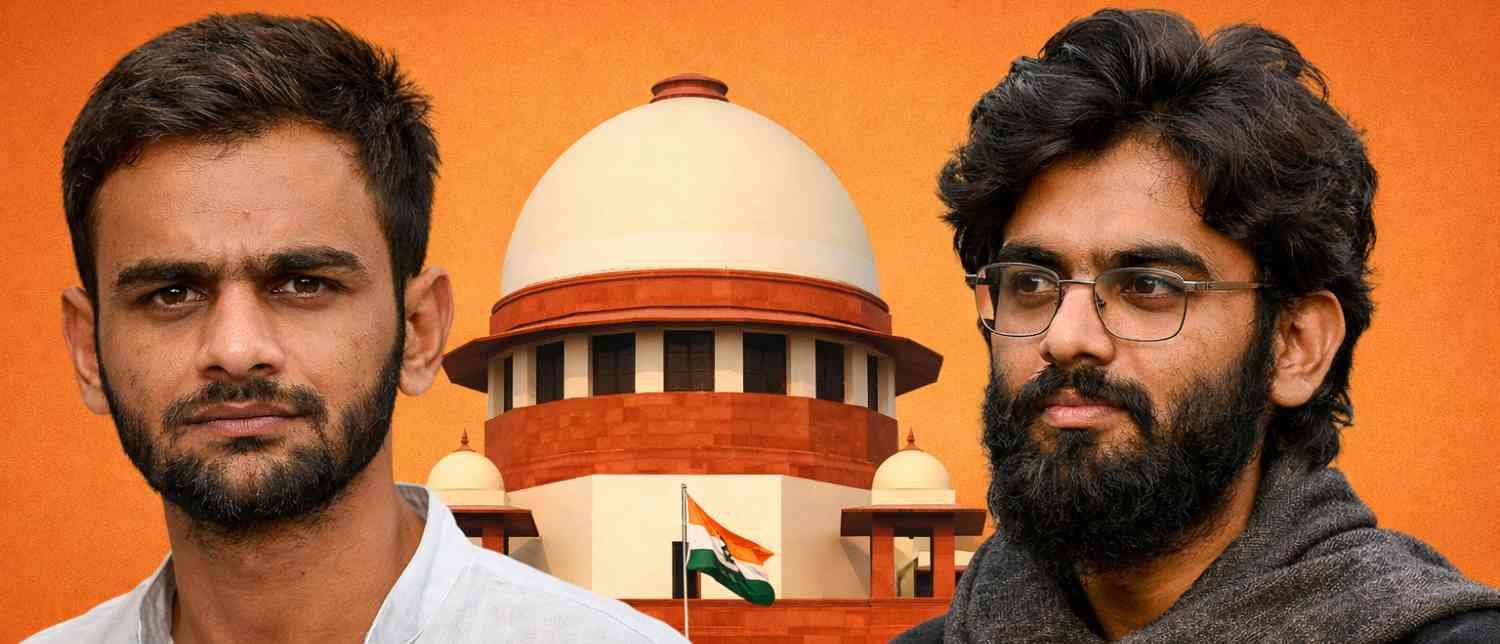
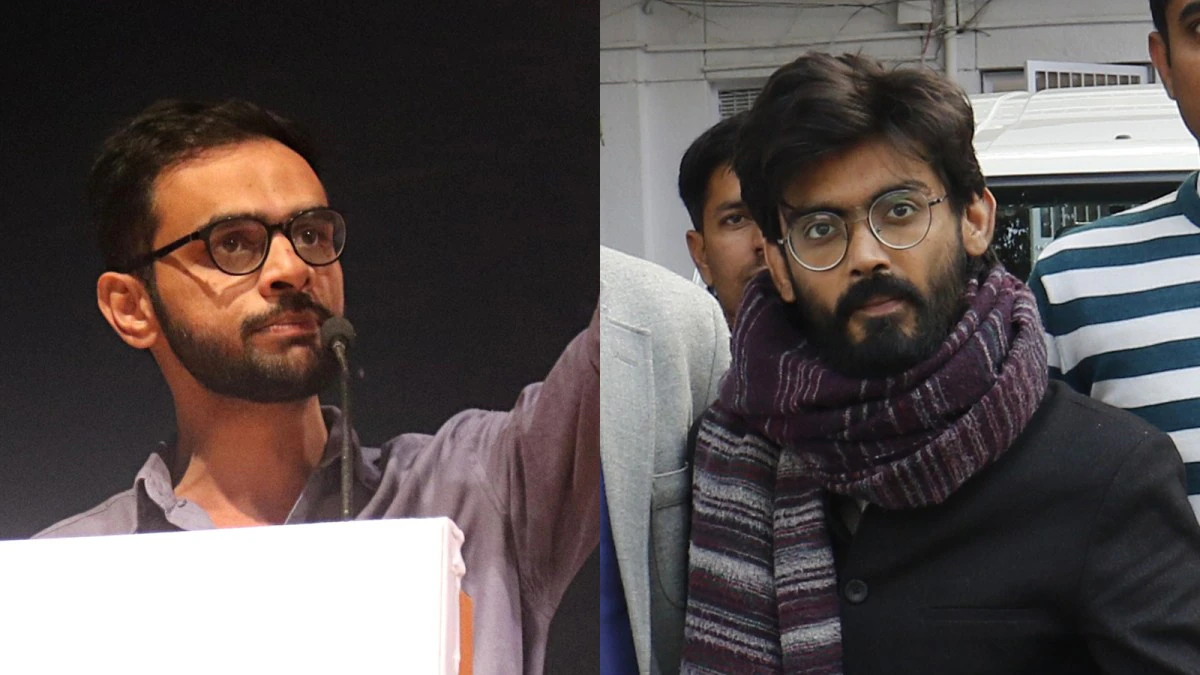
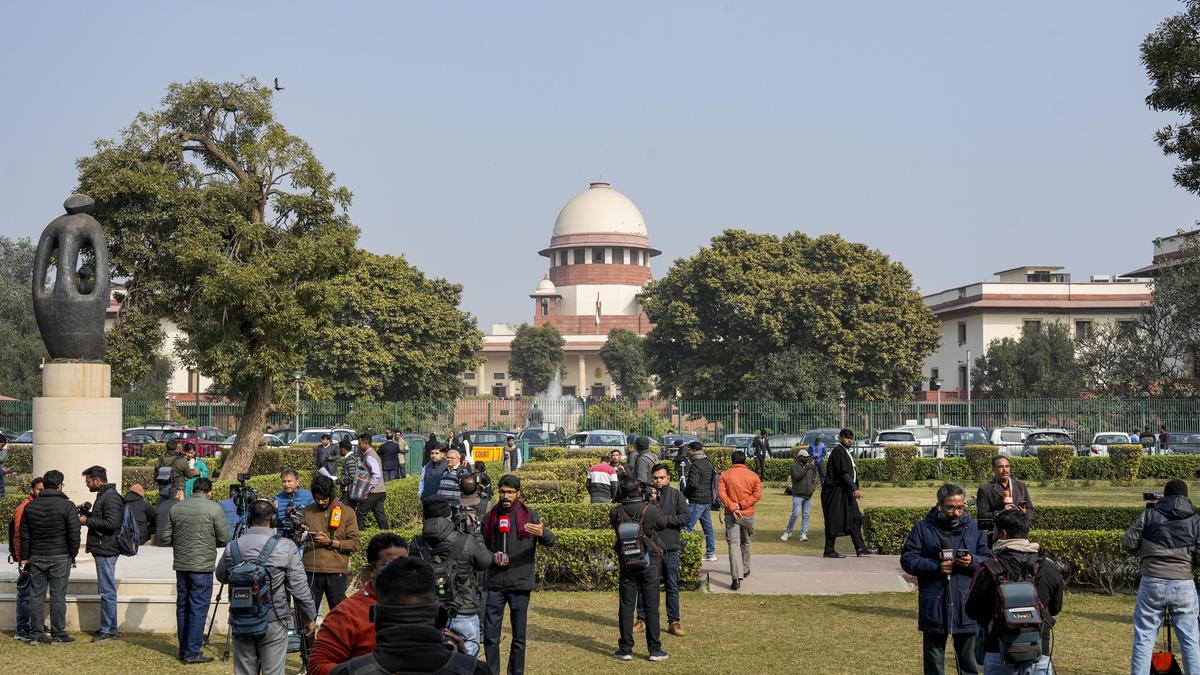
In a significant ruling on January 5, the Supreme Court of India declined to grant bail to student activists Umar Khalid and Sharjeel Imam in the high-profile Delhi riots larger conspiracy case, holding that the material placed on record establishes a prima facie case against them under the Unlawful Activities (Prevention) Act, 1967 (UAPA). At the same time, the Court granted bail to five other accused in the same case—Gulfisha Fatima, Meeran Haider, Shifa Ur Rehman, Mohd. Saleem Khan, and Shadab Ahmed—underscoring that not all accused stand on the same footing when bail is considered under stringent anti-terror legislation.
The judgment was delivered by a bench comprising Justice Aravind Kumar and Justice N.V. Anjaria, which made it clear that the Court had conducted an accused-specific analysis rather than adopting a collective or parity-based approach. While rejecting the bail pleas of Khalid and Imam, the Court allowed them the liberty to renew their applications after the examination of protected witnesses or after one year, whichever is earlier.
Central Role and Statutory Bar Under UAPA
Explaining the denial of bail, the Supreme Court observed that the prosecution material, if taken at face value, indicates that Umar Khalid and Sharjeel Imam played a “central and formative role” in the alleged conspiracy. According to the Court, their involvement extended beyond isolated or localised incidents and included planning, mobilisation, and strategic direction, thereby satisfying the statutory threshold under Section 43D(5) of the UAPA, which severely restricts the grant of bail once a prima facie case is established.
The bench held that the continued detention of Khalid and Imam, though prolonged, has not crossed the threshold of constitutional impermissibility so as to override the statutory embargo on bail. Emphasising the nature of the allegations, the Court stated that the materials disclose conduct that allegedly aimed at destabilising public order and threatening national integrity—elements that fall squarely within the ambit of the UAPA.
Trial Delay Not an Automatic Ground for Bail
Justice Aravind Kumar, while pronouncing the judgment, addressed one of the principal arguments raised by the defence—prolonged incarceration and delay in trial. The Court clarified that in prosecutions under the UAPA, delay cannot be treated as a “trump card” to automatically displace statutory safeguards.
At the same time, the bench reiterated that Section 43D(5) does not completely oust judicial scrutiny. Courts are still required to conduct a structured and limited inquiry to determine whether the prosecution material, if accepted as true, establishes a prima facie case against the accused. This inquiry, the Court stressed, must remain accused-specific, and at the bail stage, courts are not expected to evaluate the defence version or weigh evidence as would be done during trial.
Interpretation of “Terrorist Act” Under UAPA
In an important clarification, the Supreme Court rejected a narrow interpretation of Section 15 of the UAPA, which defines “terrorist acts.” The bench held that the provision is not confined to acts of overt or blatant violence alone. Apart from causing death or destruction, it also encompasses acts that disrupt essential services, threaten public order, or undermine the economic and sovereign foundations of the State.
This interpretation, the Court noted, is crucial when examining alleged conspiracies that may operate through mobilisation, coordination, and sustained disruption rather than conventional armed conflict.
Why Five Accused Were Granted Bail
While denying bail to Khalid and Imam, the Supreme Court granted relief to Gulfisha Fatima, Meeran Haider, Shifa Ur Rehman, Mohd. Saleem Khan, and Shadab Ahmed, subject to twelve stringent conditions. The Court cautioned that any misuse of liberty would result in the cancellation of bail.
The bench explained that the roles attributed to these five accused, as reflected in the prosecution material, did not cross the same statutory threshold as that of Khalid and Imam. Observing that “all accused do not stand on the same footing”, the Court warned against mechanical application of parity, stating that equality in bail jurisprudence cannot ignore differences in hierarchy of participation and culpability.
Article 21 of the Constitution, the Court held, does require the State to justify prolonged pre-trial custody, but this constitutional protection must be balanced against the statutory framework governing serious offences under special laws like the UAPA.
Background of the Case and Procedural History
The appeals before the Supreme Court arose from a September 2 judgment of the Delhi High Court, which had dismissed the bail pleas of several accused, including Umar Khalid and Sharjeel Imam. The High Court had observed that, prima facie, the roles attributed to them were grave, noting allegations that they delivered inflammatory speeches along communal lines to instigate mass mobilisation.
The petitioners are among a group of student activists who were at the forefront of protests against the Citizenship (Amendment) Act (CAA) during 2019–2020. The prosecution alleges that these protests were used as a cover to orchestrate a larger conspiracy that culminated in communal riots in north-east Delhi in February 2020.
Those accused in the case include Tahir Hussain, Umar Khalid, Khalid Saifi, Isharat Jahan, Meeran Haider, Gulfisha Fatima, Shifa-Ur-Rehman, Shadab Ahmed, Mohd. Saleem Khan, Athar Khan, Sharjeel Imam, and others. Some co-accused, such as Asif Iqbal Tanha, Devangana Kalita, Natasha Narwal, and Safoora Zargar, were granted bail earlier, the latter on humanitarian grounds due to pregnancy.
Prosecution’s Case: Alleged Pan-India Conspiracy
Opposing the bail pleas, the Delhi Police maintained that the riots were not spontaneous but the outcome of a deep-rooted, premeditated, and well-planned conspiracy. According to the prosecution, the alleged objective was “regime change” and “economic strangulation”, with the Citizenship Amendment Act deliberately used as a “radicalising catalyst” under the guise of peaceful protest.
The police further claimed that the conspiracy was timed with the official visit of the then U.S. President to India, in order to attract international attention and globalise opposition to Indian policy. It was also alleged that digital platforms and WhatsApp groups such as the Delhi Protest Support Group (DPSG) and Jamia Awareness Campaign Team were used to coordinate activities and attempt replication of the model on a pan-India scale.
According to official figures cited by the prosecution, the violence resulted in 53 deaths, extensive damage to public and private property, and the registration of 753 FIRs across Delhi.
Defence Arguments and Claims of Fabrication
Senior advocates appearing for the accused—including Kapil Sibal, Siddharth Dave, Abhishek Manu Singhvi, Salman Khurshid, and others—argued that the accused had spent over five years in custody without the trial making meaningful progress. They contended that there was no direct evidence linking the petitioners to acts of violence and that prolonged incarceration violated constitutional guarantees.
In September, Umar Khalid had also opposed the framing of charges, describing the FIR as a “joke” and alleging that the case was built through fabricated evidence. His counsel argued that the prosecution first decides whom to implicate and then engages in “reverse engineering” to justify the arrest, asserting that there were no recoveries or direct linkages to the alleged offences.
Supreme Court’s Final Observations
While directing the trial court to expedite proceedings, the Supreme Court reiterated that bail determinations under the UAPA require a careful balancing of individual liberty and national security concerns. The Court made it clear that treating all accused identically could itself result in injustice, particularly where the nature and degree of alleged involvement differ substantially.
In conclusion, the bench held that Umar Khalid and Sharjeel Imam remain on a qualitatively different footing, and at the present stage of proceedings, the statutory bar under the UAPA prevents their release on bail. However, by granting bail to five co-accused and allowing Khalid and Imam to seek bail again after one year, the Court left the door open for future judicial reconsideration as the trial progresses.
With inputs from agencies
Image Source: Multiple agencies
© Copyright 2025. All Rights Reserved. Powered by Vygr Media.