

 By

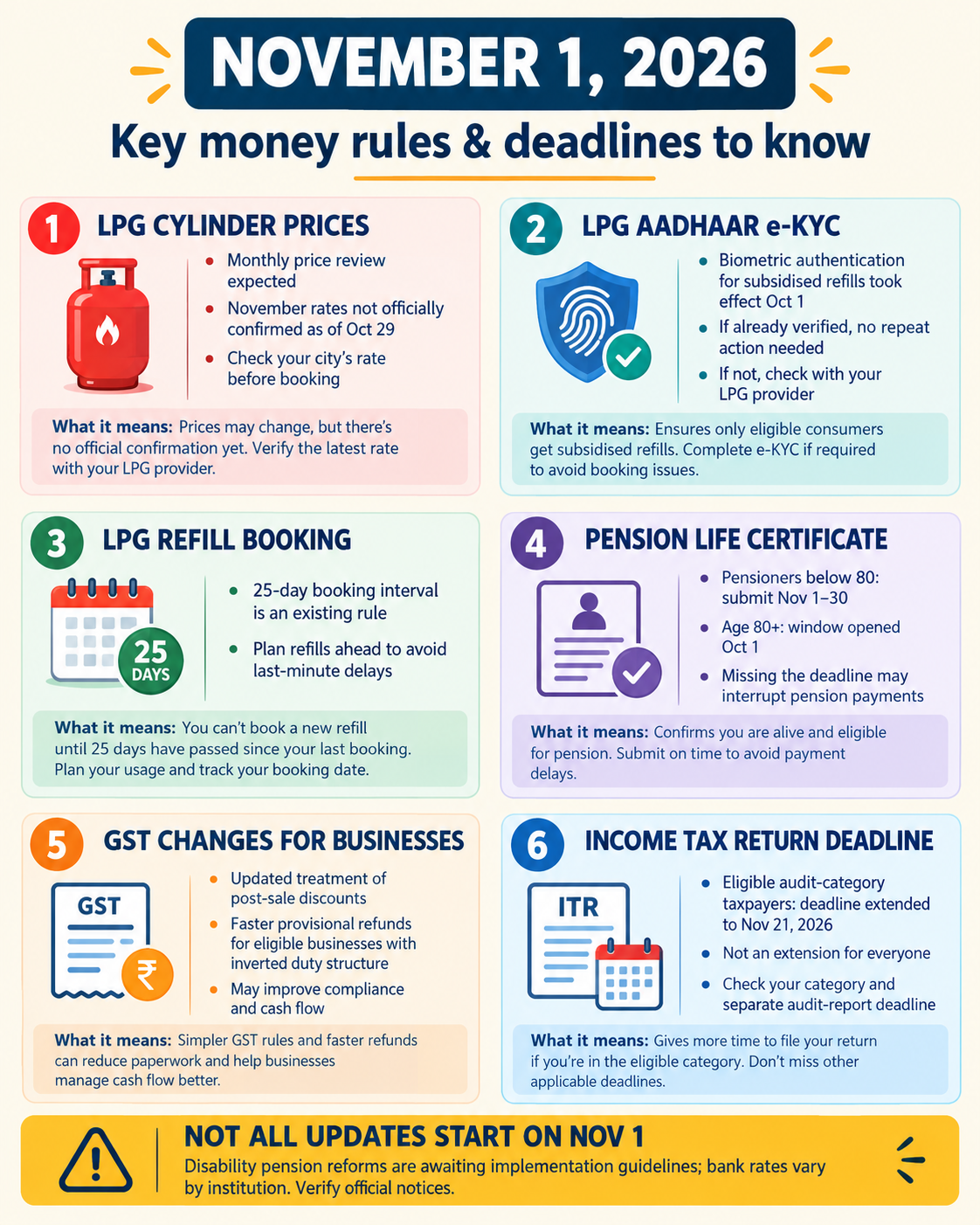
As November 2026 approaches, several important financial and administrative updates are coming into focus across India. From LPG cylinder prices and pension documentation to changes in Goods and Services Tax (GST) procedures and income tax filing deadlines, the beginning of the new month is an important date for households, pensioners, taxpayers and businesses.
While some changes are scheduled to take effect from November 1, others involve existing requirements, approaching deadlines or policy developments that consumers should monitor carefully.
For millions of Indian households, the most immediate concern is whether LPG cylinder prices will increase. Pensioners, meanwhile, need to pay attention to their annual life certificate submissions to avoid interruptions in their pension payments. Businesses may benefit from changes to GST procedures, while certain taxpayers have received additional time to file their income tax returns for Assessment Year (AY) 2026-27.
However, not every widely discussed update represents a new rule taking effect on November 1. Understanding the difference between a confirmed policy change, a routine monthly review and a proposed reform is essential.

Here is a detailed breakdown of the key financial changes and deadlines to watch as November begins.
1. LPG Cylinder Prices: Will Domestic and Commercial Rates Increase From November 1?
LPG cylinder prices are among the most closely watched monthly updates in India because they directly affect household budgets and business operating expenses.
Public-sector oil marketing companies generally review LPG prices on the first day of every month. Their decisions can affect both domestic cooking gas cylinders and commercial cylinders used by restaurants, hotels, catering businesses and other establishments.
As of October 29, 2026, however, no official announcement had confirmed a new LPG price revision for November 1. Consumers should therefore avoid assuming that domestic or commercial cylinder prices will automatically increase when the month changes.
Domestic LPG cylinder prices
Most households depend on the standard 14.2-kg domestic LPG cylinder for everyday cooking. Even a modest price adjustment can affect families managing monthly expenses, particularly those already dealing with higher food, transport and utility costs.
Domestic LPG prices can vary by city, and eligible consumers may also receive subsidies under applicable government schemes. The amount ultimately paid can therefore depend on the location, connection type and applicable subsidy arrangements.
As a reference point, the domestic 14.2-kg cylinder in Delhi was reported at ₹942 in October 2026. This figure should not be treated as the applicable rate for every city or as confirmation of the November price.
Before booking a refill, consumers should check the latest rate displayed by their authorised LPG distributor or official booking platform.
Commercial LPG cylinder prices
Commercial LPG prices deserve particular attention because restaurants, hotels, food businesses and catering services use these cylinders extensively.
A rise in commercial LPG rates can increase operating costs. Businesses may absorb the additional expense, reduce other expenditures or adjust menu prices, depending on their financial position and competitive environment.
In October, the reported price of a 19-kg commercial cylinder in Delhi was ₹2,810. The rate applicable from November 1 will depend on the official monthly pricing announcement.
For households and businesses alike, the practical advice is simple: verify the applicable city-specific price rather than relying on predictions circulating online.
2. LPG Cylinder New Rules 2026: Aadhaar Biometric e-KYC Requirements
Apart from prices, Aadhaar biometric authentication is an important issue for eligible domestic LPG consumers receiving subsidised refills.
The biometric authentication requirement was brought into effect from October 1, 2026, under the announced policy. As a result, November is not necessarily the starting point of a completely new requirement; it is a period when consumers should ensure that their existing compliance obligations have been completed.
Who needs to complete LPG e-KYC?
Eligible domestic consumers who are required to complete biometric Aadhaar authentication should check their verification status with their respective oil marketing company.
Consumers who have already completed the required authentication do not need to repeat it merely because November has arrived.
However, those whose verification remains incomplete may face restrictions on booking subsidised refills until the applicable requirement is fulfilled.
Consumers should confirm their individual eligibility and the procedure applicable to their connection before taking action.
How can consumers complete LPG biometric authentication?
Customers can check the available authentication options through their LPG provider's official channels. Depending on the provider and connection, these may include:
-
Indane customers using the IndianOil ONE app.
-
Bharatgas customers using the HelloBPCL app.
-
HP Gas customers using the HP PAY app.
-
Assistance from an authorised LPG distributor, including confirmation of available in-person or delivery-time verification options.
Consumers should use official applications and verified distributor channels. OTPs, Aadhaar authentication details and other sensitive information should never be shared with unknown callers or unauthorised agents.
The key takeaway is that households should check their LPG e-KYC status in advance rather than wait until a refill is urgently needed.
3. LPG Refill Booking: What the 25-Day Rule Means for Consumers
Another important LPG-related measure is the uniform 25-day interval between domestic cylinder refill bookings.
The rule was announced in September 2026 and should not be presented as a new restriction beginning specifically on November 1.
Under the announced arrangement, the interval between domestic LPG refill bookings is 25 days for both urban and rural consumers, replacing the earlier temporary arrangement that applied different intervals.
How will the 25-day LPG booking rule affect households?
The booking interval can affect families that consume cooking gas quickly or need to plan refills around travel, celebrations or large family gatherings.
For example, if a household has booked a cylinder recently, its next booking may be restricted until the applicable interval has passed. The actual booking eligibility depends on the consumer's connection and the LPG provider's system.
Consumers can reduce the risk of last-minute inconvenience by keeping track of their previous booking date, monitoring the cylinder's remaining gas and checking their eligibility before placing another request.
The 25-day rule does not mean that every household must wait until November 1 to begin using it. It is an existing requirement that consumers should understand while planning their monthly fuel expenses.
4. Pensioners Must Submit Their Annual Life Certificate in November
For government pensioners, November is an important month because it marks the regular submission window for the annual life certificate, commonly known as Jeevan Pramaan.
The certificate helps establish that a pension beneficiary is alive and eligible to continue receiving pension payments. Failure to submit it within the prescribed period can lead to a temporary interruption in payments until the required documentation is furnished.
Jeevan Pramaan 2026: Important dates
Pensioners below 80 years of age can generally begin submitting their annual life certificates from November 1. The usual deadline is November 30.
Pensioners aged 80 years and above have an earlier submission window, which opens on October 1.
This distinction is important for elderly beneficiaries who may need additional time or assistance to complete the process.
| Pensioner category | Submission window |
|---|---|
| Below 80 years | November 1–30, 2026 |
| Aged 80 years and above | From October 1, 2026, with the usual deadline of November 30 |
Pensioners should verify the precise requirements applicable to their pension authority, particularly if they receive benefits under a state government scheme or another arrangement with separate instructions.
How can pensioners submit a life certificate?
Depending on the applicable scheme and available facilities, pensioners may be able to submit their certificate through an authorised bank branch, pension disbursing authority or a supported digital life certificate service.
Digital submission can be especially useful for elderly pensioners and people who find travelling difficult. However, the available method may depend on the beneficiary's pension arrangements and authentication requirements.
The most important step is to avoid leaving the submission until the final few days of November.
Pensioners and family members should check whether the certificate has been successfully submitted and retain the acknowledgement or confirmation for their records.
5. GST Rule Changes From November 1: What Businesses Should Know
Changes to the Goods and Services Tax framework are also scheduled to take effect from November 1, 2026.
The reforms concern post-sale discounts and provisional refunds for businesses affected by inverted duty structures. Both areas are relevant to businesses managing tax compliance, cash flow and accounting procedures.
Easier treatment of post-sale discounts
Businesses sometimes offer discounts after a sale has already taken place. Depending on the circumstances, these discounts can create questions about how the transaction should be treated under GST rules.
The upcoming changes are intended to ease the framework governing post-sale discounts, helping simplify compliance for businesses that offer such concessions.
The practical effect will depend on the transaction, the applicable statutory provisions and the procedures businesses must follow.
Companies should therefore review their invoicing, discount documentation and accounting processes with their tax advisers rather than assume that every post-sale discount will automatically qualify for identical treatment.
Faster provisional GST refunds
The changes also seek to accelerate provisional refunds for businesses affected by inverted duty structures.
An inverted duty structure can arise when the GST rate on inputs purchased by a business is higher than the rate on the goods or services it sells. This mismatch can result in accumulated input tax credit and put pressure on working capital.
For eligible businesses, faster provisional refunds could improve cash flow and reduce the time money remains tied up in the tax system.
However, businesses should not assume that all refund claims will be approved immediately or that eligibility conditions have disappeared. They should check the amended provisions, documentation requirements and applicable procedures before filing claims.
These GST changes are primarily relevant to businesses and tax professionals. They do not automatically mean that ordinary consumers will see an immediate reduction in the prices of everyday goods.
6. Income Tax Return Deadline Extended to November 21, 2026 for Certain Taxpayers
Taxpayers with outstanding filing responsibilities should pay close attention to the revised income tax return deadline for Assessment Year 2026-27.
The filing deadline has been extended from October 31 to November 21, 2026, for specified categories of taxpayers whose accounts are required to be audited under the applicable provisions.
The extension provides additional time for eligible taxpayers to complete their filings, but it is not a blanket extension for every individual taxpayer.
Who benefits from the extended ITR filing deadline?
The revised deadline applies to the specified taxpayer categories covered by the extension, rather than all people filing income tax returns.
Taxpayers should confirm whether they fall within the eligible category before relying on November 21 as their deadline.
It is also important to distinguish between filing an income tax return and submitting an audit report. These are separate compliance obligations, and their deadlines may differ.
The audit report deadline for the specified cases was separately extended to October 21, 2026. That date has already passed by the end of October, so eligible taxpayers should check their filing status immediately if the audit report remains outstanding.
What should taxpayers do now?
Eligible taxpayers who have not yet filed their returns should organise their financial statements, tax calculations, deductions, supporting documents and audit-related information without delay.
Waiting until November 21 can create unnecessary pressure, especially if discrepancies or missing documents emerge during the final review.
Those who are unsure whether the extension applies to them should consult the latest tax department instructions or seek advice from a qualified tax professional.
The additional time is useful, but it should not be mistaken for permission to postpone every related compliance requirement.
7. Disability Pension Reforms: Important Proposal, but Not a Confirmed November 1 Change
Another development attracting attention concerns proposed changes to disability pension eligibility and assistance.
The Union Cabinet has approved a proposal that includes reducing the minimum disability threshold for eligibility from 80% to 40%, removing the minimum age requirement and revising the amount of central assistance.
Under the approved proposal, central assistance would increase to ₹375 per month for eligible beneficiaries below 80 years of age and ₹625 per month for those aged 80 and above.
These proposals could matter significantly to eligible beneficiaries if implemented as approved. A lower disability threshold could broaden access, while revised assistance amounts could change the support available to qualifying recipients.
However, the revised operational guidelines had not yet been issued as of October 29, 2026. The changes should therefore not be described as automatically becoming effective on November 1.
Potential beneficiaries should wait for the applicable official guidelines and implementation date before making financial plans based on the proposed revisions.
This distinction matters because Cabinet approval and the actual commencement of an operational scheme are not necessarily the same event.
8. Bank Fixed Deposit and Lending Rates: Check Individual Bank Announcements
Fixed deposit returns and lending rates are another area consumers may wish to monitor around the start of November.
Banks can revise interest rates on selected fixed deposit schemes or lending products according to their policies and prevailing market conditions.
However, there is no basis to assume that every bank will change its rates on November 1 or that all depositors and borrowers will be affected equally.
For fixed deposit investors, the applicable interest rate may depend on the bank, deposit tenure, deposit amount, customer category and the date on which the deposit is booked or renewed.
Borrowers should similarly review the terms of their loan agreements and check whether any applicable rate changes affect their repayments.
Anyone considering opening or renewing a fixed deposit should compare the currently available rates and conditions instead of relying on general claims about a nationwide change.
What Should You Do Before November Begins?
With several deadlines and administrative requirements approaching, a short checklist can help households, pensioners and businesses avoid unnecessary complications.
For LPG consumers:
-
Check the latest domestic or commercial cylinder price applicable to your city.
-
Confirm whether Aadhaar biometric e-KYC is required for your connection and whether it has been completed.
-
Keep track of your previous refill booking date and the applicable 25-day interval.
-
Use official booking platforms and authorised distributors.
For pensioners:
-
Check the annual life certificate submission window applicable to your pension category.
-
Complete Jeevan Pramaan submission well before November 30.
-
Keep proof of successful submission and verify the status if confirmation is delayed.
For taxpayers:
-
Confirm whether the extended November 21 ITR deadline applies to your category.
-
Check the status of any separately required audit report.
-
Organise outstanding documents and complete the filing process promptly.
For businesses:
-
Review the GST changes relating to post-sale discounts and provisional refunds.
-
Consult a tax professional if the revised provisions affect your accounting or refund claims.
-
Monitor official announcements concerning commercial LPG prices and bank rates.
November 1 Updates Require Attention, Not Panic
The November 1 rule changes for 2026 cover several areas of everyday financial life, but their implications differ depending on the person or business concerned.
LPG consumers should monitor official cylinder prices, confirm applicable Aadhaar biometric e-KYC requirements and understand the existing 25-day refill booking interval. Pensioners should prioritise their annual life certificates, while eligible taxpayers need to take advantage of the extended income tax return deadline without overlooking separate audit obligations.
Businesses may benefit from changes to GST procedures governing post-sale discounts and provisional refunds. Meanwhile, proposed disability pension reforms and possible bank interest rate adjustments require careful attention to official implementation details.
The central message is to separate confirmed changes from anticipated announcements. An approaching monthly price review does not guarantee a price increase, and an approved policy proposal does not necessarily take effect immediately.
By checking official notifications, verifying individual eligibility and completing time-sensitive requirements early, consumers can prepare for November with greater confidence and fewer last-minute surprises.
Information in this article reflects developments available as of October 29, 2026. LPG rates, scheme implementation dates and individual compliance requirements should be verified through the relevant official channels before taking action.
© Copyright 2026. All Rights Reserved. Powered by Vygr Media.