 By
By 
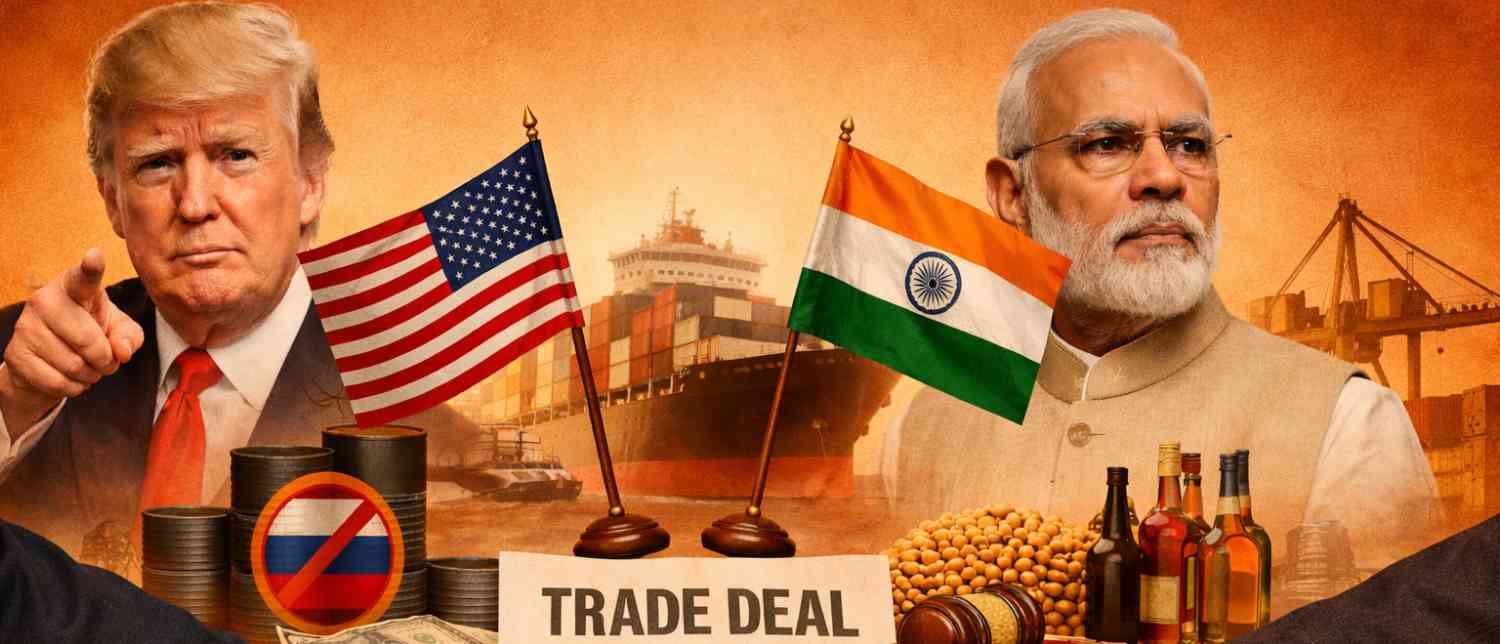
The India–United States trade agreement announced in early February has been hailed by the White House as a “historic” breakthrough that promises to reshape bilateral economic ties. Yet, behind the celebratory language and sweeping claims—particularly US President Donald Trump’s assertion that India has agreed to cut tariffs and non-tariff barriers “to ZERO”—lies a far more complex and contentious reality.
The agreement, which currently exists as a framework for an interim deal rather than a full-fledged treaty, is the result of months of mounting pressure, escalating tariffs, and intense political bargaining. While Washington has framed it as a decisive win for American exporters and workers, critics in India argue that the deal is deeply asymmetrical, offers limited gains for New Delhi, and exposes vulnerable sectors such as agriculture and labour-intensive industries to long-term risks.
How the Interim Deal Came Together
India’s push for a trade agreement with the United States gathered momentum after Donald Trump returned to the White House in January 2025. Aware of Trump’s long-standing grievances over trade deficits and what he describes as unfair market barriers, New Delhi sought to signal goodwill early.
In the Union Budget for 2025–26, India cut tariffs on a range of American products, including bourbon whiskey, motorcycles, information and communication technology (ICT) products, and certain medical devices. Prime Minister Narendra Modi followed this up with a high-profile visit to the US in February 2025, where he signed the United States–India Joint Leaders’ Statement. This document committed both sides to negotiating the first tranche of a multi-sector, mutually beneficial Bilateral Trade Agreement (BTA) by the fall of 2025.
However, the diplomatic overtures did little to soften Trump’s aggressive trade posture. In April 2025, he threatened India with steep “reciprocal tariffs” of up to 26 per cent—tariffs designed explicitly to counter what the US sees as trade imbalances. By July, Washington imposed a 25 per cent reciprocal tariff on Indian exports. The pressure intensified further on August 6, when an additional 25 per cent penalty was slapped on Indian goods as punishment for India’s continued imports of Russian crude oil.
For Indian negotiators, the situation quickly turned desperate. Despite public assurances that politically sensitive sectors—especially farmers and exporters of labour-intensive products—would be protected, New Delhi faced the prospect of losing competitiveness in its most crucial export markets.
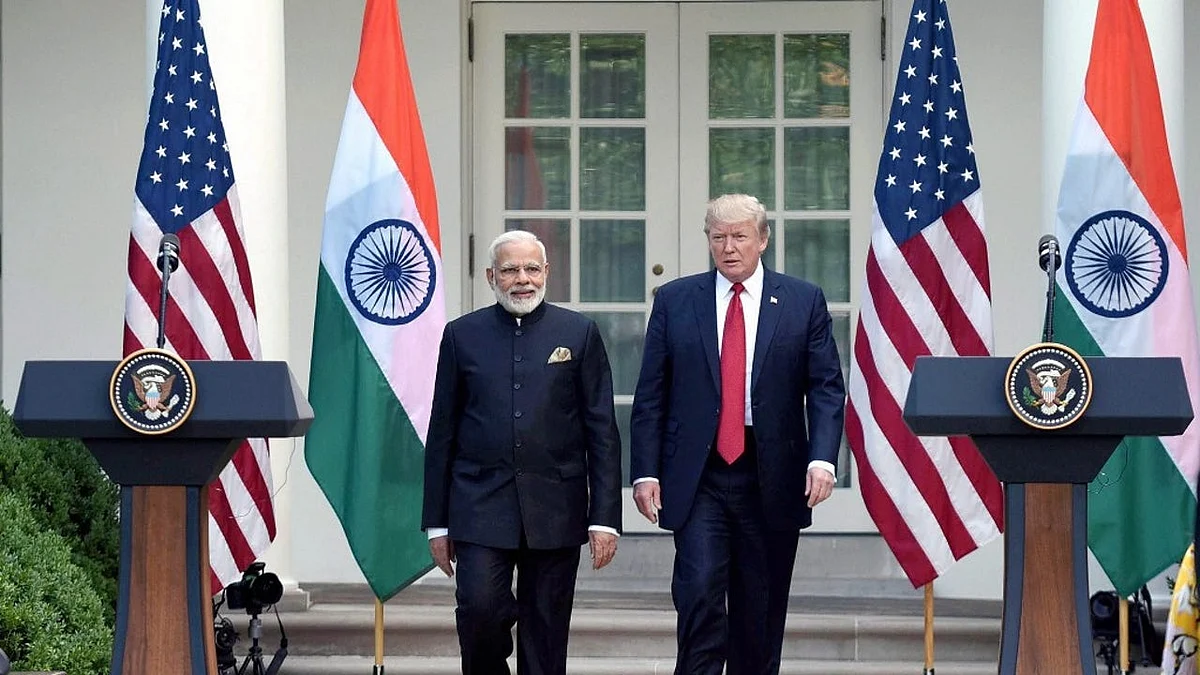
It was against this backdrop that Trump announced the India–US trade deal on February 2 via social media. Four days later, on February 6, the White House released the United States–India Joint Statement, outlining the framework for an interim agreement on reciprocal and mutually beneficial trade.
What the White House Fact Sheet Actually Says
Shortly after Trump’s announcement, the White House issued a detailed fact sheet titled “The United States and India Announce Historic Trade Deal (Interim Agreement)”. The document provides clarity on what has been agreed upon—and just as importantly, what has not.
-
Reduction in US Tariffs
One of the headline measures is Washington’s decision to lower its reciprocal tariff on India from 25 per cent to 18 per cent. This reduction applies to roughly half of India’s exports to the US. The White House explicitly linked this concession to India’s commitment to stop purchasing Russian oil.
In recognition of that commitment, Trump also agreed to remove the additional 25 per cent tariff that had been imposed as a penalty. The President signed an executive order formalising the removal of this extra duty.
-
India’s Market Access Commitments
In return, India has agreed to “eliminate or reduce tariffs” on all US industrial goods and a wide range of American food and agricultural products. These include: Dried distillers’ grains (DDGs), Red sorghum, primarily used as animal feed, Tree nuts, Fresh and processed fruits, Certain pulses, Soybean oil, Wine and spirits, Other additional products not explicitly listed.
The White House emphasised that these measures would open India’s vast domestic market—home to over 1.4 billion people—to American exporters.
India has also committed to purchasing more than $500 billion worth of US products, spanning energy, information and communication technology, agriculture, coal, and other sectors.
-
Addressing Non-Tariff Barriers
Beyond tariffs, the agreement focuses heavily on non-tariff barriers, which the US has long criticised as being overly protectionist. India has agreed to address these barriers in “priority areas” affecting bilateral trade, particularly in food and agricultural products.
While the statement does not spell out all the changes, critics note that this could involve easing restrictions on imports such as chicken legs, dairy products, and genetically modified soybean oil—items that have historically been sensitive in India.
-
Digital Trade and Technology Cooperation
Digital trade is another major pillar of the framework. According to the White House, India has agreed to remove its digital services taxes and negotiate a robust set of bilateral digital trade rules. These rules are intended to eliminate discriminatory or burdensome practices and prohibit customs duties on electronic transmissions.
The two countries have also committed to significantly expanding bilateral trade in technology products and deepening joint technology cooperation. This includes closer alignment on economic security, supply chain resilience, innovation, investment reviews, and export controls.
-
Rules of Origin and Supply Chains
To ensure that the benefits of the agreement accrue mainly to the two signatories, the US and India will negotiate rules of origin. Both sides have also pledged to coordinate efforts to counter non-market policies of third parties and strengthen supply chain resilience.
Trump’s ‘Zero Tariff’ Claim vs the Reality
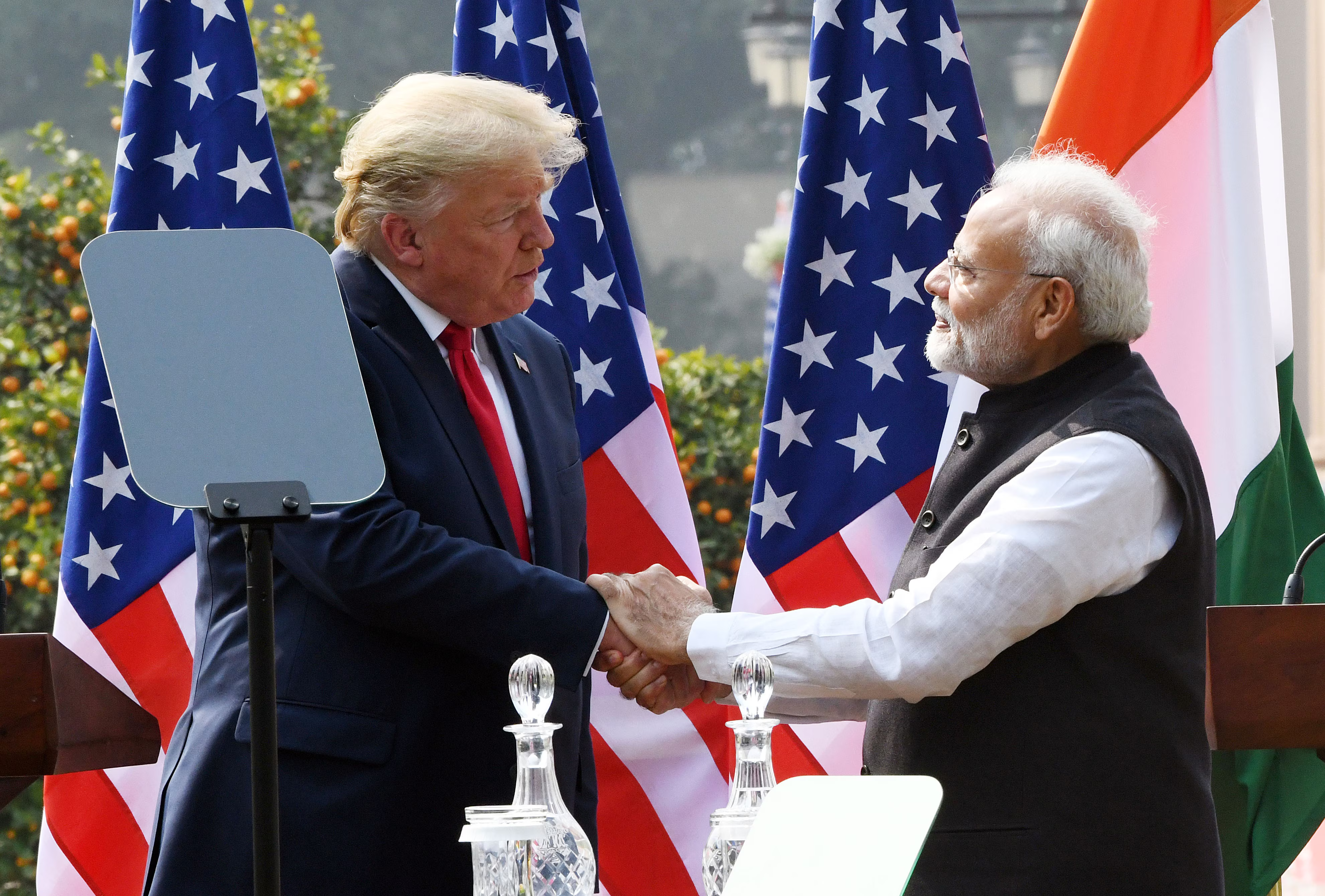
Despite the detailed language of the fact sheet, Trump’s public remarks quickly became the centre of controversy. The President claimed that India had agreed to reduce “Tariffs and Non-Tariff Barriers against the United States, to ZERO.”
This phrasing caused immediate anxiety among Indian traders and industry groups. In reality, US officials later clarified that the agreement represents an in-principle commitment to reduce or phase out duties on selected products over time—not an immediate elimination of all import tariffs.
Nonetheless, critics argue that the rhetorical damage had already been done. The perception that India had conceded too much, too quickly, intensified domestic backlash and raised questions about the balance of the deal.
Who Gains—and Who Loses?
-
India’s Limited Gains
From a purely numerical standpoint, India’s most tangible gain is the 7 percentage point reduction in reciprocal tariffs—from 25 per cent to 18 per cent—on about half of its exports to the US. Beyond that, the benefits are far less clear.
Crucially, by agreeing to an 18 per cent reciprocal tariff, India has effectively accepted this rate as a negotiated outcome rather than a unilateral imposition. Critics warn that this makes the tariff more durable, even if Trump’s broader reciprocal tariff regime is later challenged or struck down in US courts.
-
Impact on Farmers
One of the most contentious aspects of the interim agreement is its impact on Indian agriculture. The deal does not explicitly exclude genetically modified soybean oil, corn, dairy, or poultry products from tariff reductions. The inclusion of vague terms such as “additional products” has heightened fears that these sensitive sectors could be exposed to import competition.
Equally troubling for farmers is India’s commitment to address long-standing non-tariff barriers on US agricultural exports. These barriers have historically been used to protect domestic producers through quantitative restrictions and regulatory controls.
-
MSMEs and Labour-Intensive Sectors
India’s labour-intensive industries—textiles and apparel, leather and footwear, plastics and rubber, organic chemicals, home décor, artisanal products, and certain machinery—face an 18 per cent reciprocal tariff under the interim agreement. This is on top of the base tariff of 0 to 3 per cent that existed before the Trump era.
Critics point out that this offers no real competitive advantage against exporters from countries like Vietnam, Bangladesh, and Indonesia, which face similar tariff levels. For India’s MSMEs, which rely heavily on price competitiveness, the impact could be severe.
Russian Oil Clause: A Geopolitical Pressure Point
Perhaps the most politically sensitive element of the deal is the linkage between trade concessions and India’s energy imports. Trump has reserved the right to reimpose the additional 25 per cent tariff if India is found importing Russian oil—directly or indirectly.
A committee of US secretaries and officials will monitor India’s compliance. Critics in India see this as a significant erosion of strategic autonomy and describe it as humiliating external oversight of domestic energy policy.
An Avoidable Deal?
Opponents argue that India should not have agreed to the interim framework at all. They note that Trump’s reciprocal tariffs are currently being challenged in the US Supreme Court and may eventually be declared unconstitutional. If that happens, India’s acceptance of an 18 per cent rate could leave it worse off than if it had waited.
From this perspective, the interim agreement locks India into an unequal arrangement: a developing economy paying high tariffs to export to a rich country, while allowing that country’s products to enter at zero or near-zero tariffs.
The Road Ahead: Toward a Full BTA
Despite the controversy, both governments insist that the interim deal is only a stepping stone. In the coming weeks, Washington and New Delhi are expected to implement the framework and work toward finalising the interim agreement.
Negotiations will continue on a wide range of unresolved issues, including:
-
Remaining tariff and non-tariff barriers
-
Technical barriers to trade
-
Customs and trade facilitation
-
Regulatory practices
-
Trade remedies
-
Services and investment
-
Intellectual property
-
Labour and environmental standards
-
Government procurement
-
Trade-distorting practices of state-owned enterprises
The stated goal is to conclude a comprehensive Bilateral Trade Agreement that delivers “balanced, reciprocal trade.”
A Historic Deal—or a Historic Miscalculation?
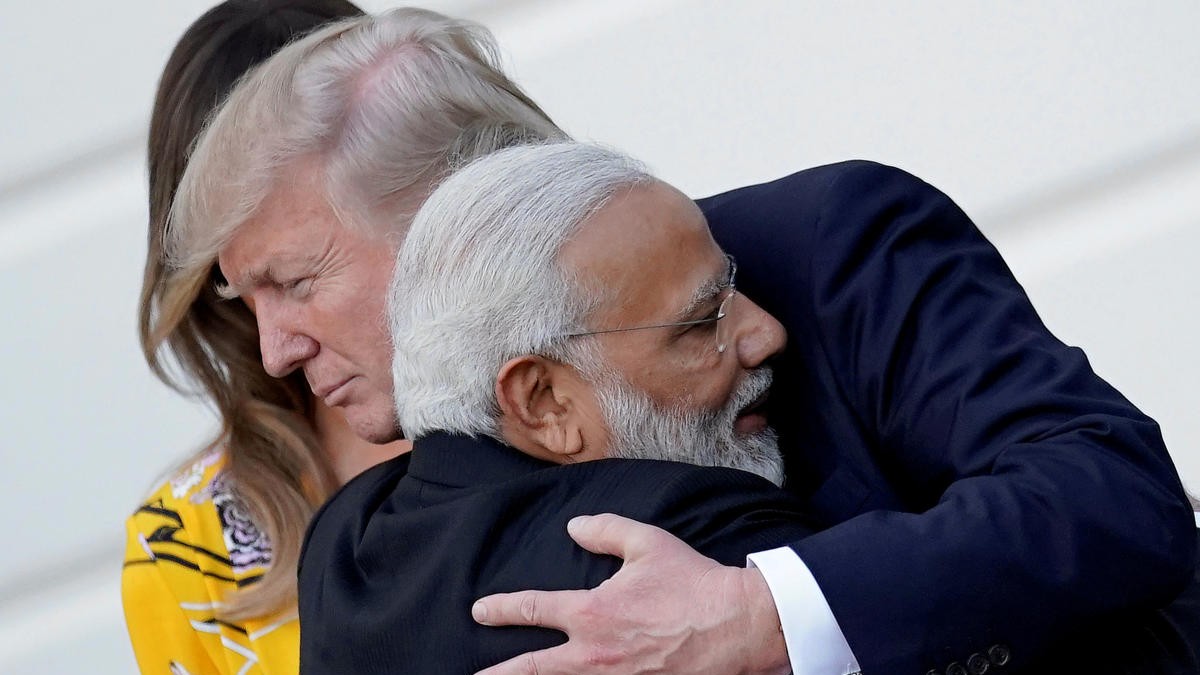
The India–US interim trade agreement has been marketed as a landmark achievement that opens markets, strengthens supply chains, and deepens strategic ties. Yet, beneath the celebratory headlines lies a deal that many in India view as lopsided, coercive, and fraught with long-term risks.
Whether it ultimately proves to be a stepping stone toward a genuinely balanced partnership—or a costly concession extracted under pressure—will depend on how the next phase of negotiations unfolds. For now, the deal stands as a stark reminder that in global trade politics, power dynamics matter just as much as principles.
With inputs from agencies
Image Source: Multiple agencies
© Copyright 2025. All Rights Reserved. Powered by Vygr Media.