 By

West Bengal has the highest number of sitting MPs and MLAs who have declared cases related to crimes against women, followed by Andhra Pradesh and Odisha. The findings of a nationwide analysis by the Association for Democratic Reforms (ADR) have raised fresh questions about candidate selection, political accountability and the need for faster trials in India.
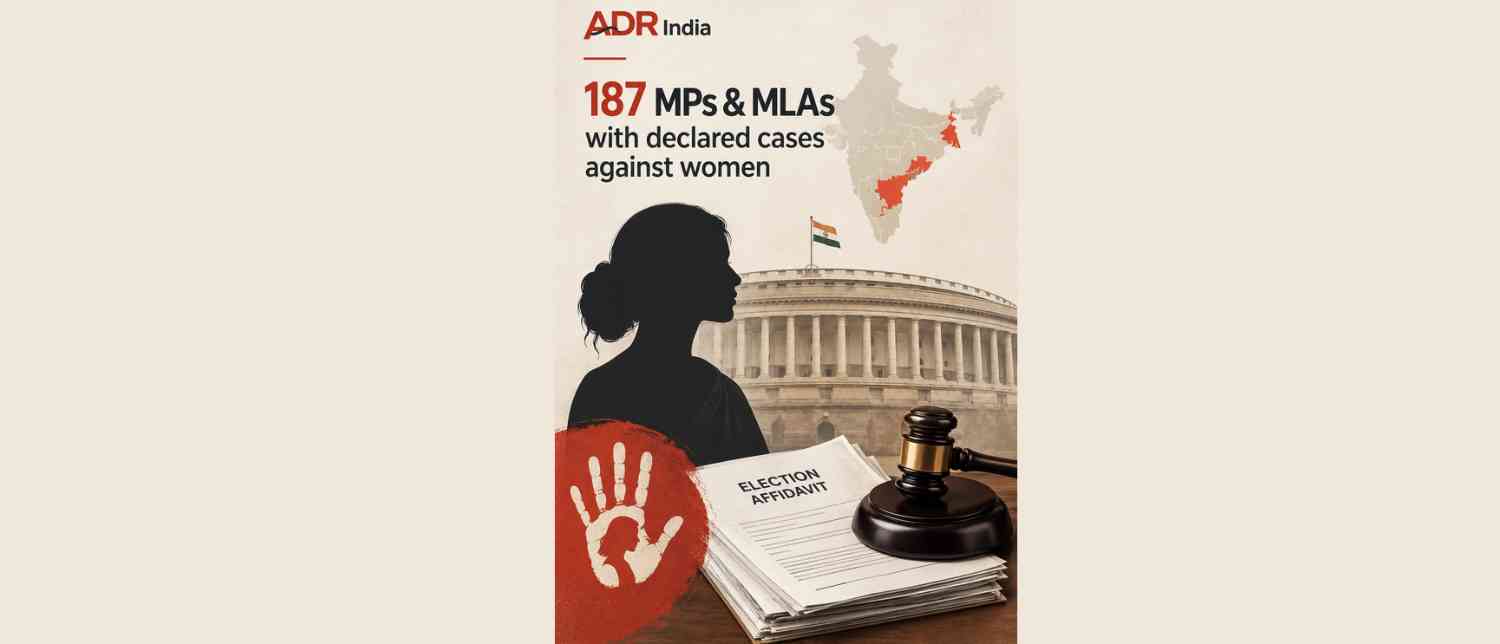
India’s political landscape faces renewed scrutiny after a nationwide analysis found that 187 sitting Members of Parliament (MPs) and Members of Legislative Assemblies (MLAs) have declared cases related to crimes against women in their election affidavits. The report, published by ADR India and National Election Watch in October 2026, examines criminal cases declared by elected representatives in affidavits submitted during elections over the past five years.
Of particular concern is the presence of elected representatives who have declared cases involving serious allegations, including rape. The analysis identified 14 sitting MPs and MLAs who have declared rape-related cases, highlighting the need for closer public scrutiny and timely judicial proceedings.
However, an important distinction must be maintained: a declared criminal case is not the same as a conviction. The analysis is based on candidates’ election affidavits and does not establish the current status or final outcome of every case. Nevertheless, the findings raise significant questions about electoral transparency, candidate selection and the standards expected of public representatives.
ADR India Report 2026: Key Findings at a Glance
The ADR India report, titled Analysis of Sitting MPs/MLAs with Declared Cases Related to Crimes Against Women, provides a nationwide assessment of election affidavits filed by sitting legislators.
Its principal findings include:
-
187 sitting MPs and MLAs have declared cases related to crimes against women.
-
19 MPs and 168 MLAs account for the total.
-
West Bengal leads the state-wise list with 69 representatives, followed by Andhra Pradesh with 22 and Odisha with 17.
-
14 sitting MPs and MLAs have declared rape-related cases, including cases involving repeated rape of the same woman.
-
The Bharatiya Janata Party (BJP) has the highest absolute number of representatives with declared cases related to crimes against women, followed by the Indian National Congress (INC) and the Telugu Desam Party (TDP).
These findings are based on an examination of 4,881 election affidavits out of 4,899 available affidavits covering sitting MPs and MLAs. The analysis includes 772 of 776 sitting MPs and 4,109 of 4,123 sitting MLAs, drawing on election affidavits filed between 2022 and 2026, including relevant by-elections.
The numbers offer a broad picture of declared criminal cases among elected representatives. They do not, by themselves, determine guilt or establish the present legal status of every allegation.
West Bengal Tops the List With 69 MPs and MLAs
West Bengal has emerged as the state with the highest number of sitting MPs and MLAs who have declared cases related to crimes against women. According to the report, 69 elected representatives from the state feature in the analysis.
The total comprises 63 MLAs, four Lok Sabha MPs and two Rajya Sabha MPs. Their election affidavits contain declarations of cases involving alleged offences against women, with the reported categories ranging from rape and sexual harassment to stalking, intimidation and other offences.
The figures place West Bengal significantly ahead of the next two states in the ranking.
Andhra Pradesh comes second with 22 sitting MPs and MLAs who have declared such cases, while Odisha ranks third with 17. The gap between West Bengal and Andhra Pradesh is substantial, making the state's position the most prominent finding of the nationwide assessment.
The state-wise figures are important because they identify where the largest absolute number of elected representatives with these declared cases is concentrated. However, they should not automatically be interpreted as a measure of the prevalence of crimes against women in each state. The number of representatives, the size of legislatures and the number of cases declared all influence the comparison.
The findings nevertheless place the spotlight on candidate-selection processes in West Bengal and the scrutiny applied to nominees seeking public office.
For voters, the central question is not merely how many representatives appear in the report, but whether parties adequately explain their decisions to nominate candidates with declared criminal cases and whether the public receives enough information to make informed electoral choices.
ADR India Report 2026: Key Statistics at a Glance
| Category | Key findings |
|---|---|
| MPs and MLAs with declared cases related to crimes against women | 187 |
| Sitting MPs | 19 |
| Sitting MLAs | 168 |
| West Bengal | 69 |
| Andhra Pradesh | 22 |
| Odisha | 17 |
| MPs and MLAs with declared rape-related cases | 14 |
| BJP representatives with declared cases related to crimes against women | 106 |
| Congress representatives with declared cases related to crimes against women | 20 |
| TDP representatives with declared cases related to crimes against women | 18 |
| Election affidavits analysed | 4,881 |
| Registered cases of crimes against women in India in 2024, as cited in the report | 4,41,534 |
Source: Association for Democratic Reforms (ADR) and National Election Watch. Figures are based on the report's analysis of declared cases and election affidavits. Declared cases do not establish guilt or indicate that every case remains pending.
187 MPs and MLAs Have Declared Cases Related to Crimes Against Women
The national figures reveal that the issue extends beyond any single state or political organisation. Of the 4,881 election affidavits analysed, 187 sitting MPs and MLAs have declared cases related to crimes against women.
The breakdown includes 19 sitting MPs and 168 sitting MLAs. This means that legislators in state assemblies account for the overwhelming majority of the representatives identified in the report.
The distinction matters because MPs and MLAs exercise considerable public authority. Members of Parliament participate in national lawmaking, scrutinise government policy and represent constituencies in the Lok Sabha or Rajya Sabha. MLAs legislate at the state level, raise local concerns and hold state governments accountable through legislative processes.
Consequently, the criminal cases declared by elected representatives are not simply a matter of individual reputation. They also raise broader questions about the standards political parties apply when choosing candidates and how voters assess the people seeking their support.
The analysis draws on Form 26 affidavits submitted to the Election Commission of India during nomination proceedings between 2022 and 2026. These documents provide voters with information about candidates' declared criminal cases and other relevant background details.
However, the report does not independently establish the latest status of every case. Some matters may have progressed through the courts, while others may remain under investigation or await further judicial proceedings. The findings should therefore be understood as an assessment of declared cases recorded in the analysed affidavits, rather than a definitive account of current convictions or pending proceedings.
BJP Leads in Absolute Numbers, Followed by Congress and TDP
The party-wise findings place the BJP at the top in terms of the absolute number of sitting MPs and MLAs who have declared cases related to crimes against women.
According to ADR India, 106 representatives belonging to the BJP have declared such cases. The Indian National Congress follows with 20 representatives, while the Telugu Desam Party has 18.
These figures put the BJP well ahead of the other parties in the report's overall count. However, the absolute numbers alone do not provide a complete picture of the relative concentration of such cases within each party.
A party with a larger presence in Parliament and state assemblies may naturally have more representatives in a nationwide count. Comparing the number of representatives with declared cases against each party's overall legislative strength can offer an additional perspective.
The analysis reported that the proportion was highest for the TDP at 11.6 per cent, followed by the BJP at 4.9 per cent and Congress at 2.6 per cent. These percentages provide a different way to interpret the figures, rather than relying exclusively on the raw totals.
The broader lesson is that political accountability cannot be assessed through party-wise rankings alone. Voters need transparent information about individual candidates, the nature of the cases declared, their procedural status and the reasons a party considers a candidate suitable for nomination.
The figures also underline the importance of applying consistent standards across political parties. Concerns about candidates' criminal backgrounds are relevant regardless of their party affiliation, electoral popularity or position within the political establishment.
14 MPs and MLAs Have Declared Rape-Related Cases
Among the report's most serious findings is the identification of 14 sitting MPs and MLAs who have declared cases related to rape, including repeated rape of the same woman.
The group comprises two sitting Lok Sabha MPs and 12 sitting MLAs.
These declarations concern offences covered by Sections 376 and 376(2)(n) of the Indian Penal Code, as specified in the analysis. The report records the legal provisions cited in the relevant election affidavits; it does not establish that every individual concerned has been convicted.
The party-wise breakdown shows that the BJP and Congress each have four sitting MPs or MLAs who have declared rape-related cases. In the BJP, the total comprises two MPs and two MLAs, while all four representatives identified for Congress are MLAs.
The report also identifies one sitting MLA each from the TDP, All India Trinamool Congress, Biju Janata Dal, National People's Party, Bharat Adivasi Party and All India Secular Front.
The presence of representatives with declared rape-related cases makes the wider debate over criminal backgrounds in electoral politics particularly urgent. Such allegations concern grave offences, and their handling demands both respect for due process and a commitment to ensuring that serious cases are not allowed to languish indefinitely.
The report's findings also highlight the need for accurate public information. Allegations must not be presented as proven guilt, but neither should the existence of serious declared cases be overlooked when examining candidate selection and political accountability.
For voters, the practical implication is clear: election affidavits should be treated as an important source of information, and political parties should be prepared to explain their decisions when nominating candidates with serious criminal cases.
What Types of Crimes Against Women Are Covered?
The analysis encompasses a range of offences related to crimes against women, rather than focusing exclusively on rape.
The categories described in the reported findings include:
-
Rape and repeated rape of the same woman.
-
Acid attacks.
-
Sexual harassment.
-
Offences involving outraging a woman's modesty.
-
Abduction or intimidation intended to compel a woman to marry.
-
Stalking and other offences involving alleged intimidation or harassment.
The range of allegations underscores why a single overall figure cannot explain every case. Different offences involve different legal provisions, factual circumstances and stages of judicial proceedings.
Some cases may involve allegations of sexual violence, while others concern harassment, threats or other offences against women. The seriousness and legal implications of each matter must be assessed individually.
It is equally important to distinguish between the number of representatives and the number of criminal cases. The report identifies 187 legislators with declared cases related to crimes against women; that figure should not be interpreted as the total number of individual cases or as evidence that all the cases involve the same type of offence.
This distinction is essential for responsible reporting. The purpose of analysing election affidavits is to improve transparency and help the public evaluate candidates, not to replace the judicial process or prejudge the outcome of a case.
Criminal Backgrounds in Politics: Why Candidate Selection Matters
The ADR India findings bring renewed attention to a long-standing concern in Indian electoral politics: the selection of candidates who have declared criminal cases.
Political parties play a central role in determining who contests elections under their banners. Their choices influence the range of candidates available to voters and, ultimately, who occupies positions of public authority.
The question becomes particularly significant when a candidate has declared a serious criminal case involving an alleged offence against women. In such circumstances, voters may reasonably expect a clear explanation of the nomination decision, alongside accessible information about the allegations and their legal status.
The Supreme Court addressed transparency in candidate selection in February 2020, directing political parties to publish information about candidates with criminal antecedents and explain the reasons for selecting them. The disclosure framework is intended to help voters understand candidates' backgrounds and the considerations behind parties' decisions.
ADR India has argued that political parties continue to fall short of the transparency standards required by the court's directions. Its latest analysis again places the implementation of those requirements under scrutiny.
The issue is not simply whether information is technically available. For disclosure to serve its purpose, it must be accessible, sufficiently detailed and presented in a way that enables voters to make meaningful comparisons.
Political parties also face a broader question of public trust. Their decisions on candidate selection can influence perceptions of their commitment to women's safety, the rule of law and accountability in public life.
A transparent explanation of a nomination decision does not determine the outcome of a criminal case. Instead, it allows voters to evaluate the party's reasoning while the judicial process proceeds independently.
ADR India Recommendations: What Needs to Change?
In response to the findings, ADR India has recommended a series of measures intended to address the presence of candidates with criminal backgrounds in electoral politics.
1. Debar candidates with criminal backgrounds from contesting elections
One recommendation calls for candidates with criminal backgrounds to be barred from contesting elections. This proposal raises important questions about the design of eligibility rules, the stage at which restrictions should apply and how safeguards for due process should operate.
Any such change would require careful consideration of the distinction between allegations and convictions, as well as the legal framework governing electoral disqualification.
2. Permanently disqualify candidates convicted of heinous crimes
ADR India has recommended permanent disqualification from contesting elections for candidates convicted of heinous crimes, including rape.
This proposal focuses specifically on convictions, which are legally distinct from allegations or cases declared in election affidavits. It reflects the argument that serious criminal convictions should carry substantial consequences for eligibility to hold elected office.
3. Avoid appointing candidates with serious criminal backgrounds as ministers
The organisation has also recommended that individuals with serious criminal backgrounds, particularly cases involving crimes against women, should not be appointed ministers.
The proposal brings attention to executive appointments as well as elections. A candidate's selection for a ministerial position involves an additional assessment of public responsibility and the standards expected of someone exercising executive authority.
4. Impose stronger penalties for non-compliance with disclosure requirements
ADR India has called for substantial financial penalties against political parties that disregard Supreme Court directions on publishing candidates' criminal antecedents and explaining their selection.
It has also recommended holding the party officials responsible for compliance accountable.
Such measures would aim to make disclosure obligations more than a procedural formality. If parties are expected to provide meaningful information to voters, there must also be mechanisms to encourage compliance and address failures to meet the required standards.
5. Ensure time-bound investigations and trials
The report's findings have also renewed calls for time-bound investigations and trials in criminal cases involving politicians.
Expeditious proceedings can help prevent serious cases from remaining unresolved for extended periods. Timely judicial decisions also serve the interests of all parties by reducing prolonged uncertainty and allowing cases to be decided on the evidence.
At the same time, speed must not come at the expense of fairness. Investigations and trials need to preserve due process, protect the rights of complainants and accused persons, and maintain the independence of the judiciary.
Together, these recommendations place responsibility on political parties, enforcement agencies and the justice system, while leaving voters better informed about the candidates seeking public office.
Crimes Against Women in India: The Wider Context
The political implications of the findings become clearer when viewed against the broader national picture.
According to the National Crime Records Bureau figures cited in the ADR India report, India registered 4,41,534 cases of crimes against women in 2024. This amounts to approximately 1,210 registered cases per day.
These figures provide context for the public concern surrounding crimes against women. However, they measure registered cases nationally and should not be directly equated with the number of legislators who have declared such cases in their election affidavits.
The two datasets address different questions. National crime statistics track reported offences recorded by authorities, while the ADR India analysis examines declarations made by elected representatives in their election affidavits.
Even so, the juxtaposition highlights why transparency, institutional accountability and access to justice remain important public issues.
Women's safety cannot be addressed through electoral disclosures alone. Effective policing, accessible complaint mechanisms, sensitive investigation procedures, timely trials and support for survivors are all important parts of a wider response.
At the same time, elected representatives occupy positions of public trust. Greater transparency about declared criminal cases can help voters assess whether political parties are exercising due diligence when selecting candidates.
What the ADR India Report Means for Voters
For voters, the report offers a reminder that election decisions involve more than party manifestos, campaign promises and political affiliations.
Election affidavits provide an opportunity to examine a candidate's declared criminal background before casting a ballot. Voters can use these disclosures to seek clarification, compare candidates and ask political parties to explain their nomination decisions.
The findings also reinforce the importance of separating factual scrutiny from political rhetoric. A declared case deserves attention, but its legal status must be accurately represented. A pending allegation should not be reported as a conviction, and a party's political identity should not substitute for examining the available evidence.
Political parties, meanwhile, have an opportunity to strengthen public confidence through consistent disclosure practices, clear explanations of candidate selection and cooperation with lawful judicial proceedings.
Civil society organisations, journalists and voters can contribute by making publicly available information easier to understand and by keeping attention on whether disclosure requirements are being followed.
Ultimately, transparency is most valuable when it enables informed decisions rather than merely generating headlines.
Political Accountability Must Go Beyond Disclosure
The ADR India report has placed an uncomfortable but important question before India's political establishment. With 187 sitting MPs and MLAs declaring cases related to crimes against women, the findings demand closer attention to candidate selection, disclosure practices and the progress of criminal proceedings.
West Bengal's position at the top of the state-wise ranking, followed by Andhra Pradesh and Odisha, makes the issue particularly prominent. The party-wise figures and the 14 representatives who have declared rape-related cases add further urgency to the debate.
Yet the numbers must be interpreted carefully. Election affidavits record declared information, and the current status of individual cases may differ. The findings are not a substitute for court judgments and should not be treated as proof of guilt.
The wider challenge is to ensure that voters have reliable information, political parties are accountable for their choices, and serious criminal cases proceed through fair and timely legal processes.
A stronger democracy depends not only on the right to vote, but also on the ability of voters to make informed choices. Transparent candidate selection, meaningful enforcement of disclosure requirements and timely justice can help strengthen public confidence in India's democratic institutions.
© Copyright 2026. All Rights Reserved. Powered by Vygr Media.