 By

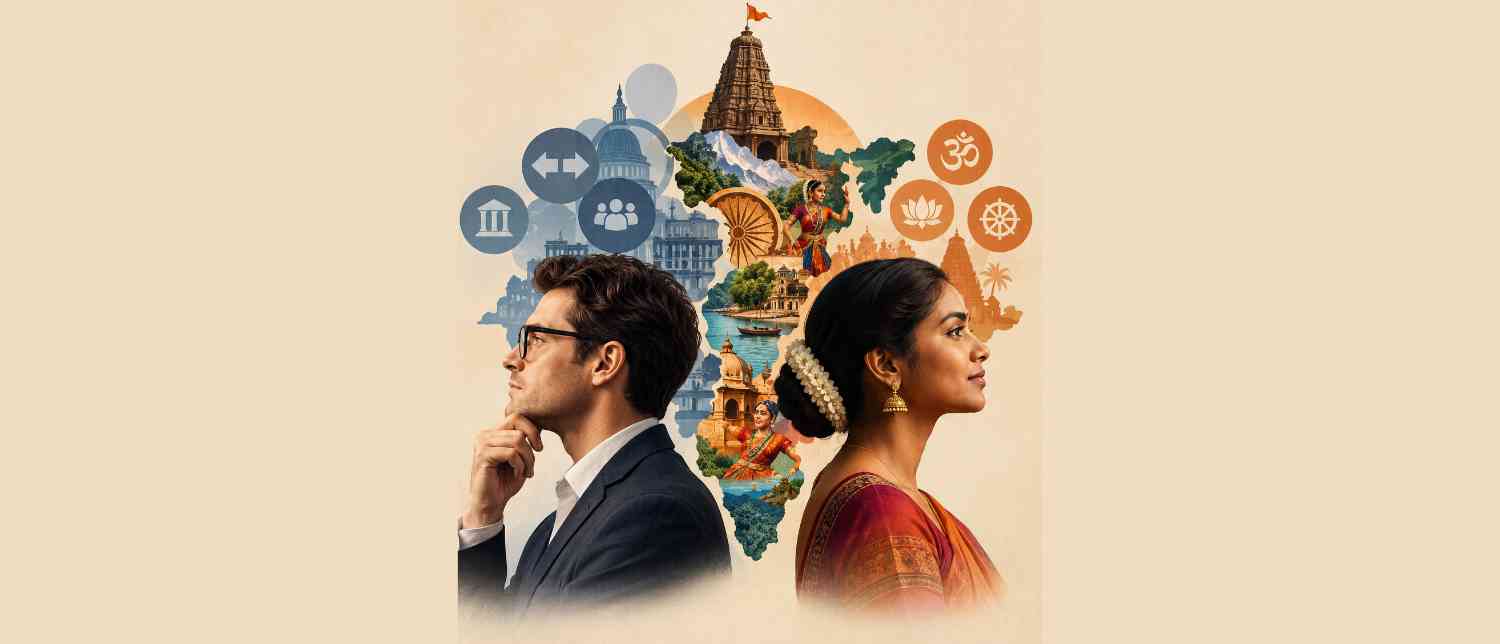
India is often described as a contradiction. It is a country where ancient spiritual traditions coexist with artificial intelligence, where religious devotion shares space with scientific ambition, where cultural conservatism can exist alongside ambitious welfare programmes, and where hundreds of languages and diverse communities contribute to a shared national identity. For many outside observers, these realities appear difficult to reconcile. But perhaps the problem is not India’s complexity. Perhaps it is the narrowness of the frameworks used to understand it.
For decades, much of the global conversation about India has been shaped by ideas developed in Europe and North America. Concepts such as individualism, secularism, nationalism, capitalism, socialism and religious identity have provided useful tools for interpreting Western societies. Yet when these categories are applied to India without considering its distinct history, philosophical traditions and social structures, they can produce misleading conclusions.
The debate over why the West struggles to understand India is therefore about more than cultural differences. It raises a fundamental question: can a civilisation with its own intellectual traditions, historical experiences and social realities be understood accurately through frameworks developed elsewhere?
India does not exist outside the modern world, nor is it immune to criticism. Its democratic institutions, social inequalities, religious tensions, economic priorities and political choices deserve rigorous scrutiny. But meaningful criticism requires an accurate understanding of the society being criticised.
The challenge is not to reject Western ideas altogether. It is to recognise their limitations, question their universal application and make room for an Indian perspective that cannot always be reduced to familiar Western categories.
Understanding India Through a Western Lens: Where the Disconnect Begins
Western political and philosophical thought developed through particular historical experiences, including the European Enlightenment, the Reformation, the rise of modern nation-states, industrial capitalism and struggles over individual rights. These experiences shaped how many Western societies understand religion, political authority, freedom and social progress.
India followed a different historical trajectory. Its civilisation evolved through centuries of philosophical debate, religious movements, regional kingdoms, migrations, cultural exchanges and social transformations. Colonial rule subsequently reshaped its institutions, economy and political structures, leaving an enduring influence on modern Indian society.
These histories are neither entirely separate nor mutually exclusive. India has absorbed ideas from outside its borders, just as European societies have been influenced by the wider world. The problem arises when one historical experience is treated as the universal standard against which every other society must be measured.
For example, Western observers may interpret a political movement primarily through the familiar categories of liberalism, conservatism or populism. An Indian observer, however, may also consider its relationship with civilisational memory, religious symbolism, regional identity, social mobility and national sovereignty.
Both perspectives can reveal something important. But the first becomes inadequate when it assumes that its own categories explain the entire picture.
This is the central limitation of interpreting India through a Western lens: a framework designed to explain one society can illuminate another without necessarily capturing its full reality.
India's complexity is not evidence that it defies reason or analysis. It is evidence that analysis must begin with the society's actual historical and cultural context rather than forcing its experiences into predetermined categories.
Indian Philosophy Goes Beyond Simple Binaries
One of the biggest differences between Indian and Western intellectual traditions lies in how they approach competing ideas, conflicting truths and the nature of existence.
Modern Western political discourse frequently relies on binaries: left versus right, secular versus religious, individual versus collective, and tradition versus progress. These distinctions can be useful, particularly when examining political institutions or competing policy positions. However, they can also create artificial divisions when applied too rigidly.
Indian philosophical traditions offer a more varied intellectual landscape. The Sanskrit term darshana, commonly understood as a philosophical viewpoint or way of seeing, reflects a long history of inquiry into existence, knowledge, consciousness and the nature of reality.
Indian thought includes schools that differ profoundly in their assumptions. Advaita Vedanta explores non-duality, while other Vedantic traditions maintain distinctions between the individual self and the divine. Buddhist and Jain philosophies offer distinctive accounts of existence, knowledge and liberation. The Charvaka tradition is associated with materialist thought and scepticism towards religious authority.
These traditions do not agree on everything. Their significance lies partly in the fact that disagreement itself has been an enduring feature of India's intellectual history.
The Jain principle of anekantavada, or the multiplicity of viewpoints, provides one example of an approach that cautions against assuming that a complex reality can always be captured from a single perspective. It does not mean that every claim is equally true. Rather, it encourages recognition that a question may require several angles of examination.
This philosophical diversity challenges the assumption that a society must fit neatly into one ideological or intellectual category.
Consider the relationship between tradition and modernity. In some Western narratives, traditional religious practices are presented as obstacles to individual freedom or scientific progress. In India, the relationship is often more complicated. A person may embrace modern medicine, work in a global technology company, practise yoga, participate in religious festivals and support scientific research without necessarily experiencing these commitments as contradictory.
Of course, such coexistence does not eliminate genuine conflicts between tradition and modern values. It simply demonstrates that the relationship is not always an either-or choice.
India's intellectual traditions encourage us to examine how apparently contradictory ideas coexist, rather than assuming that one must automatically eliminate the other.
Dharma Is Not Simply Another Word for Religion
Another reason India is frequently misunderstood is the difficulty of translating its philosophical concepts into familiar Western terminology.
The word dharma is often translated as religion. Yet this translation can be incomplete, depending on the context.
In different Indian traditions, dharma can refer to duty, ethical conduct, social responsibility, the sustaining order of existence or the appropriate way of living. Its meaning varies across philosophical, religious and social contexts. It cannot be reduced to one universal definition, nor should it be treated as an exact equivalent of a Western concept.
The modern Western understanding of religion has been shaped significantly by historical developments involving organised churches, competing denominations, doctrines, religious authority and the relationship between religious institutions and the state. Those experiences influence how religion is discussed in contemporary politics.
Indian traditions have developed through a different combination of ritual practices, philosophical schools, devotional movements, sacred narratives, community customs and institutions. Many forms of Indian religiosity do not depend on adherence to one universally binding creed or a single central religious authority.
This distinction matters when analysing Indian society. A framework that expects religion to function primarily as a set of fixed beliefs may overlook the importance of practice, family traditions, festivals, pilgrimage, ethical obligations and locally interpreted customs.
It is equally important, however, not to romanticise the distinction. Indian religious traditions also contain institutional hierarchies, exclusions, contested interpretations and struggles over authority. The diversity of Indian spirituality does not make every practice inherently tolerant or every tradition free from discrimination.
The more useful conclusion is that Indian concepts such as dharma require contextual interpretation rather than automatic translation into Western religious categories.
Understanding this difference can improve discussions of Indian identity, secularism, religious freedom and the relationship between faith and public life.
It can also prevent a common analytical mistake: assuming that the absence of familiar Western religious structures necessarily indicates the absence of a coherent religious or philosophical tradition.
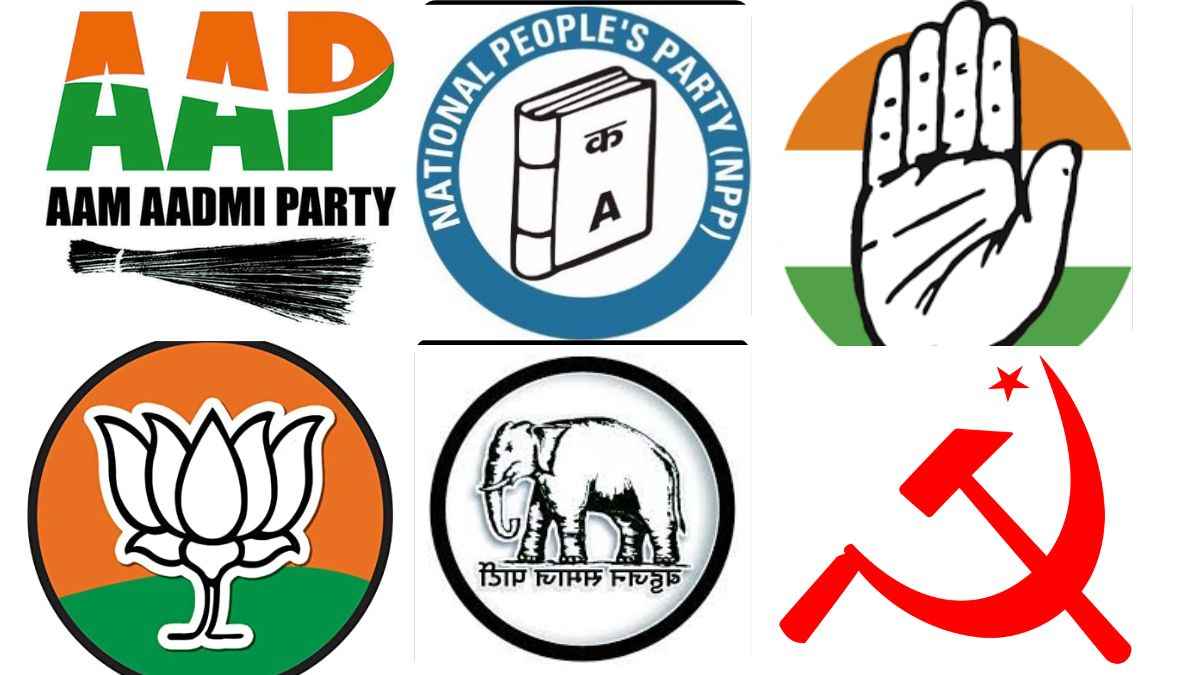
Why Western Left-Right Politics Cannot Fully Explain India
Few examples demonstrate the limits of imported political categories more clearly than India's complicated relationship with the ideological left and right.
In much of Western political discourse, the left is associated with redistribution, social welfare, labour rights and progressive social change, while the right is commonly associated with conservatism, national identity, traditional values and market-oriented economic policies. These are broad tendencies, not universal rules, but they often shape how international observers classify political movements.
India's political landscape does not always follow this pattern.
A party that emphasises cultural nationalism and religious identity may simultaneously support extensive public welfare programmes. A government that promotes private investment, entrepreneurship and economic growth may also expand food assistance, housing support, healthcare access, sanitation and financial inclusion.
Such combinations are not necessarily ideological contradictions. They reflect a political environment in which electoral legitimacy, social development, cultural identity, economic aspirations and the demands of a vast population interact.
The political debate surrounding Narendra Modi illustrates this complexity. International commentary frequently places his leadership within the framework of right-wing nationalism. That classification captures important elements of his political identity, but it cannot, by itself, explain every aspect of his government's policy agenda.
India's major welfare programmes, including subsidised food distribution and public healthcare initiatives, demonstrate that cultural conservatism and state-led social assistance can coexist. The scale, design, implementation and outcomes of these programmes remain legitimate subjects of debate, but their existence complicates the assumption that a right-wing government must necessarily pursue a narrowly minimal state.
India's electoral politics also operates within a distinctive environment. Caste coalitions, regional parties, rural livelihoods, religious identities, economic aspirations and demands for public services influence political behaviour alongside conventional ideological preferences.
A voter may support a party because of its cultural message, appreciate its welfare delivery, disagree with aspects of its economic policy and still make a pragmatic electoral choice. Another voter may prioritise employment, local leadership or regional autonomy above national ideological debates.
These motivations cannot always be placed on a single left-right spectrum.
This does not mean that ideological differences are irrelevant in India. Nor does it mean that every political combination is uniquely Indian. Other democracies also mix welfare policies with conservative values. The point is that political labels must be tested against actual policies, institutions and voter behaviour.
To understand Indian politics, it is necessary to examine what parties do, whom their policies serve and how voters interpret their choices—not merely where foreign observers place them on an ideological map.
India Is More Than a Modern Nation-State
The distinction between a nation-state and a civilisation is another important part of this debate.
The modern European nation-state emerged through a long and uneven process involving territorial consolidation, state-building, political centralisation and changing ideas of national identity. In some cases, national unity was associated with a dominant language, shared historical narratives or efforts to establish common institutions.
India's national identity developed through a different combination of political and cultural experiences. Its civilisation predates the modern republic by many centuries, while its present constitutional and democratic institutions emerged through the independence movement and the establishment of the Republic of India in 1950.
The modern Indian state is not simply an ancient civilisation preserved unchanged. It is a contemporary political entity shaped by colonial rule, partition, constitutional negotiations, democratic movements and ongoing social transformation.
Nevertheless, civilisational memory remains an important part of how many Indians understand their country.
India's cultural geography encompasses pilgrimage routes, philosophical traditions, epics, artistic practices, festivals and historical connections that cross present-day state boundaries. These shared references coexist with powerful regional identities rather than replacing them.
The country recognises 22 languages in the Eighth Schedule of its Constitution, while countless regional speech varieties and dialects enrich everyday life. Tamil cultural history differs considerably from Bengali intellectual traditions; Punjabi identity cannot be reduced to the experience of Kerala; and the social realities of the Northeast cannot be understood solely through the experiences of metropolitan northern India.
Yet these differences do not automatically undermine national belonging.
India's constitutional framework accommodates diversity through federalism, linguistic states, democratic representation and protections for religious and cultural rights. National unity is continually negotiated through these institutions, public debates and competing political visions.
This is not to claim that India has always managed pluralism successfully. Linguistic disputes, regional tensions, communal violence and demands for greater autonomy demonstrate the continuing challenges of maintaining unity.
Rather, the Indian experience shows that national identity need not depend on complete cultural uniformity.
When outside observers expect India to behave like a culturally homogeneous state, they risk misunderstanding both the sources of its cohesion and the reasons behind its internal disagreements.
India's unity is not the absence of difference. It is an ongoing political and social process through which diverse communities negotiate a common future.
Individual Rights, Family and Community: The Indian Social Context
Western political philosophy has made significant contributions to the development of individual rights, personal liberty and the principle that individuals should be protected from arbitrary authority. These ideas have also influenced India's constitutional framework and its democratic aspirations.
However, social life in India is often experienced through overlapping relationships involving family, community, caste, religion, region and occupation. For many people, identity is not merely a personal declaration; it is also shaped by social obligations, inherited circumstances and collective affiliations.
Family networks can provide financial support, childcare, emotional security and assistance during periods of crisis. Community institutions can help people navigate migration, employment, education and social change. Such relationships remain important even as urbanisation, education and economic mobility transform how Indians live.
A purely individualistic model of society may therefore miss important dimensions of Indian social behaviour.
At the same time, the idea of an organic or naturally harmonious Indian community must be treated cautiously. Family expectations can restrict individual autonomy. Community authority can reinforce unequal power relationships. Caste discrimination, gender inequality and social exclusion can limit opportunities for those who do not conform to dominant expectations.
The same social networks that provide support to some individuals can impose restrictions on others.
This tension is central to understanding contemporary India. People negotiate personal ambition and collective responsibility, inherited customs and individual freedom, and social belonging and the desire for change.
For instance, a young Indian choosing a career, marriage partner or place of residence may weigh personal preferences alongside family expectations and financial responsibilities. Neither individual choice nor collective obligation necessarily determines the outcome on its own.
A meaningful account of Indian society must recognise both the protective and restrictive dimensions of community life.
It must also acknowledge that India is changing. Migration, digital communication, women's education, new employment opportunities and changing family structures are reshaping social relationships across generations.
The objective should not be to portray individualism as exclusively Western or collectivism as exclusively Indian. Both orientations exist in different forms across societies. The more useful question is how particular social institutions influence people's choices, freedoms and opportunities in the Indian context.
Why Intersectionality Must Account for India's Unique Social Realities
The limitations of imported frameworks become particularly visible when examining gender, inequality and social justice.
Intersectionality, a concept developed to explain how different forms of discrimination overlap, provides an important way to understand why people within the same broad social category may experience very different disadvantages.
However, its application to India requires careful attention to the country's specific social structures and historical experiences.
Consider the category of women. It is tempting to discuss women's experiences as though gender alone determines their social position. In reality, an urban professional woman from an economically privileged background may face very different barriers from a rural woman experiencing poverty, a Dalit woman confronting caste discrimination, or a woman from a marginalised tribal community navigating limited access to education and healthcare.
Religion, caste, class, disability, language, region and access to institutions can all influence how gender inequality is experienced.
These factors do not simply add separate disadvantages together. They can interact in ways that shape employment opportunities, personal safety, political participation, access to justice and control over economic resources.
Caste is particularly important. Its historical development cannot be adequately explained through one simple narrative, and its present-day effects vary across regions and communities. Nevertheless, caste-based exclusion and discrimination remain real concerns that cannot be dismissed as merely historical or cultural differences.
The interaction between gender and religious personal laws also illustrates the complexity of Indian debates. Questions concerning marriage, divorce, inheritance and family rights involve constitutional principles, religious freedom, gender justice and competing interpretations of equality.
These issues cannot be resolved by assuming that either individual rights or community autonomy should automatically prevail in every situation. They require careful legal analysis, attention to the people affected and a willingness to confront unequal power structures.
An Indian approach to intersectionality should therefore do two things simultaneously: learn from established international scholarship and develop analyses grounded in local experiences.
The objective is not to reject a concept because it originated elsewhere. Nor is it to claim that Indian society is so unique that external intellectual tools have nothing to offer.
Instead, it is to ensure that those tools remain responsive to the realities they are intended to explain.
Social justice becomes more effective when theories are adapted to the people, institutions and inequalities they seek to address, rather than applied as universal templates.
Colonial History Still Shapes How India Sees the West
Any serious discussion of India and Western perceptions must confront the legacy of colonialism.
British rule transformed India's political institutions, economy, administrative systems and legal structures. It also influenced how Indian society was described, classified and interpreted. Colonial administrators frequently relied on categories that simplified complex communities into fixed identities, often making local populations easier to govern.
The consequences of colonialism were not limited to material exploitation or political subordination. Colonial narratives also shaped perceptions of cultural authority, modernity and civilisation. India was frequently portrayed through stereotypes that emphasised exotic customs, poverty and supposed backwardness, reinforcing the idea that Western intervention was necessary for progress.
Such representations have not disappeared entirely. Even today, some international commentary can reduce India to a familiar collection of images: overcrowded cities, religious conflict, poverty, spiritual exoticism or political disorder. These subjects may reflect genuine realities, but they become misleading when they dominate coverage while India's scientific achievements, technological capabilities, cultural diversity and institutional complexity receive less attention.
The problem is not that international media should avoid negative stories about India. A free press must be able to investigate corruption, discrimination, abuses of power and failures of governance. The problem arises when criticism relies on inherited stereotypes or applies different standards to comparable situations in different countries.
Historical memory helps explain why such representations can provoke strong reactions among Indians. An image that one audience considers harmless satire may remind another of generations of cultural humiliation and racial stereotyping.
Understanding this reaction does not require accepting every accusation of bias. It requires recognising that media interpretation takes place within a historical context.
India, too, must be willing to examine its own historical narratives critically. Colonialism should not become a universal explanation for every contemporary problem, nor should historical grievances prevent honest discussion of domestic failures.
The constructive path lies between historical amnesia and permanent resentment: acknowledging the past while evaluating present-day events through evidence, consistency and mutual respect.
Strategic Autonomy: Why India Does Not Always Follow Western Expectations
India's foreign policy offers another clear example of the limits of interpreting the country through a Western lens.
International relations are often discussed through competing geopolitical camps, alliances and ideological partnerships. From this perspective, countries are sometimes expected to align consistently with a particular bloc, especially during periods of international tension.
India's approach has historically placed considerable emphasis on strategic autonomy: the ability to make foreign policy decisions according to national interests rather than automatically following the preferences of a powerful partner.
This approach has roots in India's experience of colonial rule, its early commitment to non-alignment and its long-standing concern with preserving independent decision-making. Although India's foreign policy has evolved significantly, the desire to retain strategic flexibility remains important.
Consequently, India may deepen security cooperation with Western countries while maintaining relationships with Russia, engaging with countries across the Global South and pursuing economic partnerships with competing powers.
Such decisions can frustrate governments that expect greater alignment on particular international issues. They may also create genuine policy disagreements involving security, trade, technology or human rights.
Yet disagreement should not automatically be interpreted as hostility or a lack of principle.
For India, strategic autonomy can be a practical response to its geography, energy requirements, defence needs, development priorities and assessment of international risks. A country with a large population and extensive domestic challenges has strong incentives to evaluate foreign policy decisions according to their consequences at home.
This does not mean that every decision made in the name of national interest is necessarily wise or justified. Strategic autonomy must still be assessed in terms of outcomes, consistency and long-term costs.
However, understanding India's perspective requires asking why a particular decision makes sense within its own strategic calculations, rather than judging it exclusively by whether it matches Western expectations.
For Europe and the United States, the lesson is straightforward: meaningful partnerships require an understanding of India's priorities, not merely demands for alignment.

Understanding India Requires More Than Defending It
There is an important danger in arguments about the failure of Western frameworks: the temptation to replace one oversimplification with another.
India is not a single, unified voice. Its citizens disagree intensely about religion, nationalism, caste, gender, economic policy, freedom of expression and the role of the state. Different regions and communities hold competing ideas about what India is and what it should become.
Nor is everything that can be described as Indian necessarily better suited to Indian society. Domestic traditions can preserve wisdom, but they can also sustain inequality. Cultural continuity can provide belonging, but it can also become a justification for exclusion. Civilisational pride can encourage confidence, but it can become counterproductive if it discourages self-criticism.
Likewise, Western intellectual traditions are not inherently incapable of understanding India. Comparative political science, human rights scholarship, feminist theory, economic analysis and historical research can all contribute valuable insights when applied thoughtfully.
The real problem is intellectual rigidity: the assumption that a familiar framework must be correct simply because it has been influential elsewhere.
A better approach begins with curiosity. It asks how historical experience shapes contemporary attitudes, how institutions interact with local customs, how policies work in practice and how people understand their own circumstances.
It also distinguishes between explaining a social phenomenon and defending it. Understanding why a practice persists does not make that practice immune to criticism. Understanding why Indians value strategic autonomy does not require endorsing every foreign policy decision. Recognising the importance of civilisational identity does not justify ignoring minority rights.
The goal of understanding India should be neither uncritical admiration nor reflexive condemnation, but a more accurate and intellectually honest engagement with its realities.
India Must Be Understood on Its Own Terms
The question of why the West struggles to understand India ultimately exposes a broader problem in global intellectual and political debate: the tendency to treat historically specific ideas as universal standards.
India's philosophical diversity, complex social structures, civilisational memory, political combinations and strategic priorities cannot always be explained through conventional Western binaries. Its experiences demand approaches that account for local history, constitutional institutions, regional differences and the coexistence of competing social forces.
But understanding India on its own terms does not mean placing it beyond comparison, criticism or international scrutiny. It means beginning with context instead of assumptions.
For Western policymakers, journalists, scholars and businesses, this requires greater historical awareness and a willingness to engage with Indian perspectives without presuming that every disagreement reflects irrationality or defiance. For Indian thinkers and institutions, it requires developing frameworks that draw confidently from indigenous intellectual traditions while remaining open to useful ideas from around the world.
The future of India-West relations will depend partly on this intellectual adjustment. As India assumes a more prominent role in global affairs, superficial interpretations will become increasingly inadequate for understanding its decisions, ambitions and disagreements.
India is neither an inexplicable civilisation nor a puzzle that the West must solve. It is a diverse, changing society whose complexity deserves serious engagement.
Perhaps the most important lesson is this: understanding another civilisation begins when we stop asking why it does not fit our categories and start asking whether our categories are adequate to understand it.
© Copyright 2026. All Rights Reserved. Powered by Vygr Media.