 By
By 
US-based artificial intelligence company Anthropic has formally launched its first office in India, marking a significant expansion into what it now calls its second-largest global market for Claude.ai. The new Bengaluru office not only underscores India’s growing importance in the global AI ecosystem but also coincides with a strategic partnership between Anthropic and Infosys—a collaboration that could reshape how Indian IT firms position themselves in the era of generative and agentic AI.
Anthropic Opens Bengaluru Office, Doubles Down on India
Anthropic’s Bengaluru office is its second in Asia after Tokyo and will function as a central hub for enterprise, startup, and public-sector partnerships. The expansion reflects the rapid growth of Claude.ai in India, where usage patterns reveal a distinctive technical focus.
Nearly 50 percent of Claude usage in India is concentrated in computer and mathematical tasks, including application development, system modernisation, and production software deployment. Educational and instructional use cases account for 12 percent of usage, highlighting the platform’s emerging footprint in learning and skills development.
“India represents one of the world’s most promising opportunities to bring the benefits of responsible AI to vastly more people and enterprises,” said Irina Ghose, Managing Director of India at Anthropic. Ghose, who previously served as Managing Director of Microsoft India, will lead operations from Bengaluru. She pointed to India’s deep technical talent pool, scalable digital infrastructure, and strong track record of leveraging technology for social impact as critical advantages.
Anthropic is actively hiring across sales, management, and development roles in India. The company also revealed that its run-rate revenue in the country has doubled since announcing its India expansion plans in October 2025, signaling strong early momentum.
Enterprise and Startup Adoption Accelerates
Anthropic attributes its growth in India to widespread adoption across large enterprises, digital-native firms, and early-stage startups.
Among major enterprises, Air India is deploying Claude Code to help developers ship custom software faster and at lower cost. This initiative forms part of a broader strategy to integrate agentic AI into operational workflows.
Fintech firm CRED reported tangible performance gains, including two-times faster feature delivery and 10 percent better test coverage after implementing Claude Code. Meanwhile, IT services giant Cognizant is rolling out Claude to 350,000 employees globally to modernise legacy systems, accelerate software development, and support enterprise AI adoption.
Startup adoption has been equally robust. Razorpay has integrated AI into its risk systems, decision-making processes, and operations. Enterpret uses Claude to power its AI assistant and build daily with Claude Code. It has also shipped a Model Context Protocol integration that feeds customer insights directly into Claude.
Emerging AI-native companies are building entirely on Anthropic’s platform. Emergent, which enables users to create software using plain-language prompts, reached $25 million in annual recurring revenue and two million users in under five months—built entirely with Claude.
To deepen engagement, Anthropic plans to provide applied AI expertise to enterprises, digital-native firms, and startups, helping them design, build, and scale Claude-powered solutions tailored to business needs.
Expanding into Education, Judiciary, and Agriculture
Education represents a growing segment of Claude’s India footprint. Pratham, one of India’s largest education nonprofits, has selected Anthropic as its first strategic AI lab partner.
Pratham’s Anytime Testing Machine, powered by Claude, is currently being piloted with 1,500 students across 20 schools. The programme is expected to expand to 100 schools by the end of 2026. The same system was earlier adapted for more than 5,000 learners in Pratham’s Second Chance programme, which supports women who have dropped out of formal schooling.
Anthropic is also collaborating with Central Square Foundation to provide technical mentorship, expertise, and API credits to organisations building AI-enabled tools. These include personalised tutors, teacher coaching solutions, and assessment-driven instruction aimed at underserved communities.
Beyond education, Anthropic is supporting judicial innovation. India currently faces around 50 million pending court cases. In response, Anthropic is working with Adalat AI to launch a national WhatsApp helpline. The service will provide instant case updates, translation, document summarisation, and interactive querying of legal documents in Indian languages.
Agriculture, which accounts for nearly one-sixth of India’s economy and employs close to half of its labour force, is another focus area. Anthropic is collaborating with EkStep Foundation through the OpenAgriNet initiative to deploy Claude in ways that broaden farmers’ access to expert knowledge.
Together, these efforts signal Anthropic’s intention to embed responsible AI across India’s public systems and development sectors—not just private enterprises.
Infosys-Anthropic Partnership Reignites AI Debate in Indian IT
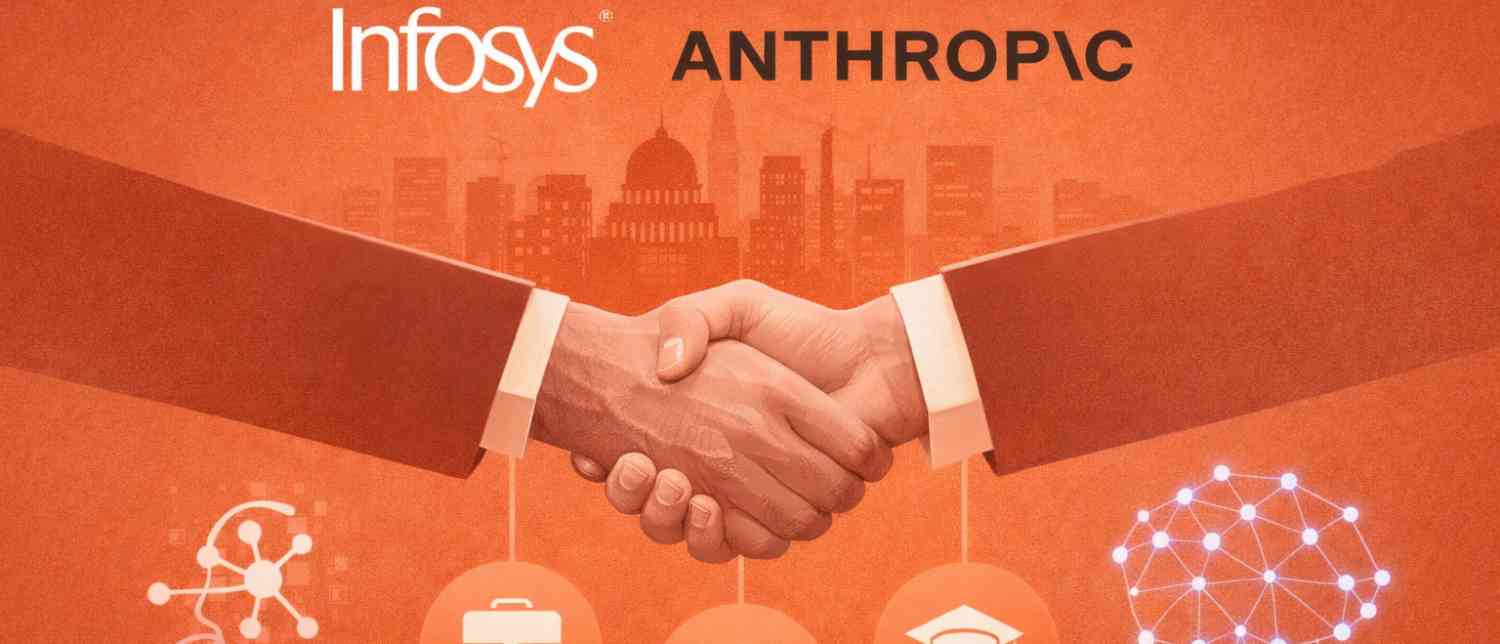
Anthropic’s India expansion coincides with a strategic collaboration with Infosys that has captured investor attention.
Shares of Infosys surged up to 5 percent to Rs 1,430.95 on the BSE following the announcement, reversing recent pressure fueled by fears that generative AI could disrupt traditional IT outsourcing and software services.
Under the agreement, Anthropic’s Claude models—including Claude Code—will be integrated with Infosys’s proprietary Topaz AI platform. The partnership will initially focus on telecommunications, financial services, manufacturing, and software development.
“There’s a big gap between an AI model that works in a demo and one that works in a regulated industry — and if you want to close that gap, you need domain expertise,” said Dario Amodei, CEO and co-founder of Anthropic. He emphasised that Infosys possesses precisely that expertise across highly regulated sectors.
Infosys CEO Salil Parekh described AI as a transformative force that is redefining how industries operate and innovate. He outlined six new service lines emerging from AI adoption: AI strategy and engineering, agentic legacy modernisation, data readiness, process reimagination, physical AI, and AI trust.
The company estimates a $300–$400 billion market opportunity by 2030 and aims to capture a meaningful share of this expanding demand.
Agentic AI and Legacy Modernisation at the Core
At the heart of the collaboration lies agentic AI—systems capable of independently executing multi-step tasks such as processing insurance claims, generating and testing code, or conducting compliance reviews, rather than simply responding to prompts.
Using tools like the Claude Agent SDK, Infosys plans to develop AI agents that operate persistently across complex enterprise workflows.
Legacy modernisation, historically a significant revenue stream for Indian IT companies, is another key focus. By combining Anthropic’s AI models with Infosys’s enterprise platforms, the companies aim to accelerate migration away from aging infrastructure and modernise large-scale systems more efficiently.
The partnership will begin with a dedicated Anthropic Center of Excellence focused on telecommunications before expanding to financial services, manufacturing, and other verticals.
Analysts: Relief for Indian IT, But Questions Remain
Market analysts have largely welcomed the development as a positive signal for the Indian IT sector.
Vinod Nair, head of research at Geojit Investments, described the partnership as encouraging. He suggested that next-generation AI applications are unlikely to disrupt Indian IT business models as severely as initially feared. Instead, these technologies are expected to be integrated into both existing and new projects, easing long-term sustainability concerns.
However, Nair cautioned that uncertainties persist around deal sizes, pricing evolution, and the net margin impact once employee cost efficiencies are weighed against productivity gains. He characterised the sector’s FY27-28 outlook as muted compared to the strong performance of the past two to three years, though subdued valuations could offer re-entry opportunities for long-term investors.
Sumit Pokharna of Kotak Securities called the collaboration “a step in the right direction and the need of the hour,” highlighting the importance of governance, transparency, compliance, reliability, and security in regulated industries’ AI adoption strategies.
Repositioning Indian IT in the AI Era
The broader significance of the Infosys-Anthropic deal extends beyond a single corporate alliance. For nearly two years, Indian IT firms have grappled with investor anxiety that generative AI could compress headcount, shrink project scopes, and undermine the labour-arbitrage model that historically drove growth.
This partnership represents a deliberate pivot. Rather than being sidelined by cutting-edge AI models, Indian IT firms are positioning themselves as indispensable intermediaries—bridging the gap between powerful foundation models and the compliance-heavy, operationally complex realities of global enterprises.
Whether this strategic shift translates into sustained deal flow, improved pricing power, and stronger margins will ultimately depend on execution. For now, the market appears cautiously optimistic. Infosys’s sharp rally suggests that investors are willing to give the company the benefit of the doubt as it navigates the AI transformation.
With Anthropic deepening its India presence and forging high-profile partnerships, the country is fast emerging not only as a major market for AI consumption but also as a proving ground for enterprise-grade, responsible AI deployment at scale.
With inputs from agencies
Image Source: Multiple agencies
© Copyright 2025. All Rights Reserved. Powered by Vygr Media.