
 By
By 
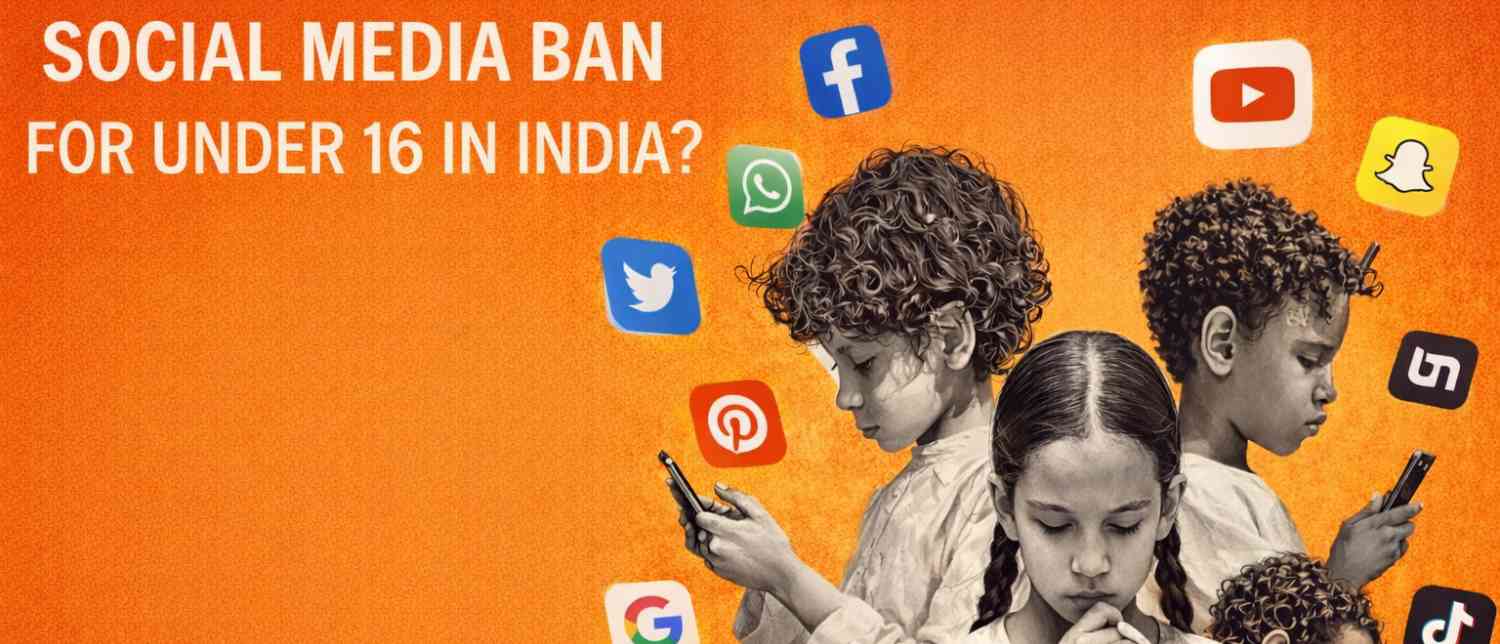
India is weighing a significant shift in its digital governance framework as it considers introducing age-based restrictions on social media access for children under 16. The move comes amid mounting global concerns over online safety, screen addiction, deepfakes, and data exploitation. While no formal decision has been announced, high-level consultations between the government and social media platforms indicate that child protection in the digital ecosystem has become a pressing policy priority.
India Considers Social Media Age Limits for Children Under 16
At present, India does not have a law that explicitly bans children below a certain age from accessing social media platforms. However, the Union government is examining the possibility of restricting social media access for users under 16 years of age. The proposal may involve amendments to the Information Technology (Intermediary Guidelines and Digital Media Ethics Code) Rules, 2021.
According to a senior official from the IT Ministry, the government is exploring differentiated access rather than a blanket prohibition. This means minors could be allowed to operate certain types of accounts while being restricted from others. Policymakers are studying international models to determine what may work best in the Indian context.
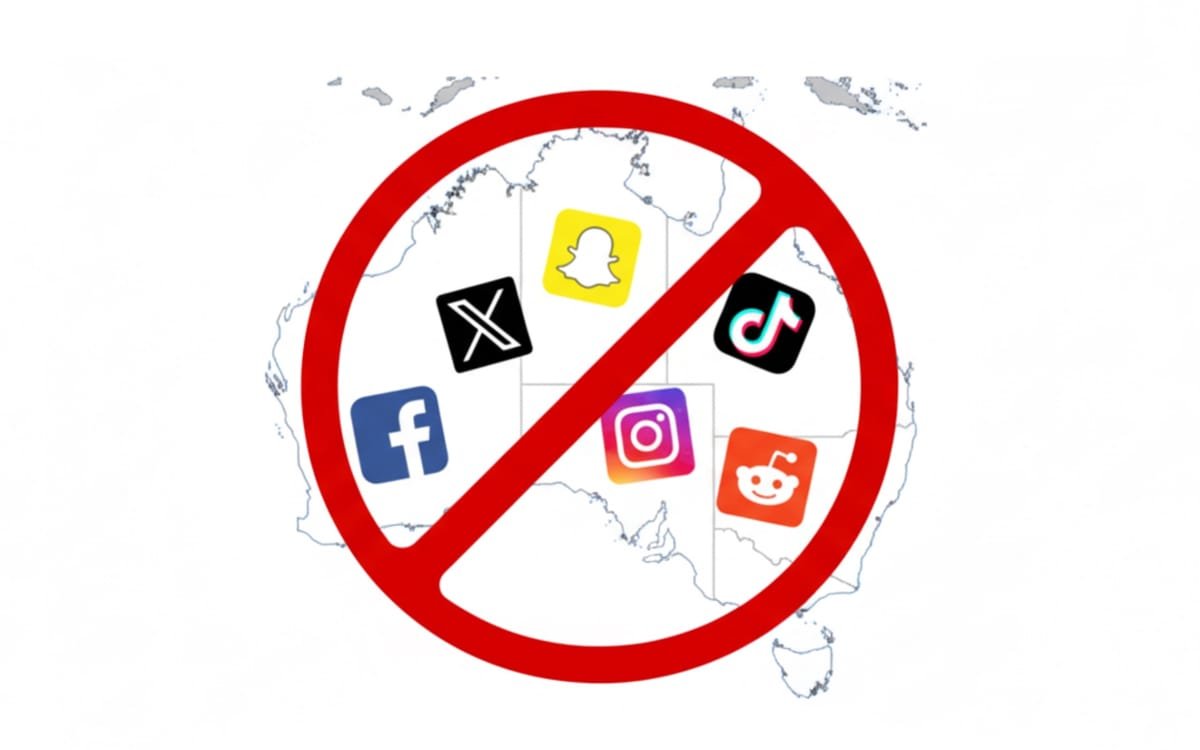
One such model drawing attention is Australia’s landmark decision to impose a legal ban on social media accounts for children under 16. However, sources suggest India may not adopt an outright ban and is instead focusing on calibrated regulatory tightening that balances child safety with digital inclusion.
Government Consultations Underway
Union Electronics and IT Minister Ashwini Vaishnaw has publicly confirmed that discussions with social media companies are ongoing. Addressing the media at a recent press conference, he said age-based regulation is increasingly being accepted globally and was already embedded within India’s Digital Personal Data Protection (DPDP) Act.
“This is something that has been accepted by many countries — that age-based regulation has to be there. It was part of our DPDP (Digital Personal Data Protection) Act. Right now, we are in conversation regarding deepfakes and age-based restrictions with various social media platforms,” Vaishnaw said.
He further emphasized that the problem is intensifying and requires proactive measures. “It’s a problem that is growing day by day, and certainly there is a need for protecting our children and society from these harms. We have initiated a dialogue with the industry already on what kind of regulation will be needed beyond the steps that we have already taken.”
His remarks make it clear that the Centre is inclined toward consultation and regulatory refinement rather than sudden prohibitions.
What the Digital Personal Data Protection Act Already Says
Although India does not explicitly bar minors from using social media, the Digital Personal Data Protection Act has already introduced indirect safeguards. Under the law, platforms must obtain verifiable parental consent before processing the personal data of individuals under 18.
This provision significantly limits how companies can interact with minors. Without parental approval, platforms cannot freely collect children’s data, deploy targeted advertising, or process personal information. In effect, it places accountability on intermediaries to ensure responsible data practices involving minors.
The government is now evaluating whether additional amendments to the IT Rules are required to strengthen enforcement. Possible measures include:
-
Stronger age verification systems
-
Age-appropriate default settings
-
Restrictions on addictive platform features
-
Limits on targeted advertising to minors
-
Enhanced compliance obligations for social media intermediaries
The aim is to prevent children from exposure to harmful content, compulsive design mechanisms, and exploitative data practices.
States Step Into the Debate
The discussion is not confined to the Union government. Several state governments, including Goa, Andhra Pradesh, and Karnataka, are reportedly examining Australia-style restrictions for users under 16. While states cannot independently impose nationwide digital bans, they can recommend policy frameworks and push for stricter implementation of central laws.
Their involvement underscores growing concerns among parents, educators, and mental health experts regarding cyberbullying, online addiction, and inappropriate content exposure.
The judiciary has also entered the conversation. The Madras High Court has advised the Centre to examine the feasibility of enacting legislation similar to Australia’s approach. Although this advisory does not mandate action, it adds institutional weight to the ongoing deliberations.
Global Push for Social Media Age Curbs
India’s debate mirrors a broader international movement to regulate minors’ access to digital platforms.
Australia became the first country to introduce a legal ban on social media accounts for children under 16. Shortly afterward, France passed legislation seeking to restrict social media use for minors under 15.
Other nations, including Denmark, Norway, Malaysia, Spain, and the United Kingdom, are either considering or discussing comparable measures.
Governments worldwide argue that excessive screen time, compulsive platform design, and exposure to harmful or misleading content carry significant social and economic costs. Many policymakers believe stricter age verification systems and digital guardrails can mitigate online risks for young users.
Economic Survey Flags Screen Addiction Concerns
The debate gained further momentum after India’s Economic Survey, released in January, highlighted the social and economic consequences of compulsive screen use among young people.
The Survey supported age-based regulation of digital platforms and recommended:
-
Stricter age verification mechanisms
-
Age-appropriate default settings
-
Enhanced oversight of gambling applications
-
Regulation of autoplay features
-
Limits on targeted advertising aimed at minors
By flagging screen addiction as both a social and economic concern, the Survey elevated the issue beyond moral panic into the realm of public policy and economic impact.
Deepfakes and Digital Safety: A Parallel Concern
Age-based restrictions are being discussed alongside tighter controls on deepfake technology. Minister Vaishnaw described deepfakes as a growing threat and stressed the need for multinational technology companies to account for India’s cultural and social sensitivities.
He noted that content banned in one country may not necessarily be restricted in another, underscoring the complexities of global platform governance.
Recent amendments to the IT Rules already mandate:
-
Removal of deepfake content within three hours
-
Compulsory labeling of AI-generated material
-
Stricter compliance requirements for intermediaries
The parliamentary standing committee on communications and information technology has also examined the misuse of deepfake technology and proposed recommendations to address emerging risks.
By linking age-based restrictions and deepfake regulation, the government appears to be building a broader digital safety architecture.
What Could Change in India’s IT Rules?
If implemented, any new social media age restriction would likely be introduced through amendments to the Information Technology Rules rather than through entirely new legislation.
Possible regulatory adjustments under consideration include:
-
Differentiated account categories for minors
-
Mandatory age verification systems
-
Stronger parental consent mechanisms
-
Platform design changes to reduce addictive engagement
-
Tighter scrutiny of advertising practices targeting young users
The government appears cautious about imposing a total ban, recognizing the importance of digital access for education, social interaction, and skill development. Instead, it is leaning toward regulatory refinement that aligns safety with digital growth.
Balancing Protection and Digital Growth
India is one of the world’s largest digital markets, with millions of young users active on social media platforms. Any regulatory shift will have far-reaching implications for technology companies, advertisers, parents, and educational institutions.
The central challenge lies in balancing two competing priorities:
-
Protecting children from harmful content, data misuse, cyberbullying, and addictive design features
-
Preserving access to digital tools that support learning, creativity, and communication
Officials have repeatedly emphasized that consultations are ongoing and no final notification has been issued. However, the tone of recent statements indicates that age-based digital regulation may soon become stricter.
The Road Ahead
India’s potential move to restrict social media access for users under 16 signals a pivotal moment in the country’s digital governance journey. While the government is not currently considering an outright shutdown of platforms for minors, it is clearly preparing to tighten oversight.
With inputs from state governments, judicial observations, the Economic Survey, and parliamentary committees, the policy conversation is becoming more structured and evidence-based.
Whether India ultimately follows Australia’s path of a strict ban or adopts a more nuanced regulatory model, one thing is certain: the era of unregulated digital access for minors is coming under serious scrutiny.
As consultations continue, parents, educators, technology firms, and policymakers alike will be watching closely. The final framework, whenever announced, is likely to reshape how young Indians experience the online world — aiming to make it safer without stifling the country’s digital ambitions.
With inputs from agencies
Image Source: Multiple agencies
© Copyright 2025. All Rights Reserved. Powered by Vygr Media.