 By
By 
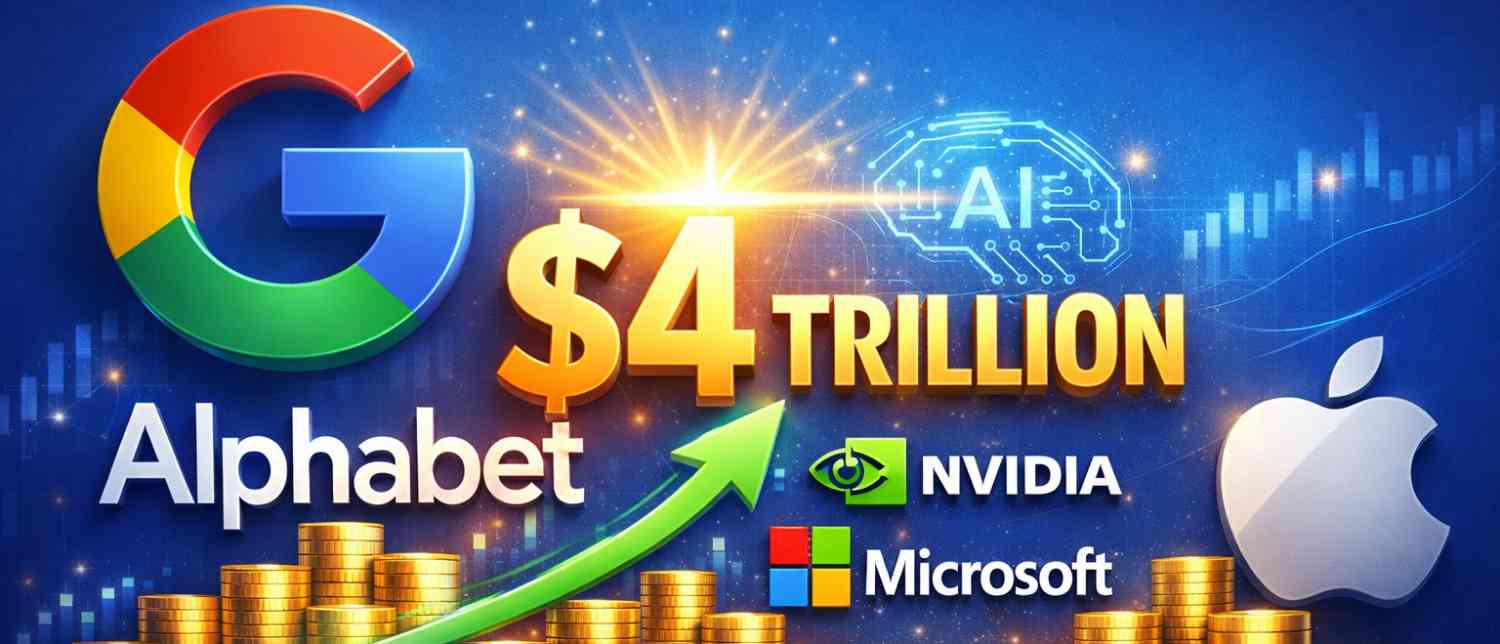
Alphabet Inc., the corporate parent of Google, has officially crossed the $4 trillion market capitalisation mark, becoming the fourth technology giant to achieve what once seemed an unimaginable valuation milestone. The achievement underscores the growing dominance of artificial intelligence in shaping investor sentiment and redefining the global technology hierarchy.
Alphabet’s ascent into the $4 trillion club places it alongside Nvidia, Microsoft, and Apple—companies increasingly viewed not just as technology providers, but as architects of the AI-powered future. While the milestone reflects years of strategic investment, it also highlights how the ongoing AI arms race has become the central force driving market capitalisation across Big Tech.
From Antitrust Pressure to Market Triumph
Alphabet’s rise to $4 trillion is particularly striking given the regulatory headwinds it faced only months ago. Just four months earlier, Google had narrowly avoided a dramatic breakup after a US federal court ruled that its search engine constituted an illegal monopoly. The ruling initially cast a shadow over the company’s long-term prospects, prompting concerns about structural remedies that could weaken its dominance.
However, investor fears eased after US District Judge Amit Mehta rejected the Justice Department’s proposal to force Google to divest its Chrome browser. The judge reasoned that rapid technological changes—particularly those driven by artificial intelligence—were already reshaping online search and competition. Instead of dismantling the company, the court ordered Google to share certain data with rivals to promote greater competition.
Markets interpreted the decision as a relatively mild intervention. Since the ruling, Alphabet’s stock has surged roughly 57%, adding an estimated $1.4 trillion in shareholder wealth and accelerating its march toward the $4 trillion valuation milestone.
A Historic Market Milestone
Alphabet crossed the $4 trillion threshold on January 12, briefly pushing its market capitalisation above the landmark level during intraday trading. Class-A shares rose as much as 1.7% to hit a record high of $334.04, reflecting investor enthusiasm fueled by AI-driven growth and major strategic partnerships.
The milestone also reshaped Wall Street rankings. Alphabet overtook Apple to become the second-most valuable company globally for the first time since 2019, trailing only Nvidia, which remains the most valuable firm in the world following its own AI-fueled surge.
Alphabet’s stock performance has been exceptional. Shares climbed approximately 65% throughout 2025, outperforming its peers within the so-called “Magnificent Seven” tech stocks, and have gained an additional 6% so far this year. The rally marks a dramatic turnaround from earlier concerns that Google was falling behind rivals like OpenAI in the generative AI race.
The AI Boom and the $4 Trillion Club
Alphabet’s entry into the elite valuation club comes amid extraordinary growth across AI-focused technology companies. Nvidia became the first company to cross the $4 trillion threshold in July, driven by insatiable demand for its AI chipsets. Its market value briefly exceeded $5 trillion in late October before retreating amid growing fears that massive AI spending could morph into a speculative bubble.
Apple and Microsoft also surpassed $4 trillion last year, though both have since slipped below the mark as investors reassessed the sustainability of heavy AI investments. Outside the $4 trillion group, Amazon is currently valued at around $2.6 trillion, buoyed in part by its AI ambitions, while Meta Platforms stands at roughly $1.6 trillion.
Tesla, valued at approximately $1.5 trillion, is also betting heavily on AI, particularly in autonomous driving and robotics. The company’s confidence in AI-driven growth is reflected in a controversial compensation package that could eventually pay CEO Elon Musk up to $1 trillion if ambitious performance targets are met, including pushing Tesla’s valuation beyond $8.5 trillion.
Gemini: The Engine Behind Alphabet’s AI Momentum
At the core of Alphabet’s resurgence is Gemini, the AI model family powering Google’s next-generation products. The latest iteration, Gemini 3, launched in November and delivered record-breaking benchmark scores, earning strong reviews across the tech industry. A subsequent release, Gemini 3 Flash, introduced Google’s fastest AI model to date.
The positive reception has helped counter fears that Google was losing ground to competitors such as OpenAI’s ChatGPT and Perplexity. Instead, Alphabet is now widely viewed as one of the most formidable players in the AI ecosystem, with strengths spanning infrastructure, models, and consumer applications.
Cantor Fitzgerald reinforced this perception in January by upgrading Alphabet’s stock and setting a price target of $370. Analyst Deepak Mathivanan described the company as the “king of all AI trades,” citing its end-to-end control of the AI value chain—from proprietary Ironwood tensor processing units (TPUs) to large language models and mass-market consumer products.
Cloud Growth and AI at Scale
Alphabet’s cloud division has emerged as a major beneficiary of its AI push. Over the past three years, Google Cloud has become the company’s fastest-growing segment, transforming from a long-term investment into a powerful revenue engine.
In the third quarter alone, Google Cloud revenue jumped 34%, while unrecognised sales contracts climbed to $155 billion. The division now serves corporate customers and government agencies seeking advanced AI tools, positioning Alphabet as a critical infrastructure provider in the global AI economy.
AI has also accelerated progress in Alphabet’s other “Other Bets,” particularly Waymo. The self-driving unit has expanded its robotaxi operations, deploying more autonomous vehicles across US cities as AI advancements improve safety and scalability.
Game-Changing Partnerships with Apple and Samsung
Alphabet’s valuation surge coincided with a landmark announcement that Apple will rely on Google’s AI technology to power the next generation of Siri. Under a multi-year agreement, Apple will use Gemini models and Google’s cloud infrastructure for future AI features after its own internal efforts fell short.
In a statement, Apple said it had determined that Google’s technology provided “the most capable foundation” for its Apple Foundation Models. The deal represents a significant endorsement of Alphabet’s AI leadership and adds a powerful revenue and credibility boost.
Alphabet has also deepened its relationship with Samsung, striking a deal to double the number of Gemini-powered mobile devices to 800 million units in 2026, up from 400 million last year. These partnerships significantly expand Gemini’s reach, embedding Google’s AI into hundreds of millions of consumer devices worldwide.
Meta, TPUs, and Expanding Influence
Alphabet’s influence in AI infrastructure continues to grow. According to reports, Meta Platforms has expressed interest in using Google’s TPU chips in its data centres starting in 2027. Last year, Meta was also reported to have entered a multi-billion-dollar deal with Google Gemini to help train its next-generation Llama models—an agreement that reportedly wiped $250 billion from Nvidia’s market capitalisation.
These developments underscore Alphabet’s expanding role not just as an AI developer, but as a critical supplier of AI hardware and infrastructure.
A Decade-and-a-Half in the Making: Alphabet’s Valuation Timeline
Alphabet’s journey to a $4 trillion valuation reflects steady evolution rather than overnight success. In December 2010, the company’s market capitalisation stood at $190 billion as it solidified its dominance in search. By 2014, the valuation had climbed to $360 billion, driven by mobile advertising and the rapid adoption of Android.
In January 2020, Alphabet became the fourth US company to surpass $1 trillion in market value. By April 2024, it crossed $2 trillion, announcing its first dividend alongside a $70 billion share buyback. Relief from antitrust pressures and accelerating cloud growth pushed the valuation beyond $3 trillion in September 2025. Finally, in January 2026, the Apple partnership and Gemini’s rising influence propelled Alphabet past the $4 trillion mark.
Investor Confidence—and Caution
Alphabet’s rally has also attracted backing from some of the world’s most influential investors. Berkshire Hathaway, led by Warren Buffett, made a significant investment in Alphabet, signaling confidence in the company’s long-term AI strategy and reinforcing market optimism.
Still, risks remain. Alphabet’s valuation is deeply tied to expectations that AI spending will deliver sustained returns. Any sudden shift in sentiment could trigger sharp declines, particularly if concerns about an AI bubble intensify.
Even Alphabet CEO Sundar Pichai has acknowledged the potential for excess. In a November interview with the BBC, he warned that some “irrationality” is contributing to soaring Big Tech valuations and cautioned that no company, including Alphabet, would be immune if AI-driven euphoria were to fade.
A Defining Moment for Big Tech
Alphabet’s entry into the $4 trillion club marks a defining moment not just for the company, but for the technology sector as a whole. It reflects how artificial intelligence has moved from a promising innovation to the central pillar of corporate strategy, investor confidence, and global competition.
Whether the current valuations prove sustainable or signal the peak of an AI-fueled boom remains an open question. For now, Alphabet stands firmly at the forefront of the AI revolution, reshaping search, cloud computing, and consumer technology—while redefining what is possible in market capitalisation.
With inputs from agencies
Image Source: Multiple agencies
© Copyright 2025. All Rights Reserved. Powered by Vygr Media.