 By
By 
The romance of India’s startup boom is colliding with a harder truth in 2025: volatility is not a phase — it is the model.
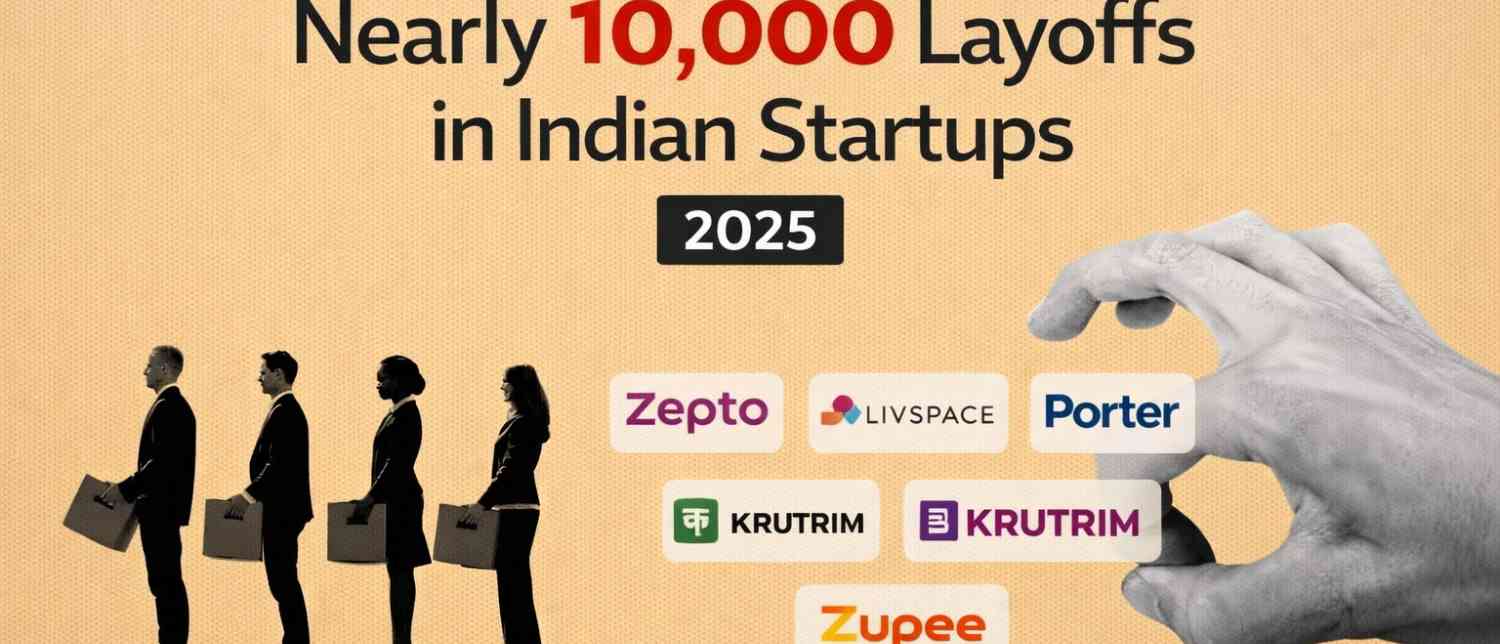
Over the past eight months alone, more than 4,500 employees have been laid off across Indian startups, according to data sourced from Longhouse Consulting and reported by The Times of India. Zoom out, and the numbers are even starker. An annual survey by startup-focused platforms estimates that nearly 9,500 jobs were lost in 2025. Broader tallies suggest around 10,000 employees have been laid off this year (as of mid-2024 in some datasets).
This follows a bruising 2024, when layoffs touched 17,000, and an even harsher first half of 2023 that saw 21,000 job losses. Compared to those peaks, 2025 may appear less catastrophic — but the anxiety feels sharper. Why? Because this time, the disruption isn’t just about funding cycles. It’s about structural change, artificial intelligence, regulatory shocks, and a fundamental reset in how startups are built.
So, are Indian startups firing because of AI? Or is something deeper unfolding?
The answer is more complex — and more revealing — than a single trigger.
The Numbers Behind the Layoffs
Let’s start with the hard data.
-
4,500+ layoffs in the last eight months.
-
9,500 job losses recorded in 2025 by startup tracking surveys.
-
Around 10,000 layoffs in 2024 (as of June 2024).
-
17,000 layoffs in 2024 overall, reflecting the hangover from the Covid-19 pandemic.
-
21,000 job losses in the first half of 2023 alone.
-
Around 15,000 employees were fired in the preceding six months of 2023.
While the absolute number in 2025 is lower than 2024, the pattern shows something else: startups are not bouncing back to their old hiring habits. Instead, they are redesigning themselves to operate leaner by default.
Globally, the trend is even more dramatic. In the United States, layoffs have crossed one million, even as the economy remains robust. Technology-driven disruption is volatile everywhere — India is not alone in this turbulence.
The Companies Cutting Jobs
Layoffs have spanned sectors and stages.
Companies such as Zepto, Krutrim, Porter, Simpl, and Zupee have all reduced headcount.
In October 2025, Zepto eliminated around 300 roles as the quick commerce firm sought to lower costs amid intensifying competition. The company clarified that these cuts were not due to AI optimisation.
Zupee implemented job cuts in two phases. Over 200 employees were laid off in the second round, bringing total layoffs to nearly 370 by January 2026. Founder and CEO Dilsher Singh Malhi described the restructuring as “difficult but necessary,” aligning the organisation with long-term sustainability.
Meanwhile, home decor platform Livspace laid off around 1,000 employees, publicly stating that the move was aimed at saving costs and running operations using AI.
And the tremors extend further back. In the past six months, venture-funded companies including Swiggy, Ola, Cultfit, Licious, PristynCare, and Byju’s have also implemented significant job cuts.
This is not an isolated sector issue. It is ecosystem-wide recalibration.
The Real-Money Gaming Shock
One of the biggest contributors to recent layoffs was regulatory disruption — specifically, the sudden ban on online real-money gaming.
Several startups in the segment were forced to shut down operations almost overnight. Immediate job losses followed, significantly inflating layoff numbers in the past eight months.
This episode highlights a reality often overlooked in startup glamour: regulatory risk can be existential. When policy shifts abruptly, runway evaporates instantly.
AI did not cause these job losses. Regulation did.
The Funding Winter Is Structural
Beyond gaming, the deeper reason lies in capital flows.
Venture funding has tightened. Investors are backing fewer companies and demanding sharper financial discipline. Startups are being pushed toward profitability much earlier in their lifecycle.
Anshuman Das, CEO of Longhouse Consulting, has noted that even early-stage startups seeking growth capital must now demonstrate a credible path to profitability. The era of “growth at all costs” has ended.
Much of the big money in 2024 and 2025 flowed into quick commerce. Traditional SaaS sectors are attracting less capital as the AI economy takes over.
Selective capital flow means: Smaller teams, Incremental hiring only, Senior hires only when essential, and Longer runways by design.
Viswanath P.S., MD & CEO at Randstad India, described this as a “lean by design” approach. Investors now reward startups that achieve milestones with optimised headcount. Lean teams are not just reactions to tight funding; they are deliberate de-risking strategies against macroeconomic volatility.
In simple terms: fewer people, more output.
Is AI Replacing Jobs?
Artificial intelligence is unquestionably reshaping headcount decisions — but it is not the only factor.
AI-first startups are being built from scratch with smaller teams. Founders are architecting companies differently, automating functions that once required large support staff.
The influence of AI intensified with tools like Claude from Anthropic, whose code-generating capabilities rattled markets. Startup founder Ira Bodner publicly shared how her advertising product, Ryze AI, was effectively rendered obsolete overnight by Claude.
When code can be generated instantly, entire job categories feel exposed.
Livspace’s AI-led restructuring is another example of automation-driven efficiency. But companies like Zepto have explicitly stated that their layoffs were not linked to AI optimisation.
The truth lies in nuance:
-
AI is reducing the need for repetitive roles.
-
Investors prefer AI-augmented efficiency.
-
But regulatory shocks and funding discipline remain equally powerful drivers.
AI is an accelerant — not the sole cause.
The Rise of “Silent Layoffs”
A more subtle trend is emerging: silent layoffs.
In 2024, around 40–50% of layoffs have reportedly been conducted quietly, compared to 20% last year. Companies are reducing staff without major announcements to avoid negative publicity and protect morale.
This reflects a cultural shift. Layoffs are becoming operational adjustments rather than dramatic events.
The startup ecosystem is maturing — and so are its crisis responses.
The Bigger Context: Startup India and Scale
India’s startup universe is vast.
Under the government’s Startup India scheme, approximately 200,000 startups have generated 2.1 million jobs over the past decade.
In that context, a few thousand layoffs over several months, while painful for individuals, are statistically small within the broader ecosystem.
But perception matters. Startups became a social “flex.” Co-working offices replaced garages as symbols of ambition. Smartphones and social media enabled nearly every small business to call itself a startup.
Yet not every venture qualifies as a scalable, tech-heavy disruptor. True startups create new categories or plug uniquely into scalable ecosystems.
When funding tightens, soft targets fall first.
A Silicon Valley Mindset — Without the Stigma
There is one encouraging shift: failure carries less stigma in India today.
Like Silicon Valley, the ecosystem increasingly views failed startup experience as valuable learning. Large firms often hire former startup employees, hoping they bring innovation and urgency.
New startups, too, welcome experienced professionals from shuttered ventures.
The philosophy once articulated by N. R. Narayana Murthy remains relevant:
“Love your job, but never fall in love with your company, because you never know when the company stops loving you.”
In a volatile era, loyalty to learning matters more than loyalty to logos.
Lessons for Gen Z and Millennials
For young professionals who entered startups during the funding boom, this is a wake-up call.
Venture capital cycles shift. AI reshapes relevance. Global uncertainties — from geopolitical tensions to policy unpredictability — amplify volatility.
The dotcom bubble of 2000 offers a historical parallel. Back then, B2C and B2B dreams collapsed spectacularly. Some professionals returned to corporate jobs; others reconsidered their appetite for risk.
The triggers change. The volatility doesn’t.
Startup life is a rollercoaster. The highs are steep — but so are the drops.
Signs of Recovery
It’s not all bleak.
There are signs of gradual improvement anticipated in the second half of 2024 and beyond:
-
Increased early-stage funding
-
Upcoming public listings
-
Promising momentum in fintech and quick commerce
Companies such as Zomato and Nykaa signal potential hiring upticks in growth segments.
The ecosystem is adjusting — not collapsing.
The Real Takeaway
Startups are what they are because capitalism rewards higher risk with higher potential reward. Innovation demands reinvention — of companies and individuals.
What separates seasoned professionals from naïve enthusiasts in startup culture is the ability to pivot — like a batsman executing a reverse sweep in a T20 match to beat tight field placements.
Layoffs in 2025 are not merely about AI. They are about:
-
Regulatory shocks
-
Tighter funding
-
Investor pressure for profitability
-
Lean-by-design operating models
-
Automation-led efficiency
-
Structural maturity of the ecosystem
The glamour was always paired with risk. The difference now is that the ecosystem is acknowledging it openly.
Startups are an option. Reinvention is compulsory.
And in that relentless cycle of risk, reset, and reinvention lies both the pain — and the promise — of India’s startup future.
With inputs from agencies
Image Source: Multiple agencies
© Copyright 2025. All Rights Reserved. Powered by Vygr Media.