 By
By 
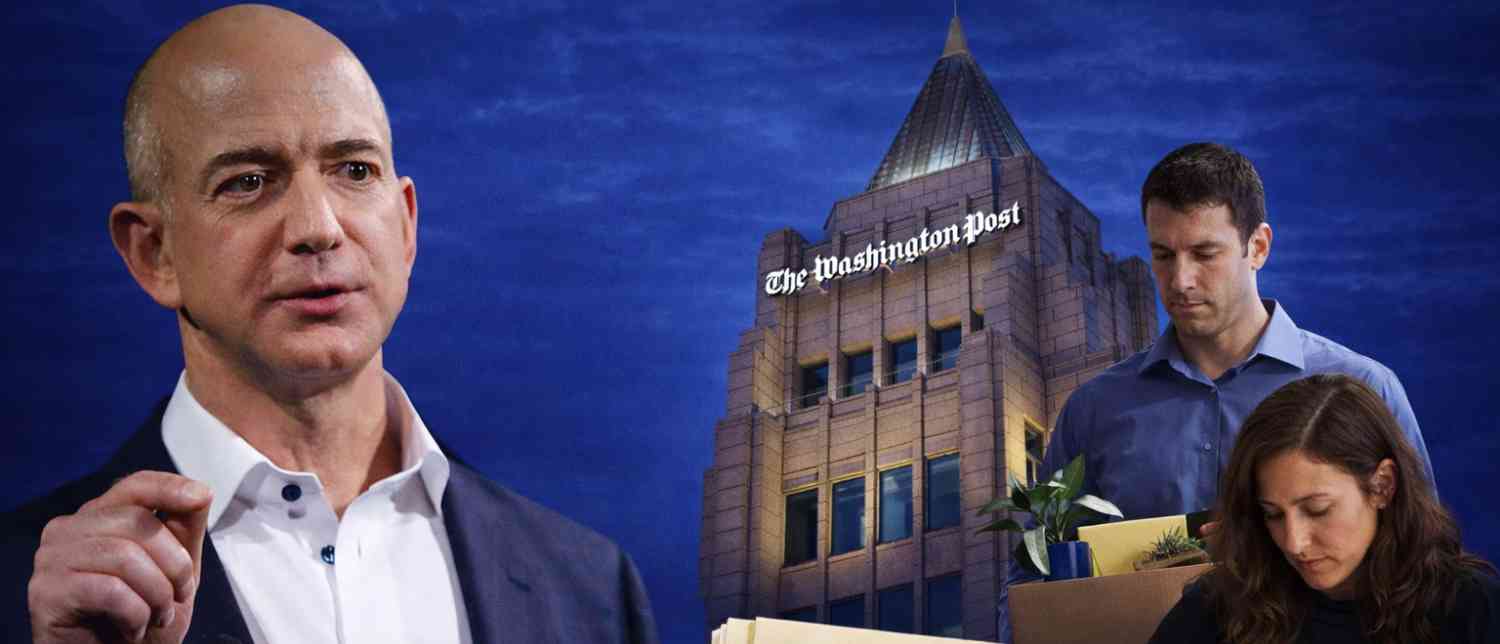
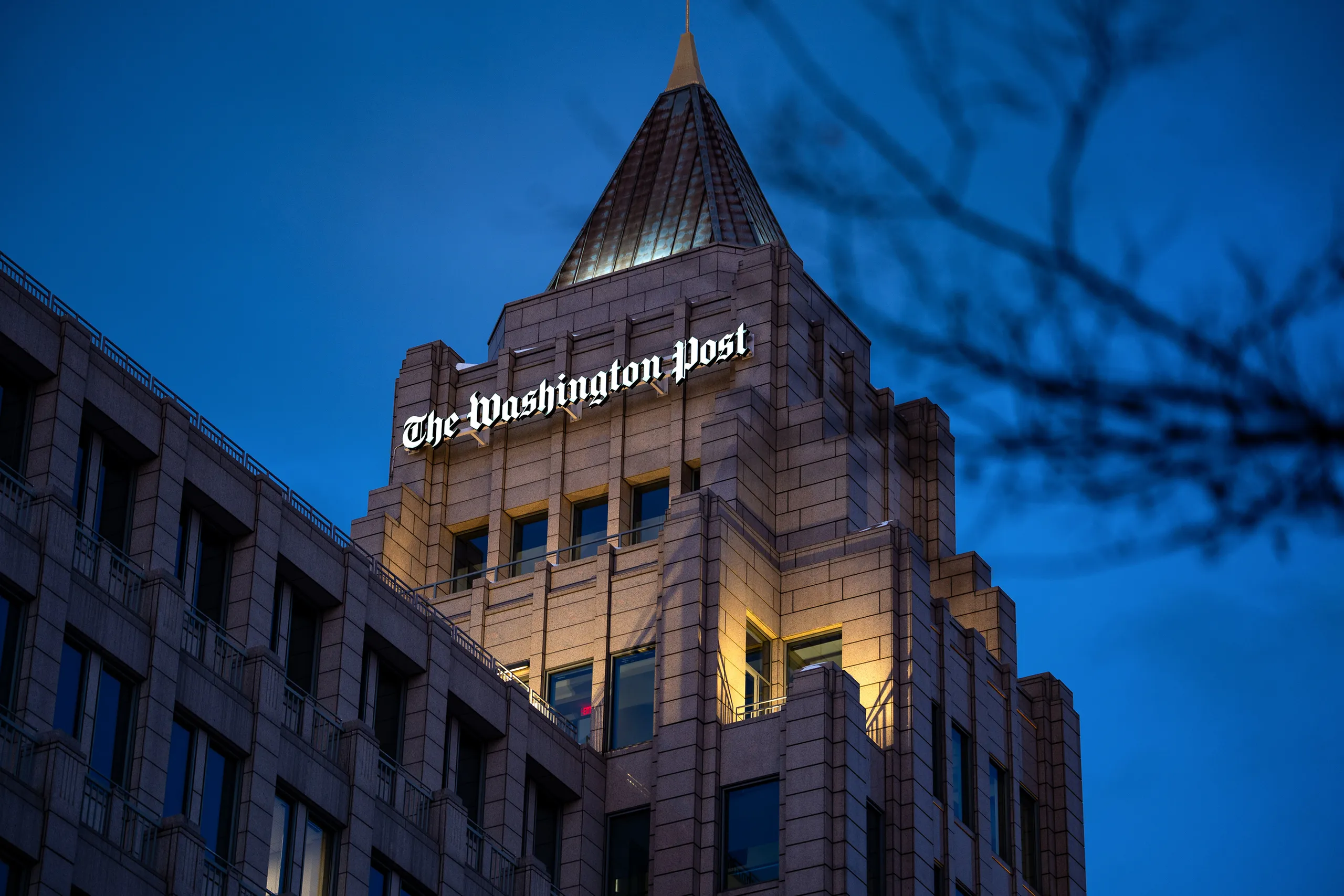
The Washington Post, long regarded as one of the most influential newsrooms in the world, is facing what many insiders and observers are calling one of the bleakest chapters in its history. Once celebrated as a rare success story of billionaire ownership in journalism, the paper is now grappling with mass layoffs, shuttered bureaus, and a growing sense of betrayal among journalists and readers alike.
Hundreds of employees—many of them seasoned reporters, editors, and correspondents—were laid off in a single sweeping move. Entire desks that once defined the Post’s journalistic legacy were hollowed out or erased altogether. Even journalists reporting from active war zones were not spared.
Hovering silently above the chaos is Jeff Bezos, the Amazon founder and one of the richest individuals in the world, who purchased The Washington Post in 2013. His continued silence has become one of the most contentious elements of this unfolding crisis, drawing criticism not only from journalists but also from some of the most powerful political voices in the United States.
This is not just a story about layoffs. It is a story about power, accountability, democracy, and the future of journalism in the age of billionaires, algorithms, and artificial intelligence.
A newsroom shaken overnight: The scale of the Washington Post layoffs
The Washington Post confirmed this week that it had carried out a dramatic restructuring that resulted in the elimination of nearly 30 per cent of its workforce. More than 300 newsroom employees were laid off, part of a broader round of cuts affecting both editorial and business-side staff.
Employees were instructed to stay home and log into a video call where senior leadership delivered the news. The message, according to multiple accounts, was stark: the cuts were “painful but unavoidable.”
Executive editor Matt Murray told staff that the organisation had become “too rooted in a different era.” He acknowledged that the paper was losing substantial amounts of money and that readership had declined sharply. The restructuring, he said, was intended to reset the newsroom for a changing media landscape.
What stood out immediately was the scope. No department was spared. This was not a targeted trimming of peripheral roles—it was a deep, structural overhaul that struck at the heart of the newsroom.
According to reporting by The New York Times, more than 300 journalists were laid off from a total editorial workforce of roughly 800. Reuters quoted the paper’s official statement, which described the move as “a number of difficult but decisive actions” designed to strengthen the Post’s footing and sharpen its focus on journalism that “engages our customers.”
For many inside the building, the language rang hollow.
“If Jeff Bezos is no longer willing to invest in the mission that has defined this paper for generations and serve the millions who depend on Post journalism, then the Post deserves a steward who will” https://t.co/hp2Vuhj1KR— WABJ - Washington Association of Black Journalists (@WABJDC) February 4, 2026
War correspondents, global desks, and the dismantling of legacy reporting
The true shock of the layoffs came into focus as names and desks began to emerge.
Journalists covering race, culture, technology, books, and international affairs were laid off en masse. Entire foreign bureaus—including Jerusalem and Ukraine—were shut down. The famed Metro desk, synonymous with some of the most consequential reporting in American history, including the Watergate investigation, was reduced to a fraction of its former self.
Among those laid off was Lizzie Johnson, a reporter who had been covering the war in Ukraine. Her dismissal reverberated widely after she reshared a post from January 26 showing her working inside a car in winter gear in Kyiv.
“Waking up without power, heat, or running water. (Again.) But the work here in Kyiv continues… Despite how difficult this job can be, I am proud to be a foreign correspondent at The Washington Post,” she had written at the time.
Resharing the image after being laid off, Johnson added:
“I was just laid off by The Washington Post in the middle of a warzone. I have no words. I’m devastated.”
That moment came to symbolise the human cost of the restructuring—journalists risking their safety to report global conflicts, only to be discarded without ceremony.
The emotional toll extended inside the newsroom as well. At least one senior department head reportedly asked to be laid off rather than oversee the termination of colleagues, underscoring the moral distress felt by managers forced to carry out the cuts.
Heartbroken to share I've been laid off from The Washington Post. Gutted for so many of my talented friends who are also gone. It was a privilege to work here the past four years. Serving as the paper's New Delhi bureau chief was an honor.— Pranshu Verma (@pranshuverma_) February 4, 2026
Ishaan Tharoor, Pranshu Verma, and voices from a dismantled global network
One of the most high-profile layoffs was Ishaan Tharoor, a global affairs columnist and son of Indian Congress MP Shashi Tharoor. In a post on X (formerly Twitter), Tharoor revealed that he had been laid off “along with most of the International staff and so many other wonderful colleagues.”
“I’m heartbroken for our newsroom and especially for the peerless journalists who served the Post internationally — editors and correspondents who have been my friends and collaborators for almost 12 years,” he wrote. “It’s been an honour to work with them.”
Tharoor highlighted his work at the paper, noting that he launched the WorldView column in January 2017 to help readers better understand global affairs and America’s role in the world. He expressed gratitude to the half a million loyal subscribers who followed the column multiple times a week over the years.
In a later post, he shared an image of an empty newsroom with two stark words: “A bad day.”
Pranshu Verma, the Post’s New Delhi Bureau Chief, also confirmed his layoff.
“Heartbroken to share I’ve been laid off from The Washington Post,” he wrote. “Gutted for so many of my talented friends who are also gone. It was a privilege to work here the past four years.”
Former Asia editor Anna Fifield announced her exit as well, writing that her “heart breaks for everyone who lost their job today — and for the readers who will be the worse for it.”
Turkish news reporter Jennifer Hassan wrote simply, “My colleagues deserve better.”
Berlin Bureau Chief Aaron Weiner called it a “dark day.”
Sam Fortier shared a video showing the email informing him of his layoff. “I am sad and angry,” he wrote. “We all want to keep doing the work.”
The pattern was clear: this was not just a workforce reduction—it was the dismantling of a global reporting network built over decades.
@grok
Will artificial intelligence & automation impact media & journalist when it comes to employment?— JD (@JD78741001) February 4, 2026
The Amazon beat reporter paradox and questions of independence
Adding a layer of bitter irony to the situation was the firing of Caroline O’Donovan, The Washington Post’s reporter covering Amazon—the trillion-dollar company founded by Jeff Bezos himself.
O’Donovan had frequently noted that readers were often surprised by how aggressively the Post covered Amazon, despite Bezos’ ownership. Nearly every story she wrote included a disclosure about his dual role.
Her final article, published just days before she was laid off, focused on layoffs at Amazon.
The symbolism was not lost on readers or fellow journalists. Her dismissal intensified criticism that the restructuring may not be purely financial, but also political or ideological in nature—a charge the paper’s leadership denies, but one that has gained traction in public discourse.
A bad day pic.twitter.com/cIX8rIjJPu— Ishaan Tharoor (@ishaantharoor) February 4, 2026
A struggling business in a collapsing industry
The Washington Post’s leadership maintains that the layoffs are part of a necessary response to structural challenges facing the news industry.
Print readership continues to collapse. Digital traffic is increasingly unpredictable. Generative AI has transformed how audiences consume information, often bypassing traditional news outlets altogether.
Under publisher Will Lewis, who was hired by Bezos in late 2023, the Post has experimented with AI-driven comment moderation, podcasts, and aggregation tools. Leadership says the organisation will now focus on areas where it still performs strongly, such as national politics, governance, and national security.
Yet critics within the newsroom argue that cutting core reporting talent undermines the very journalism that once set the Post apart.
The numbers reinforce the concern. According to the Alliance for Audited Media, The Washington Post’s paid average daily circulation in 2025 stood at approximately 97,000, with Sunday circulation at around 160,000. This marks a steep decline from the 250,000 daily average recorded in 2020.
Reuters also noted that this is not the first round of cost-cutting. Last year, the company reduced jobs across business operations, initially promising that the newsroom would be spared—a pledge that has now been decisively broken.
I have been laid off today from the @washingtonpost, along with most of the International staff and so many other wonderful colleagues. I’m heartbroken for our newsroom and especially for the peerless journalists who served the Post internationally — editors and correspondents…— Ishaan Tharoor (@ishaantharoor) February 4, 2026
Jeff Bezos’ silence and a $250-billion question
Perhaps the most explosive aspect of the crisis is Jeff Bezos’ continued silence.
Bezos, whose net worth is estimated at nearly $250 billion, has not publicly addressed the layoffs, despite appeals from journalists and the Post’s own union urging him to intervene.
The Washington Post Guild issued a pointed statement on X:
“If Jeff Bezos is no longer willing to invest in the mission that has defined this paper for generations and serve the millions who depend on The Post journalism, then The Post deserves a steward that will.”
If Jeff Bezos could afford to spend $75 million on the Melania movie & $500 million for a yacht to sail off to his $55 million wedding to give his wife a $5 million ring, please don't tell me he needed to fire one-third of the Washington Post staff.
Democracy dies in oligarchy.— Sen. Bernie Sanders (@SenSanders) February 5, 2026
The backlash has extended far beyond the newsroom.
US Senator Elizabeth Warren wrote:
“Jeff Bezos just fired hundreds of reporters at the Washington Post — including the Amazon reporter holding his OWN company accountable. Reminder: Jeff Bezos' net worth is nearly $250,000,000,000.”
Representative Alexandria Ocasio-Cortez accused Bezos of exerting ideological control, saying the layoffs were “the result of billionaires with vested political agendas taking over our media.”
Former executive editor Marty Baron, who once led the Post under Bezos, condemned the situation as “a case study in near-instant, self-inflicted brand destruction.”
Former House Speaker Nancy Pelosi described the layoffs as “part of a broader reprehensible pattern in which corporate decisions are hollowing out newsrooms across the country.”
Senator Bernie Sanders was even more blunt:
“If Jeff Bezos could afford to spend $75 million on the Melania movie & $500 million for a yacht to sail off to his $55 million wedding to give his wife a $5 million ring, please don't tell me he needed to fire one-third of the Washington Post staff.”
Lot of people criticizing Bezos cuts at Washington Post, but at his current level of wealth, if he kept funding this rate of losses at the paper it would leave him broke in less than 3,000 years— Deva Hazarika (@devahaz) February 4, 2026
“Democracy Dies in Darkness” — and the reckoning ahead
Online, users turned the Post’s famous slogan against its owner.
“Democracy Dies in Darkness is the official slogan and motto of the Washington Post. Jeff Bezos is killing it in broad daylight,” one user wrote.
The Nation editor Jack Mirkinson argued that the decision was not financial at all, stating that Bezos could fund the paper’s losses for thousands of years without denting his wealth.
Another user sarcastically noted that at his current level of wealth, Bezos could sustain the Post’s losses for nearly 3,000 years before going broke.
Once, Bezos spoke passionately about The Washington Post, calling it one of the achievements he hoped to be proudest of later in life. He publicly celebrated Pulitzer wins and defended the paper during periods of intense political pressure.
Today, that voice is absent.
Former editor Marty Baron summed up the prevailing sentiment: this is one of the darkest days in the Post’s history, and many no longer see the same commitment from its owner.
What remains is an open question—not just about the future of The Washington Post, but about what happens to journalism when its survival depends on the goodwill of billionaires who can afford to stay silent.
With inputs from agencies
Image Source: Multiple agencies
© Copyright 2025. All Rights Reserved. Powered by Vygr Media.