

 By
By 
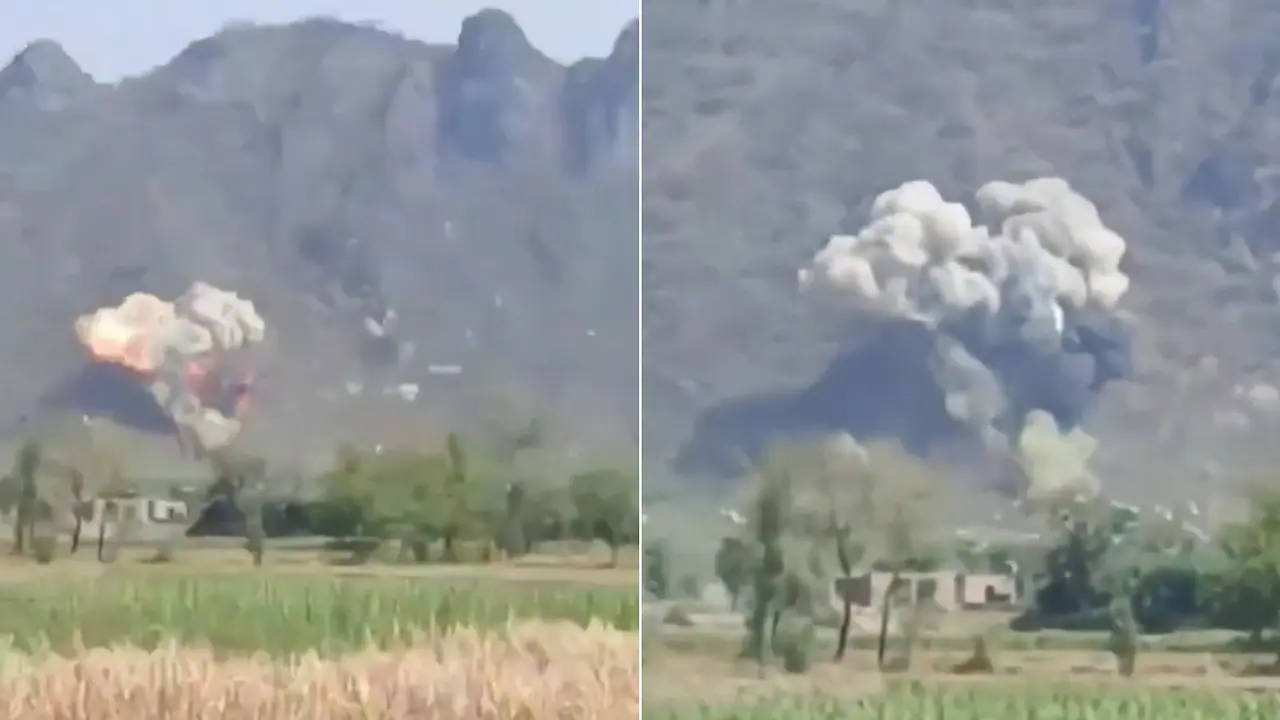
An Indian loitering munition did strike Pakistan’s strategically important Kirana Hills during Operation Sindoor in May 2025, but the impact was not the result of a deliberate attack on the site, former Chief of Defence Staff General Anil Chauhan has revealed.
According to Chauhan, the Indian drone was operating in the vicinity of Sargodha while searching for Pakistani radar installations when it apparently ran low on fuel. Unable to locate its intended target within its operational window, the loitering munition eventually struck one of the hills at Kirana. The revelation offers a new explanation for an incident that had generated considerable speculation during and after the India-Pakistan military confrontation.
The clarification is particularly significant because Kirana Hills is associated with Pakistan’s military and nuclear infrastructure. Any intentional strike on the location could therefore have carried major strategic and diplomatic implications. Chauhan, however, stressed that India had not selected Kirana Hills as a target.

What Happened to the Indian Drone at Kirana Hills?
Explaining the incident, Chauhan said Indian forces had deployed several loitering munitions around Sargodha to search for Pakistani radar systems.
Kirana Hills lies roughly 10 kilometres north of Sargodha, placing the area close to the broader operational zone in which the drones were looking for military targets. The weapons were designed to remain airborne for a limited period while searching for suitable targets.
One of the munitions apparently failed to identify the radar it was seeking before exhausting its available fuel. As a result, the drone eventually came down in the Kirana Hills area.
Chauhan indicated that the munition was likely an Israeli-designed Harop loitering munition, a weapon designed to search for and attack targets while remaining airborne for an extended period. Rather than being directed specifically at Kirana Hills, the drone was operating as part of a wider effort to locate Pakistani radar installations around Sargodha.
The distinction between an intentional strike and an unintended impact is crucial. While the drone did hit the area, Chauhan's account indicates that there was no decision to attack Pakistan's nuclear-linked facility at Kirana Hills.
Why Kirana Hills Became a Point of Concern
Kirana Hills had attracted attention during Operation Sindoor because of its association with Pakistan's strategic military infrastructure. Images and reports showing activity around the hills had prompted questions about whether India had deliberately attacked the site.
The uncertainty persisted because the operation involved multiple simultaneous strikes against military targets across Pakistan and Pakistan-occupied Jammu and Kashmir. The use of drones and other precision weapons also made it difficult for observers to immediately establish the exact purpose of every munition deployed during the campaign.
Chauhan's latest explanation provides an operational account of how the impact could have occurred without Kirana Hills being an assigned target. It also aligns with earlier statements from senior Indian military officials that the location had not been deliberately targeted.
Importantly, there was no indication from the account that the incident resulted in a nuclear accident or radiation release. The reported impact should therefore not be confused with an attack designed to damage Pakistan's nuclear weapons infrastructure.
Sargodha Was the Intended Operational Focus
The episode also sheds light on the wider targeting strategy adopted by India during Operation Sindoor.
Sargodha was among the Pakistani military locations being considered for strikes, while radar systems in and around the area were of particular interest. The deployment of loitering munitions allowed Indian forces to search for such systems rather than relying solely on fixed coordinates.
This represented a broader effort to exploit the lower airspace during the operation. Chauhan described the approach as a distinct operational option that could provide an element of surprise while keeping the escalation threshold comparatively controlled. Low-flying drones and loitering munitions can operate differently from conventional fighter aircraft and can remain over an area while waiting for an appropriate target.
The Kirana Hills incident consequently illustrates one of the inherent complexities of using autonomous or semi-autonomous loitering weapons. Their ability to search for targets gives them flexibility, but their limited endurance also means that a munition that fails to locate its intended target eventually has to terminate its flight.
India Had Also Cleared a Strike on Skardu
Chauhan's remarks went beyond the Kirana Hills incident and offered additional details about India's target selection during the final stages of Operation Sindoor.
He said the Indian Air Force had received approval to strike Skardu, a strategically important location in Pakistan-occupied Kashmir. The plan, however, had to be abandoned because of adverse weather conditions.
According to Chauhan, the Air Force chief had sought approval for a strike on Sargodha and was asked to identify additional targets. Skardu was subsequently cleared, but deteriorating weather made the mission impractical. The target was then changed to Bholari.
The resulting attack on a Bholari hangar became one of the most prominent episodes of the May 10 air campaign. Post-strike satellite imagery showed substantial damage to the structure, including a large breach in its roof and debris around the facility.
The sequence demonstrates that India's operational planning during Operation Sindoor was not static. Targets could be reassessed or changed depending on intelligence, weather and battlefield conditions.
Operation Sindoor and the Use of Loitering Munitions
Operation Sindoor began on May 7, 2025, following the April 22 Pahalgam terror attack in which 26 people were killed. India initially struck nine sites linked to terrorist organisations in Pakistan and Pakistan-occupied Jammu and Kashmir.
The confrontation subsequently expanded after Pakistan launched military actions against India. Indian forces then targeted Pakistani military infrastructure, including airbases and radar-related facilities. The conflict ended after Pakistan sought a cessation of hostilities, with the two sides communicating through their military channels.
The campaign demonstrated the increasing role of drones and loitering munitions in modern warfare. Unlike conventional missiles, loitering weapons can spend time searching an operational area before attacking a detected target. That capability can be especially useful against mobile radar systems and other assets that may change positions.
At the same time, the Kirana Hills episode highlights the limitations and risks associated with such systems. A weapon searching for a target has to operate within constraints such as endurance, fuel and geography. If its intended target cannot be located in time, the weapon may ultimately strike a different location.
What the Kirana Hills Revelation Means
The former CDS's disclosure effectively closes a major question surrounding the Kirana Hills incident: Did India deliberately target Pakistan's nuclear-linked site during Operation Sindoor?
According to Chauhan, the answer is no.
The Indian munition was operating in the Sargodha area while searching for radar targets. Its eventual impact at Kirana Hills was an unintended consequence of the weapon running out of fuel rather than an authorised strike against the strategic site.
The revelation also provides a glimpse into the complexity of Operation Sindoor, where multiple weapons, targets and missions were being coordinated in a rapidly changing battlefield. What may have appeared from the outside to be a single deliberate action could, in reality, have resulted from a much more complicated chain of operational events.
For India and Pakistan, the distinction matters. An intentional attack on a location associated with nuclear infrastructure could have been interpreted as a major escalation. An accidental impact, while still militarily significant, carries a fundamentally different strategic meaning.
More than a year after Operation Sindoor, Chauhan's explanation therefore adds an important piece to the understanding of the conflict. It confirms that an Indian drone did strike the Kirana Hills area—but also makes clear that Kirana Hills was not the intended target.
The episode ultimately underscores a broader reality of modern warfare: precision weapons can dramatically expand a military's ability to find and engage targets, but even highly sophisticated systems operate within physical and operational limits. In the case of Kirana Hills, a drone sent to hunt for a radar appears to have reached the end of its mission not by finding its intended target, but by running out of fuel.
With input from agencies
Image Source: Multiple agencies
© Copyright 2026. All Rights Reserved. Powered by Vygr Media.