
 By
By 
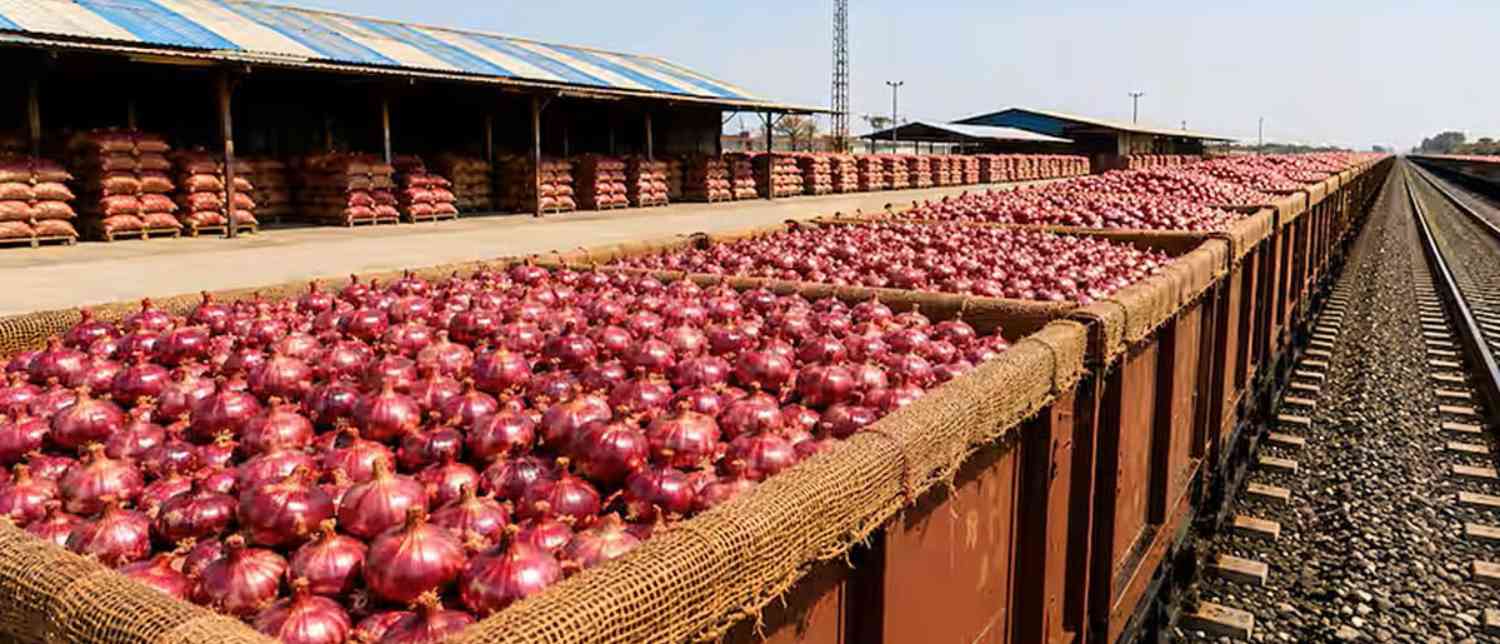
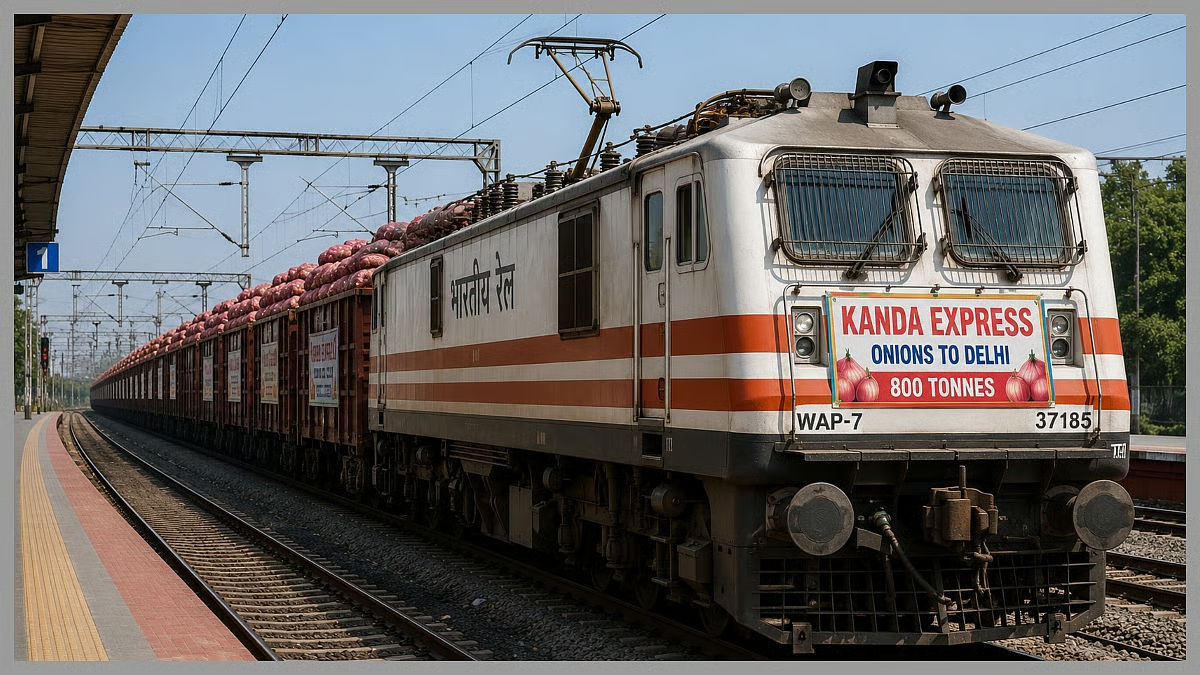
India’s onion market is having one of those moments when a humble kitchen staple suddenly becomes headline material. With onion prices climbing sharply across major cities, the Centre has rolled out the Kanda Express, a dedicated railway operation designed to move buffer-stock onions from Maharashtra to high-price consumption centres.
The first Kanda Express carrying 800 tonnes of onions is scheduled to reach Delhi on Wednesday, August 26, where the stock will be sold at a subsidised ₹35 per kg through government-linked retail outlets. The move comes as the average retail price of onions across India has jumped 59% year-on-year, putting fresh pressure on household budgets.
The government’s message is straightforward: there is onion stock available, and it needs to reach the places where consumers are paying the most.
Onion prices jump sharply across India
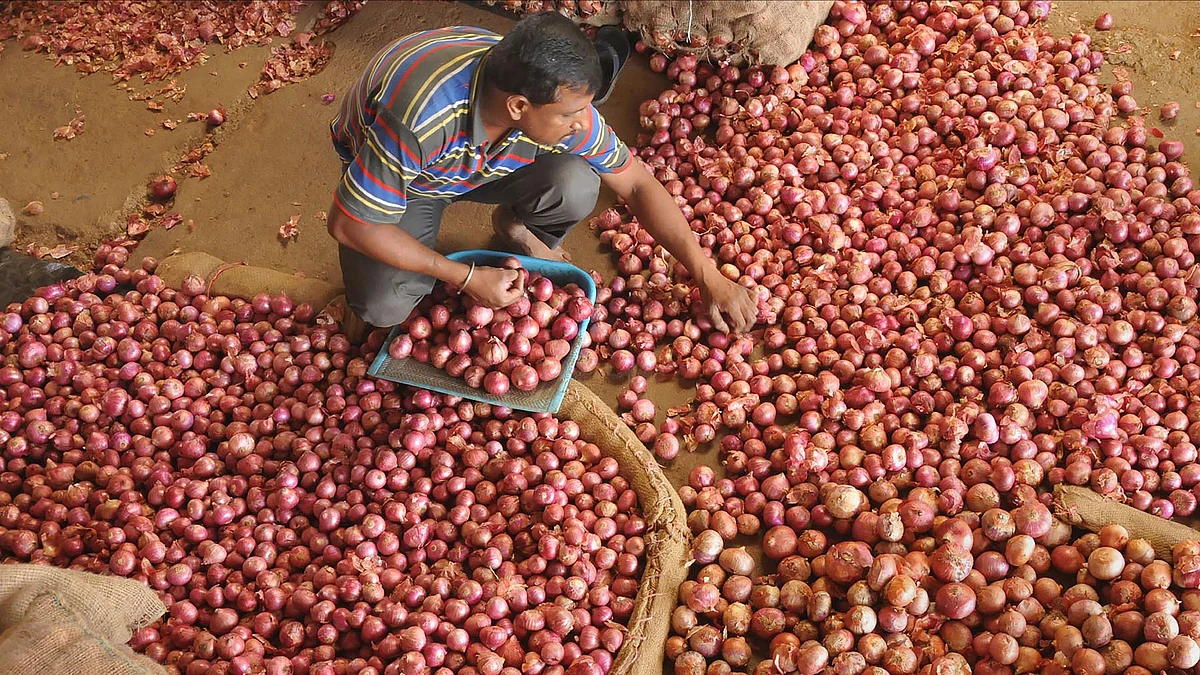
According to government data cited in the reports, the all-India average retail price of onions reached ₹43.53 per kg on August 24, compared with ₹27.37 per kg a year earlier — a rise of 59%.
The wholesale market has seen an even sharper increase. The average wholesale price rose 68% year-on-year to ₹35.58 per kg, from ₹21.23 per kg during the same period last year.
The pressure is particularly visible in major cities.
On August 24, onions were selling at around ₹60 per kg in Chennai, ₹55 per kg in Delhi and ₹53 per kg in Kolkata, according to the government figures cited in the reports. Chennai’s price, for instance, was nearly twice its year-ago level of ₹33 per kg.
For consumers, the problem is bigger than the price tag on a vegetable basket. Onions are an everyday ingredient in Indian kitchens, restaurants and food businesses. A sudden increase can therefore ripple through household grocery bills and, if sustained, contribute to broader food inflation.
That is precisely why the government is moving before the seasonal price pressure gets worse.
What is Kanda Express?
The Kanda Express is essentially a dedicated rail-based supply system for transporting large quantities of onions from producing regions to cities experiencing higher prices.
The current operation is moving buffer-stock onions from Nashik in Maharashtra, one of India’s major onion-producing regions, to large consumption centres.
The initiative is not entirely new. It was launched in the 2024-25 financial year and has expanded significantly since then.
During 2024-25, 14 railway rakes carrying nearly 12,000 tonnes of onion buffer stock were dispatched to five cities. In 2025-26, the operation expanded dramatically, with 86 rakes transporting about 88,000 tonnes to 16 major cities.
This year’s operation is now being scaled up again as prices begin their seasonal climb.
The logic is simple: instead of waiting for market forces to correct a supply imbalance on their own, the government is physically moving onions from its reserves to areas where consumers are facing higher prices.
Delhi gets 800 tonnes at ₹35 per kg
Delhi is among the first major beneficiaries of the latest intervention.
The first Kanda Express carrying 800 tonnes of onions is headed to the national capital, with the stock to be sold at ₹35 per kg.
The onions are expected to be retailed through Nafed, NCCF and Kendriya Bhandar outlets in Delhi.
At ₹35 per kg, the government-supplied onions would be substantially cheaper than the roughly ₹55 per kg retail price recorded in Delhi on August 24. That represents a discount of about 36% against that prevailing price.
But the initiative is not simply about Delhi.
Dedicated railway rakes are also being used to move onions to Chennai, Madurai, Ernakulam and Guwahati. The government has indicated that additional destinations could be added depending on how prices and market conditions develop.
In other words, Kanda Express is being designed as a flexible response rather than a one-city operation.
Why are onion prices rising?
The timing is significant.
Onion prices traditionally face upward pressure around August and September, when several factors can converge: festive demand, weather disruptions, supply-chain movements and changes in consumption patterns.
That seasonal pattern is playing out again this year, although the government has maintained that overall onion availability remains comfortable.
Estimated onion production for 2025-26 stands at around 307.37 lakh tonnes, broadly similar to the previous year’s 307.67 lakh tonnes. The government also says it has maintained around 1.21 lakh tonnes of onion buffer stock for the current year.
That creates an interesting contradiction at first glance: if production is broadly stable and buffer stocks exist, why are consumers still paying more?
Part of the answer lies in how agricultural commodities move through markets. Having sufficient onions nationally does not automatically mean that every city has sufficient onions at the right time and price.
Transportation, arrivals, local demand, market behaviour and expectations about future supplies can all influence prices.
The government has also raised concerns over market practices. Consumer Affairs Secretary Nidhi Khare said mandi prices in Nashik were higher than those in Delhi, arguing that such a situation warranted scrutiny and pointing to possible cartelisation and speculation.
Buffer stock: the government's price shield
The onions being moved through Kanda Express are not ordinary fresh arrivals. They are part of the government’s strategic onion buffer stock, maintained specifically to intervene when prices rise sharply.
The reserve is built through procurement under the Price Stabilisation Fund and can subsequently be released into markets experiencing supply pressure.
The idea is to provide a cushion between sudden market shocks and consumers’ wallets.
Instead of allowing a temporary shortage or seasonal imbalance to push prices relentlessly higher, the government can release stored onions into wholesale markets and targeted retail channels.
This year, the government has also increased the procurement price for onions from ₹1,875 to ₹2,125 per quintal, a move intended to improve returns for farmers while supporting procurement for the buffer stock.
The balancing act is important. Governments have to keep onions affordable for consumers without depressing prices so much that farmers lose the incentive to grow them.
Will Kanda Express actually bring prices down?
That is the million-rupee question — or, in this case, the ₹35-per-kg question.
The Kanda Express can certainly address one part of the problem: physical availability.
Moving hundreds of tonnes by dedicated railway rakes allows large quantities to be shifted relatively efficiently from a producing region to major consumption centres. Releasing government stock at a lower retail price can also create competitive pressure on private-market prices.
If traders and retailers know that additional onions are entering the market, excessive price escalation could become harder to sustain.
However, the impact will depend on the scale and duration of the intervention.
An 800-tonne shipment is significant, but Delhi is a huge consumption market. If demand remains elevated or supply disruptions continue, a single shipment may not be enough to permanently change market prices.
That is why the government has indicated that it will monitor prices, arrivals and availability across states and make further interventions when necessary.
The Kanda Express, therefore, is less a one-off train ride and more a signal that the government is prepared to keep using its buffer stock and logistics network if the onion price surge continues.
Political heat rises alongside onion prices
As onions became more expensive, the issue also turned political.
The opposition has attacked the government over rising prices, arguing that the increase is putting pressure on poor and middle-class households already dealing with higher everyday expenses.
The criticism has focused on the broader inflation picture, with onion prices becoming the latest symbol of the squeeze on household budgets.
The government, meanwhile, has highlighted the availability of buffer stocks, stable production estimates and its decision to intervene through dedicated rail transportation and subsidised retail sales.
So, while the onion may look innocent sitting in a vegetable basket, it has once again found itself at the centre of an economic and political debate.
What happens next?
For consumers, the immediate focus will be on whether the arrival of government onions translates into lower prices at neighbourhood markets.
Delhi’s ₹35-per-kg retail intervention is likely to be closely watched, particularly because the prevailing city price has been significantly higher.
The Centre has already indicated that the initial five destinations are not necessarily the final list. More cities can be added depending on emerging market conditions.
That means the Kanda Express could become a much bigger operation if onion prices continue climbing.
For now, the government has several tools at its disposal: buffer-stock releases, dedicated railway transportation, targeted retail sales and continued monitoring of wholesale and retail markets.
And for Indian households, the hope is refreshingly uncomplicated: that the next visit to the vegetable market involves buying onions without having to perform mental gymnastics over the grocery bill.
With input from agencies
Image Source: Multiple agencies
© Copyright 2026. All Rights Reserved. Powered by Vygr Media.