 By
By 
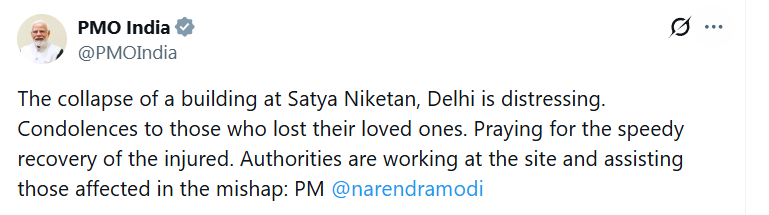
New Delhi: A five-storey building being used as a paying guest accommodation for students collapsed in Delhi's Satya Niketan area on Sunday afternoon, killing at least three people and leaving several others trapped under tonnes of concrete and debris. The incident triggered a large-scale rescue operation involving multiple agencies, while disturbing questions emerged over the age and condition of the building, basement repair work, structural safety and the unchecked conversion of residential properties into densely occupied student accommodations.
The building, popularly identified as Hostel Daze, stood in a congested locality close to Delhi University's South Campus, an area where hundreds of students live in paying guest accommodations. According to police, the structure was around 40 to 50 years old and comprised a basement and five upper floors. Repair or renovation work was underway in the basement when the building suddenly collapsed at around 1:30 pm.
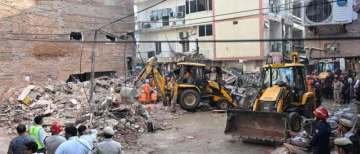
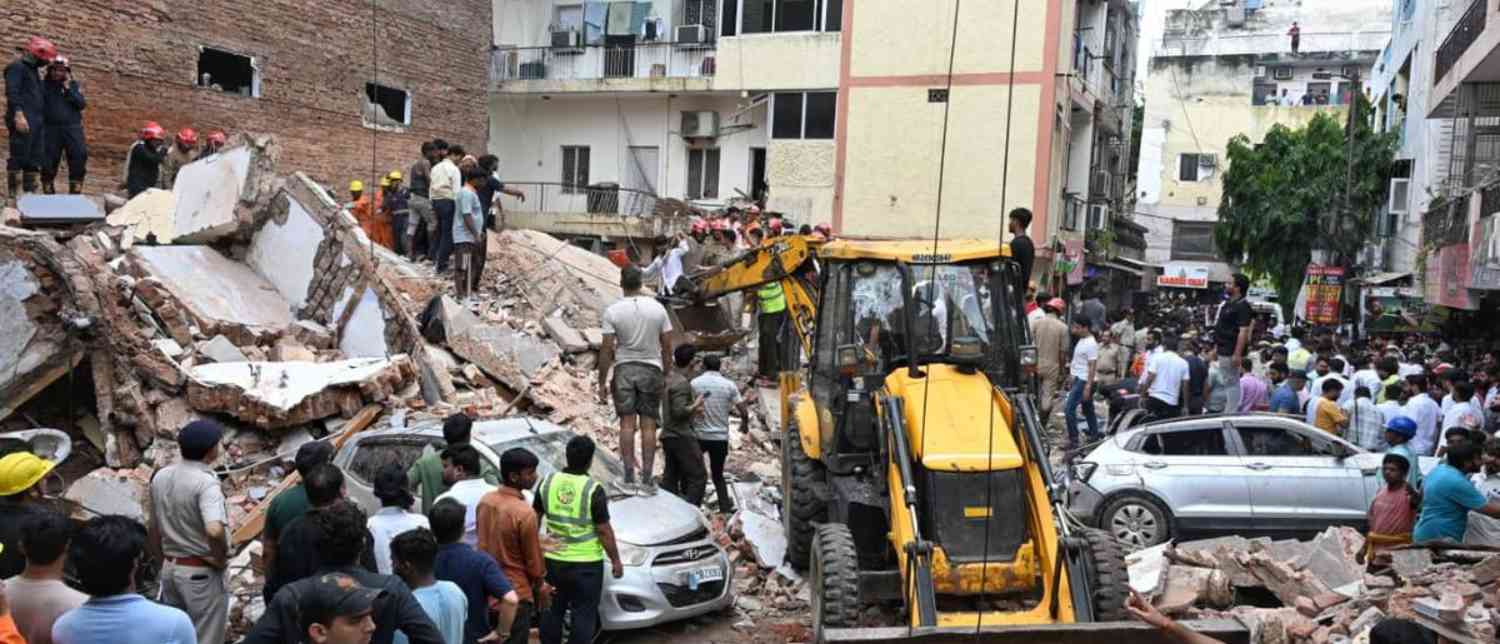
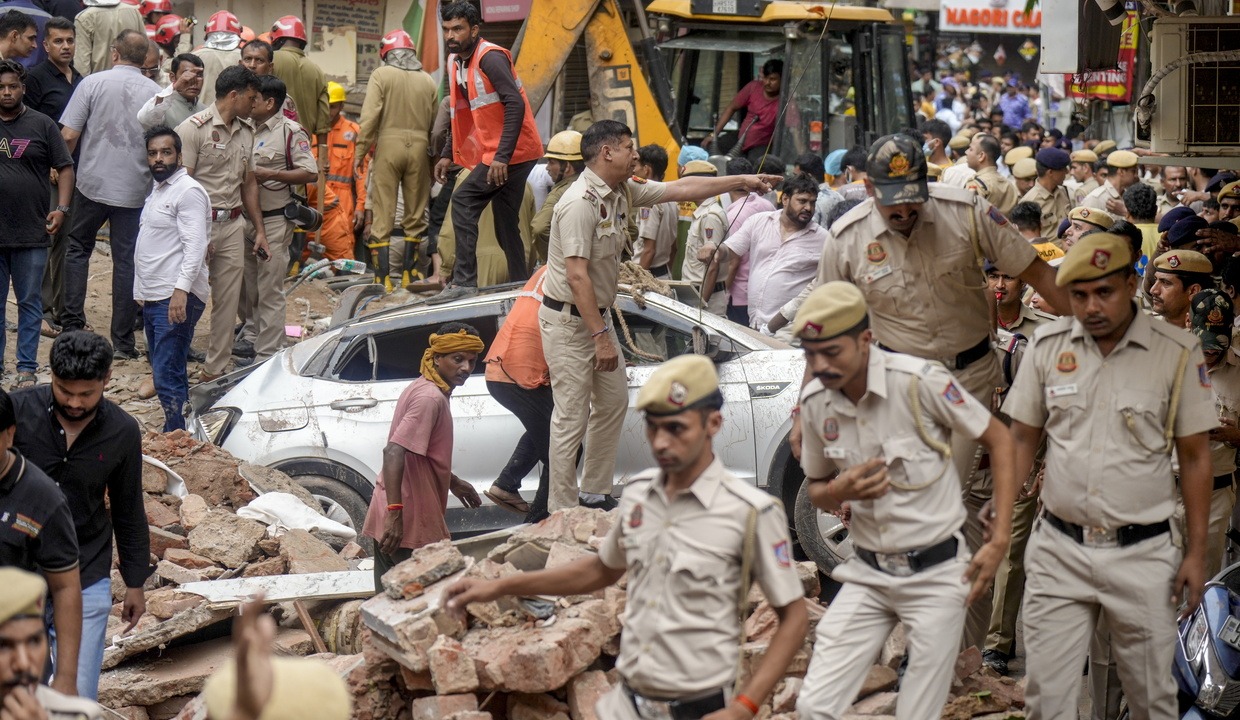
The disaster quickly turned the narrow lanes of Satya Niketan into a rescue zone. Police, Delhi Fire Services, the National Disaster Response Force, Delhi Disaster Management Authority, CATS, Civil Defence and other emergency personnel were deployed. Fire tenders, excavators and oxygen cylinders were brought in as rescuers tried to reach people believed to be trapped beneath the rubble.
By the evening, the reported death toll had risen to three. Several people were rescued, although reports during the rescue operation varied as teams continued searching the debris. Some survivors were taken to hospitals, with critically injured people being treated at the AIIMS Trauma Centre and Safdarjung Hospital.
A Sunday afternoon turned into a nightmare
The timing of the collapse made the situation particularly frightening. Sunday meant many students were inside the PG rather than attending classes or travelling to college.
Residents estimated that between 35 and 50 students could have been inside the building. Some witnesses reported hearing cries for help from beneath the debris, while there were also reports of people making phone calls from underneath the collapsed structure.
For families, those calls represented a thin thread of hope. For rescuers, they were a race against time.
Local residents were among the first to respond. Before heavy machinery could fully reach the site, people were seen trying to remove debris with their hands and whatever tools were available. Videos and eyewitness accounts showed desperate attempts to reach people trapped beneath concrete slabs.
One survivor's narrow escape underlined how sudden the collapse was. Residents said the structure came down almost without warning, with one witness describing a sensation resembling an earthquake or sudden tremor immediately before the building fell. Another resident reportedly said he had walked out of the structure only minutes before it collapsed.
The incident was not simply a case of an old building unexpectedly giving way. It has raised questions about what was happening inside the structure immediately before the collapse.
Basement excavation under scanner
The most significant question emerging from the incident concerns construction and repair activity in the basement.
Delhi Chief Minister Rekha Gupta, who visited the site while rescue operations were underway, said the old building was undergoing construction and renovation work. According to her account, excavation in the basement caused a pillar to shift, after which the entire structure collapsed. She said those responsible, including potentially the building owner or officials, would face action.
Police had earlier confirmed that repair work was underway in the basement when the building collapsed.
Residents also alleged that water had accumulated in the basement and raised concerns about the foundation of the building. However, the precise technical cause of the collapse will need to be established through a proper structural investigation rather than assumptions based solely on preliminary accounts.
That distinction matters because the question is bigger than identifying one immediate trigger.
If excavation weakened a supporting pillar, the next question is why such work was allowed to take place in an occupied, ageing structure without adequate structural assessment and safety precautions.
And if the building was already decades old, another question becomes unavoidable: when was it last structurally inspected?
#WATCH | Delhi: Search and rescue operations are underway on a war footing in South Delhi's Satya Niketan area following the collapse of a building.
Teams from the National Disaster Response Force (NDRF), Fire Service, Delhi Police, and other agencies are working at the site… pic.twitter.com/7mUvZDgvoS— ANI (@ANI) September 6, 2026
Satya Niketan's PG problem
The collapse has also exposed a larger urban problem in Satya Niketan.
The locality near Delhi University's South Campus has become a major student housing hub. Residential properties have increasingly been converted into PG accommodations to meet the enormous demand for affordable housing.
That demand is understandable. Students arriving in Delhi need places to stay, and landlords have a ready market. But the conversion of residential buildings into high-density accommodations raises questions when the number of occupants increases substantially without corresponding improvements in structural safety, fire preparedness, sanitation and emergency access.
Residents said many properties in the area have been converted into student PGs, while some owners no longer live in the neighbourhood. One resident claimed that only a minority of house owners actually reside locally and alleged that several buildings had not received adequate maintenance.
Students also described the density inside some PGs. Accounts from the locality suggested that a single floor could contain several rooms and a large number of beds. In some accommodations, multiple students share individual rooms, allowing property owners to maximise occupancy.
The collapsed building itself reportedly had around 10 rooms, while residents estimated that dozens of students were staying on its upper floors. One account suggested that students were paying roughly ₹12,000 per bed, illustrating the commercial value of student accommodation in the area.
This raises a critical question: when a residential building becomes a densely occupied commercial accommodation, does its safety oversight change accordingly?
If it does not, then the regulatory system may be leaving thousands of students dependent on buildings that were never designed to accommodate such numbers.
A warning for more than one building
The danger may not be limited to the collapsed structure.
The incident reportedly left an adjacent building leaning, prompting authorities to take precautions and evacuate the neighbouring structure. The concern is obvious: when one ageing building collapses in a tightly packed locality, surrounding structures can also become vulnerable.
The Satya Niketan incident should therefore not end with debris removal.
It should trigger an immediate structural safety review of buildings operating as PG accommodations, hostels and other high-occupancy establishments in the area.
The questions should be straightforward.
How old are these buildings?
Were they originally approved for their present use?
Were additional floors or basements added later?
Have structural changes been made?
Are basements being excavated or modified?
How many people are actually living inside each property?
Have mandatory inspections been conducted?
Are emergency exits accessible?
Are fire safety requirements being followed?
And most importantly, who is responsible for checking all of this before disaster strikes?
#WATCH | Delhi: Search and rescue operations are underway on a war footing in South Delhi's Satya Niketan area following the collapse of a building.
Teams from the National Disaster Response Force (NDRF), Fire Service, Delhi Police and other agencies are working at the site to… pic.twitter.com/FKwSOyY2pm— ANI (@ANI) September 6, 2026
The familiar promise: action after tragedy
Authorities have understandably focused on rescue and accountability following the collapse.
The Chief Minister has said that no one responsible will be spared. An FIR has also been registered against the building's owner. The government has assured that the guilty will face consequences, while rescue agencies have worked through the rubble to find survivors.
But this is where the tragedy raises an uncomfortable question.
Why does accountability so often begin only after people die?
Governments change. Political leadership changes. Administrations change. Officials are transferred, departments are reorganised and new announcements are made.
Yet the underlying problems frequently remain.
Old buildings continue to stand without adequate maintenance. Residential properties continue to be converted into densely occupied establishments. Construction and renovation continue in structures whose structural capacity may be uncertain. Fire incidents continue to claim lives. Buildings collapse. People get trapped. Families wait outside hospitals and rescue sites for news.
Then comes the familiar sequence: condolences, inspections, inquiries, promises of strict action, announcements of punishment and assurances that such an incident will not happen again.
But what about the inspection that should have happened before the collapse?
What about the warning signs that could have been identified before someone was buried under concrete?
What about the children and young people who could have been protected before an emergency became inevitable?
Punishing someone after a death may establish legal responsibility. It may even provide some measure of justice to grieving families. But punishment cannot reverse death.
It cannot bring back the student who was buried beneath a collapsed ceiling.
It cannot return a child to their parents.
It cannot erase the trauma suffered by survivors.
And it certainly cannot rebuild a life that has already ended.
That is why the most important question emerging from Satya Niketan is not simply who will be punished?
It is why was this allowed to happen in the first place?
Prevention cannot remain a slogan
India has witnessed building collapses and deadly fire incidents repeatedly. After almost every major tragedy, questions are raised about safety audits, illegal construction, building permissions, negligence and regulatory failures.
And almost every time, the public hears some version of the same promise: strict action will be taken.
But a functioning safety system should not depend on tragedy to activate itself.
The purpose of regulation is prevention.
A building should be inspected because it is old, not because it has collapsed.
A PG should be checked because dozens of students live inside it, not because those students are trapped beneath rubble.
A basement alteration should be examined because it can affect a building's structural stability, not after a pillar has shifted and the structure has already fallen.
A fire-safety inspection should happen before flames spread through a building, not after families are searching for missing relatives.
This is where the principle of prevention is better than cure becomes more than a familiar phrase. In matters involving public safety, prevention is not merely preferable. It is the government's fundamental responsibility.
The accountability gap needs to be addressed
The Satya Niketan collapse should prompt a broader examination of how urban building safety is monitored.
Accountability cannot end with naming the property owner.
If rules were violated, the investigation must establish how those violations went unnoticed. If permissions were required, investigators should determine whether they were obtained. If inspections were mandatory, authorities must establish whether they occurred. If an official failure contributed to the disaster, responsibility should extend beyond private individuals.
At the same time, allegations of corruption or negligence should be established through evidence and investigation rather than political claims.
The goal should not be to find a convenient scapegoat.
The goal should be to identify every failure that allowed an unsafe situation to develop.
Only then can accountability become meaningful.
What happens after the rubble is cleared?
That may ultimately be the most important test.
Rescue teams will eventually clear the debris. The police investigation will progress. Injured victims will receive treatment. Families will mourn those who did not survive.
But what happens to the other buildings in Satya Niketan?
What happens to the thousands of students living in similar PG accommodations across Delhi?
Will ageing buildings undergo comprehensive structural inspections?
Will authorities verify whether properties being used as PGs comply with permitted usage and occupancy norms?
Will basement construction and renovation work receive proper structural scrutiny?
Will unsafe buildings be evacuated before another collapse?
And will these measures continue after the headlines disappear?
The tragedy will have little meaning if the answers are limited to another round of inspections immediately after the incident, followed by months or years of silence.
A city cannot afford to wait for the next collapse
The Satya Niketan building collapse is a tragedy in its immediate form, but it is also a warning about a much larger urban safety problem.
Delhi is a city where ageing structures coexist with rapidly increasing population density and intense demand for housing. In neighbourhoods surrounding major educational institutions, the pressure is particularly high. Students need affordable accommodation, landlords want to maximise rental income and buildings are often modified to meet demand.
That system can work only when safety regulations keep pace with changing use.
When they do not, a building can quietly become a disaster waiting to happen.
The lesson from Satya Niketan should therefore not be limited to one building, one owner, one construction activity or one locality.
It should be about creating a system in which authorities identify dangerous buildings before they become crime scenes.
Governments will keep changing. Political priorities will keep shifting. New officials will take charge and old ones will move on.
But the concrete remains.
The buildings remain.
The students remain.
The families remain.
And the risk remains unless someone takes responsibility for eliminating it.
The real measure of governance is not how quickly leaders respond after a building collapses. It is whether they can ensure that the next building does not collapse.
Because once the lives are lost, no investigation can bring them back.
No punishment can bring them back.
No compensation can replace them.
No statement promising action can undo the damage.
The question, therefore, is no longer whether action will be taken after Satya Niketan.
The question is whether action will finally be taken before the next Satya Niketan happens.
With input from agencies
Image Source: Multiple agencies
© Copyright 2026. All Rights Reserved. Powered by Vygr Media.