 By
By 
A Delhi High Court order has brought an unusual but deeply personal moment from a POCSO trial back into focus. The court has directed the District Legal Services Authority (DLSA) to ensure that a message written by a trial court judge for a 10-year-old girl who survived sexual assault is delivered to her or her family, along with ₹10.50 lakh awarded as compensation.
The direction came while the High Court was hearing an appeal against the conviction and life sentence awarded to the accused in the case. While the appeal will continue, the court declined to suspend the sentence at this stage, noting the evidence on record, including forensic evidence.
The case dates back to July 23, 2023, when the child was seven years old. She is now 10.
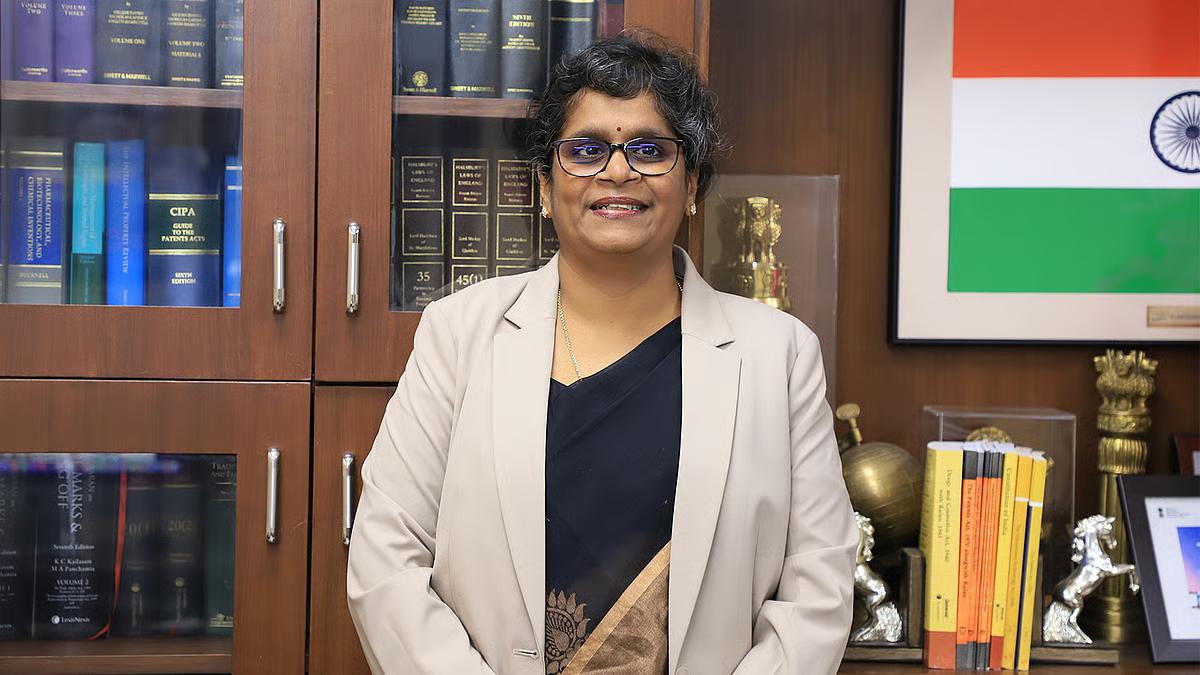
Delhi High Court Orders Judge’s Message To Be Given To Child Survivor
The direction was passed by a Division Bench comprising Justice Prathiba M Singh and Justice Dinesh Bhatt on September 22, 2026.
The bench directed the Secretary of the North-West Delhi District Legal Services Authority to print the message written by the trial court judge and hand it over to the child survivor or her family within two weeks. The compensation awarded to the family is also to be delivered, and the DLSA has been asked to submit a status report on the payment.
The message had been written by Additional Sessions Judge Rajani Ranga at the end of the trial court's judgment. Rather than ending the order in conventional legal language, the judge directly addressed the child and acknowledged what she had told the court.
The girl had expressed a simple but powerful wish: that the man she referred to as “uncle” should remain in jail until he grew old.
The trial judge acknowledged that plea and told the child that the court had heard her and acted on it.
The judge also encouraged the girl to look beyond the case and return to the ordinary things that belong to childhood going to school, making friends, laughing, playing and dreaming.
“The Court Cannot Give You Back Your Childhood”
One of the most striking aspects of the trial court's message was its recognition that a criminal conviction, however severe, cannot undo the harm suffered by a child.
The judge told the survivor, in substance, that the court could not give her childhood back but could assure her that her words had been heard.
The message also sought to reassure the girl that the convicted man would remain behind bars and would not be able to harm her, her younger sister or another child.
The Delhi High Court later described the trial judge's note as a message of courage and directed that it should actually reach the child rather than remain buried inside the court record.
That direction gives the message significance beyond the sentencing order itself. It ensures that the child, who participated in the judicial process at a very young age, receives a direct acknowledgement that her voice mattered in the proceedings.
The message reads:
What Happened In The POCSO Case?
The case arose from an incident reported on July 23, 2023, when the survivor was seven years old.
The accused, identified in the proceedings as Sumit Shakya, was convicted by the trial court for aggravated penetrative sexual assault against a child below 12 years of age under the Protection of Children from Sexual Offences Act, commonly known as the POCSO Act.
He was also convicted for criminal intimidation.
The trial court subsequently sentenced him to rigorous imprisonment for the remainder of his natural life for the POCSO offence and imposed a fine of ₹1 lakh. For criminal intimidation, he was sentenced to five years of rigorous imprisonment and fined ₹20,000.
The sentences were directed to run concurrently.
The trial court also awarded ₹10.50 lakh as compensation to the child survivor, taking into account the nature of the offence, the suffering caused to the child and family, and the potential long-term impact of the abuse.
Delhi High Court Refuses To Suspend Life Sentence
The accused challenged his conviction and sentence before the Delhi High Court.
While the High Court admitted the appeal, it did not suspend the sentence or grant immediate relief from custody.
The bench specifically considered the evidence available in the case, including forensic evidence, and said it was not inclined to suspend the sentence at this stage.
This does not mean that the appeal has been finally decided. The conviction and sentence remain subject to the appellate proceedings, which will continue before the High Court.
The court also directed that notice of the appeal be served on the survivor through the investigating officer.
The matter concerning the DLSA's compliance and the compensation status is scheduled to come up on November 4, 2026. The criminal appeal is listed again for January 20, 2027.
₹10.50 Lakh Compensation To Be Tracked By DLSA
The compensation component is another important part of the High Court's order.
Although the trial court had already fixed compensation at ₹10.50 lakh, the High Court sought a status report from the DLSA to determine whether the amount had actually been disbursed.
The court's direction therefore goes beyond simply recording that compensation was awarded. It places attention on whether the financial assistance reaches the child survivor and her family.
For victims of child sexual abuse, compensation can form part of the broader support available through the legal system. However, the High Court's latest direction makes clear that an award on paper is not enough; the authorities must also ensure its implementation.
Why The Judge’s Message Matters
Court proceedings involving children are necessarily different from ordinary criminal cases because the survivor is not simply a witness in a legal dispute. The process can become part of a child's memory of the crime, the investigation and the pursuit of justice.
In this case, the trial judge's decision to speak directly to the survivor created a moment outside the formal language of criminal sentencing.
The message did not focus only on the punishment imposed on the accused. It also turned toward the child's future.
That distinction is significant.
The legal process determined the accused's punishment. The personal message, meanwhile, attempted to tell the child that the case should not define the rest of her life.
The Delhi High Court's decision to ensure that the message is physically delivered to the survivor adds another layer to that approach.
POCSO Case Highlights Need To Protect Child Survivors
The case also highlights the difficult balance courts face in POCSO cases: ensuring accountability for crimes against children while protecting survivors from being reduced to the details of the offence.
The child's identity has not been disclosed, in keeping with legal protections applicable to child survivors of sexual offences.
The proceedings also show how a POCSO case can continue long after a trial court delivers its judgment. Even after conviction and sentencing, questions relating to appeal, sentence suspension, compensation and communication with the survivor can remain before the courts.
Here, the Delhi High Court has simultaneously allowed the appeal process to continue, declined to suspend the life sentence at this stage, and directed authorities to ensure that the child receives both the compensation awarded to her family and the trial judge's message.
For the 10-year-old survivor, however, the most significant part of the order may not be the legal terminology.
It may simply be the assurance that the court heard her.
At seven, she entered a judicial process that most adults would struggle to endure. Three years later, the court is ensuring that the words written for her do not remain confined to a judgment file.
The criminal appeal is still pending, and the final outcome of that proceeding remains to be decided. But the High Court's latest directions have placed the focus on another question that is often lost in lengthy criminal proceedings: after a child has spoken, been heard and received a court's decision, what does the justice system do to help that child move forward?
In this case, the answer begins with a message one telling her that she was heard, that her courage was recognised, and that she should now be allowed to live, learn, play and dream.
With input from agencies
Image Source: Multiple agencies
© Copyright 2026. All Rights Reserved. Powered by Vygr Media.