 By

For years, Jensen Huang represented the extraordinary rise of Silicon Valley's artificial intelligence revolution. His trademark black leather jacket, unconventional leadership style and ambitious vision for accelerated computing made him one of the most recognisable figures in the global technology industry. Under his leadership, Nvidia transformed from a graphics processing company into one of the most strategically important technology businesses in the world.
But the latest controversy surrounding Huang has changed the conversation dramatically.
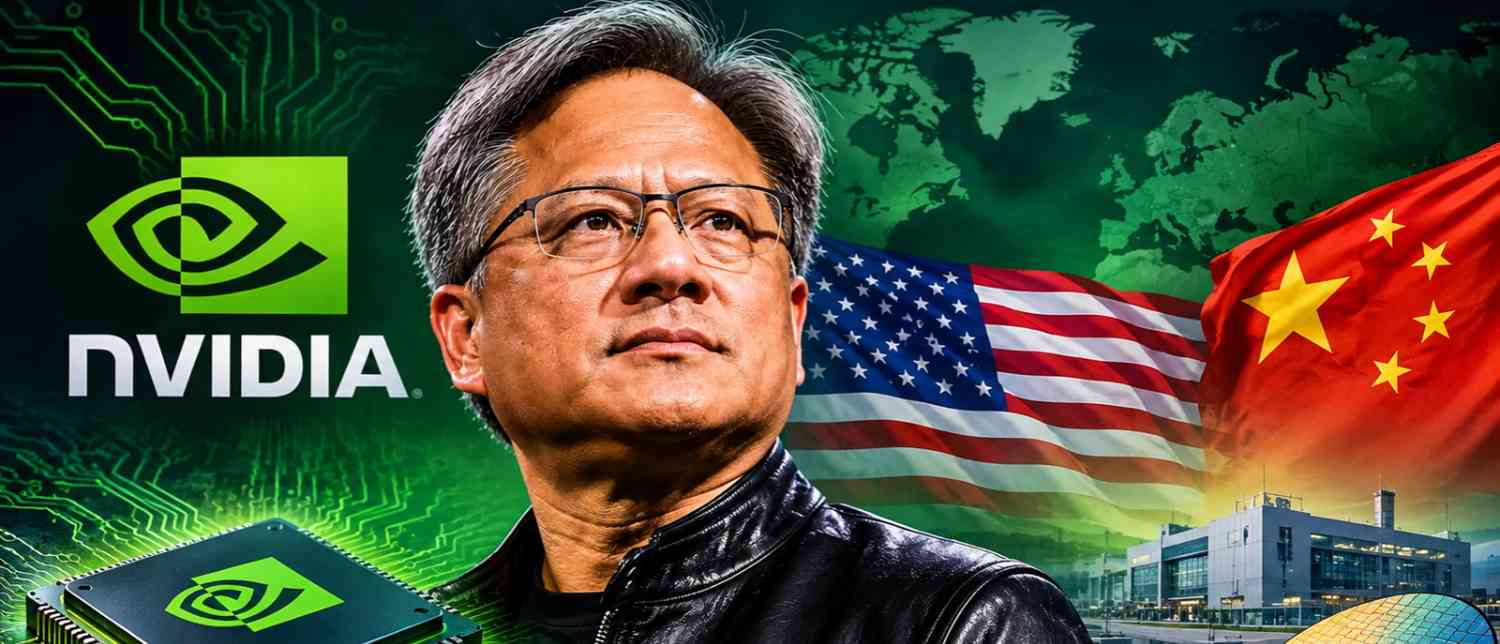
Reports concerning his alleged personal relationships, a businesswoman suspected by American intelligence officials of having connections to Chinese intelligence, and questions about Nvidia's business dealings with Singapore-based Megaspeed International have turned an executive controversy into a national security debate. Huang's departure from the company's top leadership positions on November 12, 2026, has further intensified scrutiny of Nvidia's future.
Yet the most consequential question is not simply what happens to Jensen Huang or who succeeds him. It is what this episode reveals about America's dependence on a handful of powerful technology companies to maintain its global AI advantage.
The Nvidia controversy has exposed a difficult reality: in the modern geopolitical order, control over artificial intelligence and advanced semiconductors is as strategically important as control over conventional military capabilities.

From Silicon Valley visionary to the centre of a national security controversy
When Jensen Huang co-founded Nvidia in 1993, few could have anticipated the company's eventual importance to the global economy. Initially recognised for its graphics processing units (GPUs), Nvidia gradually expanded its technological capabilities and positioned itself at the centre of high-performance computing.
The emergence of generative AI transformed that position into extraordinary influence.
Modern AI systems require enormous computing resources to train increasingly sophisticated models. Nvidia's GPUs, supported by its software ecosystem and specialised computing infrastructure, became essential components of this transformation. From cloud computing and autonomous technologies to scientific research and large language models, Nvidia's technology became deeply embedded in the expanding AI economy.
Huang was more than the company's chief executive. He was its principal public advocate, strategic visionary and most influential representative. His appearances frequently shaped expectations about the future of artificial intelligence, while his comments attracted attention from investors, policymakers and technology executives.
That extraordinary association between a founder and a company, however, can become a vulnerability.
The recent controversy has brought that vulnerability into focus. Reporting about Huang's alleged relationship with Alice Huang, a Singapore-based businesswoman previously associated with Megaspeed International, raised questions about possible foreign intelligence exposure and the movement of advanced computing technology towards China.
American intelligence officials reportedly suspected that Alice Huang had links to Chinese intelligence. Jensen Huang denied knowing about any alleged intelligence connection. China rejected the espionage allegations, while Megaspeed has denied wrongdoing. Nvidia's board initiated an independent investigation and stated that it had no reason at that stage to believe that corporate secrets or American national security had been compromised.
These distinctions matter. Suspicion is not proof of espionage, and an investigation is not a finding of guilt.
Nevertheless, the controversy became a serious corporate and political issue. Huang's departure on November 12 marked a dramatic development for a company whose identity had been closely associated with its founder for more than three decades.
The episode also raises an uncomfortable question: how adequately can a corporation protect its strategic interests when its leadership becomes entangled in circumstances that potentially overlap with national security concerns?
Why Nvidia is much more than another American technology company
To understand the significance of the Nvidia controversy, it is necessary to look beyond the company's market valuation.
Nvidia's importance comes from the strategic capabilities its products provide. GPUs are not simply components used to make computers faster. They enable the enormous computational workloads required to develop and operate advanced artificial intelligence systems.
The same computing infrastructure that supports commercial AI applications can also contribute to military simulations, intelligence analysis, cybersecurity operations, surveillance technologies and weapons research.
This dual-use nature of advanced computing makes semiconductor technology particularly sensitive.
For Washington, the question is therefore not merely whether Nvidia can sell more products or expand its international customer base. It is whether the unrestricted availability of its most advanced chips could strengthen a strategic competitor.
This is the central tension behind America's semiconductor export controls.
The US government wants American companies to remain technologically dominant, financially competitive and influential across global markets. At the same time, it wants to prevent China from acquiring computing capabilities that could undermine American military and intelligence advantages.
These objectives do not always align.
A company operating in a competitive global market naturally wants access to large customer bases. China, with its substantial technology industry and ambitions in artificial intelligence, represents an important commercial opportunity. But the American government views access to advanced AI computing through a national security lens.
The result is a conflict between corporate commercial interests and national strategic priorities.
The Nvidia-China relationship and the dilemma of semiconductor export controls
Washington's approach to restricting advanced semiconductor exports to China is built around a relatively straightforward strategic calculation: certain technologies are so important to future economic and military power that their availability to potential adversaries must be controlled.
This approach is often described as a targeted restriction strategy, rather than an attempt to sever every commercial relationship between the two countries.
Advanced AI chips are among the most important technologies covered by this policy.
Jensen Huang had repeatedly argued that restricting American companies from the Chinese market could ultimately weaken America's technological position. His argument was that Chinese developers might turn towards domestic alternatives if American technology became inaccessible.
In other words, maintaining commercial access could help preserve American technological influence.
There is a reasonable economic argument behind this position. A company that continues serving international customers can generate revenue, fund research and development, expand its ecosystem and maintain relationships with developers.
However, the national security argument is equally difficult to dismiss.
If advanced Nvidia chips become available to Chinese companies operating in sensitive sectors, the computing capabilities they provide could potentially support applications extending beyond ordinary commercial activity.
This is where the controversy surrounding Megaspeed International becomes particularly significant.
The Singapore-based company emerged as an important buyer of Nvidia technology and was associated with cloud-computing infrastructure serving customers across Southeast Asia. Its business model raises questions about how computing resources can cross geopolitical boundaries even when physical semiconductor exports remain subject to restrictions.
The distinction between selling a chip and providing access to its computing power is increasingly important.
A company might purchase advanced processors legally, install them in data centres outside China and subsequently rent computing capacity to Chinese customers. Such arrangements may be permitted under existing regulations, depending on the circumstances. But they also create difficult enforcement questions.
Could restricted technology reach prohibited end users through intermediaries? Are existing monitoring systems sufficient to establish where advanced chips are being used? How should governments regulate access to computing infrastructure rather than simply the physical movement of hardware?
These are not minor regulatory questions. They go to the heart of the future of semiconductor export controls.
The controversy has demonstrated that controlling the movement of advanced technology is considerably more complicated than controlling the movement of conventional goods.
Megaspeed International: The challenge of monitoring AI chip diversion
The scrutiny surrounding Megaspeed International illustrates a growing weakness in the global semiconductor supply chain.
International technology businesses operate through complex networks involving manufacturers, distributors, cloud providers, data-centre operators and customers. Products can pass through multiple jurisdictions before reaching their ultimate users.
This creates opportunities for legitimate international business, but it also complicates enforcement.
American authorities have been concerned about the possibility of advanced Nvidia chips reaching restricted Chinese users through third-party intermediaries. Previous investigations into suspected semiconductor diversion have already demonstrated that sophisticated hardware can be moved through complicated commercial arrangements.
In the Megaspeed case, the reported purchases and possible onward movement of Nvidia technology have attracted particular attention. However, the distinction between reported purchases, suspected diversion and proven violations must be maintained. No wrongdoing should be assumed merely because a company has attracted investigative scrutiny.
The larger problem is that conventional export-control systems were designed primarily around the physical movement of products.
Artificial intelligence introduces a different dimension: computing power itself can be accessed remotely.
A GPU installed in Singapore does not necessarily serve only Singaporean customers. A data centre can provide computing resources to businesses located thousands of kilometres away. Consequently, the geographical location of a chip does not automatically establish the identity or purpose of its ultimate users.
Washington will need more sophisticated mechanisms for monitoring advanced AI infrastructure. These could include stronger customer verification, more transparent ownership structures, improved hardware tracking, enforceable end-use restrictions and closer cooperation between governments and technology companies.
But these measures also raise questions about privacy, commercial autonomy and the extent of government oversight.
The challenge is to prevent sensitive technology from reaching prohibited users without creating an excessively restrictive system that damages legitimate international innovation.
America's semiconductor supremacy has a geographical weakness
There is another dimension to this controversy that deserves greater attention: America's dependence on a semiconductor supply chain that extends far beyond its own borders.
The United States possesses some of the world's most influential semiconductor design companies and technological research institutions. Yet designing an advanced chip and manufacturing it at scale are two very different capabilities.
The production of cutting-edge semiconductors requires highly specialised equipment, manufacturing expertise, enormous capital investment and extremely complex supply networks.
Taiwan occupies a particularly important position in this ecosystem, with its semiconductor manufacturing industry playing a central role in producing advanced chips for global technology companies.
This creates a strategic vulnerability for Washington.
America may lead in chip design, AI software and several critical technology segments, but its technological leadership depends on manufacturing capabilities concentrated in a relatively small number of locations, particularly in East Asia.
Any major disruption involving Taiwan could have consequences extending well beyond the island.
It could affect American technology companies, global data-centre expansion, consumer electronics, automotive manufacturing and the development of advanced AI systems.
This is the deeper meaning of America's silicon Achilles' heel.
The country is competing to establish technological supremacy while remaining dependent on a geographically concentrated manufacturing ecosystem.
Consequently, semiconductor security cannot be understood only through export restrictions against China. It must also involve manufacturing resilience, supply-chain diversification, domestic production capabilities and strategic partnerships with trusted economies.
The United States has recognised this challenge through efforts to strengthen domestic semiconductor manufacturing. But rebuilding an entire industrial ecosystem takes years, substantial investment and specialised human capital.
It cannot be achieved simply by announcing new factories or imposing restrictions on foreign competitors.
The corporate governance question: Can one individual become too powerful?
The controversy also exposes a weakness that extends beyond Nvidia.
For more than three decades, Jensen Huang was closely associated with the company's strategic direction and public identity. His leadership helped create a powerful corporate culture and a technology ecosystem that became central to the AI industry.
But when a company becomes so closely identified with one individual, the distinction between institutional strength and personal influence can become blurred.
Investors may begin to associate the company's future not only with its products, intellectual property and revenue prospects, but also with the continued presence of its founder.
That creates risks.
A founder's departure can unsettle investors, complicate strategic decision-making and raise questions about succession planning. If the departure occurs amid allegations involving corporate disclosures, governance and national security, those risks become even more pronounced.
Nvidia's board now faces the challenge of demonstrating that the company is larger than its former chief executive.
It must establish that internal controls are effective, that investigations are independent, that shareholder interests are protected and that decisions involving sensitive international business relationships receive appropriate oversight.
The controversy also raises questions about whether corporate boards possess sufficient expertise to evaluate national security risks in industries whose products have strategic military applications.
Traditional corporate governance frameworks are not necessarily designed to assess the geopolitical consequences of advanced AI technology.
That gap needs attention.
When private corporations control infrastructure that governments consider strategically indispensable, their accountability cannot be treated as an ordinary matter of executive performance.
The US-China AI race is bigger than Jensen Huang
Perhaps the most important lesson from this episode is that the global AI race will continue regardless of what happens to Nvidia's former chief executive.
China is investing heavily in domestic semiconductor capabilities, AI research and alternative technology ecosystems. American export restrictions may slow access to certain advanced technologies, but they also strengthen Beijing's incentive to reduce its dependence on foreign suppliers.
This creates a difficult strategic calculation for Washington.
Restricting access to advanced chips could preserve a technological advantage in the short term. However, excessive restrictions could encourage the development of competing domestic technologies and reduce the long-term influence of American companies.
Allowing unrestricted access, on the other hand, could create national security risks.
There is no simple solution.
The competition is no longer limited to which country can manufacture the fastest processor. It involves the entire AI ecosystem: semiconductor design, advanced manufacturing, software platforms, data centres, energy infrastructure, research talent and access to computing resources.
In this environment, Nvidia remains strategically important even after Huang's departure.
The company possesses technological expertise, established relationships, a widely adopted software ecosystem and an important position in the global AI infrastructure market. These strengths do not disappear simply because its leadership changes.
But the controversy could force a reassessment of how much strategic influence should be concentrated in private technology companies and their executives.
The real question is who controls the future of computing
The Nvidia controversy began as a story about a powerful technology executive and allegations surrounding his personal and professional relationships. It has evolved into something considerably larger.
It now touches corporate accountability, international intelligence concerns, semiconductor export controls, AI infrastructure, American industrial policy and the geopolitical competition between the United States and China.
Jensen Huang's departure may close one chapter in Nvidia's history, but it does not resolve the questions that brought the controversy into public view.
Can the United States protect its technological advantage while allowing its companies to compete in global markets? Can export controls remain effective when computing resources can be accessed remotely? Can private corporations be trusted to balance commercial interests with national security responsibilities? And can America reduce its dependence on geographically concentrated semiconductor manufacturing?
These questions will shape the next phase of the global AI race.
The future of technological supremacy will not be determined solely by who designs the most advanced chips or builds the most powerful AI models. It will also depend on who manufactures those chips, who can access them, where the computing infrastructure is located and how effectively governments can protect technologies with strategic consequences.
America's greatest vulnerability may not be the loss of one influential CEO. It may be the growing realisation that its technological power rests on a complicated network of private companies, international supply chains and geopolitical relationships that no single government can fully control.
In the age of artificial intelligence, silicon is no longer merely the foundation of computing. It is an instrument of economic power, national security and international influence.
And that is why the Nvidia controversy matters far beyond Nvidia itself.
© Copyright 2026. All Rights Reserved. Powered by Vygr Media.