
 By
By 
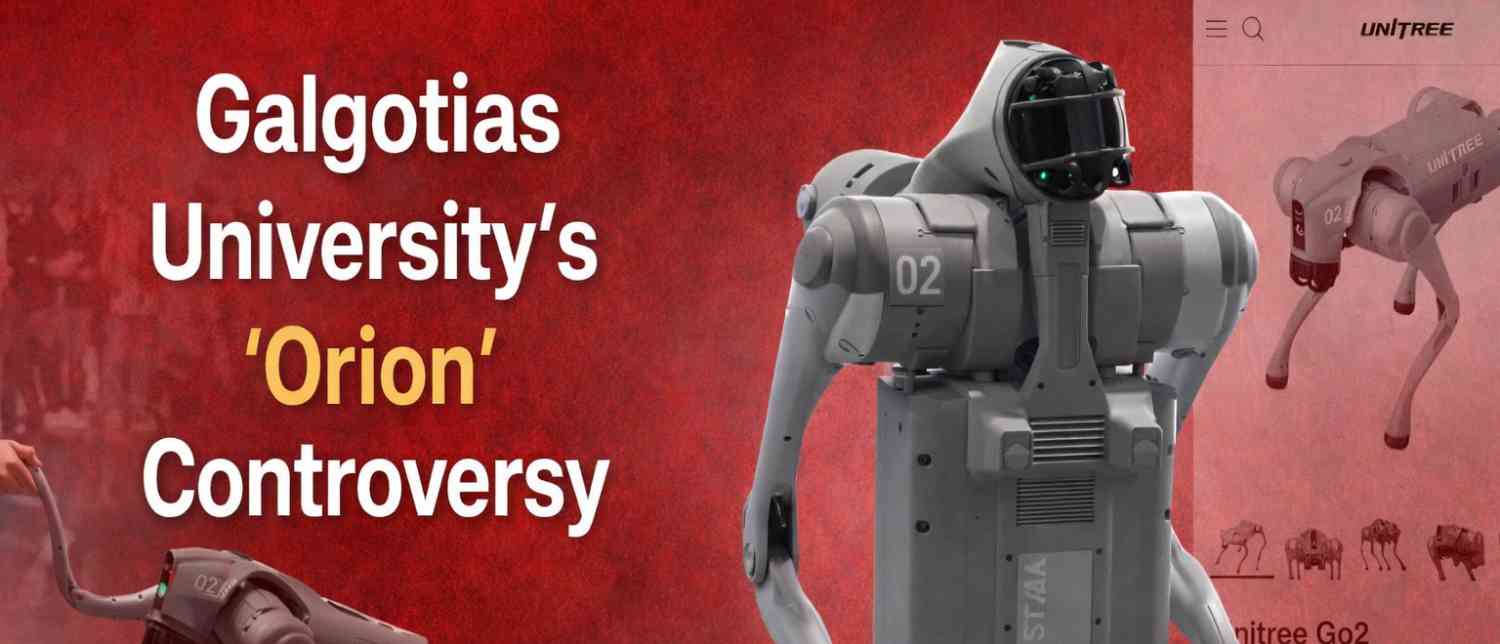
The India AI Impact Summit in New Delhi was meant to spotlight innovation, emerging technologies, and India’s growing footprint in artificial intelligence. Instead, it became the epicentre of a controversy involving Galgotias University after the institution was accused of presenting a Chinese-made robotic dog as its own innovation.
The Greater Noida-based university was reportedly asked to vacate its stall at the AI Summit Expo following widespread backlash. At the heart of the storm was a quadruped robot displayed at the event under the name “Orion” — a machine that social media users quickly identified as the Unitree Go2, manufactured by Chinese robotics company Unitree Robotics.
How the Controversy Began
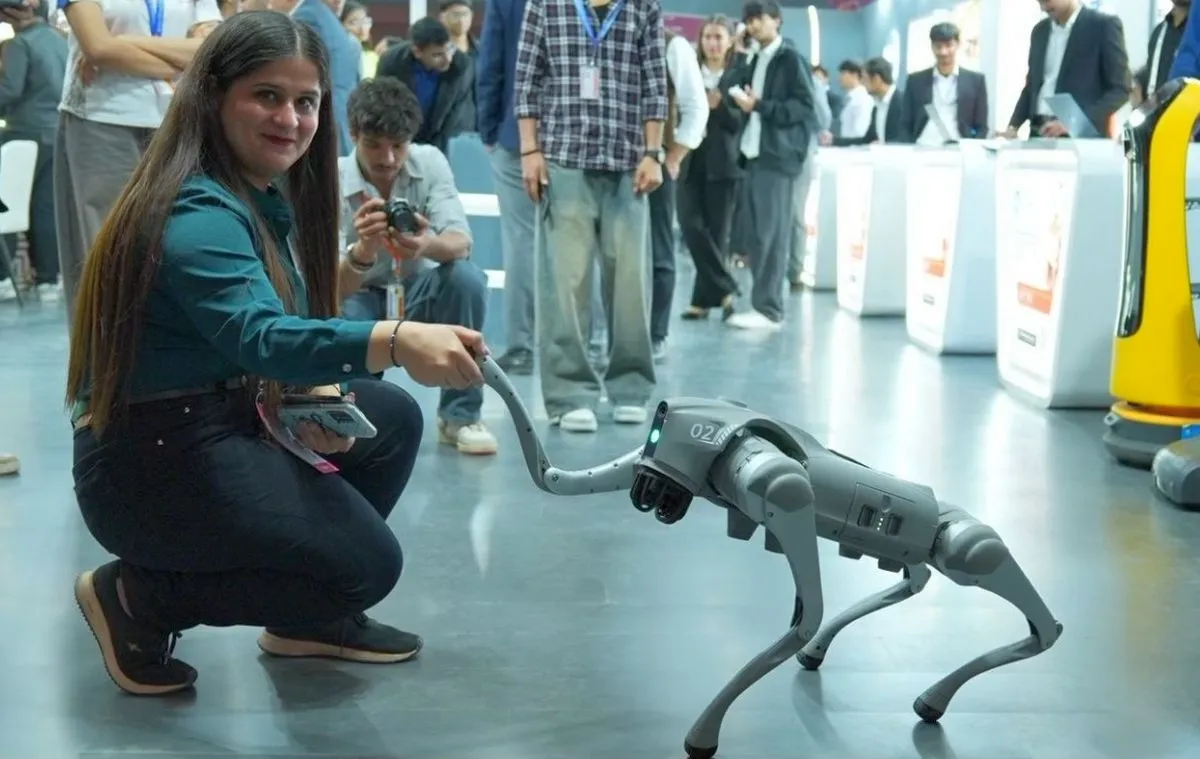
The uproar started when a video from the AI Summit went viral on social media platforms. In the clip, a woman identified in reports as a representative of the university’s Centre of Excellence described a robotic dog named “Orion” during a media interaction.
In the video, she stated that the robotic dog had been developed by the university’s Centre of Excellence. A separate interview clip showed a university professor making a similar claim, telling a reporter that the robot had been built at the institution.
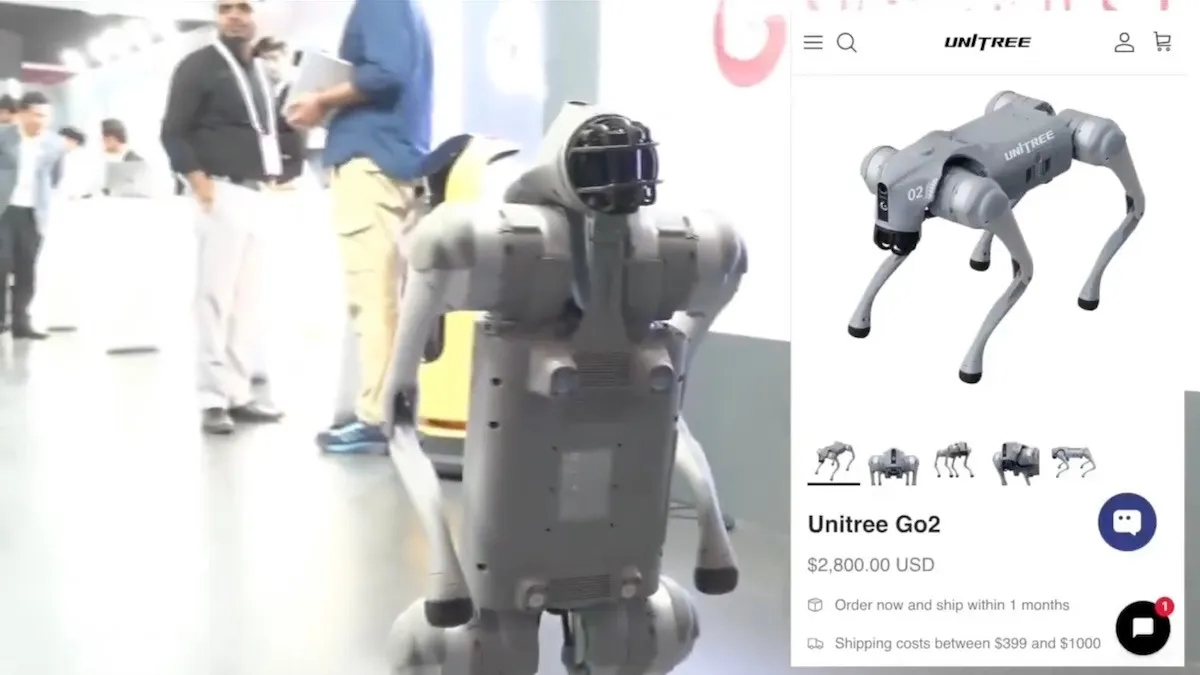
However, eagle-eyed viewers were quick to notice striking similarities between “Orion” and the commercially available Unitree Go2. The Go2 is sold online in India for approximately ₹2–3 lakh and is widely recognized in robotics circles. Social media users accused the university of rebranding imported technology as an indigenous innovation.
The backlash was swift and intense, with critics alleging that the university had misrepresented foreign-made hardware as its own creation at a prestigious national AI platform.
What Is the Unitree Go2?
The robot at the centre of the controversy, the Unitree Go2, is part of a family of advanced quadruped robots manufactured by Unitree Robotics.
Unitree’s robotic dogs are designed to:
-
Move dynamically like real animals
-
Navigate obstacles
-
Perform inspections
-
Support research and experimentation
-
Be used in entertainment and industrial applications
The company is known for producing relatively affordable quadruped robots compared to competitors such as Boston Dynamics, whose “Spot” robot is globally recognized but significantly more expensive.
The Go2 model is readily available for purchase in India and is marketed as a programmable, AI-powered robotic platform suitable for research, development, and educational purposes.
Asked to Vacate the Expo Area
Amid the escalating controversy, government sources told media outlets that Galgotias University had been asked to vacate its stall at the India AI Summit Expo.
The display of the robotic dog reportedly raised concerns about the origin and ownership of the technology being showcased. Although an official written order was not publicly detailed, multiple reports cited sources indicating that the university was instructed to leave the exhibition area.
However, Professor Aishwarya Shrivastava of the university later stated, “As of now, we have no such information,” when asked about reports of being asked to vacate the premises.
University’s Initial Clarification
Facing mounting criticism, the university issued a clarification on X (formerly Twitter). In its statement, it asserted that:
-
The robotic dog had been procured from Unitree Robotics.
-
It was being used as a learning and experimentation tool for students.
-
The institution had never claimed to have built the robot.
The statement described the robotic dog as:
“The recently acquired robodog from Unitree is one such step in that journey. It is not merely a machine on display; it is a classroom in motion. Our students are experimenting with it, testing its limits and, in the process, expanding their own knowledge.”
The university further emphasized:
“Let us be clear: Galgotias has not built this robodog, nor have we ever claimed to.”
It added that what it is building are “minds that will soon design, engineer, and manufacture such technologies right here in Bharat.”
#WATCH | Delhi | Following row over display of a Chinese-made robodog at AI Impact Summit, Galgotias University Professor Dr Aishwarya Shrivastava says," We never claimed that we manufactured it (robodog), it was only a part of our AI investment. It got misinterpreted in a big… pic.twitter.com/xnVUPlQIi0— ANI (@ANI) February 18, 2026
Community Note Challenges the Claim
The clarification, however, did not settle the matter.
An X Community Note was attached to the university’s post, stating that the claim of never presenting the robot as its own creation was inaccurate and misleading. The note pointed out that:
-
The robot had been named “Orion.”
-
University representatives had explicitly claimed during media interactions that it was developed by their team.
This contradiction between the viral video clips and the official statement intensified public scrutiny.
Faculty Responses: “Miscommunication” and “Enthusiasm”
As criticism mounted, Professor Neha Singh from the university addressed the controversy. She acknowledged that the situation may have arisen due to miscommunication.
She stated:
“The controversy happened because things may not have been expressed clearly. I take accountability that perhaps I did not communicate it properly, as it was done with a lot of energy and enthusiasm and very quickly, so I may not have come across as eloquently as I usually do.”
She clarified that the university could not claim to have manufactured the robot and reiterated that it was introduced to students to inspire them.
In another statement, she said:
“We cannot claim that we manufactured it. I have told everyone that we introduced it to our students to inspire them to create something better on their own.”
Earlier, in a separate clip, she had commented:
“By one misinterpretation, the internet has gone by storm. It might be that I could not convey well what I had wanted to say, or you could not understand well what I wanted to say.”
She also clarified that she is a faculty member in communications at the School of Management and not in AI.
pic.twitter.com/0h8GNo4lTD— Galgotias University (@GalgotiasGU) February 17, 2026
University Calls It a “Propaganda Campaign”
In a subsequent statement, Galgotias University described the criticism as part of a “propaganda campaign” against the institution.
The university stated:
“We at Galgotias, faculty and students, are deeply pained by the propaganda campaign against our university.”
It argued that:
-
Robotic programming is part of its effort to help students learn AI programming.
-
Developing AI talent is the need of the hour.
-
Students are being trained using globally available tools and resources.
The institution further emphasized that innovation and learning should not be restricted by geographical boundaries.
“Innovation knows no borders. Learning should not either.”
The university said it regularly brings cutting-edge technologies from global innovation hubs such as the US, China, and Singapore to ensure students receive real-world exposure.
Learning Tool or Misrepresentation?
The university maintained that the initiative was not about importing technology and claiming ownership, but about:
-
Providing hands-on exposure
-
Encouraging experimentation
-
Inspiring innovation
-
Building future-ready AI talent
It stressed that its broader vision is to empower students to study advanced technologies, question them, improve upon them, and ultimately build world-class solutions from India for the world.
“We will continue to source the best technologies from across the world so our students can study them, challenge them, improve upon them—and ultimately create world-class solutions from India for the world.”
Despite these assertions, critics argue that the issue is not about using imported technology for education but about how it was presented at a national AI summit.
The naming of the robot as “Orion” and on-camera claims of internal development became central to the allegations of misrepresentation.
pic.twitter.com/cgBbhld876— Galgotias University (@GalgotiasGU) February 17, 2026
The Larger Debate: Innovation, Attribution, and Transparency
The controversy has sparked a broader conversation around:
-
Transparency in showcasing technology
-
Ethical attribution of innovation
-
The distinction between using and building technology
-
The pressure on institutions to demonstrate indigenous breakthroughs
In an era where India is aggressively promoting self-reliance in technology and AI, public claims about homegrown innovation are scrutinized closely. The optics of presenting a Chinese-manufactured robotic dog as a university-developed product—whether intentional or a result of miscommunication—proved costly in terms of reputation.
Where Things Stand
As of now:
-
Reports indicate the university was asked to vacate its stall at the AI Summit Expo.
-
The university says it has no official confirmation of such an order.
-
It continues to maintain that it never claimed to have built the robot.
-
Viral video clips suggest otherwise, according to critics and the Community Note on X.
The robotic dog at the centre of the controversy — the Unitree Go2 — remains a commercially available Chinese-made quadruped robot priced between ₹2–3 lakh.
What was intended as a showcase of AI learning tools has instead become a case study in how messaging, presentation, and public perception can shape — and sometimes derail — narratives around innovation.
Final Thoughts
The “Orion” robodog controversy at the India AI Summit underscores the importance of clarity and transparency when presenting technology, especially on national platforms. Whether it was a case of overenthusiastic communication, misinterpretation, or misrepresentation, the incident has placed Galgotias University under intense scrutiny.
For India’s growing AI ecosystem, the episode serves as a reminder that credibility is as important as capability. In the race to showcase innovation, precision in communication can make all the difference.
With inputs from agencies
Image Source: Multiple agencies
© Copyright 2025. All Rights Reserved. Powered by Vygr Media.