 By
By 
The Brihanmumbai Municipal Corporation (BMC) election results of 2026 are emerging as a defining moment in Mumbai’s political history. Held after an unprecedented eight-year gap, the civic polls have not only reshaped the city’s local governance equation but also put the Thackeray family’s three-decade-long dominance over India’s richest municipal body under serious threat. Early and mid-day trends from vote counting indicate that the BJP-led Mahayuti alliance has crossed the crucial halfway mark, signalling a possible tectonic shift in Mumbai’s power structure.
The elections were conducted after prolonged delays caused by the COVID-19 pandemic and extended legal battles over ward delimitation. Despite modest voter turnout when compared to state and national elections, the intensity of the contest—particularly between rival factions of the Shiv Sena and the BJP—appears to have energised voters in politically sensitive pockets of the city.
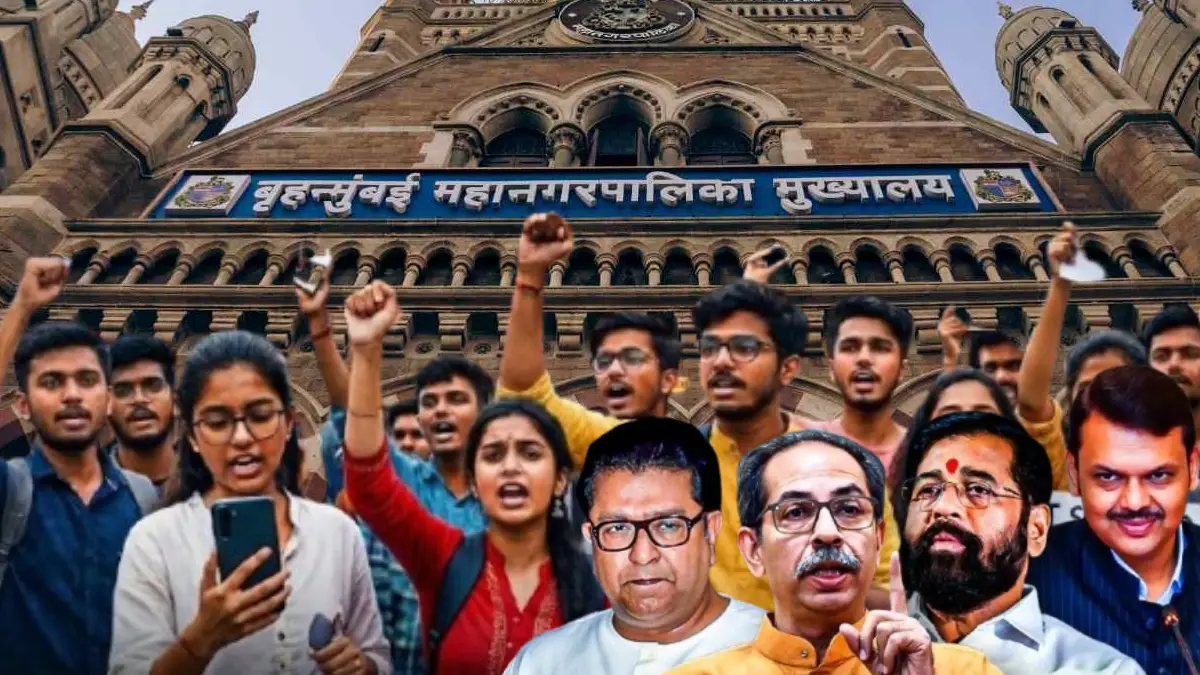
High-Stakes Contest and Voter Mood Across Mumbai
Central Mumbai’s traditional Marathi heartland once again emerged as the symbolic centre of the electoral battle. Long regarded as the Thackeray stronghold, these areas witnessed a fierce test of loyalty as defections by former corporators and even sitting MLAs reshaped local equations. The Eknath Shinde-led Shiv Sena, aligned with the BJP, made deep inroads into areas that had historically supported the undivided Shiv Sena.
In contrast, parts of suburban Mumbai such as Bandra West reported relatively sluggish voter turnout. Even the presence of celebrities and public figures campaigning to encourage participation failed to generate large queues at polling booths. Voters across these regions cited everyday civic concerns—road conditions, traffic congestion, drainage, and basic infrastructure—as their primary expectations from the next BMC administration.
With counting taking place in phases, suspense over the final composition of the BMC—and more importantly, the identity of Mumbai’s next mayor—is expected to stretch well into Friday and possibly beyond.
Early Trends: Mahayuti in Command, UBT-MNS Trails
As vote counting began on Friday, trends across Mumbai’s 227 wards showed a clear lead for the BJP-led Mahayuti alliance. With nearly 1,700 candidates in the fray, early numbers placed the Mahayuti ahead in around 115 wards, while the Shiv Sena (Uddhav Balasaheb Thackeray)-MNS alliance trailed with leads in approximately 70 wards. The Congress lagged far behind, leading in only 13 wards.
At various stages of counting, the Mahayuti’s tally fluctuated between 109 and 130 seats, consistently staying above or near the halfway mark of 114 seats required to control the civic body. At one point, trends showed the BJP-led alliance at 130 seats, with the UBT-MNS combine at 71 and Congress at 13. Another update placed the Mahayuti at 119 seats, the UBT-MNS at 70, and Congress still at 13.
Exit polls had earlier predicted a victory for the BJP–Shiv Sena alliance, projecting the Thackeray brothers’ faction in second place and indicating that Congress would fail to make any significant impact—an assessment now reflected in counting trends.
Major Upsets: Four Big Defeats That Shaped the Narrative
Several high-profile defeats have already emerged as defining moments of the 2026 BMC elections. BJP’s Ravi Raja, a former Leader of Opposition in the BMC who switched from Congress to the BJP in 2024, lost from Ward 185. Shiv Sena’s Samadhan Sarvankar, son of former MLA Sada Sarvankar, was defeated in Ward 194, while Dipti Waikar, daughter of MP Ravindra Waikar, lost from Ward 73.
Another notable upset came from Ward 106, where BJP’s Prabhakar Shinde was defeated by Maharashtra Navnirman Sena candidate Satyavani Dalwi, highlighting MNS’s selective but impactful presence in certain wards.
Key Ward-Wise Results and Vote Margins
Several ward-level results underline the shifting dynamics of Mumbai’s civic politics. In Ward 36, first-time corporator Siddharth Sharma of the BJP secured victory with 13,203 votes, while MNS candidate Prashant Mahadik finished second. The ward recorded 386 NOTA votes.
Ward 37 saw Shiv Sena (UBT) candidate Yogita Kadam win with 10,981 votes, defeating BJP’s Pratibha Shinde, with the same number of NOTA votes recorded. In Ward 88, Sharwari Parab of the Shiv Sena (UBT) clinched victory with 10,675 votes.
Mulund West’s Ward 104 delivered a decisive result in favour of BJP’s former corporator Prakash Gangadhare, who won with 15,569 votes. His nearest rival, MNS’s Rajesh Chavan, polled 7,238 votes, resulting in a commanding margin of 8,331 votes.
In Chandivali’s Ward 156, Ashwini Matekar of the Shinde-led Shiv Sena emerged victorious with 10,056 votes, ahead of Congress candidate Kavita Pawar, who received 5,501 votes. Shiv Sena (UBT) candidate Sanjana Kasle polled 2,791 votes.
Ward 157 witnessed a narrow Congress victory, with Aasha Tawade winning by just under 800 votes. She secured 9,943 votes, defeating Shiv Sena (UBT)’s Sarita Mhaske, who polled 9,157 votes. Vanchit Bahujan Aghadi candidate Sonali Bansode received 601 votes.
BJP and Allies Consolidate Gains in South and Suburban Mumbai
As counting progressed, BJP candidates continued to post strong performances in key wards. Ajay Patil won from Ward 214 (Breach Candy) with 8,759 votes, defeating MNS’s Mukesh Bhalerao. In Ward 215, BJP’s Santosh Dhale defeated Shiv Sena (UBT) candidate Kiran Bhalsaraf.
The BJP also successfully retained Ward 20, where Dipak Tavde won with 10,268 votes, defeating MNS candidate Dinesh Salvi, who polled 7,530 votes. A total of 23,260 votes—representing 56 per cent turnout—were cast in the ward. Tavde’s winning margin of 2,738 votes slightly improved upon his 2017 margin of 2,496 votes.
In Ward 51 (Goregaon), Varsha Tendulkar of the Eknath Shinde-led Shiv Sena registered a victory, reinforcing the Shinde faction’s growing footprint in Mumbai’s suburbs.
Results from Neighbouring Civic Bodies Reflect Statewide Trend
Beyond Mumbai, trends from civic elections across Maharashtra painted a similar picture of BJP dominance. In Nagpur, Chief Minister Devendra Fadnavis’s home city, the BJP surged ahead, leading in 78 of the 151 seats, while Congress trailed at 22.
In the Pune Municipal Corporation, the BJP displaced the Pawars’ long-standing influence, leading in 50 of 165 wards. The two factions of the Nationalist Congress Party led in five wards, while the Congress–UBT alliance was ahead in seven. One of the earliest declared results in Pune came from Ward 20 in the Shankar Maharaj Math–Bibewadi area, where three BJP candidates—Rajendra Shilimkar, Tanvi Divekar, and Mansi Deshpande—were elected, alongside NCP’s Gaurav Ghule, who defeated BJP’s Mahendra Sundecha.
In Thane Municipal Corporation, Deputy Chief Minister Eknath Shinde’s home turf, the BJP led in 21 of 131 wards. The NCP and the UBT-MNS-NCP(SP) alliance were each ahead in six wards. Nashik trends showed BJP leading in 12 of 122 seats, followed by the MVA-MNS combine at nine and the Shiv Sena–NCP alliance at 11.
Shambhinagar (Aurangabad) also reflected fragmented results, with the BJP leading in 18 of 115 wards, the Shiv Sena in 11, UBT Sena in seven, Congress-NCP(SP) in five, NCP in two, and the Vanchit Bahujan Aghadi in one.
Voter Turnout: Second Best Since 1992
The State Election Commission reported a final voter turnout of 52.94 per cent for the 2026 BMC elections, making it the second-highest participation rate since 1992. Out of 1.03 crore eligible voters, 54.76 lakh cast their ballots. This included 29.23 lakh men, 25.52 lakh women, and 251 transgender voters.
For historical context, Mumbai recorded a turnout of 55.28 per cent in the 2017 BMC elections, while earlier years saw significantly lower participation—49.14 per cent in 1992, 44.36 per cent in 1997, 42.05 per cent in 2002, 46.05 per cent in 2007, and 44.75 per cent in 2012.
A Civic Verdict with Far-Reaching Implications
The 2026 BMC elections mark the first civic polls since the last mayor, Kishori Pednekar, left office in March 2022. Allegations raised by the Shiv Sena (UBT)-MNS alliance during the polling process were dismissed by the State Election Commission, clearing the way for uninterrupted counting.
In the 2017 elections, the undivided Shiv Sena had emerged as the single-largest party with 84 seats. Along with the BJP’s 82 seats, the alliance comfortably crossed the halfway mark. Nearly a decade later, with the Shiv Sena split and alliances redrawn, Mumbai appears poised for a new political chapter—one that could end the Thackerays’ uninterrupted control over the BMC after 30 years.
As counting continues and final numbers crystallise, Mumbai stands on the brink of a historic civic realignment—one that will shape the city’s governance, infrastructure priorities, and political narrative for years to come.
With inputs from agencies
Image Source: Multiple agencies
© Copyright 2025. All Rights Reserved. Powered by Vygr Media.