
 By
By 
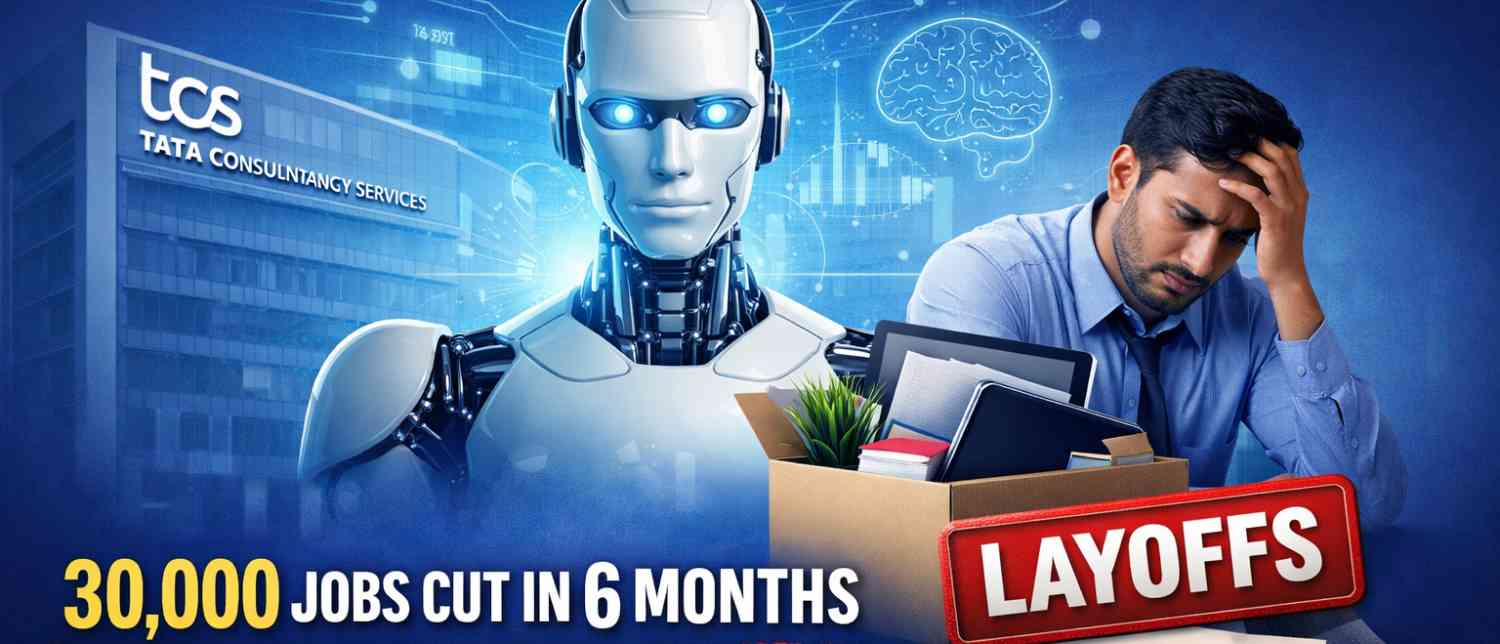
India’s largest IT services company, Tata Consultancy Services (TCS), is undergoing one of the most significant workforce transformations in its history. After cutting nearly 30,000 jobs in just six months, the company has now confirmed that employee exits linked to its restructuring plan are not over yet. Layoffs and role-based exits are expected to continue into 2026, raising fresh concerns across India’s tech workforce.
The announcement follows TCS’s third-quarter earnings call, where senior leadership acknowledged that workforce rationalisation remains ongoing. While the company insists that it is not pursuing “number-driven layoffs,” the steady decline in headcount, tightening workplace rules, delayed appraisals, and rising voluntary attrition paint a picture of sustained pressure within the organisation.
For an industry that once symbolised stable, long-term employment and middle-class security, what is unfolding at TCS signals a deeper structural shift in India’s IT sector.
Workforce Restructuring at TCS: What the Company Has Confirmed
TCS has clearly stated that employee exits linked to its ongoing restructuring will continue into upcoming quarters. However, the company maintains that it has no fixed target for layoffs.
According to TCS leadership, every termination is backed by a “clear and genuine reason” and follows a defined internal process. This reassurance comes amid rising anxiety among employees, driven by falling headcount numbers, stricter office attendance mandates, and delays in performance appraisals.
Chief Human Resources Officer Sudeep Kunnumal, speaking to analysts, stressed that exits are evaluated individually rather than driven by numerical goals. He reiterated that layoffs would continue “if needed,” but not as part of a mass downsizing exercise.
The Numbers Tell a Different Story: Headcount Falls Below Six Lakh
Despite assurances, TCS’s workforce numbers show a sharp and sustained decline.
During the October–December quarter, the company reduced its employee strength by 11,151, bringing its total headcount down to 582,163, compared to 593,314 in the previous quarter. This marked the second consecutive quarter of net headcount reduction, pushing TCS well below the six-lakh employee mark.
Looking at the broader picture, the company shed 19,755 employees in the September quarter alone. Taken together, TCS has let go of nearly 30,000 employees in the last six months.
Kunnumal told analysts that approximately 1,800 employees were formally exited during the October–December quarter. However, the significantly larger decline in total headcount suggests that job losses are not solely due to direct terminations.
Layoffs or Attrition? Understanding the Headcount Decline
The discrepancy between official layoff numbers and overall headcount reduction indicates a dual trend:
-
Planned exits: Around 1,800 employees were let go through formal processes during the quarter.
-
Natural attrition: A substantial number of employees left voluntarily, and TCS chose not to backfill those roles.
This strategy aligns with a broader cost-optimisation approach, where companies reduce workforce size without aggressive hiring freezes or public layoff announcements.
Notably, TCS’s voluntary attrition rate stands at 13.5%, which remains relatively high for a company of its size. This figure suggests underlying employee dissatisfaction and growing uncertainty about career stability within the organisation.
AI: The Real Cause or a Convenient Explanation?
Much of the narrative around tech layoffs globally revolves around artificial intelligence—and TCS is no exception. The company has acknowledged that increasing adoption of AI tools is reshaping skill requirements and workforce composition.
Advanced tools such as Claude and Cursor are enabling companies to deliver more output with fewer people, particularly reducing the need for large, junior-heavy teams focused on routine coding and maintenance tasks.
However, a recent report by Oxford Economics offers a more nuanced view. According to the report, many recent tech-sector layoffs are not directly caused by AI, but rather by efforts to:
-
Weed out underperformers
-
Optimise workforce efficiency
-
Reduce operating costs amid slowing revenue growth
The report also suggests that companies often cite AI impact to control internal and public messaging around job losses.
That said, there is no direct evidence that TCS is misusing the AI narrative in this manner. The company continues to assert that its restructuring decisions are performance- and role-alignment-based.
Mid and Senior-Level Redundancies: A Clear Signal
One of the most telling insights came directly from TCS leadership during the earnings call. Kunnumal stated:
“We’ll continue to evaluate everyone after all the investment in learning and development that we’ve done, where we find certain mid and senior level people are not able to find the right role based on their seniority. Those are the ones that we will release with a lot of care.”
This statement strongly suggests that redundancies at mid and senior levels are a key driver of ongoing layoffs. Employees who, despite reskilling efforts, are unable to transition into new AI-aligned or high-demand roles face an increased risk of exit.
For many within the organisation, this signals that further job cuts are not just possible—but likely.
Office Attendance Rules Add to Employee Stress
Beyond layoffs, TCS employees are grappling with stricter workplace policies. Like many tech firms, TCS has significantly tightened its work-from-office requirements.
Reports indicate that:
-
Some employees have had their final anniversary appraisals put on hold due to non-compliance with mandatory office attendance.
-
In several cases, appraisals cleared at the team level were not approved centrally.
-
Internal communications have warned that continued non-compliance could affect eligibility for the 2026 performance rating cycle.
These developments have added another layer of anxiety, especially for employees already concerned about job security.
Pune’s IT Hubs Reflect the Anxiety
In tech hubs such as Hinjawadi in Pune, the mood is tense. Offices that once symbolised opportunity and growth are now filled with uncertainty.
For many employees, the focus has shifted dramatically—from career progression and salary hikes to simply retaining their jobs. The message from leadership appears clear: adapt quickly to new skill demands or risk being left behind.
A Broader Signal for India’s Tech Sector
What is happening at TCS is not an isolated event. It reflects a prolonged period of stress in the global and Indian tech job markets.
Over the past two decades, Indian IT companies absorbed millions of graduates, stabilised middle-class employment, and acted as a critical shock absorber during economic downturns. That role is now shrinking.
AI and automation are fundamentally changing delivery models, reducing the need for large teams of entry-level engineers and reshaping career paths across the industry.
Implications for India’s Employment Landscape
If a behemoth like TCS can reduce its workforce at such speed, the implications for India’s broader employment ecosystem are significant:
-
Graduate unemployment risks may rise, especially for those with outdated or generic skill sets.
-
Salary growth is likely to become uneven, favouring niche, high-demand roles over traditional IT positions.
-
Career paths will grow increasingly uncertain, with lifelong employment giving way to continuous reskilling and performance-based retention.
These shifts could have long-term socio-economic consequences, particularly for India’s aspiring middle class.
Financial Pressure and Stock Performance
Adding to the concern is TCS’s stock performance. Once considered one of the most stable and dependable large-cap IT stocks, TCS has become a notable underperformer.
The company’s stock is down nearly 25% over the past year, reflecting investor concerns over:
-
Slowing growth
-
Margin pressures
-
Rising costs
-
Structural changes driven by AI and automation
While TCS remains profitable and globally respected, market sentiment suggests that its transition phase is far from over.
The End of an Era—and the Beginning of Another
The ongoing layoffs, high attrition, stricter policies, and AI-led restructuring at TCS mark the end of an era for India’s IT industry. The promise of stable, long-term employment is giving way to a new reality defined by agility, efficiency, and constant reinvention.
For employees, the challenge is no longer just about learning new skills—but about staying relevant in a rapidly evolving ecosystem. For the industry, TCS’s transformation may well serve as a blueprint for what lies ahead.
As job cuts continue into 2026, one thing is clear: the pink slip season in Indian IT is far from over.
With inputs from agencies
Image Source: Multiple agencies
© Copyright 2025. All Rights Reserved. Powered by Vygr Media.