

 By
By 
The global oil trade has once again become the epicentre of geopolitical conflict, and India now finds itself squarely in Washington’s crosshairs. The United States, under President Donald Trump, is preparing to unleash one of its most aggressive economic weapons yet — a sanctions regime that could impose tariffs as high as 500 per cent on countries that continue buying Russian oil.
At the heart of this escalation is the Sanctioning Russia Act of 2025, a bipartisan bill backed by Republican Senator Lindsey Graham and Democratic Senator Richard Blumenthal. The legislation, which President Trump has now “greenlit,” seeks to choke Moscow’s revenue streams by punishing not only Russia, but also its trading partners. India, China, and Brazil are explicitly named as targets.
Yet, despite being grouped together, Washington’s approach to New Delhi and Beijing could not be more different. While India has already been hit with punishing tariffs and faces the looming threat of a massive hike, China — the world’s largest buyer of Russian crude — has so far been spared comparable penalties. The disparity has raised uncomfortable questions about power, leverage, and the realities of global energy dependence.
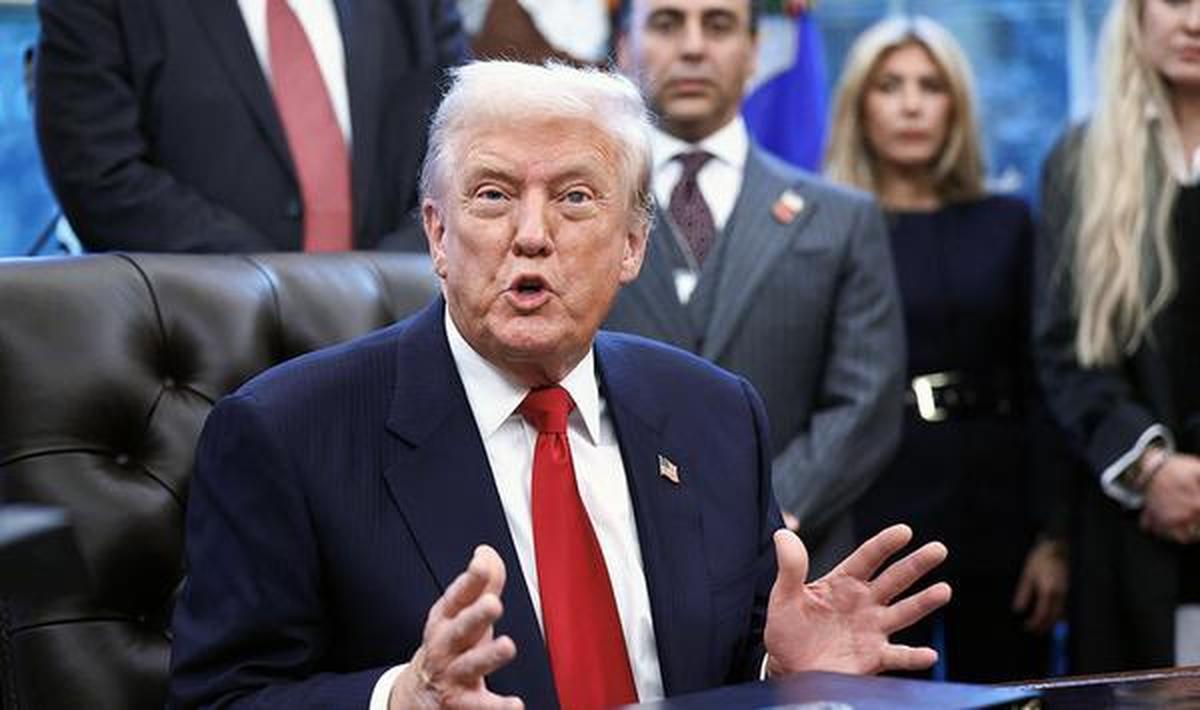
The Sanctions Bill That Could Redefine Global Trade Pressure
The Russia sanctions bill approved by Trump authorises the US president to impose tariffs of at least 500 per cent on all goods and services imported from countries that “knowingly engage” in trade involving Russian-origin petroleum products or uranium. The stated objective is to deprive President Vladimir Putin of the oil revenues that, according to US lawmakers, are “fueling Russia’s war machine” in Ukraine.
Senator Lindsey Graham confirmed Trump’s backing after a meeting at the White House, describing the bill as both timely and necessary. He argued that while Ukraine has made concessions toward peace, Moscow continues military operations, making economic pressure essential.
The bill outlines four triggers for sanctions: refusing to negotiate a peace agreement with Ukraine, violating a negotiated settlement, launching another invasion, or seeking to overthrow or subvert the Ukrainian government. Once these conditions are met, the legislation mandates sweeping measures — from visa bans and property-blocking sanctions to trade penalties of unprecedented scale.
Beyond tariffs, the bill empowers the US Treasury to impose financial sanctions on institutions doing business with Russian entities and requires the Commerce Department to ban exports of US-produced energy products to Russia.
With dozens of co-sponsors in the Senate and a companion bill already introduced in the House by Republican Representative Brian Fitzpatrick, the legislation is positioned for bipartisan momentum. A vote could come as early as next week, although scheduling complications and a Senate recess may affect the timeline.
Why China Has Escaped Washington’s Wrath — For Now
Despite being Russia’s largest crude oil customer, China has not faced additional tariffs linked to its energy trade with Moscow. In August, President Trump deferred new duties on Chinese imports, keeping tariffs at 30 per cent, a rate significantly lower than what India currently faces.
The reason lies not in diplomacy, but dependency.
China dominates the global supply of rare earth minerals, essential for electric vehicles, semiconductors, defence systems, renewable energy technologies, and advanced electronics. In April, Beijing imposed licensing restrictions on rare earth exports to the US, triggering alarm across American industries, particularly auto manufacturers and technology firms.
Even a short disruption threatened to stall production lines and destabilise supply chains. Under pressure from domestic manufacturers, Washington was forced to prioritise negotiation over escalation. The rare earth standoff demonstrated China’s ability to retaliate asymmetrically, inflicting economic pain without firing a single shot.
This leverage has made a hardline tariff strategy against Beijing a risky proposition. China can afford to absorb trade pressure in ways that could directly undermine US industrial output, something the Trump administration appears unwilling to test aggressively — at least for now.
After a very productive meeting today with President Trump on a variety of issues, he greenlit the bipartisan Russia sanctions bill that I have been working on for months with Senator Blumenthal and many others.
This will be well-timed, as Ukraine is making concessions for peace…— Lindsey Graham (@LindseyGrahamSC) January 7, 2026
Why India Is Facing a Much Tougher Line
India’s situation is starkly different. While New Delhi emerged as a major buyer of discounted Russian oil following Moscow’s invasion of Ukraine in 2022, it does not control supply chains that Washington considers irreplaceable. That asymmetry has left India vulnerable to direct economic coercion.
In August 2025, the Trump administration imposed an additional 25 per cent tariff on Indian goods explicitly as a penalty for purchasing Russian oil. This came on top of the 25 per cent levy announced earlier during Trump’s “Liberation Day” trade exercise, pushing total duties on certain Indian exports to 50 per cent — among the highest faced by any US trading partner, alongside Brazil.
Trump has repeatedly framed these tariffs as leverage. Speaking at the House GOP Member Retreat, he acknowledged that Prime Minister Narendra Modi was unhappy with the measures, but insisted they were effective.
“I have a very good relationship with PM Modi, but he is not happy with me because India is paying high tariffs,” Trump said, adding that India had “reduced it very substantially” by cutting back on Russian oil purchases.
“Modi is a very good man; he is a good guy. He knew I was not happy, and it was important to make me happy,” Trump remarked, making explicit the personal and transactional nature of the pressure.
The US president has also warned that tariffs could be raised further if India does not “help on the Russian oil issue,” directly linking trade penalties to the Ukraine conflict.
India Pushes Back, but the Pressure Persists
India has firmly rejected Trump’s earlier claim that Prime Minister Modi assured him New Delhi would stop buying Russian oil, clarifying that no such conversation or assurance ever took place. Indian officials have consistently maintained that energy purchases are driven by national interest, affordability, and supply security.
Nonetheless, the economic impact of US pressure is already visible. Stricter US and EU sanctions have slowed Russian oil flows to India. According to analytics firm Kpler, India’s imports fell to about 1.2 million barrels per day in December, a three-year low and a roughly 40 per cent drop from the June peak of nearly 2 million bpd.
As New Delhi seeks to stabilise trade relations with Washington, imports are expected to dip below 1 million bpd, even as India diversifies energy sources and accelerates negotiations on a broader trade deal with the US.
Senator Graham has claimed that India’s ambassador to the US, Vinay Mohan Kwatra, raised the issue directly, highlighting reduced oil purchases and requesting relief from the additional 25 per cent tariff.
“I was at the Indian Ambassador’s house a month ago, and all he wanted to talk about was how India is buying less Russian oil,” Graham told reporters aboard Air Force One.
What 500% Tariffs Would Mean for India
If the Sanctioning Russia Act of 2025 becomes law, the stakes will escalate dramatically. Unlike previous measures, the bill removes discretion. It states that the US president must raise tariffs to at least 500 per cent on all goods and services imported from countries knowingly trading in Russian petroleum products or uranium.
For India, such a move would severely disrupt exports, inflate costs, and potentially derail broader economic engagement with the US. It would also signal a shift from diplomatic pressure to outright economic punishment.
At the same time, Trump has positioned himself as a potential broker in the Russia–Ukraine war, holding talks with both Vladimir Putin and Ukrainian President Volodymyr Zelenskyy. Yet, with no concrete breakthrough so far, sanctions are being sharpened as leverage.
Oil’s Return as the Ultimate Geopolitical Weapon
Beyond tariffs and trade, this episode underscores a deeper reality: oil is back at the centre of global power politics.
Despite decades of rhetoric about decarbonisation and green transitions, today’s most volatile geopolitical flashpoints remain mapped onto oilfields, shipping lanes, sanctions regimes, and energy chokepoints. As energy historian Daniel Yergin warned in The Prize, oil is not merely a commodity — it is destiny.
The war in Ukraine is as much an energy conflict as it is a territorial one. Russia’s hydrocarbon revenues sustain its war economy, while Europe’s effort to cut dependence on Russian energy has redrawn global oil flows, sending discounted crude eastward and tightening markets elsewhere.
In parallel, Washington’s selective easing of sanctions on Venezuela following global supply disruptions has reinforced a blunt truth: values matter, but barrels matter more.
From the Strait of Hormuz to West Asia’s fragile balance, energy remains political gravity. Even the rivalry between the US, Russia, and China forms an energy triangle, with oil and gas shaping strategic behaviour as much as ideology.
India’s Energy Dilemma in a Fragmenting World
For India, the return of oil conflict presents an acute challenge. As one of the world’s fastest-growing energy consumers and a net importer, India is exposed to every major energy shock. High prices widen fiscal deficits, stoke inflation, and strain household budgets.
Yet India’s approach has been one of pragmatic realism — sourcing discounted Russian oil while maintaining Western partnerships, deepening Gulf ties while navigating tensions with Iran. This is not fence-sitting, but strategic necessity.
The path forward rests on three imperatives: diversifying energy sources and fuels, maintaining flexible diplomacy, and accepting that oil politics will coexist with the energy transition for decades. Planning for a frictionless exit from hydrocarbons would be a strategic miscalculation.
As oil once again asserts itself as a fault line of global power, India’s ability to navigate coercion without capitulation will define its economic and geopolitical resilience.
The age of oil, as history reminds us, never truly ends. It simply waits for the right moment to return — and that moment has arrived.
With inputs from agencies
Image Source: Multiple agencies
© Copyright 2025. All Rights Reserved. Powered by Vygr Media.