

 By
By 
In the wars of tomorrow, victory will belong less to those who possess the largest arsenals and more to those who can process information the fastest—and act with precision. Firepower still matters. Geography still matters. Political will certainly matters. But the defining advantage of 21st-century warfare is cognitive speed.
Artificial Intelligence (AI) has moved from research laboratories and speculative war games into operational reality. It now shapes how militaries see, decide, and strike. For India—confronting two nuclear-armed adversaries, persistent sub-conventional threats, and increasingly contested cyber and space domains—the question is no longer whether AI matters. The real question is whether India can integrate it fast enough, wisely enough, and on its own sovereign terms.
AI is not just another military technology. It is the great accelerator. It compresses time, sharpens situational awareness, and enables commanders to operate inside an adversary’s decision loop. Used effectively, it is a force multiplier. Ignored—or poorly governed—it becomes a strategic liability.
Why AI Has Become Central to Military Power
Modern warfare is defined by data. Satellites, drones, radars, cyber sensors, electronic intelligence systems, and battlefield networks generate oceans of information every second. Human cognition alone cannot cope with this volume, velocity, and complexity. AI fills that gap.
At its core, AI enhances four pillars of military power.
First, Intelligence, Surveillance, and Reconnaissance (ISR).
AI systems process vast sensor feeds in real time, detect anomalies, identify patterns, and cue human analysts to emerging threats. Surprise today is measured in minutes, not days. AI-enabled data fusion across land, sea, air, cyber, and space allows commanders to perceive the battlefield as a single operational picture rather than fragmented inputs.
Second, decision support and command systems.
AI-driven analytics simulate outcomes, predict adversary behaviour, optimise logistics, and generate multiple courses of action. In multi-domain operations, decision quality matters as much as decision speed. AI does not replace commanders—it expands their cognitive bandwidth.
Third, kinetic and non-kinetic operations.
AI manages simultaneous threats, prioritises intercepts in air and missile defence, coordinates drone swarms, synchronises kinetic strikes with cyber and electronic warfare, and supports information operations. Against saturation attacks, human-only systems are simply too slow.
Fourth, autonomy and robotics.
From unmanned aerial vehicles (UAVs) to autonomous ground and maritime platforms, AI extends reach, persistence, and survivability—allowing forces to operate in high-risk environments without exposing soldiers unnecessarily.
These are no longer optional enhancements. They are becoming baseline requirements for credible military power.
AI Is Transforming Defence—Globally and at Home
The global defence ecosystem recognises this shift. Major powers are investing heavily in military AI. The United States leads in defence-related AI investment, including $67 billion in private AI investment in 2023—8.7 times that of China. The Pentagon’s Defence Innovation Unit is deeply engaged with tech start-ups, while firms such as Palantir, Shield AI, Elbit Systems, Textron Inc, and Rebellion Defence are shaping the defence AI landscape.
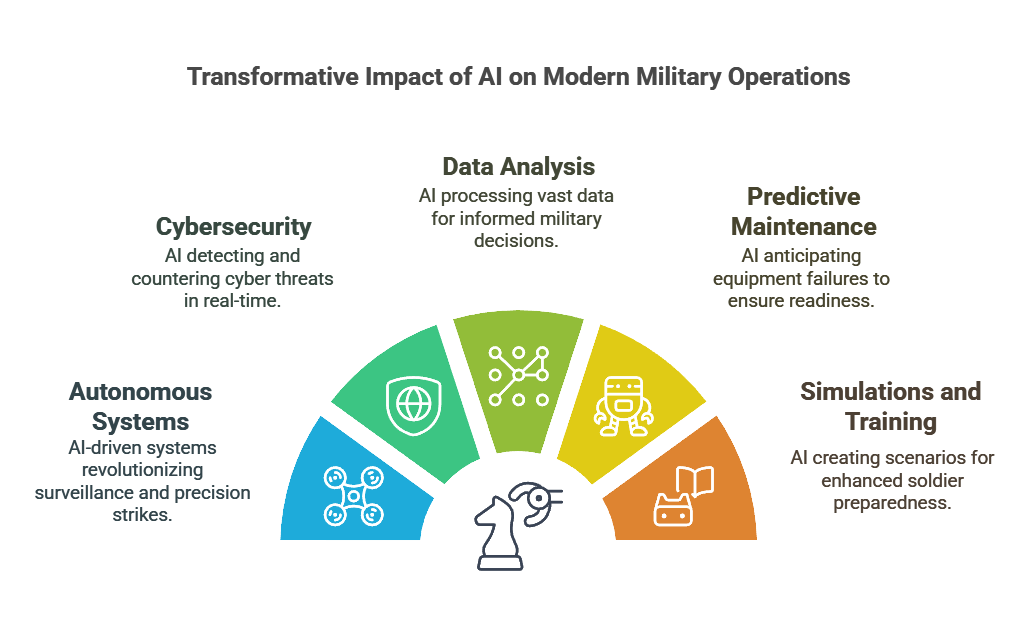
The global military AI market is projected to grow from over $22 billion in 2026 to over $100 billion by 2034, with forecasts suggesting a CAGR of 20.7 per cent. Investment focuses on C4ISR (command, control, communications, computers, intelligence, surveillance and reconnaissance), predictive maintenance, cybersecurity, autonomous systems, and target identification. By 2026, AI is expected to be deeply integrated into the “digital backbone” of military operations—reducing data redundancy by 45–55 per cent and improving coordination by 35–40 per cent.
NATO and EU countries are also stepping up investments, recognising that AI must function seamlessly across allied systems. Effective defence now requires interoperability not only of platforms—but of algorithms and data architectures.
India cannot afford to stand aside from this transformation.
India’s AI Vision: From Summit Diplomacy to National Mission
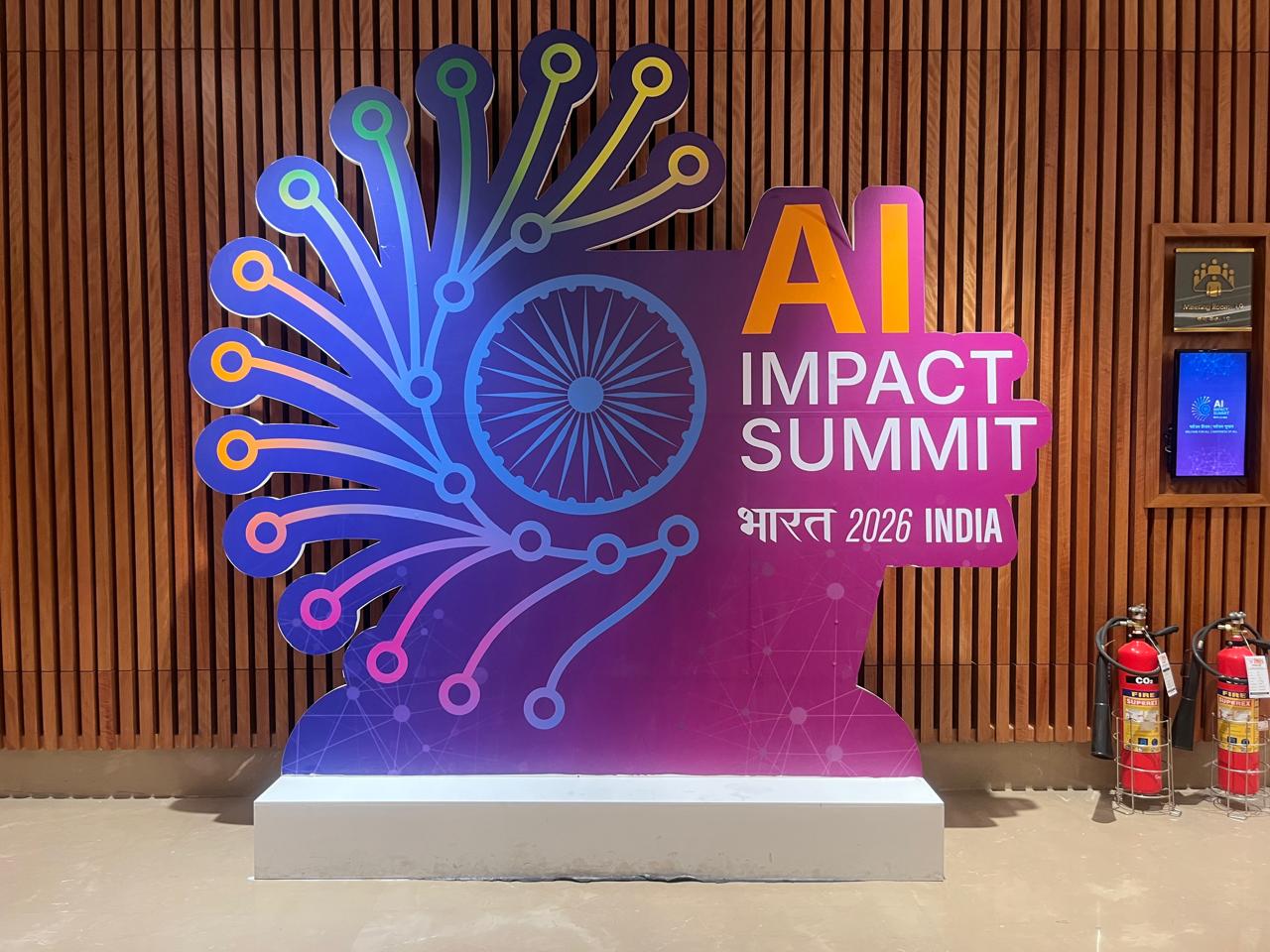
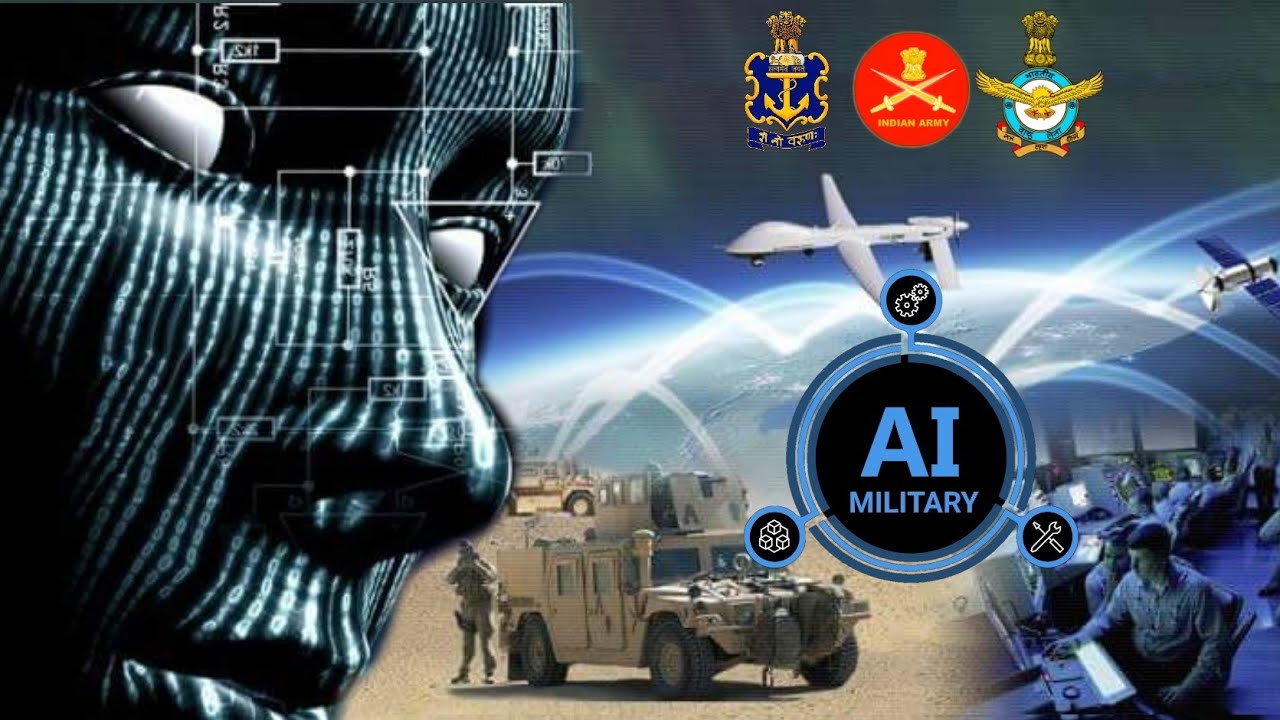
In February 2026, Prime Minister Narendra Modi inaugurated the India AI Impact Summit 2026 at Bharat Mandapam, New Delhi. He declared that India stands at the forefront of the AI transformation, balancing ambition with responsibility. UK Deputy Prime Minister David Lammy described the summit as an “important moment” to unlock AI’s full benefits. It marked the fourth AI Summit after those in the UK, South Korea, and France.
Global tech leaders including Sundar Pichai, Bill Gates, and Sam Altman joined representatives from nearly 100 countries. The summit featured over 3,250 speakers and more than 500 sessions, including “Leveraging AI for Defence: Driving Innovation & Efficiency,” which underscored secure and trusted defence AI ecosystems.
Parallel to this diplomatic signalling is the IndiaAI Mission, launched in March 2024 with a ₹10,372 crore outlay. It aims to build an inclusive AI ecosystem and position India as a global AI leader by 2035. The mission includes deploying over 38,000 GPUs to create high-performance compute infrastructure, fostering indigenous foundational and Large Multimodal Models (LMMs), supporting 30+ high-impact AI applications in agriculture, healthcare, governance, and establishing 27+ Data and AI labs.
Over 13,500 students are being supported through AI-focused skill initiatives. Projects like Bhashini (language translation), BharatGen (multimodal LLMs), and Indian-language models such as Hanooman reflect a broader “AI for All” vision. Projections suggest AI could add $1.7 trillion to India’s economy by 2035 under the Viksit Bharat 2047 vision.
This civilian AI push is strategically relevant. Defence AI cannot flourish without a strong national AI ecosystem.
Where India’s Military Stands Today
The narrative that India is a laggard in defence technology no longer holds in AI.
Along the Line of Actual Control (LAC) and Line of Control (LoC), AI-enabled surveillance integrates electro-optical sensors, radars, and analytics to detect intrusions in terrain where human vigilance cannot be sustained 24/7.
The armed forces are adopting indigenous AI for surveillance, logistics, and combat under a joint services approach coordinated by Headquarters Integrated Defence Staff (HQ IDS). Organisational structures and AI strategies are being formalised, with data handling and acquisition streamlined.
Key initiatives include:
-
EKAM (AI-as-a-Service): A secure, air-gapped indigenous cloud platform ensuring data sovereignty.
-
SAM-UN geospatial platform: AI-enabled situational awareness and mission planning, supporting autonomous drone/vehicle systems.
-
XFace: Facial recognition for surveillance and identification.
-
Nabh Drishti: Real-time mobile telemetry for enhanced surveillance.
-
AI-driven vehicle tracking and driver fatigue detection for logistics safety.
-
AI tools for deepfake detection, cybersecurity, predictive maintenance, and counter-drone operations.
Specialised AI cells have been established in the Army (Mhow), Navy (INS Valsura), and Air Force (Rajokri). A central data repository is being developed to make drone, satellite, and sensor data machine-readable and interoperable.
The Indian Army’s AI Roadmap for 2026–27 prioritises border surveillance, drone swarming, and faster decision-making. The Indian Air Force’s Integrated Aerospace Command and Control System (IACCS) is being upgraded with AI tools to shorten the OODA (Observe–Orient–Decide–Act) loop. AI in cockpits will assist pilots in rapid combat decisions, optimise flight paths, and manage air traffic in contested environments.
In electronic warfare, AI can detect unique radio or radar signatures buried within vast electromagnetic noise—tasks that once took hours or days. Now, AI can identify signals of interest in near real time and enable jamming or interception.
AI enhances ballistic missile defence by predicting trajectories, identifying electromagnetic signatures, directing interceptors, or jamming guidance systems. It may even assist in deciphering encrypted communications. It will play a growing role in embedded electronic warfare systems and directed energy weapon targeting.
The Indian Navy is deploying AI for maritime domain awareness, autonomous unmanned surface and underwater vehicles (USV/UUVs), mine countermeasures, and anti-submarine warfare—reducing risks to personnel during long-duration missions.
Logistics and maintenance management across all services are being transformed by AI-based predictive systems. AI will also accelerate development cycles for DRDO, DPSUs, private industry, and support major programmes such as the AMCA fifth-generation fighter.
The Defence Artificial Intelligence Council (DAIC), chaired by the Raksha Mantri, and the Defence AI Project Agency (DAIPA), established in 2019, coordinate AI adoption. Sixty-one AI projects have been identified, with 26 completed by DPSUs. Funding allocations are rising—but compared to China, which reportedly spends over 30 times more, India’s investment must increase significantly.
Strategic Payoffs—and Strategic Risks
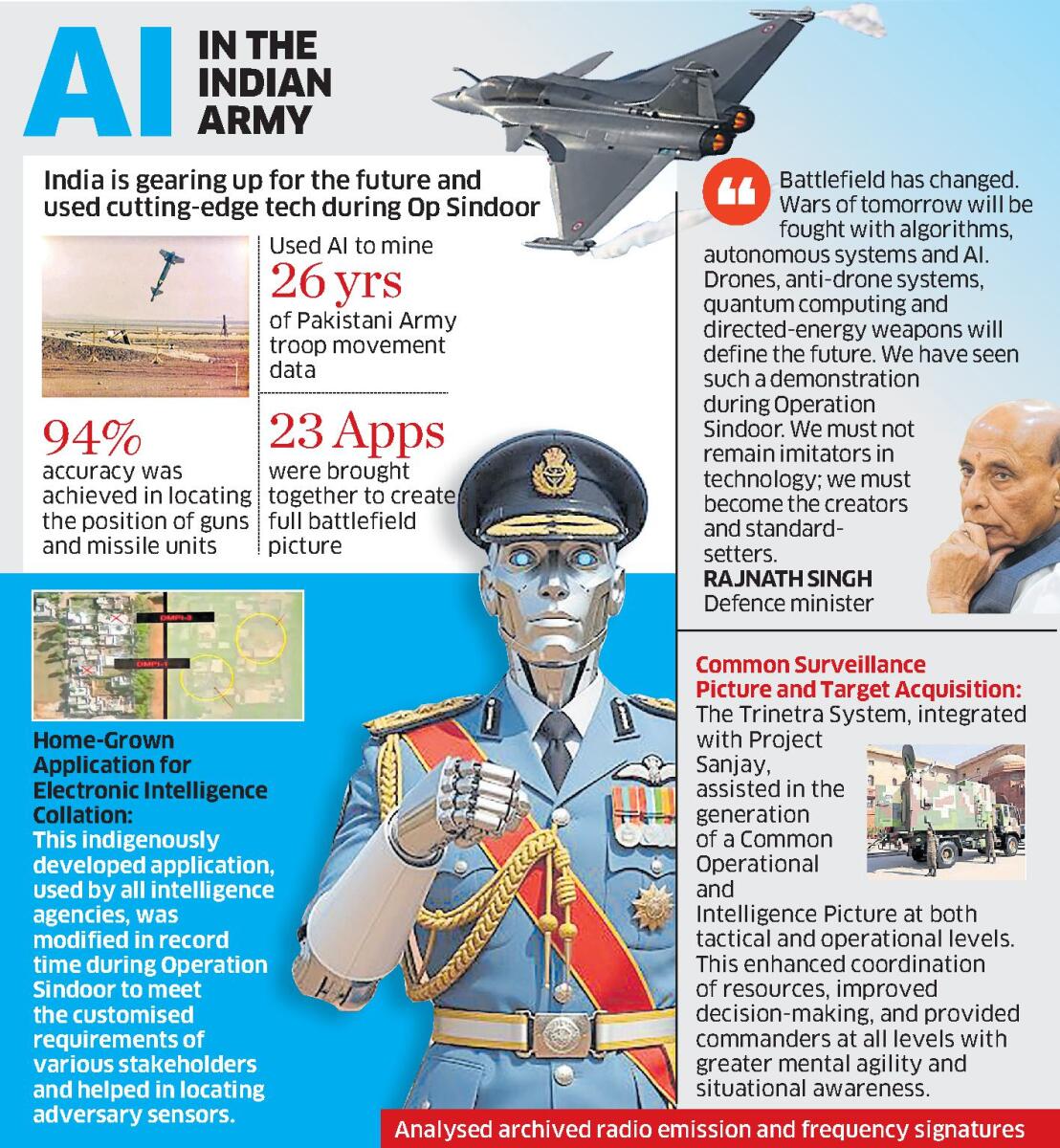
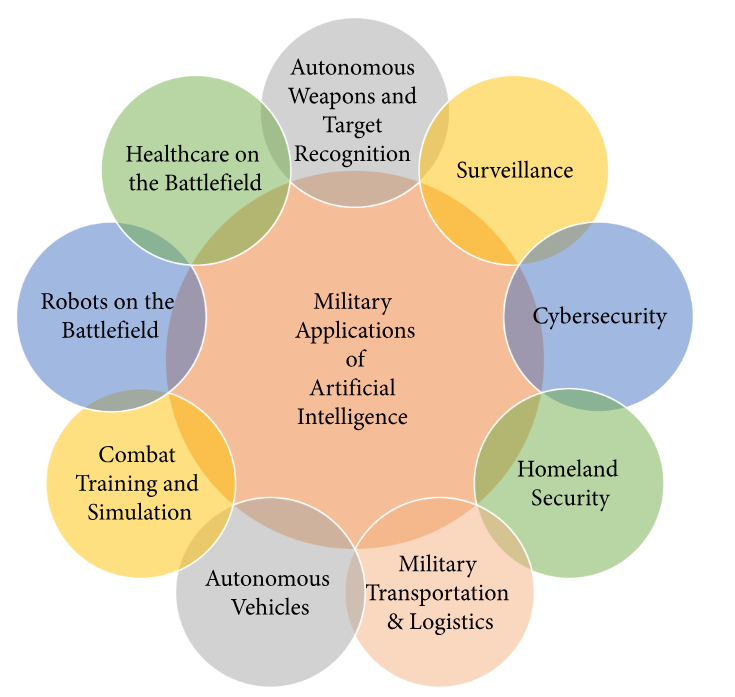
The advantages are clear: real-time situational awareness, faster threat detection, improved coordination of autonomous systems, higher target precision, reduced human exposure, improved battle damage assessment, and optimised logistics.
“Detect first, decide first, shoot first, neutralise first” is the new mantra.
Yet risks loom.
Should systems be Human-in-the-Loop with constant oversight, or Human-on-the-Loop with veto authority? What level of autonomy is acceptable for Lethal Autonomous Weapons Systems (LAWS)? Could swarms of AI-enabled “killer robots” spiral out of control? Could AI-based weapons be hijacked or misdirected toward their originator?
Over-reliance on opaque algorithms, biased datasets, or insecure networks could create brittle systems. Defence environments are adversarial and high-risk, demanding extreme reliability and resilience. With human lives at stake, mistakes are costly.
Shortages of specialised AI expertise, ESG-related investor hesitation around AI-enabled targeting systems, and ethical scrutiny add further complexity.
Data and network security are non-negotiable.
The Institutional and Ethical Imperative
Despite institutional bodies, India lacks a clearly articulated defence AI doctrine. Without it, adoption risks fragmentation across services and vendors.
A doctrine must define:
-
Boundaries between human and machine decision-making.
-
Testing, validation, and audit protocols.
-
Accountability frameworks for AI failures.
-
Data governance and interoperability standards.
India must codify principles of meaningful human control—not only to uphold democratic values but to shape international norm-setting.
AI must remain subordinate to human judgement. Political-military decisions, escalation management, counter-insurgency, and counter-terrorism require cultural understanding and moral reasoning beyond algorithms. Soldiers follow leaders—not code.
Innovation at Scale—and Strategic Partnerships
India’s defence start-up ecosystem is promising but scaling remains difficult. Procurement pathways must adapt to AI’s rapid evolution. Defence innovation funds require deeper capitalisation for long-gestation, high-risk AI and robotics projects.
The armed forces are engaging closely with IITs (Madras, Bombay, Delhi, Hyderabad, Kharagpur), IIIT Hyderabad, IISc Bangalore, VIT Vellore, and other institutions offering advanced AI research.
Partnerships with technologically advanced democracies—especially the United States—offer opportunities for co-development and interoperability. But cooperation must prioritise capability-building over dependence.
India must also actively shape global AI norms, advocating accountability, safety, and transparency.
What AI Will—and Will Not—Do
AI is already embedded in defence. It has been used in military applications for decades and will grow more central. Future fighter jets, submarines, and combat vehicles are being tested to operate alongside swarms of unmanned systems. AI will manage these swarms while pilots focus on mission execution.
Defence AI will require not only centralised data centres but ruggedised embedded systems capable of functioning in hostile environments—on land, at sea, in air, and in space.
Quantum computing may further amplify AI’s ability to process massive datasets for actionable intelligence in split seconds.
But AI will not replace human responsibility. Autonomous systems will be designed to allow commanders to exercise appropriate judgement. Ultimately, a person—not a machine—decides the final action.
The Strategic Choice Ahead
Artificial Intelligence is reshaping the character of conflict. The decisive advantage will belong to those who can think faster—and think better—than their adversaries.
India has laid the foundations: operational deployments, institutional structures, indigenous innovation, and a national AI mission aligned with economic growth. Yet compared to global AI powers, investment and doctrinal clarity must deepen.
If India gets this right, AI will strengthen deterrence, preserve stability, and save lives. If it gets it wrong, the cost will be measured in strategic vulnerability.
In the age of intelligent warfare, data is the new gunpowder. Speed, range, and precision define combat power. Nations that fail to adopt AI will become technologically inferior.
India must ensure its machines serve strategy, its algorithms reflect its values, and its soldiers remain guided by human judgement.
The future battlefield will reward those who can think faster. India’s task is to ensure it can think faster—without ever surrendering the wisdom to think better.
With inputs from agencies
Image Source: Multiple agencies
© Copyright 2025. All Rights Reserved. Powered by Vygr Media.