 By
By 
In a landmark achievement for India's Armed Forces and the nation's growing maritime ambitions, the country's first-ever tri-service all-women circumnavigation sailing expedition, Samudra Pradakshina, has successfully completed its extraordinary 314-day voyage around the world. Covering nearly 25,500 nautical miles across four oceans, the expedition has etched its place in India's military and maritime history, showcasing the spirit of Nari Shakti, tri-service integration and indigenous defence capabilities.
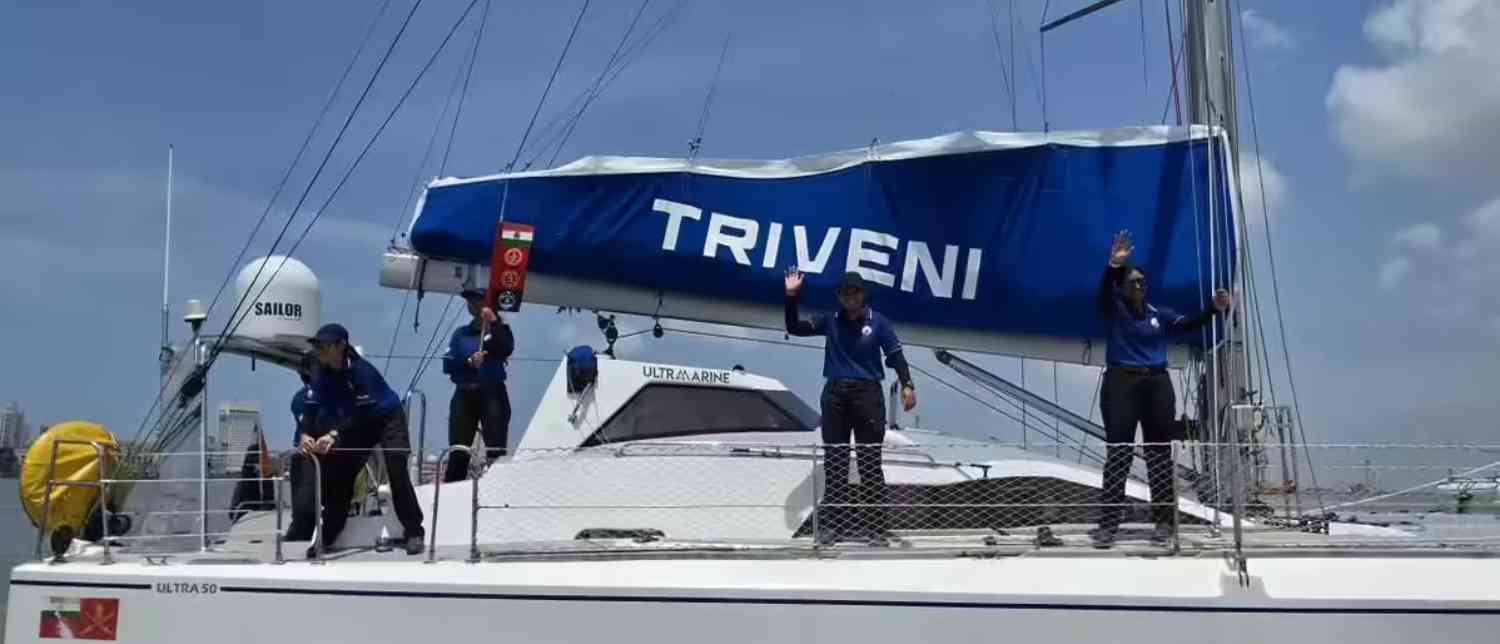
Defence Minister Rajnath Singh formally flagged in the expedition through video conferencing on July 22 as the Indian Army Sailing Vessel (IASV) Triveni returned to Mumbai's Gateway of India carrying its crew of nine women officers drawn from the Indian Army, Indian Navy and Indian Air Force. The mission, which began on September 11, 2025, stands as one of India's most ambitious military sailing expeditions undertaken entirely by women.
_1785265205.jpg)
A Voyage That Redefined Endurance
The expedition was far more than a symbolic journey. Sailing continuously through some of the world's most unforgiving waters, the crew successfully fulfilled every internationally recognised criterion for a true circumnavigation.
The sailors crossed every meridian of longitude, crossed the Equator twice, traversed the International Date Line and rounded the legendary Three Great Capes—Cape Leeuwin (Australia), Cape Horn (South America), and the Cape of Good Hope (South Africa)—before returning safely to India.
Among the mission's greatest accomplishments was navigating the infamous Drake Passage, regarded as one of the roughest stretches of ocean on Earth. Successfully rounding Cape Horn earned the crew membership of the prestigious global fraternity of Cape Horners, an honour reserved for sailors who conquer one of the world's most demanding maritime routes.
Battling towering waves, freezing temperatures, unpredictable storms and months of isolation at sea demanded exceptional seamanship, resilience and teamwork. The voyage demonstrated not only physical endurance but also mental strength, discipline and unwavering commitment.
A Testament to Nari Shakti and Tri-Service Unity
Welcoming the crew home, Rajnath Singh described Samudra Pradakshina as much more than a maritime expedition. He called it a powerful symbol of New India's resolve, women's empowerment, and the growing culture of jointness among the three Armed Forces.
"The ocean waves may rise high, but the spirit of India's daughters rises even higher," the Defence Minister remarked, praising the courage and determination displayed by the officers throughout the journey.
The expedition brought together women officers from the Army, Navy and Air Force on a single operational mission, demonstrating seamless coordination, integrated planning and shared leadership. Living, training and sailing together for over ten months, the crew functioned as one cohesive unit, reinforcing the Armed Forces' emphasis on interoperability and integrated operations.
Military officials noted that the expedition serves as a practical demonstration of the government's broader push towards greater tri-service synergy and future integrated theatre commands.
IASV Triveni: An Indigenous Symbol of Self-Reliance
At the heart of the expedition was IASV Triveni, a 50-foot sailing yacht built in India. The vessel itself became a symbol of the country's growing self-reliance in defence manufacturing under the Aatmanirbhar Bharat initiative.
Describing the yacht as a reflection of India's engineering excellence and technological confidence, Rajnath Singh said IASV Triveni represented the nation's indigenous capability and strategic self-belief.
The expedition further highlighted India's expanding expertise in ocean sailing and long-range maritime operations using domestically built platforms.
Years of Preparation Behind the Historic Voyage
The successful completion of Samudra Pradakshina was built upon years of meticulous preparation.
The women officers underwent nearly three years of rigorous ocean sailing training, progressing through increasingly demanding offshore expeditions before embarking on the global circumnavigation. Their training included coastal sailing missions, long-distance offshore voyages and an important preparatory expedition from Mumbai to Seychelles and back, which tested their endurance, navigation skills and ability to operate independently in challenging maritime conditions.
The final expedition itself was supported by a dedicated 24x7 shore-based support network and involved extensive logistical planning, technical assistance and coordination among multiple defence and civilian agencies.
Military Diplomacy Beyond the Seas
Beyond achieving a remarkable sailing milestone, Samudra Pradakshina also served as an instrument of India's military diplomacy.
During international port calls across the voyage, the crew showcased India's maritime traditions, military professionalism and rich cultural heritage while engaging with friendly nations and strengthening defence ties. These interactions projected India's growing maritime confidence and reinforced its commitment to international cooperation in the Indo-Pacific and beyond.
The expedition reflected how maritime missions can simultaneously serve operational, diplomatic and strategic objectives.
Building on India's Maritime Legacy
Samudra Pradakshina builds upon a distinguished history of Indian ocean sailing achievements.
India's first solo circumnavigation was completed by Captain Dilip Donde (Retd.), followed by Commander Abhilash Tomy (Retd.), who became the first Indian to circumnavigate the globe non-stop. More recently, the Indian Navy's Navika Sagar Parikrama missions showcased the capabilities of women naval officers in global sailing expeditions.
Just weeks before Samudra Pradakshina was launched, Indian Navy officers Lieutenant Commander Dilna K and Lieutenant Commander Rupa A successfully completed another global sailing expedition aboard INSV Tarini, further demonstrating India's growing strength in ocean sailing and women-led maritime missions.
Samudra Pradakshina expanded this legacy by becoming the first expedition to integrate women officers from all three services into a single circumnavigation mission.
An Inspiration for Future Generations
The expedition has become a powerful example of how opportunities for women in India's Armed Forces continue to expand beyond traditional roles.
From navigating some of the world's roughest oceans to overcoming months of physical hardship and operational challenges, the crew demonstrated that courage, leadership and professional excellence transcend gender.
The mission also sends a broader message to young Indians—particularly aspiring women officers—that the Armed Forces increasingly offer opportunities to excel in specialised operational domains, adventure sports, leadership and international representation.
As India continues to strengthen its maritime capabilities and pursue greater integration across its Armed Forces, Samudra Pradakshina stands as a defining milestone that combines operational excellence with national pride.
The successful return of IASV Triveni is therefore more than the conclusion of a remarkable sailing expedition—it marks the beginning of a new chapter in India's maritime story, where indigenous capability, tri-service cooperation and women's leadership sail together towards new horizons.
With input from agencies
Image Source: Multiple agencies
© Copyright 2026. All Rights Reserved. Powered by Vygr Media.