
 By
By 
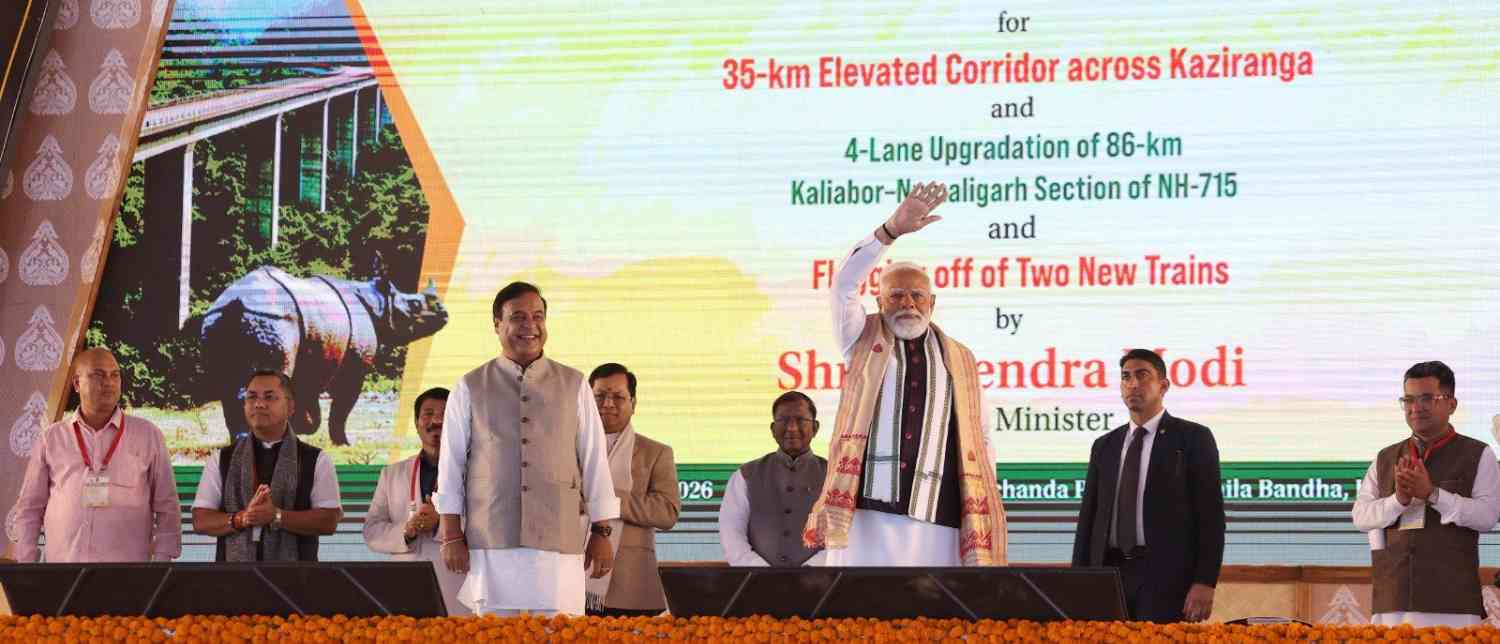
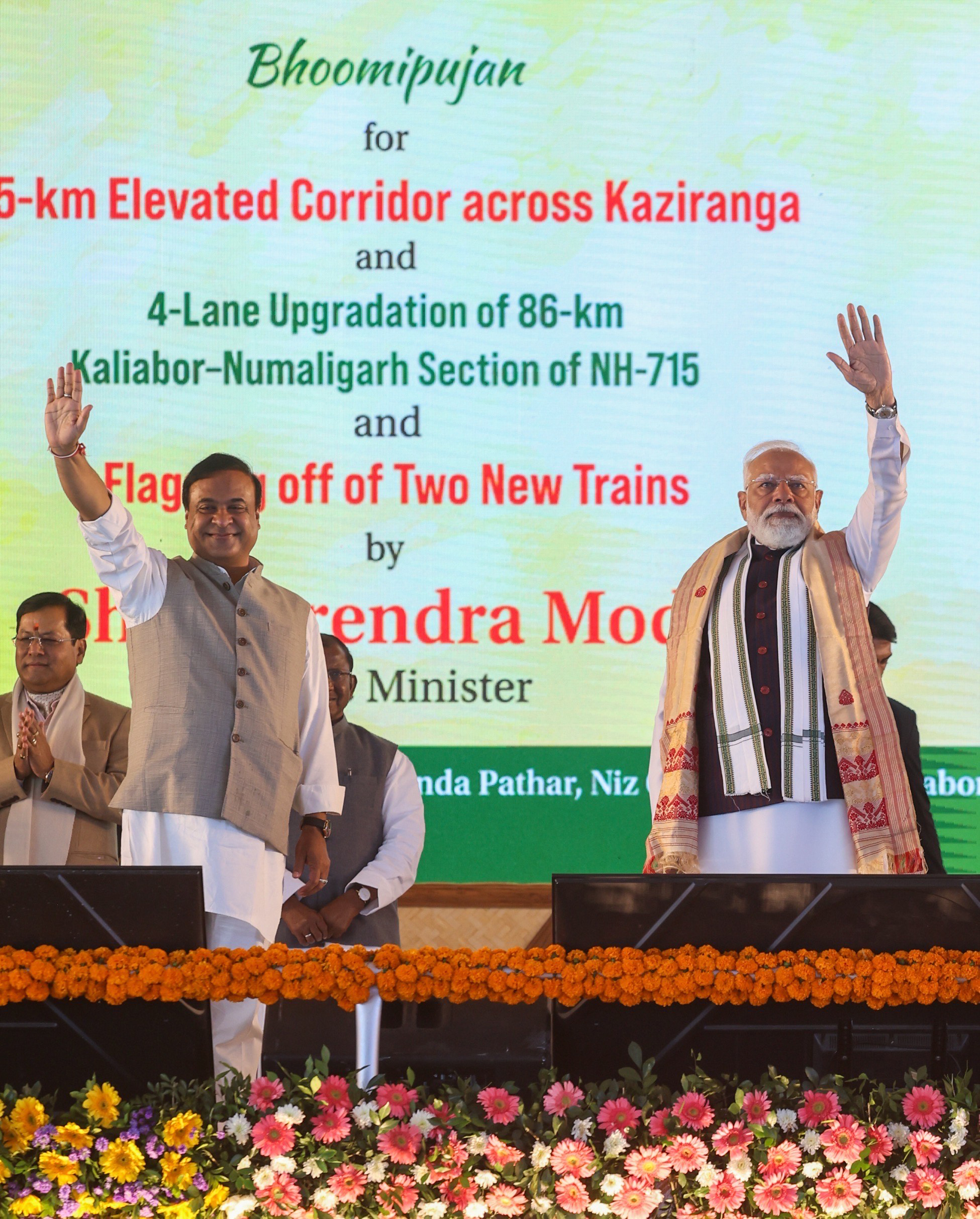
Prime Minister Narendra Modi on Saturday performed the Bhoomi Pujan of the Kaziranga Elevated Corridor Project in Kaliabor, Assam, marking a major milestone in India’s effort to blend large-scale infrastructure development with environmental conservation. Valued at over ₹6,950 crore, the ambitious project involves the four-laning of the Kaliabor–Numaligarh section of National Highway 715 and is being hailed as one of the most environmentally conscious highway projects undertaken in the country.
Addressing a large gathering at the event, the Prime Minister described Kaziranga National Park as “more than just a National Park—it is the soul of Assam and a priceless jewel of India’s biodiversity,” underscoring its global importance as a UNESCO World Heritage Site. He stressed that protecting Kaziranga is not merely about conservation but about securing Assam’s future and preserving its heritage for generations to come.
A Personal Connection with Kaziranga and Assam
Recalling his earlier visit to Kaziranga, Prime Minister Modi said the memories remained deeply etched in his mind. Two years ago, he had spent a night inside the national park and experienced its wilderness during an early-morning elephant safari. Those moments, he said, were among the most special experiences of his life.
The Prime Minister noted that every visit to Assam fills him with joy, describing the state as the land of brave hearts whose sons and daughters excel across fields. Just a day earlier, he had attended the Bagurumba Dwhou festival in Guwahati, where over 10,000 Bodo artists created history with a record-setting performance. The rhythmic beats of the kham and the melodies of the sifung, he said, mesmerised audiences and showcased Assam’s vibrant cultural soul. He praised the artists for their discipline, coordination, and dedication, and thanked social media influencers and television networks for taking Assam’s culture to national and global audiences.
Vikas Bhi, Virasat Bhi: Development Rooted in Heritage
Prime Minister Modi highlighted that his recent visits to Assam—during Jhumoir Mahotsav, Magh Bihu, and earlier development-focused programmes—reinforced the government’s guiding philosophy of “Vikas bhi, Virasat bhi” (development along with heritage). He recalled inaugurating the new terminal of Lokpriya Gopinath Bardoloi International Airport and laying the foundation stone for the Ammonia-Urea Complex in Namrup, calling them examples of balanced growth.
Emphasising the strategic importance of Kaliabor, the Prime Minister said the region has historically served as a gateway to Kaziranga and Upper Assam. It was from Kaliabor, he reminded the audience, that the legendary Lachit Borphukan planned the resistance that drove out Mughal forces. That victory, Modi said, was not just military but symbolic of Assam’s pride, unity, and self-belief. From the Ahom era to today, Kaliabor has remained crucial—and under the present government, it is emerging once again as a hub of connectivity and progress.
Speaking at the launch of development works in Kaliabor aimed at improving Assam’s connectivity and protecting the region’s biodiversity.
https://t.co/lZcydC0SLn— Narendra Modi (@narendramodi) January 18, 2026
Kaziranga Elevated Corridor: Engineering with Ecology at its Core
At the heart of the day’s event was the Kaziranga Elevated Corridor Project, an 86-kilometre-long national highway initiative designed to enhance connectivity while safeguarding wildlife. Of this, 35 kilometres will be an elevated wildlife corridor, allowing vehicles to pass above while animals move freely below along their traditional routes.
Prime Minister Modi explained that during Assam’s annual floods, animals such as one-horned rhinoceroses, elephants, and tigers are forced to cross highways in search of higher ground, often leading to fatal accidents. The elevated corridor, designed with wildlife movement patterns in mind, aims to eliminate this conflict entirely.
The project also includes 21 kilometres of bypasses and 30 kilometres of highway widening, transforming the existing two-lane road into a four-lane corridor. It will pass through Nagaon, Karbi Anglong, and Golaghat districts, significantly improving access to Upper Assam, including Dibrugarh and Tinsukia, and strengthening links with Arunachal Pradesh.
Bypasses at Jakhalabandha and Bokakhat will help decongest towns, improve urban mobility, reduce accident rates, and enhance the quality of life for residents. The corridor is expected to support rising passenger and freight traffic while dramatically reducing travel time.
Tourism, Livelihoods, and Local Growth
Prime Minister Modi noted that when nature is protected, opportunities naturally follow. Kaziranga has witnessed a steady rise in tourism in recent years, translating into new livelihoods for local communities. Through homestays, guide services, transport, handicrafts, and small enterprises, young people in the region have found sustainable sources of income without compromising the ecosystem.
He stressed that the elevated corridor would further boost eco-tourism, making Kaziranga more accessible while ensuring that conservation remains non-negotiable.
Ending Rhino Poaching: A Conservation Milestone
One of the Prime Minister’s strongest points was Assam’s success in eliminating rhino poaching, once a major concern. In 2013 and 2014, dozens of one-horned rhinos were killed annually. Determined to change this, the government strengthened forest security, deployed modern surveillance tools, empowered forest guards, and increased women’s participation through initiatives like Van Durga.
The results, Modi said, speak for themselves. In 2025, not a single incident of rhino poaching was reported—a landmark achievement made possible by political will and the collective effort of the people of Assam.
काज़ीरंगा केवल एक National Park नहीं है, ये असम की आत्मा है।
ये भारत की biodiversity का एक अनमोल रत्न है।
यूनेस्को ने इसे World Heritage Site का दर्जा दिया है: PM @narendramodi— PMO India (@PMOIndia) January 18, 2026
Economy and Ecology Moving Together
For decades, it was believed that development and environmental protection could not coexist. Prime Minister Modi said India is now proving that wrong. Over the past decade, forest and tree cover has increased, bolstered by public participation in the “Ek Ped Maa Ke Naam” campaign, under which more than 260 crore trees have been planted.
Since 2014, India has expanded its network of tiger and elephant reserves, revived cheetahs once extinct in the country, and emerged as Asia’s largest Ramsar wetland network, ranking third globally. Assam, he said, is leading by example in showing how heritage, development, and conservation can progress together.
Connecting the North East to the Nation’s Heart
Prime Minister Modi said the greatest pain of the North East for decades was distance—both physical and emotional. Development elsewhere, coupled with neglect of the region, eroded trust. That narrative, he asserted, has changed.
Under the current government, massive investments have been made in roads, railways, airways, and waterways. Rail budgets for Assam, once around ₹2,000 crore annually, have risen to nearly ₹10,000 crore, enabling new lines, electrification, doubling, and improved passenger facilities.
During the event, the Prime Minister flagged off three new train services, including the Vande Bharat Sleeper Train connecting Guwahati and Kolkata, and two Amrit Bharat Express trains—Guwahati (Kamakhya)–Rohtak and Dibrugarh–Lucknow (Gomti Nagar). These trains will benefit lakhs of passengers, connect traders to new markets, ease student travel, and strengthen links between the North East and northern India.
Such connectivity, Modi said, sends a clear message: the North East is no longer distant or marginal—it is close to the nation’s heart and to Delhi itself.
Protecting Identity, Culture, and Security
The Prime Minister also addressed concerns about illegal infiltration, praising the Assam government for reclaiming forests, cultural sites, and people’s lands from encroachments. He warned that infiltration disturbs demographic balance, threatens culture, fuels poaching and smuggling, and undermines national security.
He accused opposition parties of enabling infiltration for political gain, stating that voters across India—from Maharashtra to Bihar—have rejected such politics in favour of governance, development, and heritage protection.
A Vision for Assam and the North East
Concluding his address, Prime Minister Modi said Assam’s progress is opening doors for the entire North East and giving fresh momentum to India’s Act East Policy. When Assam advances, he said, the region advances with it.
He congratulated the people on the launch of the Kaziranga Elevated Corridor Project and other initiatives, expressing confidence that with public trust and sustained effort, Assam and the North East will reach new heights.
The event was attended by Assam Governor Lakshman Prasad Acharya, Chief Minister Himanta Biswa Sarma, Union Ministers Sarbananda Sonowal and Pabitra Margherita, along with other dignitaries.
With inputs from agencies
Image Source: Multiple agencies
© Copyright 2025. All Rights Reserved. Powered by Vygr Media.