 By
By 
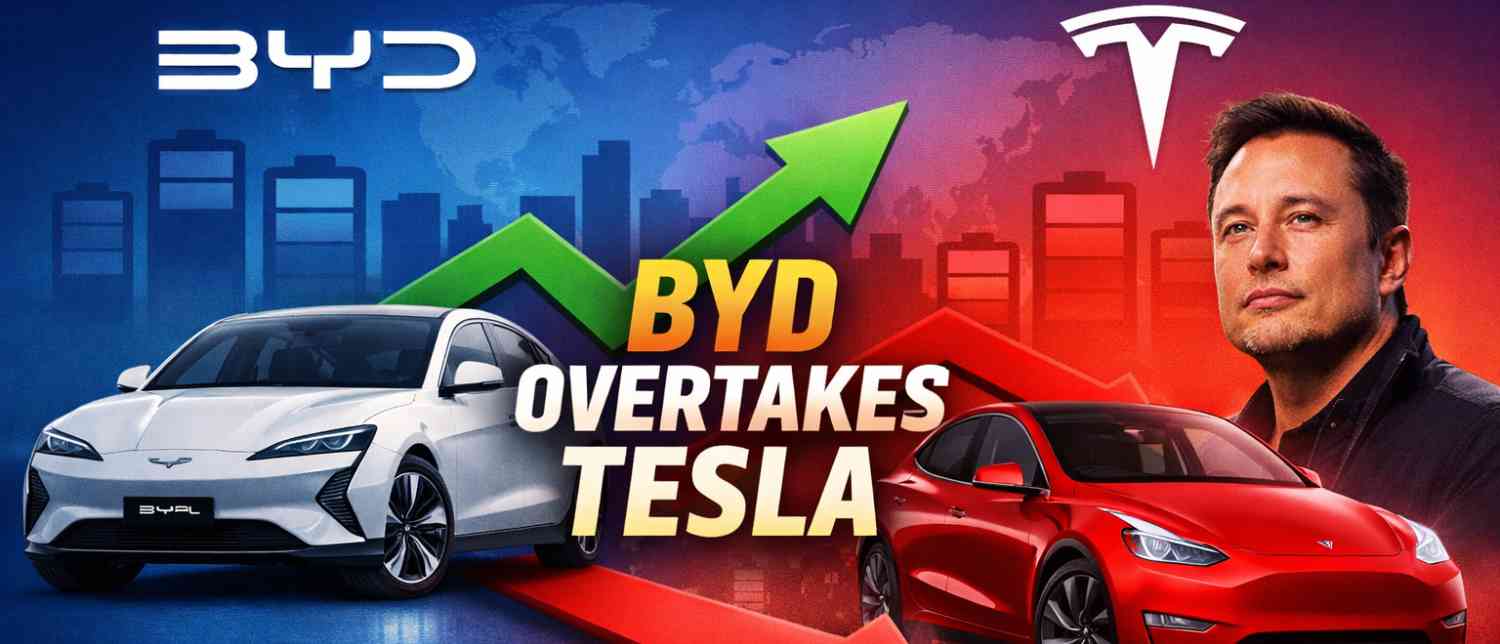
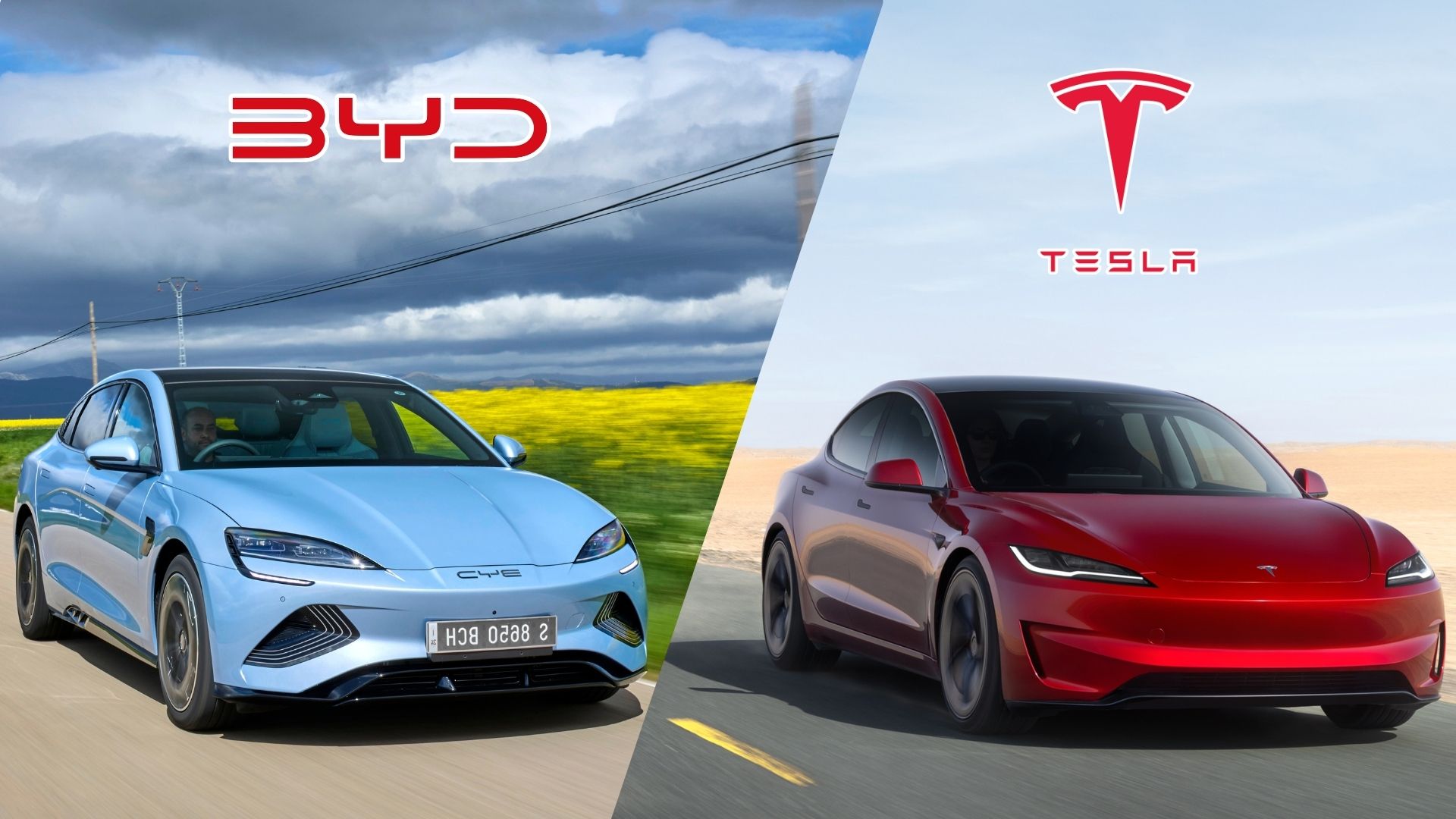
The global electric vehicle (EV) industry witnessed a historic turning point in 2025 as China’s BYD officially overtook Elon Musk-led Tesla to become the world’s largest seller of electric vehicles. For the first time in years, Tesla relinquished its long-held crown, underscoring a dramatic shift in market leadership amid intensifying competition, geopolitical pressures, pricing wars, and changing consumer sentiment across key global markets.
Tesla’s Declining Sales Mark a Turning Point
Tesla reported worldwide sales of approximately 1.64 million vehicles in 2025, representing a nearly 9% decline compared to the previous year. This marked the second consecutive year of falling annual deliveries for the American EV pioneer. The downturn was more severe than analysts had anticipated, prompting Wall Street to revise Tesla’s 2026 sales forecasts downward and signalling a growing sense of caution around the company’s near-term prospects.
The weakness was particularly visible in the final quarter of 2025. Tesla delivered 418,227 vehicles between October and December, a sharp 15.6% year-on-year decline from the 495,570 units sold during the same period in 2024. Overall, fourth-quarter sales fell by nearly 16%, highlighting mounting challenges across Tesla’s major markets.
One of the most significant contributors to the slump was the repeal of a $7,500 US federal tax credit for electric vehicles in September 2025, which had previously reduced the purchase price of certain battery electric, plug-in hybrid, and fuel cell vehicles. The subsidy removal triggered an industry-wide slowdown in demand, hitting Tesla particularly hard given its reliance on the US market.
Political Backlash and Competitive Pressure Weigh on Tesla
Beyond policy changes, Tesla also faced headwinds from growing unease around Elon Musk’s political activities, which sparked backlash in parts of Europe and North America. Sales in Europe, in particular, softened amid consumer resistance linked to Musk’s outspoken political views.
At the same time, Tesla struggled to defend its position against a rapidly expanding field of competitors. Chinese automakers such as BYD, Geely, and MG have aggressively priced their vehicles below established Western brands, intensifying pressure on Tesla’s core models. European and Asian manufacturers have also closed the technology gap, eroding Tesla’s once-clear advantage.
In response, Tesla launched lower-priced versions of its two best-selling models—the Model Y and Model 3—in October 2025, aiming to reignite demand. While the move signalled urgency, it was not enough to reverse the year’s overall decline.
BYD’s Rise to the Top of the Global EV Market
While Tesla grappled with falling sales, Shenzhen-based BYD surged ahead, reporting sales of more than 2.25 million battery-powered electric vehicles in 2025, a nearly 28% year-on-year increase. According to company disclosures, total vehicle shipments—including plug-in hybrids—reached 4.6 million units, up 7.7% from 2024.
This milestone marked the first time BYD surpassed Tesla in full-year battery electric vehicle sales, ending Tesla’s dominance of the global EV market—a title it had held since 2018.
Although BYD had already overtaken Tesla in earlier years when hybrid vehicles were included, 2025 represented a definitive shift in pure battery electric vehicle leadership. BYD’s ability to scale production while maintaining competitive pricing proved decisive.
Why BYD Succeeded Where Tesla Struggled
Industry experts point to China’s formidable manufacturing ecosystem as a key driver of BYD’s success. According to Cui Dongshu, secretary-general of the China Passenger Car Association, Chinese new-energy vehicle manufacturers continue to benefit from sustained investment in research and development, integrated supply chains, advanced manufacturing capabilities, and a vast domestic market supported by infrastructure and favourable policy measures.
Even Tesla has relied heavily on its Shanghai Gigafactory to meet delivery targets, underscoring China’s central role in the global EV supply chain. Analysts note that Chinese manufacturers are uniquely positioned to maintain cost efficiency and production scale as the industry evolves.
BYD’s product diversity has also played a crucial role. The company sells everything from high-end supercars priced around $200,000 to the ultra-affordable Seagull hatchback priced at roughly $7,800, making electric mobility accessible to a far broader audience. Over the past year, BYD has also built a reputation for innovation, introducing five-minute EV charging technology and offering autonomous driving features at no extra cost.
Challenges Persist for BYD Despite Market Leadership
Despite its headline-grabbing success, BYD has not been immune to market pressures. Its sales growth in 2025 slowed to the weakest pace in five years, largely due to fierce competition within China—its largest and most critical market. Local rivals such as Geely have intensified price competition, while a government crackdown on excessive discounting weighed on volumes.
In December 2025 alone, BYD’s sales fell 10% year-on-year, and the company’s stock price declined around 20% over the past six months. Even so, BYD’s global momentum has helped offset domestic softness.
Global Expansion Fuels BYD’s Momentum
BYD’s international expansion has emerged as a major growth engine. The company has rapidly scaled its presence in Latin America, Southeast Asia, and Europe, even as many countries impose steep tariffs on Chinese electric vehicles.
In October 2025, BYD announced that the United Kingdom had become its largest market outside China. Sales in Britain surged by an astonishing 880% year-on-year, driven largely by demand for the plug-in hybrid version of the Seal U SUV. BYD has also outlined ambitious plans to open 1,000 new retail stores across Europe, and notably, the company outsold Tesla in Europe for the first time in May 2025.
Tesla’s Long-Term Bet on Robotics and Autonomy
Despite losing its sales crown, Tesla remains more profitable than BYD in recent quarters, and investors have largely brushed off declining vehicle deliveries. Instead, they are focusing on Tesla’s long-term vision centered on robotaxis, energy storage solutions, and humanoid robots.
Elon Musk’s compensation package—approved by shareholders in November—reflects this confidence. The deal could eventually be worth up to $1 trillion, provided Musk significantly boosts Tesla’s sales, market value, and technological leadership over the next decade. As part of the agreement, Musk is also required to sell one million humanoid robots within ten years, tied to Tesla’s heavily funded Optimus project.
Analysts believe Tesla’s planned robotaxi and self-driving rollout in 2026 will be pivotal. The optimism has already helped push Tesla’s share price to record highs. Dan Ives of Wedbush Securities has predicted that Tesla could command around 70% of the global self-driving market over the next decade, citing the company’s unmatched scale and technological reach.
Questions Around Musk’s Focus and Leadership
Musk’s wide-ranging commitments—spanning Tesla, SpaceX, X (formerly Twitter), and the Boring Company—have raised concerns among some investors. His involvement in running the US Department of Government Efficiency (Doge) earlier in 2025 further fuelled speculation that Tesla was not receiving his full attention.
Musk has since stepped back from government duties, attempting to reassure stakeholders that Tesla remains his top priority. While skepticism remains, investor confidence in Tesla’s long-term vision has so far held firm.
A Broader Perspective: Lessons Beyond the Auto Industry
The rivalry between Tesla and BYD highlights how scale, pricing strategy, and supply-chain integration can reshape global leadership—lessons that resonate far beyond the automotive sector. Similar dynamics can be observed in other industries, including fashion and e-commerce.
In India, companies such as Flipkart, Flying Machine, and Arvind Fashion demonstrate how localisation, supply-chain efficiency, and consumer-centric pricing can redefine market leadership. Flipkart’s dominance in e-commerce, Flying Machine’s ability to stay relevant with younger consumers, and Arvind Fashion’s manufacturing strength mirror the strategic advantages Chinese EV makers have leveraged globally. While operating in vastly different sectors, these companies underline the same core principle: sustainable leadership depends on adaptability, scale, and deep market understanding.
The Road Ahead for the Global EV Industry
BYD’s ascent to the top of the EV market marks more than a symbolic victory—it signals a broader realignment of power within the global automotive industry. While Tesla remains a technological trailblazer with ambitious bets on autonomy and robotics, BYD’s manufacturing strength, pricing discipline, and global expansion have redefined what leadership looks like in the electric age.
As competition intensifies and governments rethink subsidies and trade policies, the next phase of the EV race will likely be shaped not just by innovation, but by who can deliver affordability, scale, and resilience in an increasingly complex global marketplace.
With inputs from agencies
Image Source: Multiple agencies
© Copyright 2025. All Rights Reserved. Powered by Vygr Media.