
 By
By 
For years, a common question in India’s e-commerce ecosystem has been: "How does Meesho generate revenue if it charges sellers zero commission?" Conventional wisdom suggests that a business must levy fees to make money, but Meesho’s latest Red Herring Prospectus (RHP) sheds light on the truth behind this model.
The zero-commission policy was never intended as a revenue stream. Instead, it acted as a strategic lure, allowing Meesho to amass one of India’s most fragmented and valuable resources: 7,06,471 active sellers. These sellers predominantly consist of small businesses dealing in unbranded and regional products—a segment that represents more than 75% of India’s retail expenditure.
Once Meesho secured this vast supply base, it activated its primary revenue engines, which are now clearly visible in its operational data:
-
Commission (0%): Initially attracting sellers with the promise of no fees.
-
Fulfillment: Generating revenue through shipping solutions.
-
Advertising: Monetizing visibility and promotional tools for sellers.
Recent data underscores the success of this approach. Over the past six months, every Re 1 spent by sellers on advertising yielded Rs 13.55 in sales. This exceptional return on investment illustrates Meesho’s transformation from a conventional e-commerce retailer into a mature ad-tech platform, circumventing the thin margins associated with selling low-cost apparel and household items.
A particularly surprising revelation from the RHP is the rapid growth of Meesho’s in-house logistics platform, Valmo. Rather than owning physical assets like trucks or warehouses, Valmo functions as a sophisticated software system that coordinates third-party logistics efficiently. In FY23, Valmo handled just 1.83% of orders. By the six months ending September 30, 2025, this figure surged to 64.52%, highlighting the platform’s operational leap.
Geographical concentration, often seen as a risk, has instead become an advantage for Meesho. The RHP notes that 45.35% of its sellers are located in Gujarat, Uttar Pradesh, and Delhi. This dense clustering allows for highly efficient parcel collection, enabling Valmo to operate at costs 0.5-11% lower than competitors. What might appear as a regional dependency has, paradoxically, become a strategic advantage that keeps Meesho’s prices competitive.
Meesho’s reliance on Cash-on-Delivery (COD) has also been a topic of concern, with 72% of orders paid in cash in the last six months. While COD comes with a roughly 80% success rate due to order cancellations, it enabled Meesho to capture the “Bharat” market, encompassing approximately 88% of customers outside India’s top eight cities—a demographic where other platforms have historically struggled.
The trend, however, is shifting. Prepaid orders have grown from 11.29% in FY23 to 28% now, showing an increasing adoption of digital payments, which boast a 96.39% success rate. This shift reduces friction-related costs and improves operational efficiency significantly.
Meesho’s IPO proceeds further indicate a transformation into a technology-driven conglomerate. Around 44% of the funds are allocated to technological enhancements, with Rs 1,400 crore earmarked for cloud infrastructure and Rs 480 crore for acquiring AI talent. This investment fuels the BharatMLStack, an artificial intelligence engine that processes 5.92 billion data points daily. The AI now drives 74.57% of orders through personalized recommendations, rather than search—a testament to the platform’s sophisticated data capabilities.
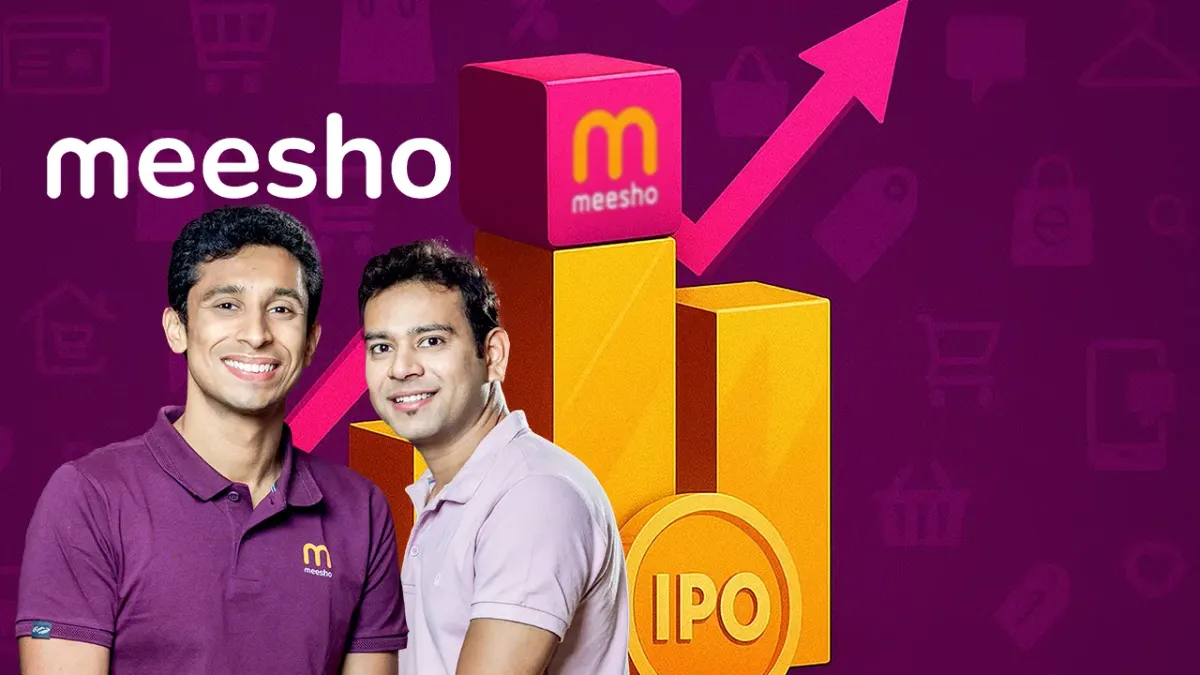
Meesho IPO Details
Meesho’s IPO, open for bidding, has attracted substantial investor interest. Positioned at the forefront of India’s value e-commerce segment, the company is debuting publicly at a time when online spending beyond metropolitan cities is rising steadily.
The IPO is a book-built issue worth Rs 5,421.20 crore, comprising a fresh issue of 38.29 crore shares valued at Rs 4,250 crore and an offer-for-sale (OFS) of 10.55 crore shares worth Rs 1,171.20 crore. The price band is set between Rs 105 and Rs 111 per share. Retail investors require Rs 14,985 to apply for one lot of 135 shares at the upper band. Non-institutional investors (sNII) need 14 lots (1,890 shares) costing Rs 2,09,790, while bNII lot size is 67 lots (9,045 shares) for Rs 10,03,995. Kotak Mahindra Capital Co. Ltd. acts as the book running lead manager, with Kfin Technologies Ltd. serving as the registrar.
Prior to the IPO, Meesho raised Rs 2,439 crore from over 60 anchor investors, including SBI MF, GIC, Fidelity, BlackRock, Axis MF, Aditya Birla MF, and global tech funds like Dragoneer, highlighting strong institutional confidence in India’s pure-play value e-commerce platform.
Investment Analysis and Subscription Considerations
Swastika Investmart observes that Meesho has built a strong foothold in Tier-2 and Tier-3 cities, where larger platforms like Amazon and Flipkart face scaling challenges. The company achieved free cash flow positivity in FY25, although net profit remains negative due to one-off costs. At an approximate valuation of Rs 50,000 crore, Meesho trades at 5.5 times Price-to-Sales for FY25, making it comparatively attractive against peers like Zomato, which often trades above 10 times sales. The platform also benefits from a scarcity premium as India’s only pure value e-commerce company.
Bajaj Broking emphasizes Meesho’s “Everyday Low Prices” strategy, which has cultivated a broad customer base by offering affordable unbranded goods, regional labels, and national brands. The company’s tech-driven operations allow low-cost fulfillment, and the zero-commission model provides sellers the flexibility to price competitively. Meesho is currently valued at a P/S multiple of 4.7 times based on FY25 earnings.

Key Risks Identified
SBI Securities outlines several risks for potential investors:
-
Customer Retention: Growth depends on maintaining and attracting buyers, requiring heavy investment in marketing, content, and platform experience.
-
Seller Retention: Dependence on third-party sellers poses risks; any departure could impact product variety and quality.
-
Logistics and Service Quality: Meesho relies on Valmo and external delivery partners. Disruptions or delays could erode customer trust.
-
Intense Competition: Rivalry from Amazon, Flipkart, and offline retailers necessitates constant improvement in pricing and delivery.
Strengths Working in Meesho’s Favor
SBI Securities also highlights four key strengths:
-
Interconnected Flywheels: Commerce, logistics, and content reinforce each other, creating barriers for new entrants.
-
Technology-First Approach: Integration of GenAI into engineering systems improves efficiency, and the app is user-friendly for widespread adoption.
-
Trust with Sellers and Buyers: Tools for fulfillment, advertising, and analytics have improved product ratings from 3.97 in FY23 to 4.11 in September 2025. Meesho commands 21%-25% market share in fashion, 23%-25% in home and kitchen, and 8%-10% in beauty and personal care.
-
Everyday Low Prices: Attracts a large user base of 23 million annual transacting customers without heavy reliance on flash sales.
Listing Expectations
Grey Market Premium (GMP) trends indicate strong market sentiment, with the latest GMP at Rs 49 on December 3, 2025. With the upper band at Rs 111, the estimated listing price could reach Rs 160, implying a potential listing gain of around 44.14%. The IPO closes on December 5, allotment finalizes on December 8, and shares will list on NSE and BSE on December 10.
IPO Subscription Data
On Day 1, the IPO saw 2.35x subscription overall, broken down as follows:
-
Qualified Institutional Buyers (QIB): 2.12x
-
Non-Institutional Investors (NII): 1.80x
-
Retail Individual Investors (RII): 3.85x
This data reflects robust investor interest, driven by Meesho’s unique positioning, technology-led operations, and strong institutional backing.
Final Thoughts
Meesho’s IPO provides an insight into a company that has leveraged a zero-commission model to build a massive seller base, efficiently monetize logistics and advertising, and adopt AI-driven operations to transform India’s value e-commerce landscape. Despite risks related to seller retention, logistics, and competition, the company’s strengths, technological innovations, and market positioning make it a compelling play in the growing Tier-2 and Tier-3 digital market. Investors can expect a potentially strong debut, with a combination of listing gains and long-term growth potential, reflecting Meesho’s evolution into a technology and logistics powerhouse rather than a conventional low-margin marketplace.
With inputs from agencies
Image Source: Multiple agencies
© Copyright 2025. All Rights Reserved. Powered by Vygr Media.