
 By
By 
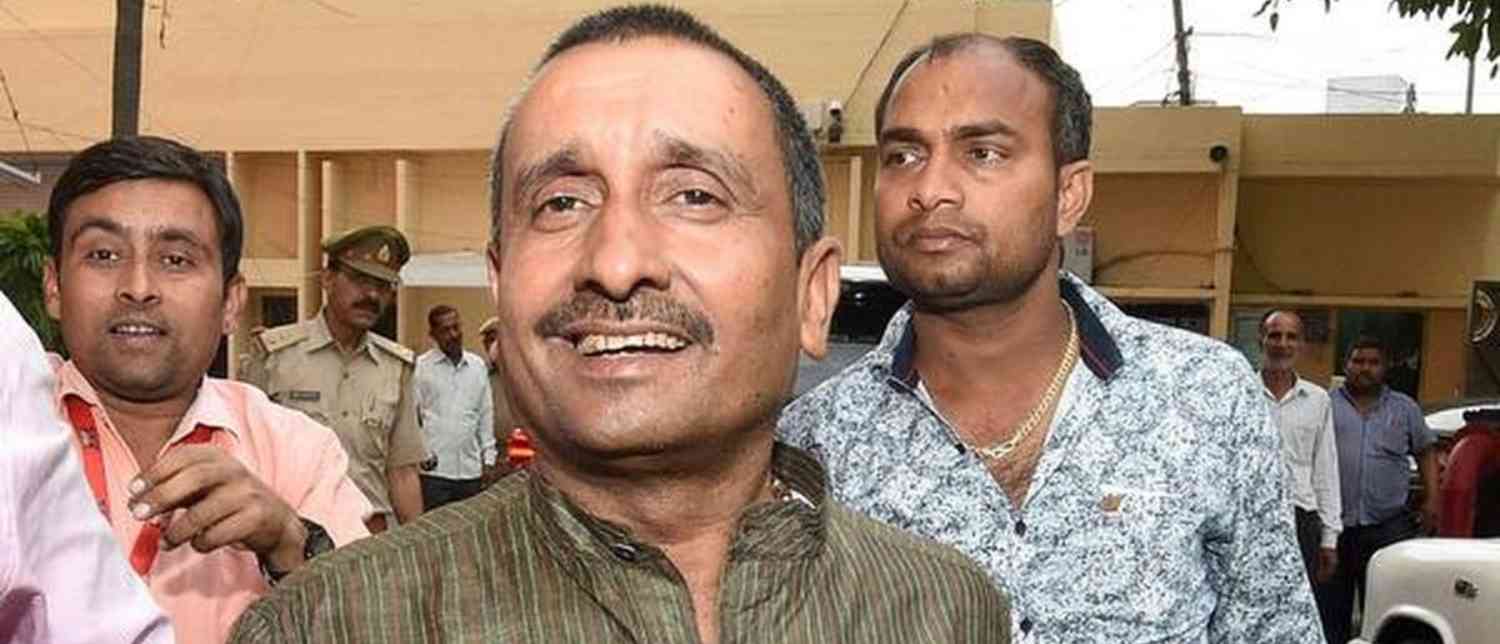
The brief relief granted to expelled BJP leader and former Uttar Pradesh MLA Kuldeep Singh Sengar came to an abrupt end on Monday after the Supreme Court stayed a controversial Delhi High Court order that had suspended his life sentence and granted him bail in the 2017 Unnao rape case. The apex court’s intervention followed widespread public outrage, protests by activists and political leaders, and anguished appeals by the survivor and her family, who feared for their safety after Sengar’s release.
A three-judge vacation bench of the Supreme Court, presided over by Chief Justice of India Surya Kant and comprising Justices J.K. Maheshwari and Augustine George Masih, took strong exception to the reasoning adopted by the High Court. The bench noted that accepting the High Court’s interpretation—that Kuldeep Sengar did not qualify as a “public servant” at the time of the offence—would lead to an illogical and untenable legal position.
“If we accept this interpretation,” the Chief Justice observed during the hearing, “then a police constable would be considered a public servant, but an elected Member of the Legislative Assembly would not.”
With that observation, the Supreme Court stayed the High Court’s December 23 order, ensuring that Sengar remains in prison for now. The court also issued notice to Sengar on the plea filed by the Central Bureau of Investigation (CBI), granting him four weeks to file his response.
Heightened Security and a Charged Atmosphere
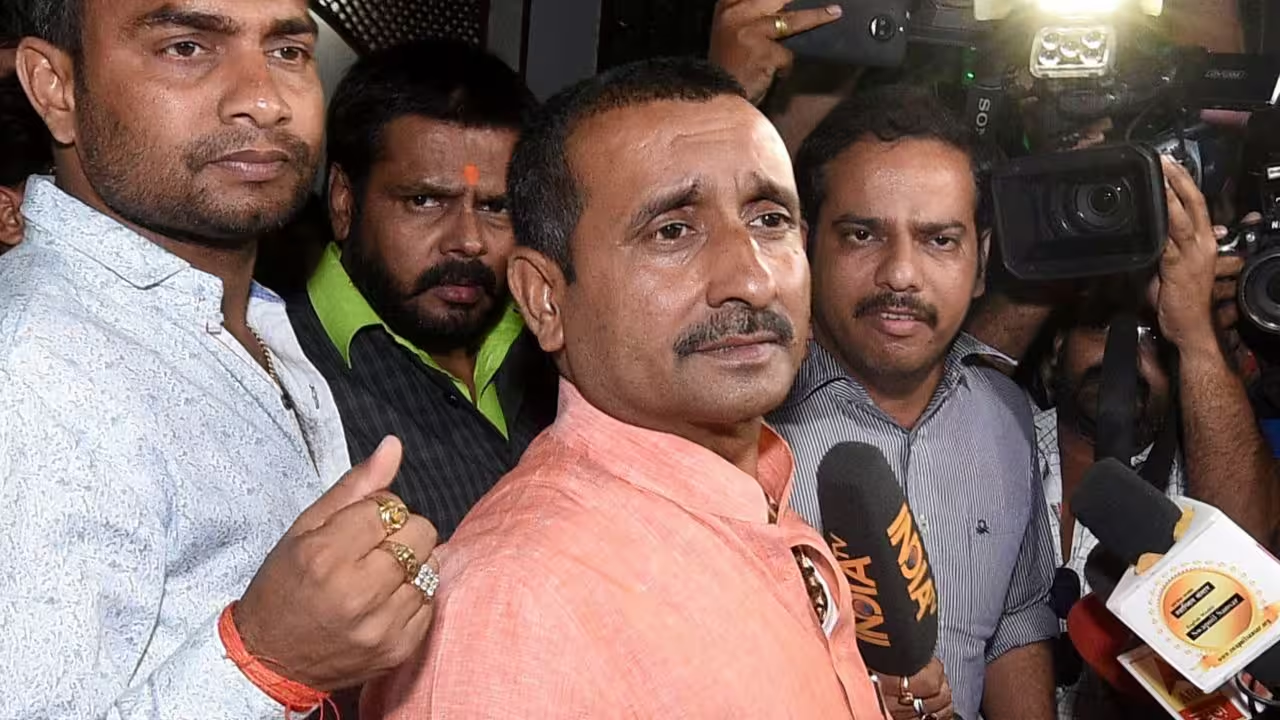
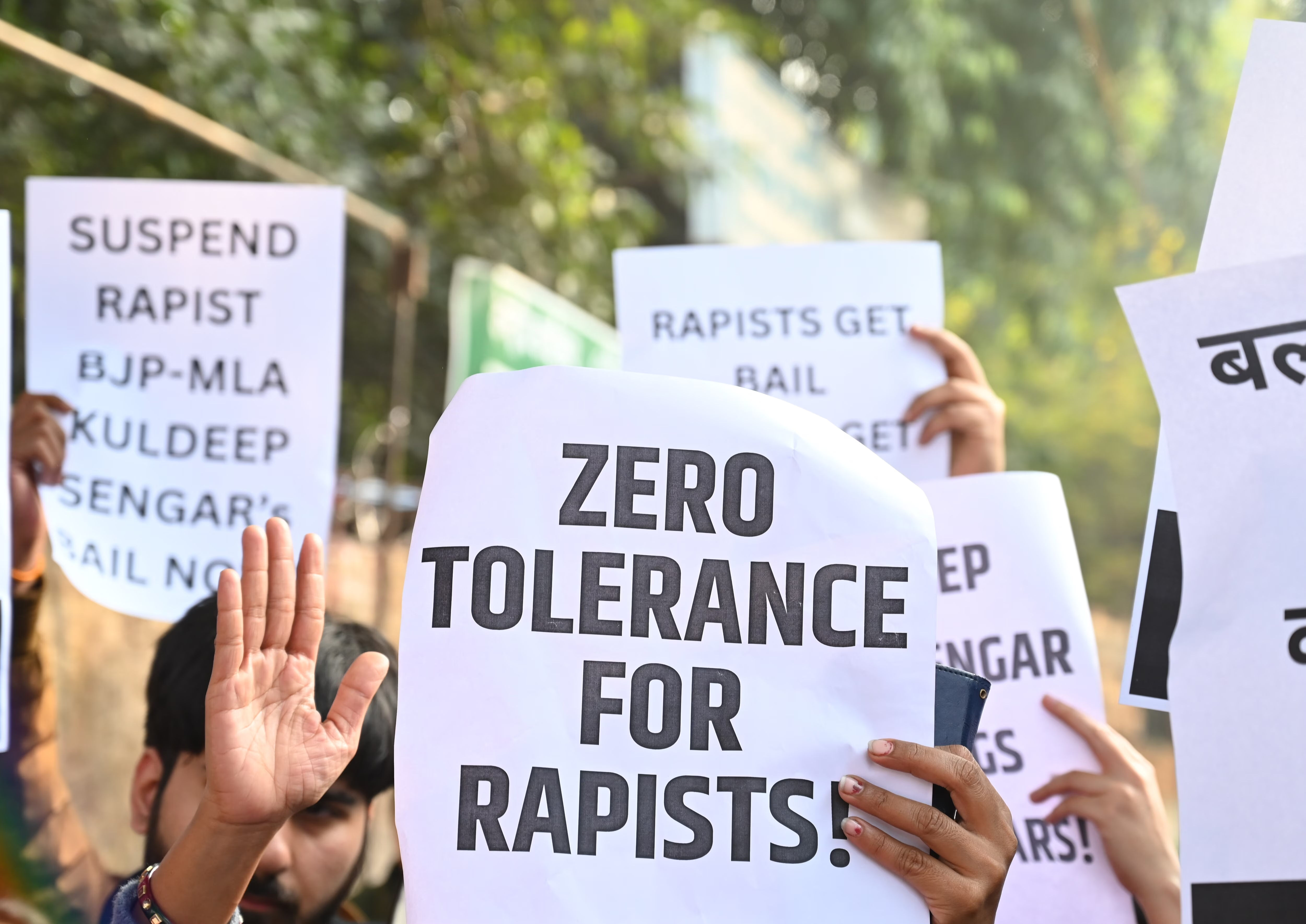
The Supreme Court hearing unfolded amid heightened security around the court complex, reflecting the sensitivity of the case and the scale of public anger it has provoked. The High Court’s decision to suspend Sengar’s life sentence had triggered sharp reactions across the political spectrum, women’s rights groups, and civil society, with many describing the order as a blow to the fight against sexual violence and accountability of powerful individuals.
The CBI, which had investigated and prosecuted the case, moved the Supreme Court on Friday, terming the High Court’s order “contrary to law” and “perverse.” The agency argued that the High Court failed to appreciate both the legal position and the broader implications of releasing a convict in such a sensitive case while his appeal remained pending.
Who Is Kuldeep Singh Sengar?
Kuldeep Singh Sengar is an expelled leader of the Bharatiya Janata Party and a former MLA from Bangarmau in Uttar Pradesh’s Unnao district. Known for frequently changing political parties and Assembly constituencies, Sengar was regarded as a dominant Thakur leader in the largely Brahmin-dominated region.
In December 2019, a Delhi trial court convicted Sengar in the Unnao rape case and sentenced him to life imprisonment. The case involved the rape of a minor girl in 2017 and became one of the most high-profile examples of alleged abuse of power by a sitting legislator.
Convictions and Criminal Cases Against Sengar
The Delhi trial court found Sengar guilty under Section 376(2) of the Indian Penal Code, which deals with aggravated rape, and under Sections 5(c) and 6 of the Protection of Children from Sexual Offences (POCSO) Act. The court ruled that Sengar qualified as a “public servant” at the time of the offence, relying on the definition under the Prevention of Corruption Act, which explicitly includes Members of Legislative Assemblies.
The trial court held that Sengar’s position as an MLA placed him in a position of authority and influence, which aggravated the offence. The case, initially investigated by the Uttar Pradesh Police, was later transferred to the CBI following allegations of intimidation and interference.
In addition to the rape conviction, Sengar was sentenced in March 2020 to ten years’ imprisonment in a separate case related to the death of the survivor’s father, who died in judicial custody. The court held Sengar guilty of culpable homicide not amounting to murder. That sentence is running concurrently with his life term.
The Delhi High Court’s Controversial Bail Order
On December 23, the Delhi High Court suspended Sengar’s life sentence and granted him conditional bail while his appeal against the trial court’s verdict was pending. The order allowed Sengar’s release subject to several conditions, including furnishing a personal bond of ₹15 lakh, not leaving Delhi, and maintaining a distance of at least five kilometres from the survivor.
In its ruling, a division bench comprising Justice Subramonium Prasad and Justice Harish Vaidyanathan concluded that Sengar’s former status as an MLA did not bring him within the definition of a “public servant” under the Indian Penal Code. The court also held that the provisions of the POCSO Act could not be applied in this case.
After excluding the application of both the “public servant” classification and the POCSO Act, the High Court reasoned that the approximately seven-and-a-half years Sengar had already spent in prison amounted to “more than the minimum number” of years prescribed under the relevant provisions. This interpretation formed the basis for suspending his sentence and granting bail.
The order was met with immediate criticism from legal experts, activists, and political leaders, who questioned both the legal reasoning and the timing of the relief.
CBI’s Appeal Before the Supreme Court
In its appeal before the Supreme Court, the CBI argued that the High Court had committed a serious error by overlooking the constitutional role and public trust associated with an elected legislator. The agency stated that a sitting MLA, by virtue of holding a constitutional office, exercises authority over the electorate and bears heightened responsibility toward the State and society.
The CBI further warned that releasing Sengar on bail during the pendency of his appeal would not only be legally unsound but would also endanger the survivor and her family. The agency emphasised the long history of alleged intimidation faced by the survivor and pointed out that the gravity of the offence and the power imbalance involved demanded a cautious approach.
The Supreme Court appeared to agree, noting that there was no question of compromising personal liberty in this instance, especially since Sengar was also serving a concurrent sentence in the custodial death case.
Survivor’s Reaction: “A Setback I Could Not Bear”
The High Court’s order had a devastating emotional impact on the Unnao rape survivor. She met CBI officials in Delhi on Saturday following the bail order and filed a complaint alleging that the investigating officer in the case was “hand in glove” with Sengar and his family.
Recalling the moment the order was pronounced, the survivor said she was present in court and felt shattered. “I wanted to commit suicide then and there,” she said, adding that she restrained herself only because of her children and family members who had stood by her through years of legal battles.
She also attempted to seek an explanation directly from the Delhi High Court judge by visiting the court later, but was told that the court was closed. In her complaint, she demanded security not only for herself but also for witnesses, family members, and friends who had supported her during the trial.
Ahead of the Supreme Court hearing, the survivor said she had faith in the apex court and appealed to Uttar Pradesh Chief Minister Yogi Adityanath to ensure her safety and that of her family. She alleged that Sengar had bribed officials, including the investigating officer and an unnamed Delhi High Court judge, and claimed her family had already suffered immensely since his release on bail.
Protests, Detentions, and Public Anger
The High Court’s order sparked protests across Delhi. On Saturday, the survivor’s mother, accompanied by activists, staged a demonstration outside the Delhi High Court. Over the past week, protests were also held at Jantar Mantar and near Parliament, drawing participation from politicians and civil society groups.
Women’s rights activist Yogita Bhayana, Congress leader Mumtaz Patel, and several other protesters were detained by police while staging a sit-in near the Parliament complex. They were later released, but the detentions further fuelled anger among protesters.
The survivor announced plans to hold a demonstration at Jantar Mantar on Monday, December 29, underscoring her determination to continue seeking justice despite the immense personal toll.
Disturbing Scenes After Sengar’s Release
Sengar’s brief release on bail led to alarming scenes in Delhi that shocked the public and intensified criticism of the authorities. Clashes were reported between central security forces tasked with “guarding” the survivor and members of her family. Disturbing visuals circulated showing the survivor’s mother apparently being forced to jump from a moving bus, which then drove off with her daughter still inside.
Breaking down while speaking to reporters after the incident, the mother said, “We did not get justice. My daughter has been held captive. It seems they want to kill us.”
A CRPF officer later claimed that the survivor was being “escorted” back home, though no official explanation was provided regarding the mother being removed from the bus.
Supreme Court Allows Survivor to Intervene
Recognising the survivor’s stake in the proceedings, the Supreme Court allowed her to intervene in the case with her own petition. The bench acknowledged its responsibility toward the survivor while issuing notice to Sengar and staying the High Court’s order.
For now, Kuldeep Singh Sengar will remain behind bars, his bail suspended pending further consideration by the Supreme Court. The case has once again highlighted the fraught intersection of power, justice, and survivor protection in India’s criminal justice system—and reinforced the scrutiny faced by courts when dealing with crimes involving influential public figures.
As the legal battle continues, the Supreme Court’s stay has provided temporary relief to the survivor and reignited hopes that accountability will prevail over influence.
With inputs from agencies
Image Source: Multiple agencies
© Copyright 2025. All Rights Reserved. Powered by Vygr Media.