
 By
By 
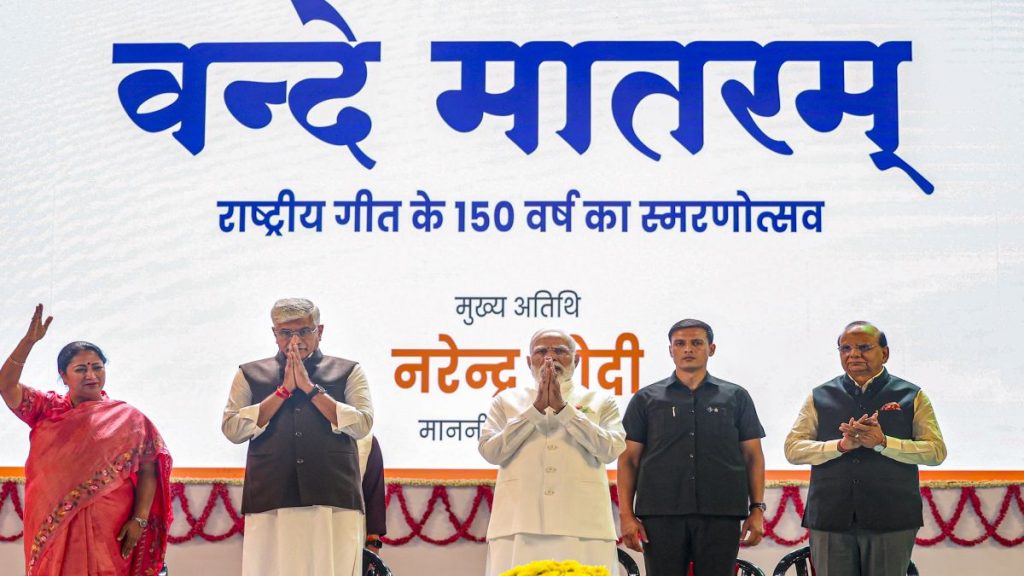
The Lok Sabha witnessed a rare and historic moment as Prime Minister Narendra Modi opened a special discussion to commemorate 150 years of India’s national song, Vande Mataram. What unfolded was not merely a parliamentary address but a sweeping journey into India’s cultural memory, political milestones, and the song’s unparalleled role in uniting the nation during its struggle for freedom.
Modi began his address by extending heartfelt gratitude to all Members of Parliament for choosing a path of collective reflection. This, he said, was an opportunity not only to honour the song that electrified India’s freedom movement but also to educate future generations about its legacy, its trials, and its continuing relevance.
A Song That Energised a Nation
Calling Vande Mataram the “mantra and clarion call” of India’s freedom movement, the Prime Minister described its 150-year journey as deeply intertwined with India’s march toward independence. The song, he remarked, awakened a sleeping nation, pushing people from despair to determination. It was not only a cultural expression—it was the pulse of the struggle, the emotional backbone that inspired sacrifice, courage, and unity.
For Modi, this moment is one of profound pride: to stand in Parliament and revisit a song that, for generations, served as India’s breath of resilience.
A Historical Timeline: 50, 100, and 150 Years of Vande Mataram
Modi noted that each milestone in the song’s journey was tied to a turbulent chapter in Indian history:
-
50 years of Vande Mataram: India remained under colonial rule.
-
100 years of Vande Mataram: The country was under Emergency, its Constitution throttled, and its democratic institutions strangled.
-
Now, at 150 years: Modi declared this moment a chance to restore its glory and reclaim the essence of unity and resistance embodied in the song.
This three-tiered historical reflection, he asserted, serves as a call to recommit to the dreams envisioned by India’s freedom fighters.
Bankim Chandra Chattopadhyay and the Birth of a Cultural Anthem
Modi traced the birth of Vande Mataram back to Bankim Chandra Chattopadhyay, who composed it in 1875, at a time when the British Empire was forcefully embedding “God Save the Queen” into Indian consciousness.
Bankim Da, Modi said, responded to this colonial imposition with cultural defiance. His composition, later included in the 1882 novel Anandamath, resurrected values deeply rooted in India’s civilizational memory. Through the song, Bankim Chandra portrayed Mother India not as a political entity but as a sacred mother figure revered through ages—from Vedic wisdom to the declarations of Lord Ram, such as Janani Janmabhoomishcha Swargadapi Gariyasi.
According to Modi, Vande Mataram is the modern echo of this timeless sentiment.
Speaking in the Lok Sabha. https://t.co/qYnac5iCTB— Narendra Modi (@narendramodi) December 8, 2025
Vande Mataram as the Emotional Nucleus of the Freedom Movement
From Bengal to Punjab, Tamil Nadu to Maharashtra, the song united India in one voice. Not only did it revive cultural self-belief during a period when educated Indians had internalised colonial stereotypes of inferiority, but it also gave Indians a renewed sense of identity and purpose.
Modi recounted how Bankim Chandra depicted the motherland as the embodiment of knowledge, prosperity, and fierce protection—invoking both Goddess Saraswati and Goddess Durga. These images transformed into a source of courage for millions living in the despair of slavery.
1905: Partition of Bengal and Vande Mataram’s Role as a Shield
The Prime Minister revisited one of the most significant chapters in the freedom struggle—the partition of Bengal in 1905, which became the British “laboratory of divide and rule.” Recognizing Bengal’s intellectual might, the British attempted to fracture India by first dividing Bengal.
But Vande Mataram rose as a counterforce.
The song echoed across Bengal's streets, uniting people in defiance. Its resonance was so powerful that, faced with the mass fervor it generated, the British imposed legal bans on singing, printing, or even uttering the words “Vande Mataram.”
Women and children played a heroic role during this period. Modi evoked the memory of:
-
Sarojini Ghosh, who vowed not to wear bangles until the ban was lifted.
-
Children in Barisal, Haritpur, and Nagpur, who endured beatings and imprisonment for chanting the mantra.
-
Young revolutionaries like Khudiram Bose, Madanlal Dhingra, Ashfaqulla Khan, Roshan Singh, Rajendranath Lahiri, and many more who mounted the gallows with Vande Mataram on their lips.
Even during the Chittagong Uprising, Master Surya Sen’s final letter echoed simply: Vande Mataram.
Modi underscored that no other country in world history possesses a poem capable of sustaining such courage and unity for decades.
Global Influence: From India House in London to Paris
The song’s global influence also found resonance in London’s India House, where Veer Savarkar passionately sang it, and in a Paris-based publication by Madam Bhikaji Cama, who named her newspaper Vande Mataram as a challenge to British censorship.
It is imperative for our younger generation to know how the Congress party brazenly pandering to its communal agenda under the Presidentship of Nehru, adopted only a truncated Vande Mataram as the party’s national song in its 1937 Faizpur Session , while PM @narendramodi ji today… pic.twitter.com/13NBta11OV— C.R.Kesavan (@crkesavan) November 7, 2025
The Song as a Swadeshi Mantra
Modi emphasized that Vande Mataram embodied the spirit of self-reliance long before independence. From matchboxes to ships, products proudly carried the inscription Vande Mataram to boycott foreign goods.
He recalled:
-
1907 – V.O. Chidambaram Pillai built a Swadeshi ship and inscribed “Vande Mataram” on it.
-
Subramania Bharati translated the song into Tamil and composed patriotic hymns celebrating it.
Modi quoted Bharati’s Tamil flag song, which saluted a flag inscribed with Vande Mataram.
Gandhi’s Admiration for Vande Mataram
The Prime Minister cited Mahatma Gandhi’s 1905 observations in Indian Opinion, where Gandhi described the song as “sweeter than the songs of other nations” and popular enough to have become a national anthem.
Gandhi praised its ability to awaken patriotism and revere India as a mother.
The Controversy: Jinnah’s Objections and the 1937 Congress Decision
Modi then addressed one of the most contentious chapters linked to Vande Mataram. He said that in October 1937, Muhammad Ali Jinnah raised objections to the song from Lucknow, claiming it would antagonize Muslims.
Rather than countering this claim, Modi argued, Jawaharlal Nehru wrote to Subhas Chandra Bose on October 20, 1937, agreeing that the background of Vande Mataram could irritate Muslims.
Following this, on 26 October 1937, the Congress Working Committee met in Kolkata and decided to adopt only the first two stanzas for public use. Modi characterized this as a “compromise driven by appeasement,” linking it to later political concessions such as the partition of India.
The Congress, however, has historically defended this move as a decision endorsed by leaders like Gandhi, Patel, Bose, Azad, and Tagore—who himself urged that only two stanzas be sung due to religious imagery in the others.
Why Parliament Is Debating Vande Mataram Again
The present debate stems from the Prime Minister’s charge that Congress “removed important stanzas” and thereby “sowed the seeds of partition.” As Parliament dedicates a full session to the 150-year commemoration:
-
Modi leads the discussion in Lok Sabha.
-
Home Minister Amit Shah will address the Rajya Sabha discussion.
-
The government states this will reveal “unknown facets” of the song.
Congress counters by accusing the BJP of distorting history and diverting attention from national issues.
From Literature to National Song: The Journey of Vande Mataram
Vande Mataram was first published in Bangadarshan on November 7, 1875. Set to music by Rabindranath Tagore, it soon became the soul of the freedom movement.
By 1920, it had been translated into multiple Indian languages, from Marathi to Malayalam.
In 1951, the Constituent Assembly accorded it the status of national song, giving it equal honor with Jana Gana Mana, which became the national anthem due to its orchestral suitability.
The Enduring Spirit of Vande Mataram: From Independence to Modern India
Modi emphasized that the song’s power did not fade after 1947. Whether during wars, the Emergency, food crises, or even the COVID-19 pandemic, the spirit of Vande Mataram, he said, has inspired India to rise above challenges.
He reminded Parliament that the song is not merely a memory but a source of strength, duty, and national resolve.
Towards 2047: Vande Mataram as the Mantra for a Developed India
Linking the legacy of freedom fighters to modern aspirations, Modi urged that just as the song inspired the dream of independence, it must now energize India’s path toward becoming a developed nation by 2047.
He concluded with confidence that this parliamentary discussion would ignite national sentiment, inspire the youth, and continue to guide India with the timeless spirit of Vande Mataram.
With inputs from agencies
Image Source: Multiple agencies
© Copyright 2025. All Rights Reserved. Powered by Vygr Media.