 By

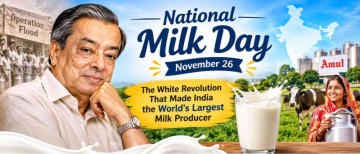
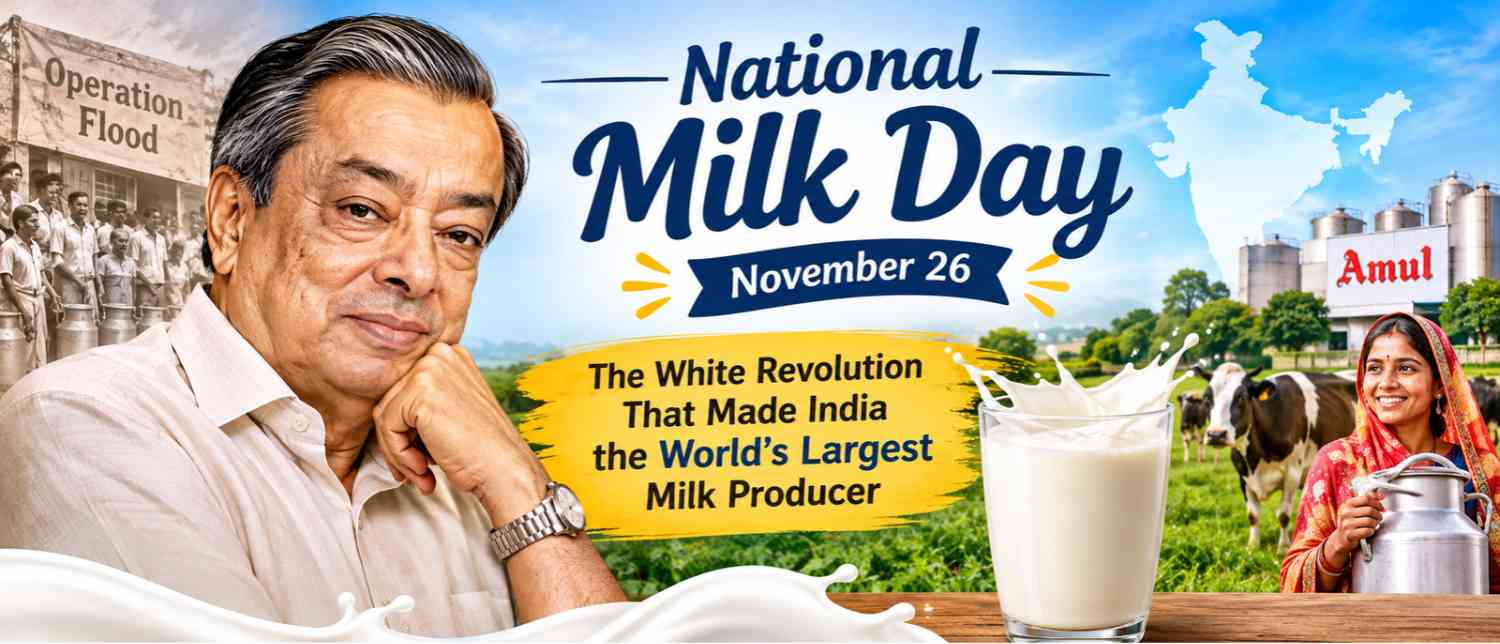
India's journey from a milk-deficient nation to the world's largest milk producer is one of the most remarkable success stories in its agricultural and rural development history. Behind this transformation lies the vision of one extraordinary man, Dr Verghese Kurien, whose determination, innovative thinking and commitment to farmers laid the foundation for what became known as the White Revolution in India.
Every year, November 26 is observed as National Milk Day to commemorate Kurien's birth anniversary and recognise his invaluable contribution to the Indian dairy industry. More than just a celebration of milk production, the occasion highlights the millions of dairy farmers whose hard work has helped establish India as a global leader in milk production.
At the heart of this achievement was Operation Flood, an ambitious dairy development programme that transformed the way milk was produced, collected, processed and distributed across the country. It strengthened rural livelihoods, empowered small farmers and demonstrated how cooperative institutions could reshape an entire industry.
As India celebrates National Milk Day 2026, Kurien's legacy offers an opportunity to revisit the remarkable journey of the White Revolution and understand how his vision continues to influence the country's dairy sector.
Who Was Dr Verghese Kurien, the Father of India's White Revolution?
Born on November 26, 1921, in Kozhikode, Kerala, Dr Verghese Kurien was an engineer, dairy technologist and visionary institution-builder whose work transformed India's dairy industry.
Interestingly, dairy farming was never part of his original career ambitions. After completing his education in India, Kurien received a government scholarship to pursue specialised studies in dairy engineering in the United States. He earned a master's degree in mechanical engineering from Michigan State University in 1948 before returning to India.
His professional journey took an unexpected turn when he was assigned to a government creamery in Anand, Gujarat, in 1949 to fulfil his scholarship obligation. Initially, he had little interest in remaining in the small town and planned to move elsewhere after completing his assignment.
However, a friendship with Tribhuvandas Kishibhai Patel, a freedom fighter and chairman of the Kaira District Cooperative Milk Producers' Union, changed his plans.
Patel approached Kurien for help in assembling equipment at the cooperative dairy. What began as a short commitment to help a friend gradually became a lifelong mission to improve the economic condition of India's milk producers.
Kurien recognised that farmers were not receiving fair returns for their hard work because private traders and middlemen controlled much of the milk supply chain. He believed that farmers needed ownership and control over the institutions responsible for collecting, processing and selling their milk.
His association with the cooperative movement eventually transformed him into one of India's most influential dairy entrepreneurs and development strategists.
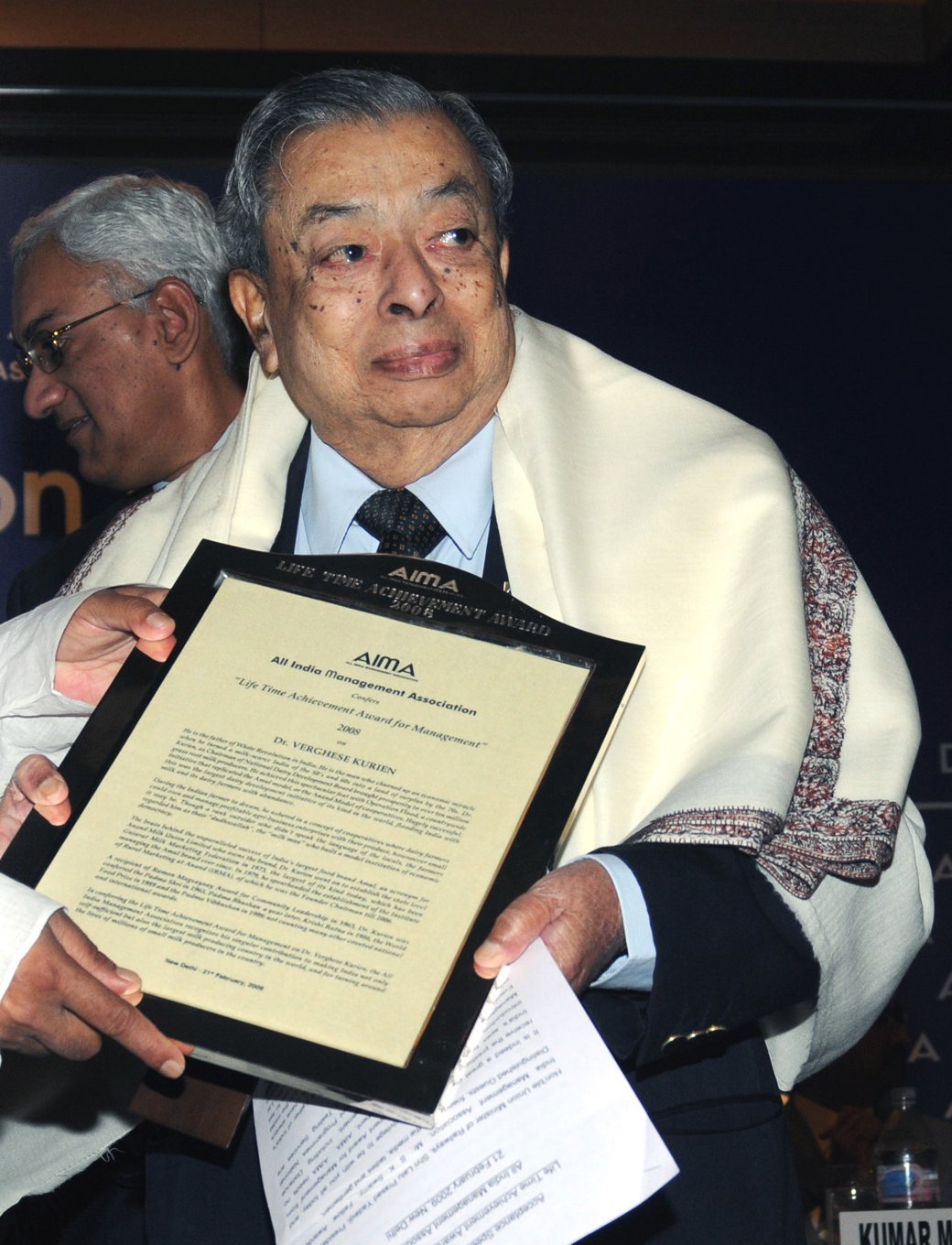
Kurien played a crucial role in expanding the Anand cooperative model, which later became the foundation of India's nationwide dairy development programme. He also served as the founding chairman of the National Dairy Development Board (NDDB), established in 1965, and helped build the Gujarat Cooperative Milk Marketing Federation, which markets products under the Amul brand.
His contribution earned him several prestigious honours, including the Padma Shri, Padma Bhushan and Padma Vibhushan.
More importantly, his work established a model in which farmers were not merely suppliers of milk but stakeholders in the entire dairy business.
What Was the White Revolution in India?
The White Revolution in India, also known as the milk revolution, refers to the massive transformation of the country's dairy industry through increased milk production, organised procurement, improved processing facilities and wider distribution networks.
Before the White Revolution, India faced considerable challenges in meeting its domestic milk requirements. Milk production was largely fragmented, dairy infrastructure was underdeveloped, and farmers often depended on local traders and intermediaries to sell their produce.
The supply chain was inefficient, making it difficult to transport milk from rural production centres to major cities. Seasonal fluctuations also affected availability and prices.
Despite having a large population of cattle and buffaloes, India struggled to establish a reliable and organised dairy economy.
The cooperative model introduced and expanded under Kurien's leadership offered a solution. It brought individual milk producers together, allowing them to collect, process and market milk collectively.
This approach helped reduce dependence on middlemen, improved access to urban markets and created more reliable income opportunities for rural households.
The movement was not simply about producing more milk. It was about creating a sustainable dairy ecosystem in which farmers could benefit directly from the growing demand for milk and milk products.
Operation Flood: The Dairy Programme That Changed India Forever
Launched in 1970, Operation Flood became the driving force behind India's White Revolution.
Implemented by the National Dairy Development Board, Operation Flood was one of the world's largest rural development programmes. Its primary objective was to establish a nationwide milk grid connecting rural milk producers with consumers in major urban markets.
The programme focused on strengthening village-level dairy cooperatives and connecting them with milk processing facilities, transportation networks and distribution centres.
Under this system, farmers could deliver milk to their local cooperative societies, where it was collected, tested and sent for processing. The milk was then transported to cities and sold to consumers through organised distribution networks.
This reduced the influence of intermediaries and helped create a more transparent relationship between milk producers and the market.
Another important objective was to reduce seasonal and regional variations in milk supply and prices. By connecting different milk-producing regions, Operation Flood aimed to ensure a consistent supply of milk throughout the year.
The programme received international assistance during its initial phase. Skimmed milk powder and butter oil donated by the European Economic Community through the World Food Programme were sold to generate funds for developing India's dairy infrastructure.
Operation Flood was implemented in three major phases over more than two decades.
Phase I (1970–1980): Building the Foundation
The first phase focused on connecting 18 major milk-producing areas with consumers in four metropolitan cities: Delhi, Mumbai, Kolkata and Chennai.
It established the initial framework for a nationwide dairy cooperative network and helped create the infrastructure needed to collect, process and distribute milk on a much larger scale.
Phase II (1981–1985): Expanding the Dairy Network
The second phase significantly expanded the programme's reach.
The number of milk-sheds increased from 18 to 136, while milk distribution extended to approximately 290 urban markets.
By the end of 1985, around 43,000 village dairy cooperatives had been established, covering approximately 4.25 million milk producers.
This expansion strengthened the connection between rural farmers and urban consumers while providing more villages with access to organised dairy markets.
Phase III (1985–1996): Strengthening Farmers and Infrastructure
The third phase concentrated on consolidating the cooperative network and improving the overall productivity of India's dairy sector.
Greater attention was given to veterinary healthcare, animal nutrition, cattle feed, artificial insemination and livestock breeding services.
It also encouraged research into animal health and productivity while expanding women's participation in dairy cooperatives.
By the time the third phase concluded in 1996, Operation Flood had laid the groundwork for a more organised, self-sufficient and farmer-oriented dairy industry.
How Amul Became the Face of India's White Revolution
The success of India's dairy cooperative movement is closely associated with Amul.
The Kaira District Cooperative Milk Producers' Union, established in 1946, became the foundation of what would eventually emerge as one of India's most recognised dairy brands.
The cooperative movement was initially driven by farmers who wanted to challenge the control of private traders and secure better prices for their milk.
Tribhuvandas Patel played an important role in organising farmers, while Verghese Kurien helped strengthen the organisation through professional management, technology and modern dairy processing.
Under Kurien's leadership, the Anand cooperative model demonstrated that farmers could collectively manage milk procurement, processing and marketing while retaining a greater share of the value generated by their produce.
Amul's success eventually inspired similar dairy cooperatives across India.
The model also demonstrated that modern technology and professional management did not have to come at the expense of farmers' interests. Instead, both could be used to strengthen rural institutions and improve the economic position of milk producers.
Today, Amul remains one of the most visible symbols of the White Revolution and India's cooperative dairy movement.
How the White Revolution Changed the Lives of Millions of Dairy Farmers
The most important achievement of the White Revolution was its impact on rural communities.
Before organised dairy cooperatives became widespread, individual farmers often had limited bargaining power. They were dependent on local traders, faced uncertainty over milk prices and had little access to modern dairy infrastructure.
The cooperative model changed this relationship by giving farmers collective ownership and a stronger voice in the dairy business.
Its impact can be understood through several major developments:
-
Better market access: Village-level cooperatives connected small and marginal farmers with organised markets, reducing their dependence on intermediaries.
-
More regular income: Organised milk procurement systems created opportunities for more predictable payments and additional household earnings.
-
Improved animal healthcare: Veterinary services, artificial insemination and livestock management support helped improve animal productivity.
-
Rural employment: Dairy development created employment opportunities across milk collection, transportation, processing, distribution and related activities.
-
Women's empowerment: Dairy cooperatives created opportunities for women to participate in economic activities and contribute directly to household incomes.
-
Greater farmer participation: Producers became stakeholders in the dairy supply chain rather than remaining limited to the role of raw milk suppliers.
The cooperative model also helped bring rural communities together around a shared economic purpose, demonstrating the potential of collective enterprise to support inclusive development.

India Becomes the World's Largest Milk Producer: The Numbers Behind the Success
India's position as the world's largest milk producer is the result of decades of investment, institutional development and farmer participation.
The latest available annual figures for 2024–25 demonstrate the remarkable growth of the country's dairy industry.
According to official estimates, India's milk production reached approximately 247.87 million tonnes in 2024–25, maintaining its position as the world's largest milk producer.
This represents an increase of approximately 69.41% compared with the 146.31 million tonnes recorded in 2014–15.
The country's per capita milk availability has also improved significantly, rising from 319 grams per person per day in 2014–15 to 485 grams in 2024–25.
These figures highlight how India's dairy sector has expanded its production capacity while improving domestic milk availability.
The country's five leading milk-producing states in 2024–25 were:
|
State |
Share of India's milk production |
|---|---|
|
Uttar Pradesh |
15.66% |
|
Rajasthan |
14.82% |
|
Madhya Pradesh |
9.12% |
|
Gujarat |
7.78% |
|
Maharashtra |
6.71% |
Together, these five states contributed approximately 54.09% of India's total milk production.
Uttar Pradesh secured the top position, underlining the importance of dairy farming to the state's agricultural and rural economy.
India also accounts for approximately 25% of global milk production, making its dairy industry an important contributor to the world's milk supply.
However, the country's achievement is not solely about producing larger quantities of milk. Improvements in animal productivity, dairy infrastructure, milk collection, processing and distribution have also played a significant role.
These developments reflect the continuing influence of the institutional foundation established during the White Revolution.
National Milk Day 2026: Why November 26 Is Important for India's Dairy Industry
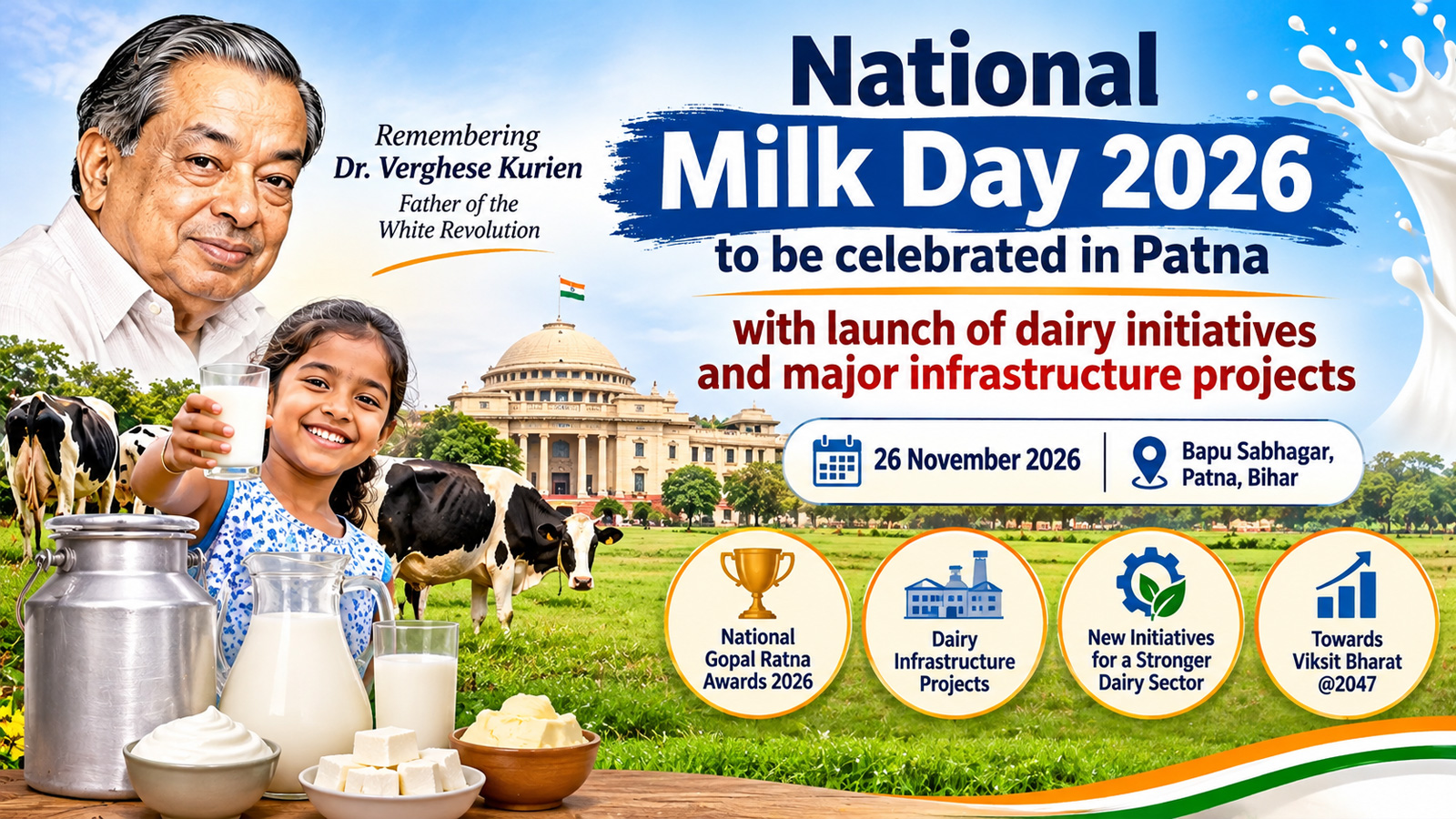
India observes National Milk Day on November 26 every year to commemorate the birth anniversary of Dr Verghese Kurien.
The observance was initiated in 2014 by the Indian Dairy Association, the National Dairy Development Board and several state-level milk federations.
The day serves two important purposes: remembering the contribution of the Father of the White Revolution and recognising the millions of dairy farmers who continue to support India's position as the world's largest milk producer.
Born on November 26, 1921, Kurien would have celebrated his 105th birth anniversary in 2026.
This year's National Milk Day celebrations are particularly significant because they also highlight the government's efforts to modernise India's dairy and livestock infrastructure.
The national celebration is scheduled to take place in Patna, Bihar, on November 26, 2026, at Bapu Sabhagar.
Several initiatives are planned as part of the celebrations, including:
-
National Gopal Ratna Awards 2026: Recognition of outstanding dairy farmers, artificial insemination technicians and dairy cooperative societies, including special awards for the North Eastern Region and Himalayan states.
-
Improved milk collection infrastructure: Distribution of Data Processing and Milk Collection Units to dairy cooperative societies to strengthen milk procurement and quality testing.
-
Better animal nutrition: Dedication of mineral mixture plants to support livestock nutrition and productivity.
-
Modern dairy processing: Dedication of a milk processing plant with a capacity of two lakh litres per day at Bihta, Patna.
-
Improved veterinary healthcare: Initiatives to expand access to veterinary medicine and livestock healthcare services.
-
Cooperative sector reforms: Introduction of standard operating procedures and an online portal for rating and grading dairy cooperatives and milk producer organisations.
-
Climate-resilient dairy development: Launch of a roadmap focused on building a productive, sustainable and climate-resilient livestock and dairy sector towards Viksit Bharat @2047.
The celebrations also recognise the importance of value-added dairy products and expanding market opportunities for dairy producers.
These initiatives demonstrate that India's dairy development agenda is gradually moving beyond increasing milk production towards improving productivity, quality, sustainability and farmers' earnings.
The Future of India's Dairy Industry: Beyond the White Revolution
India's dairy industry has come a long way since the launch of Operation Flood. However, maintaining its position as the world's largest milk producer will require continued investment, innovation and institutional support.
One of the biggest priorities is improving animal productivity. Better breeding practices, balanced nutrition, regular veterinary care and modern livestock management can help farmers increase milk yields while maintaining animal health.
Infrastructure development is equally important. Efficient milk collection centres, chilling facilities, cold chains and modern processing plants can reduce wastage and improve the quality of dairy products.
Another major area of focus is climate resilience. Rising temperatures, changing rainfall patterns, water scarcity and fluctuations in fodder availability can affect livestock health and milk production. Developing sustainable farming practices will therefore be essential for the long-term growth of the dairy sector.
Women's participation also deserves greater recognition. Nearly 70% of India's dairy farming workforce comprises women, making their contribution central to the industry's continued development.
Providing women farmers with better access to training, financial assistance, veterinary services, technology and cooperative leadership opportunities can strengthen rural livelihoods and make the dairy economy more inclusive.
The growing demand for value-added dairy products, including cheese, butter, ghee, yoghurt and other processed products, also presents opportunities for farmers and dairy businesses.
India's next phase of dairy development will depend on how effectively it combines traditional cooperative strengths with modern technology, better infrastructure and sustainable livestock management.
Verghese Kurien's Legacy Lives On in Every Drop of Milk
The story of India's White Revolution is ultimately a story of vision, determination and collective action.
Dr Verghese Kurien did more than transform milk production. He changed the relationship between farmers and the dairy industry by giving producers greater control over the institutions that handled their livelihoods.
Through Operation Flood, he helped establish a cooperative movement that connected millions of rural milk producers with urban consumers and laid the foundation for India's emergence as the world's largest milk producer.
Today, India's dairy industry stands as a powerful example of how farmer-led institutions, technological progress and long-term planning can transform an entire economic sector.
As the country celebrates National Milk Day 2026, the occasion is a reminder that this achievement belongs not to one individual or organisation but to the millions of farmers who have sustained the movement over generations.
Kurien may no longer be among us, but his vision continues to shape India's dairy economy. His greatest legacy is perhaps the belief that when farmers are empowered to take control of their own future, they can achieve something extraordinary.
© Copyright 2026. All Rights Reserved. Powered by Vygr Media.