 By
By 
India’s Media & Entertainment (M&E) sector stands at a defining moment—poised for exponential growth while simultaneously confronting unprecedented disruption brought on by Artificial Intelligence (AI). This dual reality shaped the core narrative at the 12th CII Big Picture Summit held in Mumbai, where Union Information & Broadcasting Secretary Shri Sanjay Jaju delivered a compelling inaugural address. Speaking on the theme “The AI Era – Bridging Creativity and Commerce,” he called upon industry stakeholders to embrace emerging technologies and reimagine India’s creative economy for the global stage.
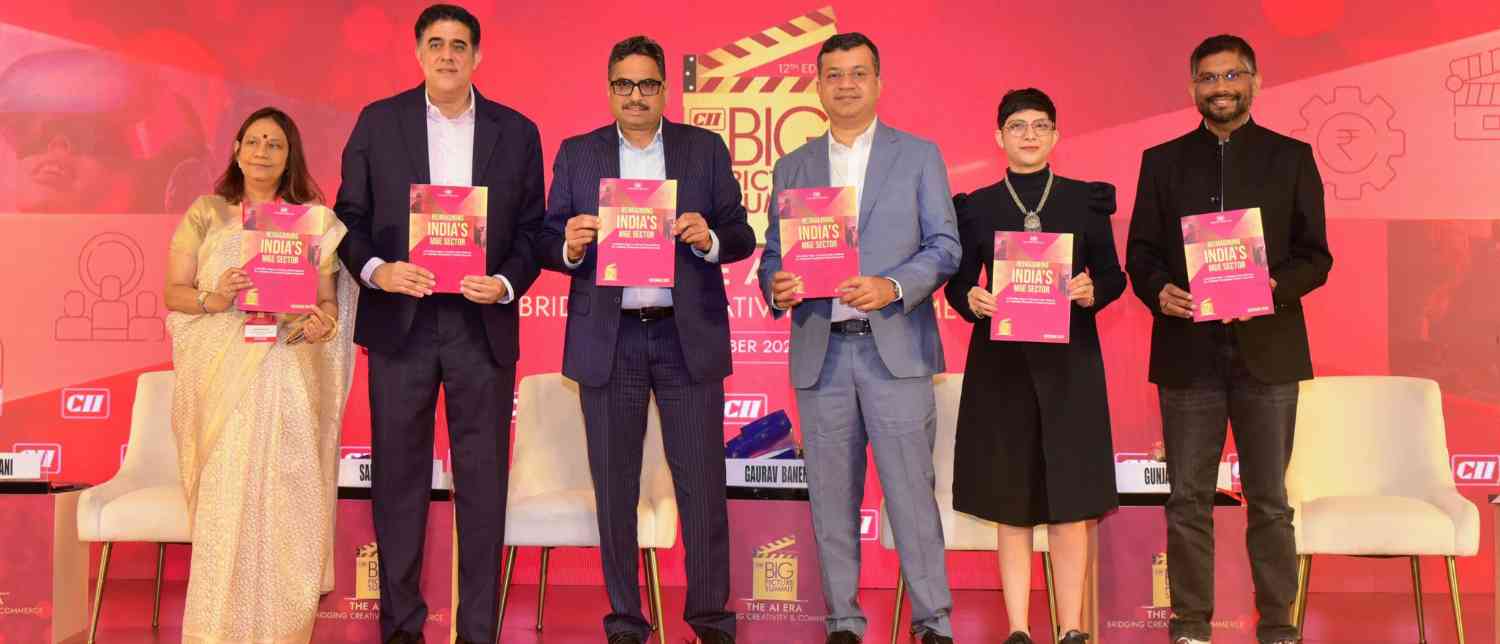
The Summit also marked the release of the Confederation of Indian Industry’s (CII) latest white paper, “Priority Policy Reforms for a Globally Competitive Creative Economy of India,” setting the tone for industry-wide transformation and policy modernization.

A Sector on the Brink of Disruption—and Unprecedented Opportunity
Opening the summit, Shri Jaju emphasized that India’s M&E landscape is undergoing a profound shift. AI, he noted, is no longer an abstract technological trend but a force reshaping every layer of the creative value chain—from content creation and distribution to monetization and audience engagement.
“The impact of AI is going to be huge on this segment,” he said, addressing both industry leaders and media. While acknowledging that AI carries both opportunities and risks, he underscored the urgent need for guardrails and ethical frameworks to ensure responsible use. At the same time, he encouraged the sector to harness the technology’s massive productivity benefits.
According to him, AI can compress workflows dramatically: “If work can be completed in one-tenth of the time and at one-hundredth of the cost with AI, it brings undeniable productivity gains.” He added that although disruption will cause losses in certain sub-segments and gains in others, a unified and harmonized approach across all verticals is essential for sustainable growth.
India’s Creative Economy: Large, Vibrant, and Ready to Scale
Despite facing technological transitions, India’s creative economy remains one of the country’s most powerful engines of cultural and economic activity. Shri Jaju highlighted some striking indicators:
-
The sector directly or indirectly supports over 10 million livelihoods.
-
It contributes nearly ₹3 lakh crore to India’s GDP.
-
India’s creative strengths span oral (Shruti), written (Kriti), and visual traditions—an immense storytelling legacy showcased at the Bharat Pavilion and the National Museum of Indian Cinema.
Yet, he noted a striking paradox: India holds only 2% of the global M&E market, despite its cultural depth and scale. This, he said, presents both a challenge and a historic opportunity.
Shri Sanjay Jaju, Secretary, @MIB_India, along with other dignitaries, released the 'CII White Paper on Priority Policy Reforms for a Globally Competitive Creative Economy of India' in course of the 12th CII Big Picture Summit, in Mumbai today.
Shri Jaju also delivered the… pic.twitter.com/vmjiGFuXDJ— PIB in Maharashtra 🇮🇳 (@PIBMumbai) December 1, 2025
A Call to Convert Passion into Commerce
While India is admired for its creativity and cultural richness, Shri Jaju emphasized that global leadership requires commercially scalable models. Passion alone, he said, will not propel Indian content to the international level; instead, the industry must learn to commercialize ideas and intellectual property more effectively.
He urged creators, producers, broadcasters, platforms, and innovators to integrate technology into storytelling, stating: “Stories immersed with technology are what sell in these times.” Creativity is no longer separate from commerce; instead, both must evolve together in a technologically advanced world.
India’s Stories as Global Soft Power
One of the strongest messages from the Secretary was his call for India to amplify its global cultural footprint. As the country rises economically, its soft power must expand proportionately.
“As a rising economic power, India’s stories must reach all parts of the world. This is the essence of our soft power,” he observed.
He stressed that entertainment is not merely a business sector but a fundamental human need—akin to food, shelter, and clothing—because it binds societies, fosters harmony, and builds bridges across cultures.
Mumbai, Maharashtra: Ministry of Information & Broadcasting Secretary Sanjay Jaju says, "AI is going to play a very important role, as we have already seen in movies and music. AI has been crucial in these sectors and similarly, it will play an important and efficient role in the… pic.twitter.com/8DuYwaUSEB— IANS (@ians_india) December 1, 2025
Government as an Enabler: Level Playing Field, Skill Building, and the IICT Model
Shri Jaju reiterated that the government's role is to enable, not compete with the industry. New policies, fiscal incentives, and structural reforms are all being drafted to support the sector’s transition into an innovation-driven future.
A key initiative is the creation of the Indian Institute of Creative Technologies (IICT) in Mumbai—approved by the Union Cabinet to address the sector’s significant skill gaps. The IICT represents a unique government-industry collaboration model already lauded for excellence and forward-thinking design.
-
The IICT campus at Film City, Goregaon, will be completed within two years.
-
The NFDC campus is already operational.
-
The Institute aims to align industry needs with advanced training, ensuring Indian talent remains globally competitive.
In addition, the WAVES Bazaar has emerged as a platform connecting creators with investors and buyers, reinforcing the government’s commitment to fostering a vibrant creative ecosystem.
AI’s Transformative Power and the Need for Regulatory Guardrails
Addressing reporters on the sidelines, Shri Jaju reiterated the disruptive capacity of AI and the urgent need for balanced regulation. While AI can create new jobs, amplify creativity, and increase efficiency, it could also raise ethical, economic, and intellectual property concerns.
He stated that ongoing proof-of-concept studies for India’s ambitious Direct-to-Mobile (D2M) broadcasting project are underway at IIT Kanpur, accompanied by stakeholder consultations. This project aims to redefine content distribution, bringing broadcast-quality video directly to mobile devices without relying solely on broadband networks.
#WATCH | Secretary Sanjay Jaju releases the latest CII White Paper, outlining key industry insights, policy recommendations, and growth strategies for India’s economic future.@sjaju1 @MIB_India pic.twitter.com/7SqhBauwVT— DD India (@DDIndialive) December 1, 2025
A Unified Approach for Sustainable Industry Growth
Shri Jaju emphasized the need to bring together diverse stakeholders—platforms, broadcasters, studios, creators, and technology providers—under a common developmental vision. The goal is to harmonize the growth of all M&E verticals so that India can increase its global share from the current 2% to at least 4–5% in the coming decade.
He also reiterated that with the global M&E industry projected to reach USD 3.5 trillion by 2029, India is at the cusp of a transformative opportunity. Current forecasts suggest that India’s M&E sector could grow at a CAGR of 9.8%, significantly higher than the global average.
CII White Paper: Reimagining India’s M&E Sector for 2030
The Summit also saw the unveiling of CII’s comprehensive white paper, “Reimagining India's M&E Sector: A Call for Action to Build a Future-Ready, Globally Competitive Industry by 2030.”
Key highlights include:
-
A roadmap of priority policy reforms.
-
Recommendations to foster innovation, boost exports, and strengthen India’s global creative competitiveness.
-
Strategies to build a digital-first, convergence-ready creative ecosystem.
-
A call for collective action from the Central and state governments, industry leaders, and creative communities.
CII emphasized that by embracing emerging technologies, digital transformation, global partnerships, and skill enhancement, India can achieve its target of becoming a USD 100 billion M&E powerhouse by 2030, growing at an annual rate of approximately 7%.
The white paper stresses that India’s future in the global creative economy hinges on its ability to embrace innovation, streamline regulatory structures, and promote market competitiveness through policy coherence.
Industry Leaders in Attendance
Several prominent industry leaders were present, including:
-
Shri Gaurav Banerjee, Chair, CII National Council on M&E and MD & CEO, Sony Pictures Networks India
-
Shri Rajan Navani, Co-Chair, CII National Council on M&E and MD & CEO, JetSynthesys
-
Ms. Gunjan Soni, Co-Chair, CII National Council on M&E and Country MD, YouTube India
Their presence signaled strong industry commitment to collaborative growth in the AI-driven era.
A Pivotal Moment for India’s Creative Future
The 12th CII Big Picture Summit reinforced that India’s M&E sector is at a historic inflection point. With AI transforming entertainment and global demand for content at an all-time high, India has the cultural richness, talent, and technological readiness to become a global creative powerhouse.
However, Shri Sanjay Jaju’s message was clear: India must move from potential to performance.
By embracing innovation, strengthening commerce, adopting new technologies, and elevating Indian stories for global audiences, the nation can redefine its soft power and solidify its place in the world’s creative economy.
With inputs from agencies
Image Source: Multiple agencies
© Copyright 2025. All Rights Reserved. Powered by Vygr Media.