

 By
By 
A film rooted in the hills of Nagaland has suddenly found itself at the centre of the global awards conversation. Angh, the debut feature by Naga filmmaker Theja Rio, has won the prestigious Platform Prize at the 2026 Toronto International Film Festival (TIFF), giving the film a direct pathway to consideration for the 2027 Academy Awards in the International Feature Film category.
The win is significant not only because it places a film from Northeast India on one of the world's major cinematic stages, but also because of the story it carries. Made largely in the Konyak language and set in 1960s Nagaland, Angh looks at a community confronting profound cultural and spiritual change through the intimate relationship between an ageing village chief and his son.
For Rio, the recognition represents a remarkable moment for a debut feature. For Naga cinema, it marks an international breakthrough.
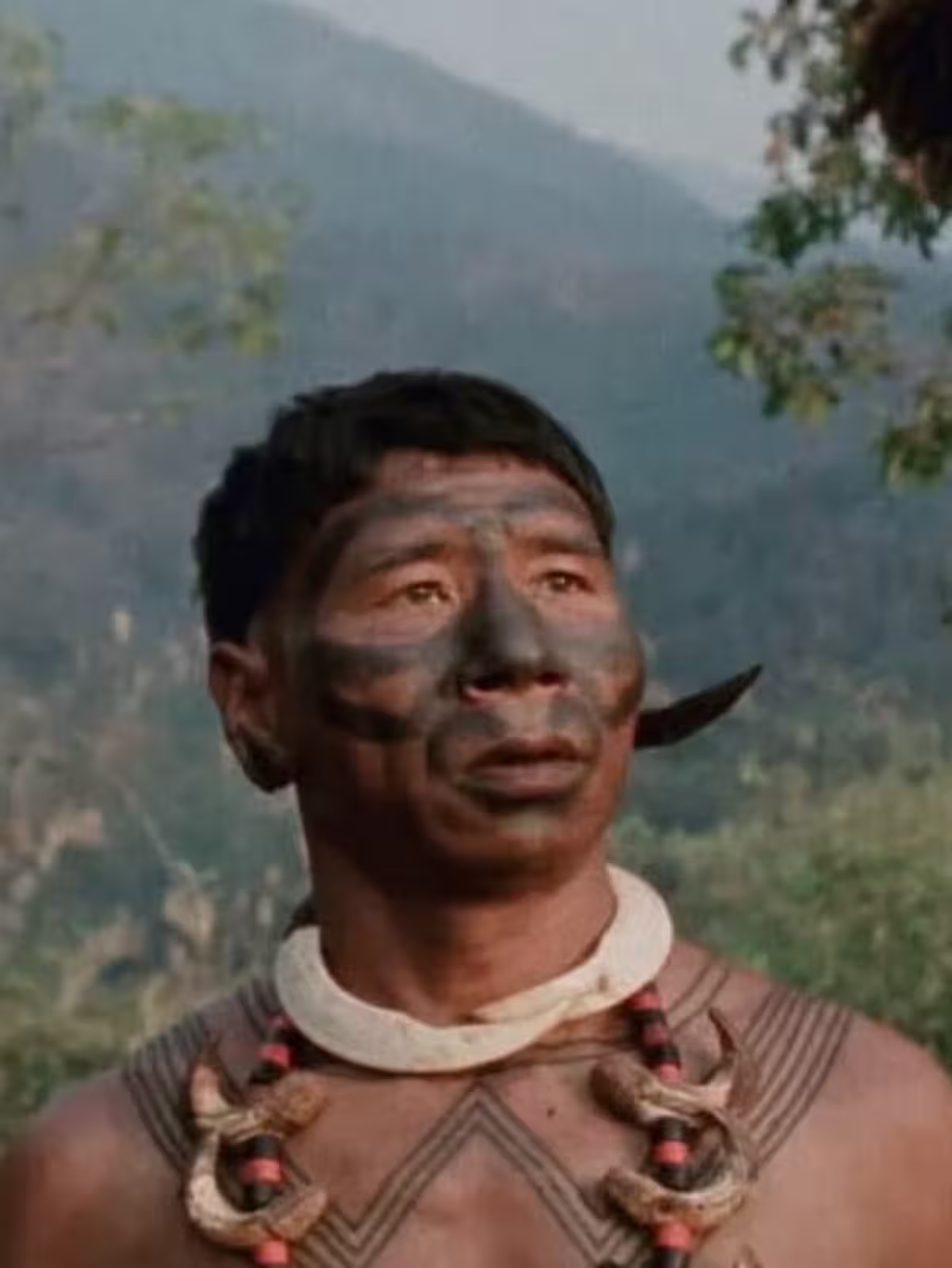
Angh wins the Platform Prize at TIFF 2026
Angh emerged victorious from TIFF's Platform Competition, one of the festival's principal competitive sections. The programme is designed to showcase films driven by distinctive directorial voices and ambitious storytelling.
The 2026 Platform jury, headed by Argentine filmmaker Pablo Trapero, selected Angh from a field of 12 films. In announcing the award, the jury highlighted the film's fresh perspective, filmmaking strength and emotionally resonant depiction of a particular world. Rio's vision and courage as a filmmaker were also recognised.
The victory comes with more than a trophy and prestige. Beginning with the 2026 award, the winner of TIFF's Platform Prize receives a direct route to eligibility for consideration in the Academy Awards' International Feature Film category.
The prize also carries a C$20,000 cash award.
That new Oscar pathway has transformed the significance of Angh's Toronto victory. The film is not an Oscar nominee yet, but it has secured eligibility for consideration through a route separate from India's official submission process.
What is Angh about?
Set in the early 1960s near the Indo-Burma border, Angh follows an ageing Konyak village chief who remains behind as his community and traditional way of life begin to disappear.
At the centre of the story is his relationship with his young son. The father represents a world built around ancestral beliefs, community and tradition, while the son is increasingly drawn towards the possibilities offered by a changing society.
The arrival of an American missionary, played by BAFTA-winning British actor Douglas Henshall, becomes an important catalyst for that transformation.
The film explores the gradual impact of cultural change rather than presenting it as a simple confrontation between two opposing sides. Religion, education and material comforts become intertwined with the larger question of what happens when an old way of life begins to give way to something new.
Questions of faith, identity, family, home, memory and letting go run through the story.
That makes Angh deeply rooted in a particular place while also giving it themes that can travel beyond its cultural setting.
From a short film to a feature-length story
The journey of Angh began years before its TIFF triumph.
Rio first developed the story as a short film. The short version received international recognition, including a Special Jury Award at the Clermont-Ferrand International Short Film Festival, before the filmmaker expanded the idea into his feature debut.
The feature was developed over several years by Rio and producer Nancy Nisa Beso, with the filmmakers determined to tell the story on their own terms.
That long development process is particularly notable given the scale of the film's eventual achievement. Rather than emerging from one of India's established film industries, Angh was developed from Nagaland and centres a community that has rarely occupied the centre of an international feature film.
Rio, who studied at the UK's National Film and Television School, has consistently focused on bringing stories from Northeast India to wider audiences.

A film made from inside the community
One of the defining aspects of Angh is its attention to cultural detail.
The film was shot on 16mm, with cinematographer Adam Pietkiewicz drawing inspiration from archival photographs and footage of Naga communities from the 1950s and 1960s.
Much of the cast consists of first-time performers, while Konyak advisers contributed to elements including dialogue, costumes and production design.
That approach gives the film an intimate relationship with the culture it portrays. Rather than treating Nagaland simply as an exotic backdrop, Angh places its people, history and traditions at the heart of the narrative.
The landscape is equally important. The forests and surrounding environment contribute to the film's atmosphere and sense of memory, reinforcing the idea of a world undergoing irreversible change.
The result is a film that uses a very specific cultural and historical setting to explore experiences that are much broader: the fear of losing one's home, the tension between generations and the painful process of accepting change.
Why the TIFF win matters for Nagaland cinema
Indian cinema is often discussed through the lens of its major film industries in Mumbai, Hyderabad, Chennai, Kolkata and other established centres.
Angh offers a different picture.
Its success demonstrates that stories emerging from India's Northeast can reach major international festivals without being stripped of their linguistic and cultural identity.
The film's use of the Konyak language is particularly important. For Rio, the opportunity to present a story from an Indigenous region in a tribal language on an international platform made the TIFF recognition especially meaningful.
In his acceptance remarks, the filmmaker dedicated the achievement to people back home in Nagaland and described the moment as the beginning rather than the end of the journey.
The producers have similarly expressed hope that the film's success will encourage other filmmakers to tell stories connected to their own communities, languages and experiences.
That could prove to be one of Angh's most lasting contributions. Its significance may extend beyond one festival award if it helps demonstrate that regional stories can retain their specificity and still find audiences around the world.
How can Angh be in the Oscars race if India selected another film?
The Oscar angle surrounding Angh has generated considerable attention because India's official submission for the 2027 Academy Awards International Feature Film category is the Marathi-language film Gondhal.
At first glance, that might appear to close the door on another Indian film entering the same category.
However, the Academy's rules provide more than one route to eligibility.
For the 2027 Oscars, the winner of certain designated international festival prizes can qualify for consideration independently of a country's official submission. TIFF's Platform Prize is among the awards covered by this pathway.
Therefore, Gondhal remains India's official submission, while Angh has earned its own eligibility route through its victory at TIFF.
This distinction is important: eligibility does not mean nomination.
Angh has secured a place in the Oscar consideration process, but it has not yet been nominated for an Academy Award. The film must still pass through the Academy's selection stages before any nomination is confirmed.
Nevertheless, securing this route is itself a major achievement for a debut feature from Nagaland.
The larger story behind Angh
Perhaps the most striking aspect of Angh's journey is the contrast between the scale of its story and the scale of the platform it has now reached.
The film is about a small community, an ageing father, a son caught between worlds and a culture confronting change. Yet those intimate concerns have travelled from Nagaland to Toronto and now towards Hollywood's most prominent awards.
That journey also reflects a gradual expansion in how Indian cinema is being represented internationally.
The global conversation around Indian films is no longer limited to familiar languages, industries or filmmaking centres. Stories from communities that have historically received less international screen visibility are increasingly finding space at major festivals.
For Rio, Angh is deeply personal. The film's themes of home, memory and impermanence are tied to the filmmaker's own connection to Nagaland and its people.
But the response at TIFF suggests that the film's emotional language extends beyond its geographical setting.
The father and son at its centre may belong to a specific community and historical moment, yet the questions they face are universal: What happens when the world you inherited begins to disappear? What do you preserve, and what do you let go? And can a culture survive while the world around it changes?
Those questions may ultimately be what carry Angh beyond the festival circuit.
What comes next for Angh?
With the TIFF Platform Prize secured, the focus now shifts towards the 2027 Oscars and the film's wider international release and distribution journey.
Angh has already achieved something rare for a debut feature: it has placed a story from Nagaland directly into the international awards conversation.
Whether it eventually becomes an Academy Award nominee will depend on the next stages of the Oscars process. But the TIFF victory has already changed the film's trajectory.
More importantly, it has placed Naga cinema, Konyak storytelling and Northeast India's filmmaking talent before a global audience.
For a film that began as a small story from Nagaland, Angh has travelled remarkably far. Its Toronto victory is not simply about one prize. It is a sign that the world's cinema stages are becoming a little wider—and that stories once considered too local to travel can sometimes be the ones that resonate farthest.
With input from agencies
Image Source: Multiple agencies
© Copyright 2026. All Rights Reserved. Powered by Vygr Media.